Carpal Tunnel and the Ulnar Nerve: When Numbness Is Not Just in the Thumb and Index Finger

When your hand goes numb at night, the automatic assumption is often carpal tunnel syndrome. But what if the tingling affects your pinky and ring finger instead of your thumb? This scenario reveals a crucial diagnostic distinction that many people—and even some healthcare providers—overlook. Carpal Tunnel and the Ulnar Nerve: When Numbness Is Not Just in the Thumb and Index Finger represents a complex diagnostic challenge that requires understanding the distinct patterns of nerve compression affecting the hand and wrist.

The location of numbness and tingling in your fingers serves as a roadmap to identifying which nerve is compressed. While carpal tunnel syndrome affects the median nerve and causes symptoms in the thumb, index, and middle fingers, ulnar nerve entrapment creates an entirely different symptom pattern. This distinction is not merely academic—it directly impacts treatment decisions, recovery timelines, and long-term outcomes.

Key Takeaways

Finger location matters: Carpal tunnel affects thumb and index finger, while ulnar nerve problems cause numbness in pinky and ring finger

Two main ulnar nerve compression sites: Cubital tunnel at the elbow (most common) and Guyon's canal at the wrist (rare)

Both conditions cause nighttime symptoms: Hands "falling asleep" during sleep is common to both median and ulnar nerve compression

Treatment success varies: About 50% of ulnar nerve cases improve with conservative treatment, while surgical intervention may be necessary for severe cases

Early diagnosis prevents complications: Delayed treatment can lead to permanent weakness and muscle atrophy in both conditions
Understanding Nerve Anatomy: The Foundation of Diagnosis

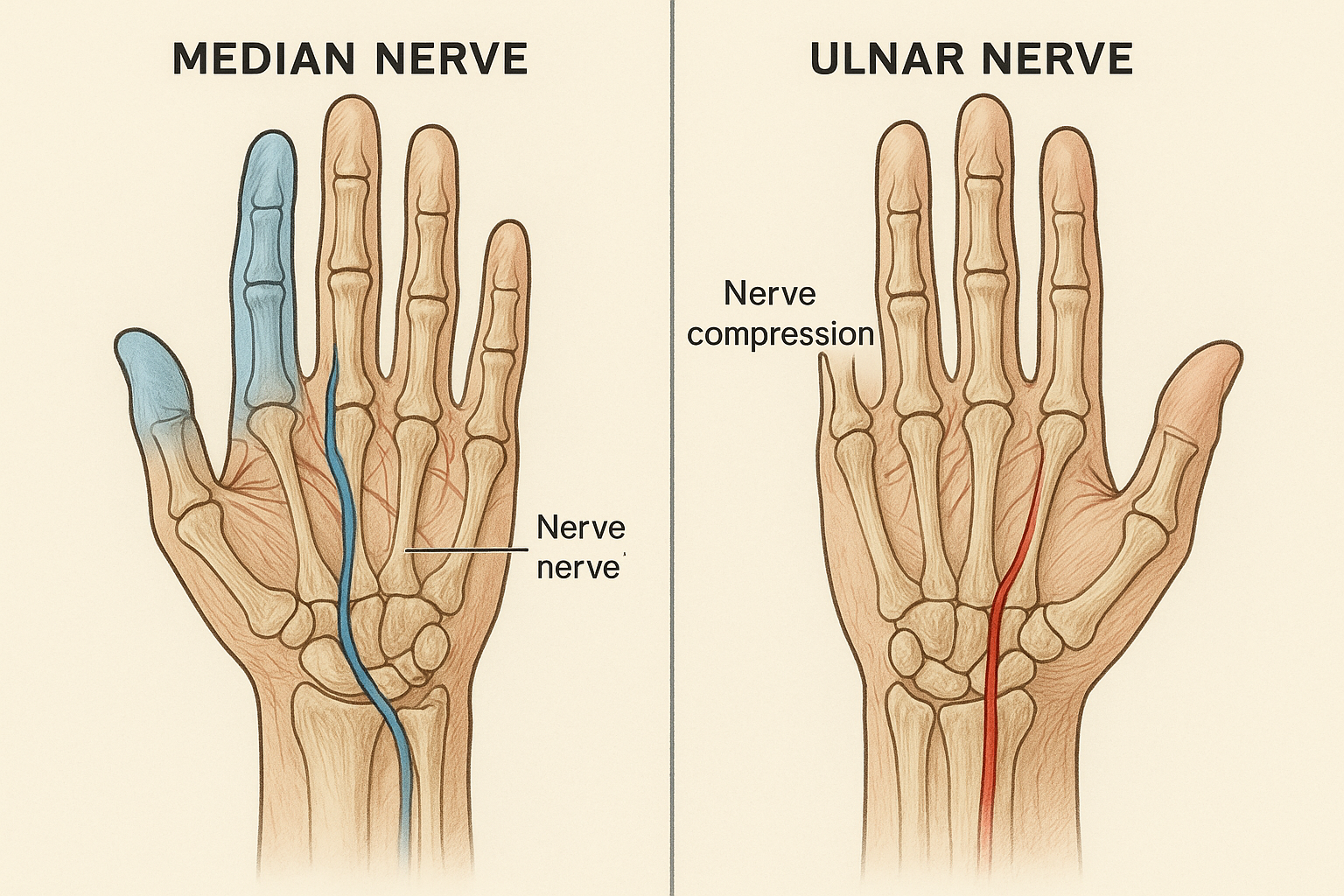
Medical illustration showing hand anatomy with median nerve pathway highlighted in blue affecting thumb and index finger, contrasted with ul

The human hand receives sensation and motor control from three primary nerves: the median, ulnar, and radial nerves. Each nerve has a specific territory it controls, creating distinct symptom patterns when compressed or damaged.

The Median Nerve Territory

The median nerve travels through the carpal tunnel at the wrist, a narrow passageway formed by bones and ligaments. This nerve provides sensation to:

  • Thumb 👍
  • Index finger
  • Middle finger
  • Half of the ring finger (thumb side)

When the median nerve becomes compressed in the carpal tunnel, it creates the classic carpal tunnel syndrome pattern of numbness and tingling in these specific fingers.

The Ulnar Nerve Pathway

The ulnar nerve takes a different route, traveling along the pinky side of the arm and hand. It can become compressed at two main locations:

  1. Cubital tunnel (at the elbow) - most common site
  2. Guyon's canal (at the wrist) - less common

The ulnar nerve provides sensation to:

  • Pinky finger
  • Ring finger (pinky side)
  • Back of the hand (pinky side)

Understanding these anatomical territories helps explain why carpal tunnel and ulnar nerve conditions create such different symptom patterns.

Carpal Tunnel vs. Ulnar Nerve Entrapment: Key Differences

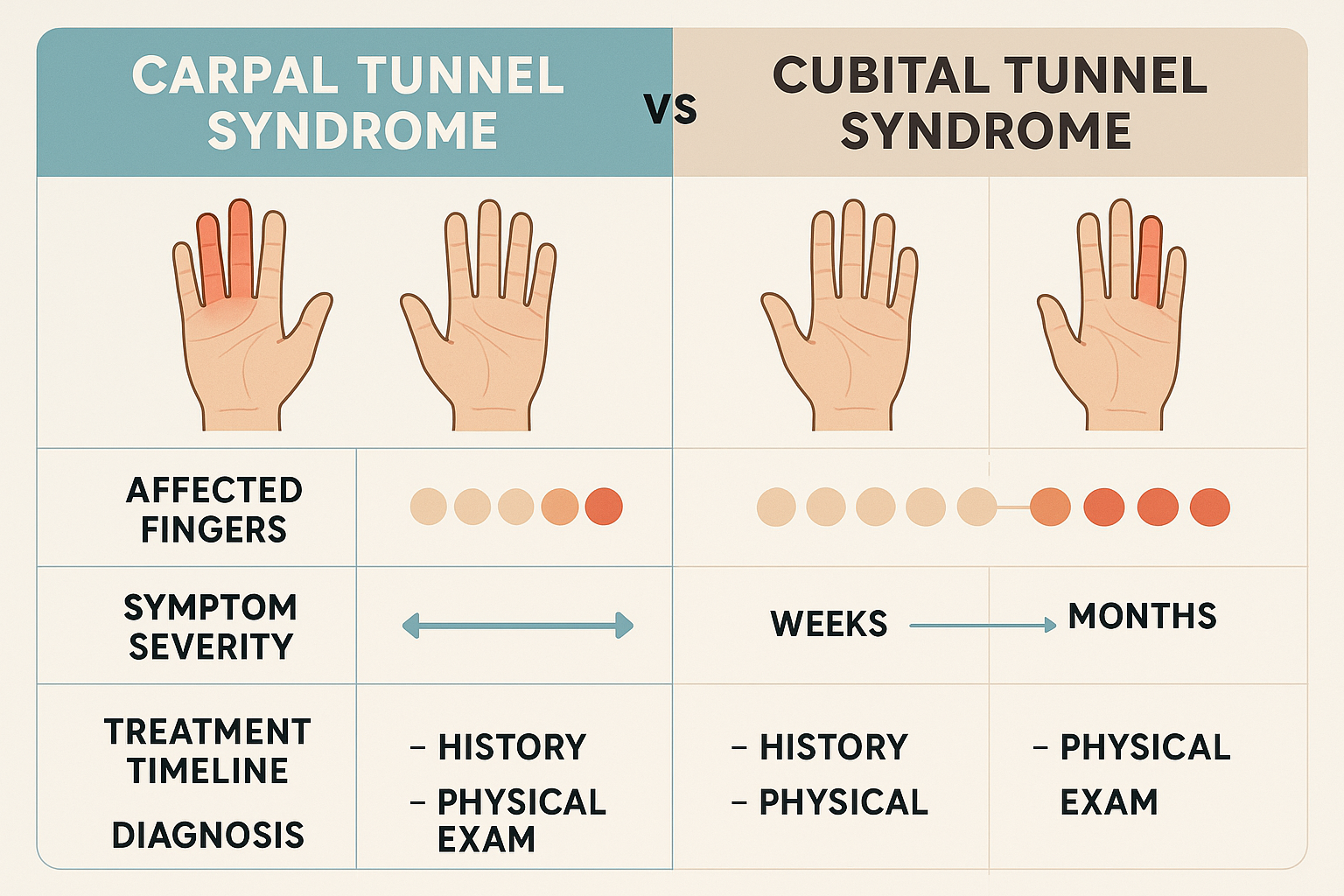
FeatureCarpal Tunnel SyndromeUlnar Nerve EntrapmentAffected FingersThumb, index, middlePinky, ringCommon LocationWrist (carpal tunnel)Elbow (cubital tunnel) or wrist (Guyon's canal)Weakness PatternThumb weaknessPinky weaknessNight SymptomsVery commonCommonMuscle AtrophyThumb musclesSpace between thumb and index finger

Symptom Timing and Triggers

Both conditions share some common characteristics that can make initial diagnosis challenging:

Nighttime Symptoms 🌙

  • Both median and ulnar nerve compression commonly cause nighttime awakening
  • Patients often report their hand "falling asleep"
  • Shaking the hand typically provides temporary relief
  • Symptoms often improve upon waking and moving around

Activity-Related Triggers

  • Carpal tunnel: Worsened by repetitive wrist motions, typing, gripping
  • Cubital tunnel: Aggravated by elbow flexion, leaning on elbows, phone use
  • Guyon's canal: May worsen with cycling, prolonged gripping

Cubital Tunnel Syndrome: The Most Common Ulnar Nerve Problem

Cubital tunnel syndrome represents the second most common peripheral neuropathy affecting the upper extremities, following carpal tunnel syndrome. This condition occurs when the ulnar nerve becomes compressed as it passes through the cubital tunnel at the elbow.

Risk Factors and Causes

Repetitive Elbow Flexion

  • Prolonged computer work with elbows bent
  • Frequent cell phone use 📱
  • Activities requiring repetitive elbow bending

Direct Pressure

  • Leaning on elbows during work
  • Sleeping with arms bent under pillows
  • Prolonged driving with elbow on window sill

Anatomical Factors

  • Bone spurs or arthritis at the elbow
  • Previous elbow injuries
  • Ganglion cysts near the nerve

Progressive Symptoms

Cubital tunnel syndrome typically develops gradually, with symptoms progressing through distinct stages:

Early Stage

  • Intermittent numbness in pinky and ring finger
  • Symptoms primarily at night or after prolonged elbow flexion
  • No significant weakness

Moderate Stage

  • More persistent numbness and tingling
  • Symptoms occur during daily activities
  • Beginning weakness in grip strength
  • Difficulty with fine motor tasks

Advanced Stage

  • Constant numbness in ulnar nerve distribution
  • Significant weakness in hand muscles
  • Visible muscle atrophy between thumb and index finger
  • "Claw hand" deformity in severe cases
  • Difficulty opening jars or performing grip activities

Understanding these progression patterns helps patients recognize when to seek professional evaluation and treatment.

Guyon's Canal Syndrome: The Rare Wrist Culprit

While cubital tunnel syndrome affects the ulnar nerve at the elbow, Guyon's canal syndrome involves compression of the same nerve as it passes through a small tunnel at the wrist. This condition is significantly less common than its elbow counterpart.

Unique Characteristics of Guyon's Canal Syndrome

Location Specificity

  • Occurs at the wrist, not the elbow
  • May be confused with carpal tunnel syndrome due to wrist location
  • Affects different fingers than carpal tunnel (pinky and ring vs. thumb and index)

Common Causes

  • Ganglion cysts: Account for up to 40% of cases
  • Idiopathic: 45% occur without identifiable cause
  • Repetitive trauma: Cycling, prolonged gripping activities
  • Anatomical variations: Unusual bone or ligament structures

Diagnostic Challenges

Guyon's canal syndrome can be particularly challenging to diagnose because:

  1. Symptom overlap: Wrist pain may initially suggest carpal tunnel
  2. Rare occurrence: Many healthcare providers have limited experience with this condition
  3. Variable presentation: Symptoms can affect motor function, sensation, or both

The key diagnostic differentiator remains the finger distribution—numbness in the pinky and ring finger points to ulnar nerve involvement, regardless of whether the compression occurs at the elbow or wrist.

When Multiple Conditions Coexist

In some cases, patients may experience symptoms suggesting both carpal tunnel and ulnar nerve problems. This scenario requires careful evaluation to determine whether:

  • Multiple compression sites exist simultaneously
  • Cervical radiculopathy (neck nerve compression) is causing widespread symptoms
  • Thoracic outlet syndrome is affecting multiple nerves
  • Systemic conditions like diabetes are causing widespread nerve dysfunction

Complex Diagnostic Scenarios

Cervical Radiculopathy Mimics Nerve compression in the neck can create symptoms that mimic both carpal tunnel and ulnar nerve entrapment. Key differences include:

  • Neck pain or stiffness
  • Symptoms extending into the shoulder or upper arm
  • Weakness in multiple muscle groups
  • Symptoms that worsen with neck movements

Thoracic Outlet Syndrome This condition involves compression of nerves and blood vessels between the collarbone and first rib, potentially affecting:

  • Multiple nerve distributions
  • Blood flow to the arm
  • Symptoms that worsen with overhead arm positions

Double Crush Syndrome Some patients experience nerve compression at multiple sites along the same nerve pathway, requiring comprehensive evaluation and potentially multiple treatment approaches.

For complex cases involving multiple symptoms or unclear diagnoses, consulting with specialists experienced in comprehensive nerve evaluation becomes essential.

Diagnostic Approaches and Testing

Accurate diagnosis of nerve compression conditions requires a systematic approach combining clinical evaluation with appropriate testing.

Clinical Examination

History Taking

  • Detailed symptom description and timing
  • Activity-related triggers and relief factors
  • Progression pattern over time
  • Previous treatments attempted

Physical Examination

  • Tinel's sign: Tapping over compressed nerve reproduces symptoms
  • Phalen's test: Wrist flexion test for carpal tunnel
  • Elbow flexion test: Sustained elbow bending for cubital tunnel
  • Strength testing: Specific muscle group evaluation
  • Sensation mapping: Precise determination of affected areas

Electrodiagnostic Testing

Nerve Conduction Studies

  • Measure nerve signal transmission speed
  • Identify specific location of compression
  • Quantify severity of nerve damage

Electromyography (EMG)

  • Evaluates muscle electrical activity
  • Detects muscle damage from nerve compression
  • Helps differentiate between nerve and muscle problems

Advanced Imaging

Ultrasound

  • Visualizes nerve swelling or compression
  • Identifies structural abnormalities
  • Guides injection procedures

MRI

  • Detailed soft tissue visualization
  • Identifies masses, cysts, or anatomical variants
  • Evaluates multiple potential compression sites

Treatment Strategies: Conservative vs. Surgical

Clinical comparison chart showing carpal tunnel syndrome versus cubital tunnel syndrome symptoms in table format. Visual includes hand diagr

Treatment approaches for both carpal tunnel and ulnar nerve entrapment follow similar principles, progressing from conservative measures to surgical intervention based on severity and response.

Conservative Treatment Options

Activity Modification

  • Avoiding repetitive motions that aggravate symptoms
  • Ergonomic workplace adjustments
  • Proper sleep positioning to avoid nerve compression

Splinting and Bracing

  • Carpal tunnel: Wrist splints maintain neutral position
  • Cubital tunnel: Elbow pads prevent direct pressure, night splints prevent flexion
  • Guyon's canal: Wrist supports reduce pressure during activities

Physical Therapy Comprehensive programs addressing:

  • Nerve gliding exercises to improve mobility
  • Strengthening exercises for supporting muscles
  • Ergonomic education and training
  • Activity modification strategies

Patients interested in specific exercise programs can explore carpal tunnel exercises and stretches for detailed guidance.

Anti-inflammatory Treatments

  • Oral medications (NSAIDs)
  • Topical preparations
  • Corticosteroid injections for severe cases

Success Rates with Conservative Treatment

Research indicates that approximately 50% of patients with ulnar nerve entrapment achieve significant symptom relief through conservative treatment alone. Success factors include:

  • Early intervention before severe nerve damage
  • Consistent adherence to treatment recommendations
  • Effective activity modification
  • Appropriate use of protective devices

Surgical Intervention

When conservative treatment fails or symptoms are severe, surgical options become necessary:

Carpal Tunnel Release

  • Endoscopic or open surgical approaches
  • Division of transverse carpal ligament
  • High success rates with proper patient selection

Cubital Tunnel Surgery

  • Simple decompression
  • Ulnar nerve transposition
  • Medial epicondylectomy in select cases

Guyon's Canal Release

  • Decompression of ulnar nerve at wrist
  • Removal of compressing structures (cysts, masses)
  • Restoration of normal nerve function

For patients considering surgical options, understanding carpal tunnel surgery recovery expectations provides valuable preparation guidance.

Prevention Strategies and Lifestyle Modifications

Preventing nerve compression conditions requires understanding risk factors and implementing protective strategies in daily activities.

Workplace Ergonomics

Computer Workstation Setup

  • Monitor at eye level to reduce neck strain
  • Keyboard and mouse at elbow height
  • Wrists in neutral position during typing
  • Regular breaks every 30-60 minutes

Ergonomic Tools and Equipment Modern technology offers numerous solutions for reducing nerve compression risk:

  • Ergonomic keyboards and mice
  • Wrist rests and supports
  • Adjustable desk and chair systems
  • Voice recognition software for reduced typing

Exploring ergonomic gadgets for preventing carpal tunnel can provide specific product recommendations and usage guidelines.

Sleep Position Optimization

Preventing Nighttime Compression

  • Avoid sleeping with arms under pillows
  • Use supportive pillows to maintain neutral arm positions
  • Consider nighttime splinting for persistent symptoms
  • Adjust sleep environment to reduce pressure points

Understanding carpal tunnel and sleeping positions offers detailed strategies for improving nighttime comfort.

Activity-Specific Modifications

Exercise and Recreation

  • Proper warm-up before activities
  • Gradual progression in intensity and duration
  • Use of protective equipment when appropriate
  • Recognition of early warning signs

Daily Life Activities

  • Alternating hands for repetitive tasks
  • Using larger, easier-to-grip tools
  • Taking frequent breaks during prolonged activities
  • Maintaining overall physical fitness

Long-term Outcomes and Prognosis

The long-term outlook for patients with carpal tunnel and ulnar nerve conditions depends on several factors:

Factors Affecting Recovery

Timing of Treatment

  • Early intervention generally leads to better outcomes
  • Delayed treatment may result in permanent nerve damage
  • Severe muscle atrophy may not fully reverse

Severity at Diagnosis

  • Mild cases often respond well to conservative treatment
  • Moderate cases may require combination approaches
  • Severe cases typically need surgical intervention

Patient Compliance

  • Adherence to treatment recommendations
  • Consistent use of protective devices
  • Lifestyle modification implementation
  • Follow-up care participation

Potential Complications

Untreated Progression Without appropriate treatment, both conditions can lead to:

  • Permanent numbness and tingling
  • Irreversible muscle weakness
  • Significant functional impairment
  • Chronic pain syndromes

Post-Surgical Considerations While surgery often provides excellent results, potential complications include:

  • Incomplete symptom relief
  • Scar tissue formation
  • Temporary weakness during healing
  • Need for additional procedures

Special Considerations and Related Conditions

Pregnancy and Hormonal Factors

Pregnancy can significantly impact both carpal tunnel and ulnar nerve symptoms due to:

  • Fluid retention causing increased pressure
  • Hormonal changes affecting nerve sensitivity
  • Positional changes during sleep
  • Temporary nature of pregnancy-related symptoms

Detailed information about carpal tunnel during pregnancy helps expectant mothers understand their options.

Age-Related Considerations

Younger Patients

  • Often related to repetitive activities or sports
  • Generally better recovery potential
  • Prevention education particularly important

Older Adults

  • May have multiple contributing factors
  • Slower healing and recovery
  • Need for comprehensive evaluation of other conditions

Systemic Conditions

Several medical conditions can increase the risk of nerve compression:

  • Diabetes: Affects nerve health and healing
  • Thyroid disorders: Can cause fluid retention and nerve sensitivity
  • Rheumatoid arthritis: Creates inflammation affecting nerve pathways
  • Kidney disease: May cause fluid retention and swelling

When to Seek Professional Help

Recognizing when symptoms require professional evaluation is crucial for optimal outcomes:

Red Flag Symptoms

Immediate Evaluation Needed

  • Sudden onset of severe numbness or weakness
  • Complete loss of sensation in affected fingers
  • Inability to perform basic hand functions
  • Signs of infection or injury

Progressive Symptoms Requiring Attention

  • Worsening numbness despite conservative measures
  • New weakness in grip or pinch strength
  • Symptoms interfering with sleep or daily activities
  • Visible muscle wasting or deformity

Healthcare Provider Selection

Primary Care Evaluation

  • Initial assessment and diagnosis
  • Conservative treatment initiation
  • Referral coordination when needed

Specialist Consultation

  • Hand surgeons for surgical evaluation
  • Neurologists for complex nerve conditions
  • Physical medicine specialists for comprehensive rehabilitation

For patients seeking specialized care, finding the right treatment center with experience in nerve compression conditions is essential.

Conclusion

Carpal Tunnel and the Ulnar Nerve: When Numbness Is Not Just in the Thumb and Index Finger represents a critical diagnostic distinction that directly impacts treatment success and long-term outcomes. Understanding that finger location serves as a roadmap to nerve involvement—with carpal tunnel affecting the thumb and index finger versus ulnar nerve problems causing pinky and ring finger symptoms—empowers patients to seek appropriate care and communicate effectively with healthcare providers.

The key to successful management lies in early recognition, accurate diagnosis, and appropriate treatment selection. While approximately 50% of ulnar nerve cases respond well to conservative treatment, the remaining cases may require surgical intervention to prevent permanent complications. Similarly, carpal tunnel syndrome benefits from early intervention, whether through ergonomic modifications, splinting, or surgical release when conservative measures prove insufficient.

Actionable Next Steps

  1. Document your symptoms: Keep a detailed log of when numbness occurs, which fingers are affected, and what activities trigger or relieve symptoms
  2. Evaluate your environment: Assess your workplace, sleep setup, and daily activities for potential nerve compression risks
  3. Implement preventive measures: Begin ergonomic modifications and activity adjustments even before symptoms become severe
  4. Seek professional evaluation: Don't wait for symptoms to worsen—early intervention typically leads to better outcomes
  5. Follow treatment recommendations: Whether conservative or surgical, consistent adherence to treatment plans maximizes success rates

Remember that nerve compression conditions are highly treatable when addressed promptly and appropriately. By understanding the distinct patterns of carpal tunnel and ulnar nerve problems, patients can become active participants in their diagnosis and treatment, leading to better outcomes and improved quality of life.

SEO Meta Information:

Meta Title: Carpal Tunnel vs Ulnar Nerve: Finger Numbness Guide 2025

Meta Description: Learn the key differences between carpal tunnel and ulnar nerve problems. Discover which fingers are affected, treatment options, and when to seek help for hand numbness.


December 10, 2025
🇨🇦 Our clinic currently provides care to patients within Canada only. We apologize for any inconvenience this may cause.