
Last updated: August 19, 2026
Technically, yes, a dermatology provider can freeze certain skin lesions with liquid nitrogen, but cryotherapy is not the recommended way to remove a true mole (melanocytic nevus) when there's any uncertainty about what the spot actually is. Major dermatology guidance through 2026 favors surgical excision with pathology testing for moles being removed, because freezing destroys the tissue without giving anyone a way to check it for cancer[1][10]. Cryotherapy remains a reasonable option only for select flat, biopsy-confirmed benign spots where a patient accepts a higher chance of regrowth in exchange for less scarring[2][6].
Cryotherapy is a medical technique that uses extreme cold, typically liquid nitrogen, to destroy targeted skin cells. On moles, it works by freezing the pigmented cells (melanocytes) until they die and the body sheds the damaged tissue over the following weeks.
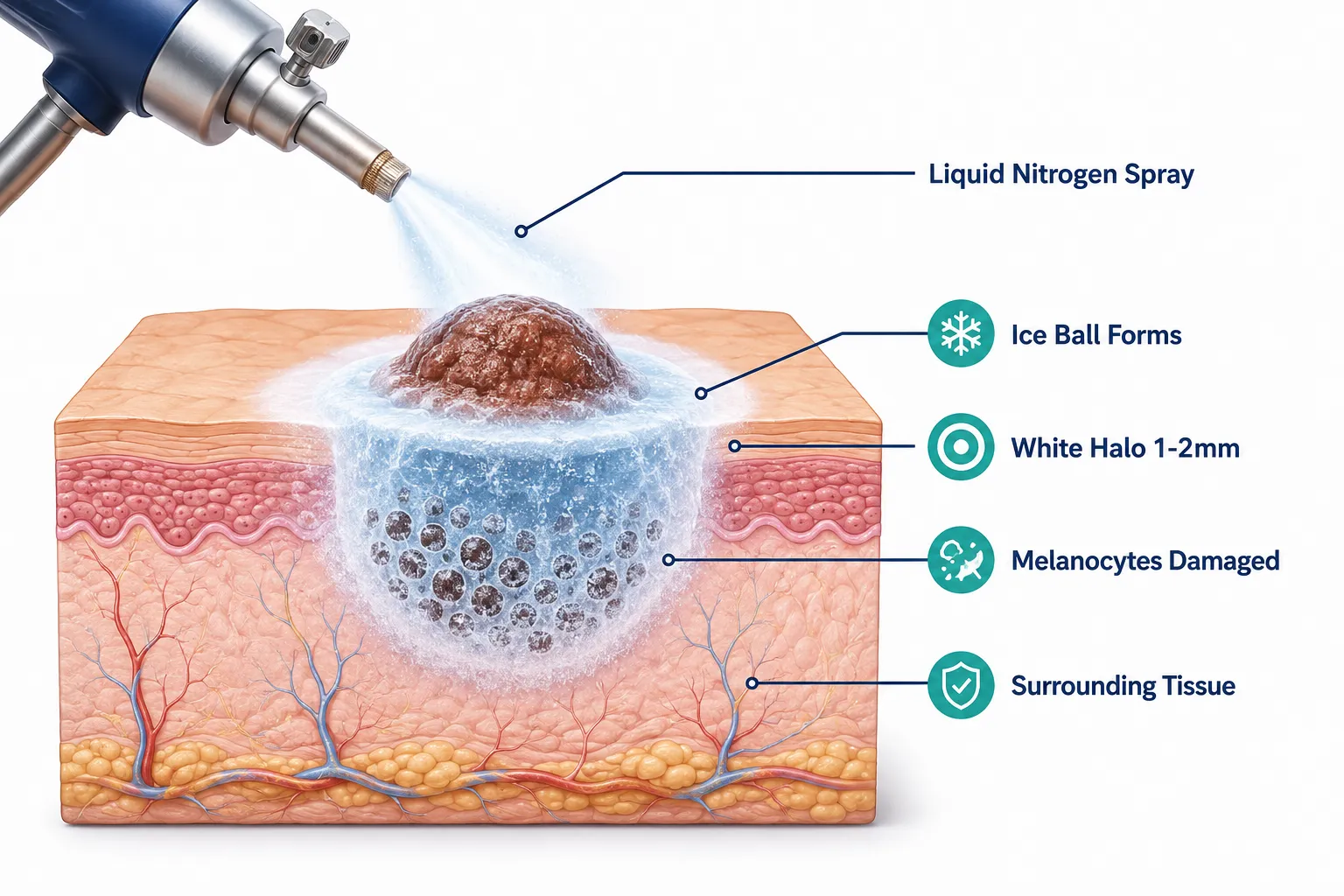
A provider sprays or applies liquid nitrogen (which sits around minus 196°C in its canister) directly onto the lesion. For benign pigmented spots, clinical guidance points to a target tissue temperature near minus 5°C, with freezing continued until a visible white halo of ice extends about 1 to 2 millimeters past the border of the lesion[5]. Freeze times vary by lesion type:
The frozen area typically blisters, scabs, and eventually flakes off, taking some or all of the pigmented cells with it. Because the tissue is destroyed rather than removed intact, there is nothing left over to examine under a microscope.
Clinics that offer this treatment, including guidance covered in our overview of cryotherapy for mole removal, generally reserve it for lesions that have already been assessed and are unlikely to be anything concerning.
You can attempt it with over-the-counter wart-freezing sprays, but doing so is not the same as clinical cryotherapy and is not considered safe practice for moles. Consumer freezing devices reach far colder temperatures for far shorter, less controlled bursts than a dermatology-grade cryogun, and they are formulated for warts, not pigmented lesions.
Home freezing kits fail moles in three specific ways:
Decision rule: if a spot has never been evaluated by a health professional, skip any at-home freezing attempt entirely and book a proper skin check first. Multiple patient-facing dermatology resources are consistent that DIY freezing of moles is unsafe precisely because it risks masking a malignancy while also causing burns, infection, or scarring[7][11].
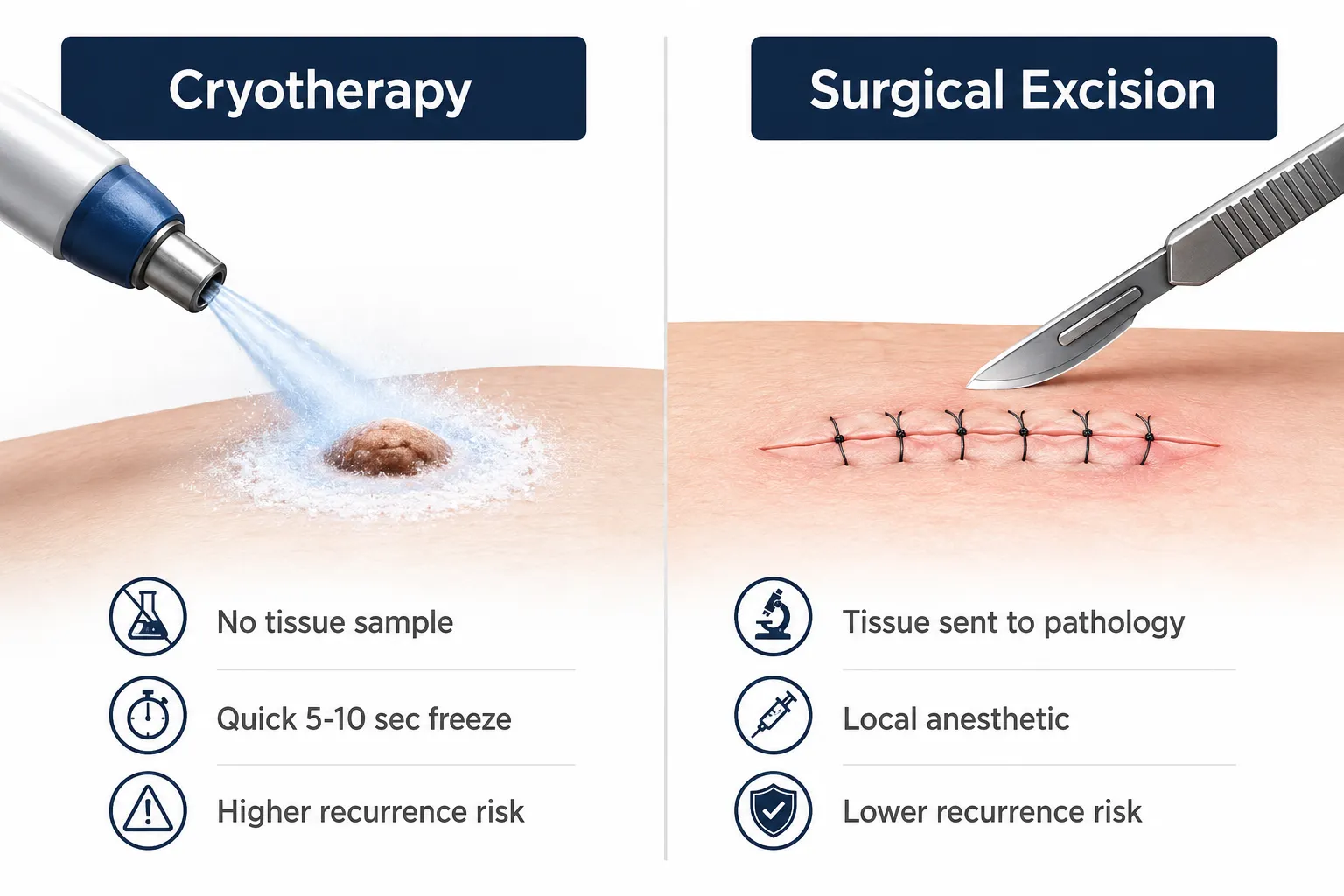
Cryotherapy destroys the mole in place with cold; surgical excision physically cuts the mole out and closes the wound, and only excision produces a specimen for pathology. For a true melanocytic nevus, dermatology guidance treats surgical excision with histopathology as the standard of care, while cryotherapy is described explicitly as something to avoid as a first-line treatment when there's diagnostic uncertainty[1].
Here's how the two compare directly:
FactorCryotherapy (freezing)Surgical excisionWhat happens to the tissueDestroyed in place, not recoverableRemoved intact and sent for pathologyBest suited forSmall, flat, biopsy-confirmed benign spotsAny mole with uncertainty, or one being fully removedProcedure timeSeconds per lesionMinutes, plus suturingDowntimeMinimal; a scab for 1 to 2 weeksDays to a couple weeks depending on siteScarringUsually minimal, but hypopigmentation possibleSmall linear scar, generally predictableDiagnostic valueNoneFull histopathology reportRecurrence riskMeaningful, higher for raised or deep molesLow when margins are clearMelanoma safety netNone, biopsy not possible after freezingBuilt in, tissue is tested
Clinical commentary updated through 2026 puts it plainly: for any melanocytic nevus being considered for removal, the recommended path is surgical excision with histopathology, not cryotherapy as a starting point[1]. Cryotherapy still has a place, but it's a secondary option for cosmetic cases where the lesion is small, flat, already known to be benign, and the patient has decided minimal scarring matters more than a guaranteed single treatment[2][6][8].
Choose surgical excision if: the mole is new, changing, asymmetric, larger than a pencil eraser, or has never been formally evaluated.
Cryotherapy may be reasonable if: a dermatology provider has already confirmed the spot is benign, it's flat and small, and the patient understands regrowth is possible.
For a deeper look at how excision fits into a full assessment pathway, see how mole biopsy and pathology testing works in practice.
Cryotherapy for a single small lesion is typically priced lower than a surgical excision because the procedure itself takes only seconds and needs no sutures. Exact pricing varies by clinic, region, and whether the visit includes a prior skin exam, so patients should request a written quote rather than relying on a flat number.
What tends to drive the final cost either way:
Because cryotherapy carries a real chance of needing a second treatment, the cheaper upfront price can even out once retreatment is factored in. Surgical excision, while often priced higher per lesion, includes the pathology report as part of the fee in many clinics, which some patients find offsets the difference. For current pricing structures and what's typically included, see mole removal cost breakdowns for 2025 and a Toronto-specific cost guide.
The main risks of DIY mole freezing are skin burns, infection, permanent pigment changes, and, most seriously, a delayed melanoma diagnosis. None of these risks are hypothetical; they show up consistently across dermatology safety literature[7][10][11].
Specific problems reported with unsupervised or DIY freezing include:
A mole that's frozen without ever being examined offers no way to know, afterward, whether it needed more than freezing in the first place.
Common mistake: treating a mole that has recently changed shape, color, or size with a home freezing kit "just to be safe." Change is exactly the signal that warrants a professional exam, not a DIY fix.
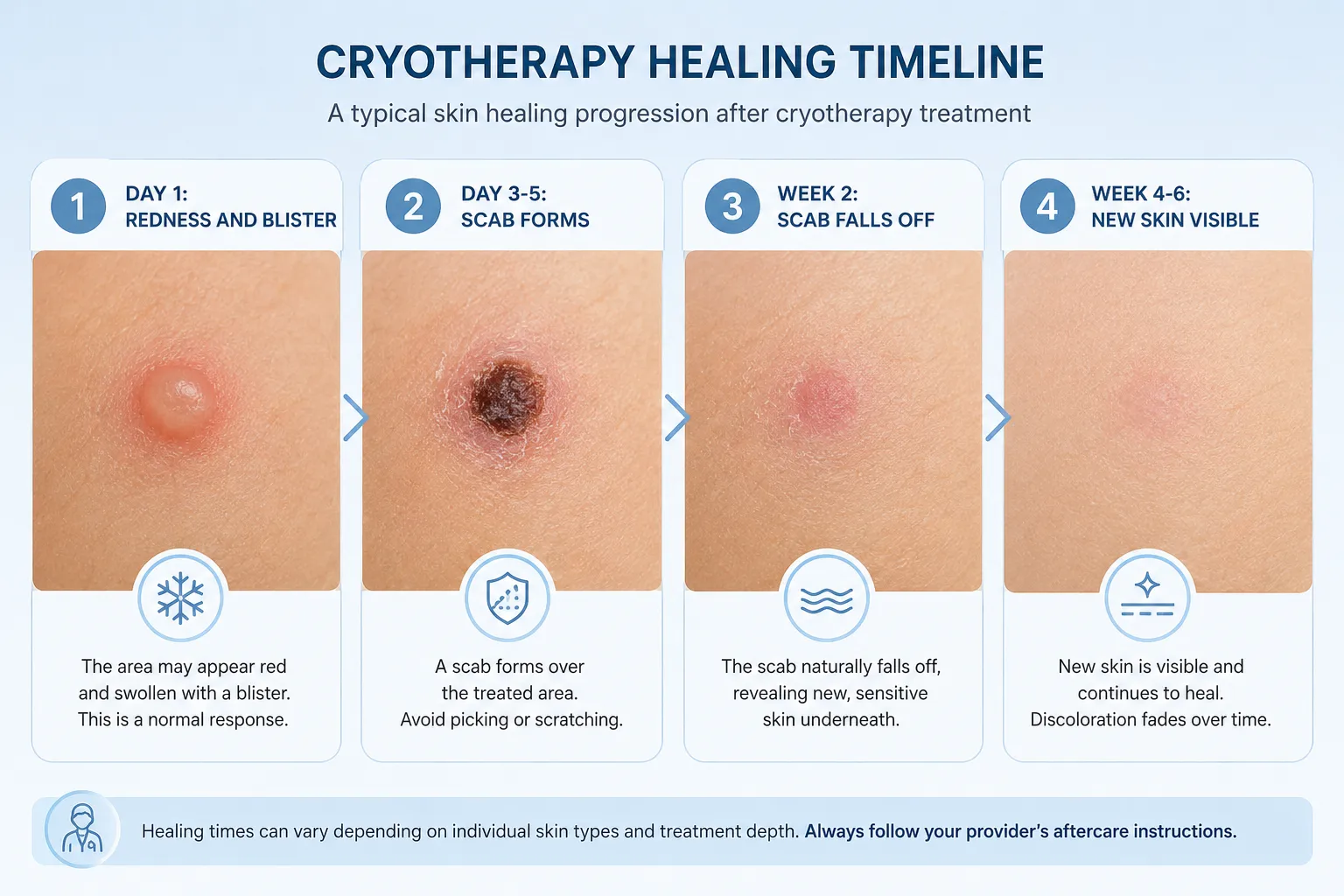
The freezing application itself takes only seconds, but full clearance of the treated skin usually takes two to six weeks depending on the size and depth of the lesion. The procedure is fast; the recovery is what takes time.
A typical timeline looks like this:
Flat, superficial spots tend to clear faster and more completely than raised or thicker ones, which sometimes need a second round of freezing spaced several weeks apart[3][7]. Anyone who wants a single-visit, no-return solution is generally better served by excision.
Yes, recurrence after cryotherapy is common enough that patients should expect it as a real possibility rather than a rare exception. Because freezing doesn't remove the lesion's full root structure the way excision does, some pigmented cells often survive and regrow.
Reported clearance patterns differ by mole type:
Edge case: a mole that partially regrows after freezing can look different from the original, sometimes patchier, sometimes with irregular pigment, which can itself prompt an unnecessary scare or, worse, mask a genuine change that needs evaluation. Surgical excision carries a much lower recurrence rate because the lesion, including its base, is physically removed. For more on why some lesions return no matter the method used, see why moles, cysts, or lipomas sometimes grow back.
If a cancerous mole gets frozen instead of excised, the malignant cells are destroyed along with the benign ones, which eliminates the ability to biopsy the lesion and can delay a melanoma diagnosis at a stage when timing matters most. This is the single biggest argument dermatology guidance makes against using cryotherapy as a first-line treatment for any mole with diagnostic uncertainty[1].
Here's why this matters practically:
This is precisely why reputable clinics position cryotherapy as appropriate only after a lesion has been assessed and is not suspicious, never as a way to avoid finding out what a mole is in the first place. Understanding a pathology report matters here too; patients considering excision instead of freezing can review how to read a pathology report after mole removal to understand exactly what testing provides that freezing cannot.
No. Dermatologists and other trained providers generally limit cryotherapy to small, flat, already-confirmed-benign pigmented lesions, not moles of every size, shape, or history. Standard indications for cryotherapy include viral warts, seborrheic keratoses, actinic keratoses, molluscum contagiosum, and skin tags, melanocytic nevi are notably absent from that core list[5][13][15].
Lesions generally considered poor candidates for freezing include:
Quick example: a flat, light-brown 3mm mole on the forearm that a dermatologist has already examined and photographed for tracking is a far better cryotherapy candidate than a dark, slightly raised 8mm mole on the back that's never been looked at. The first has a known baseline; the second needs an exam and possibly a biopsy before any removal method is even discussed.
Cryotherapy usually causes less visible scarring than surgical excision, but it isn't scar-free, and it carries its own distinct cosmetic risks like patchy pigment changes. The comparison isn't simply "no scar vs. scar", it's two different types of cosmetic outcome.
What each method tends to leave behind:
Neither outcome is guaranteed, and healing varies by skin type, lesion location, and aftercare. Patients focused specifically on minimizing visible marks after excision can find practical guidance in ways to minimize and treat mole removal scars.
Decision rule: choose cryotherapy for cosmetic priority only when the lesion is confirmed benign and flat; choose excision when the mole is larger, raised, or of uncertain origin, since the trade-off there is a small planned scar versus an unpredictable pigment change.
Cryotherapy should be avoided whenever there's any uncertainty about what a mole is, when the lesion is raised or deep, or when a tissue diagnosis is needed for peace of mind or medical necessity. This is the core message running through recent dermatology guidance on melanocytic nevi[1][10].
Avoid cryotherapy for moles in these situations:
If any of these apply, the right next step is a clinical assessment, not a freezing treatment. Patients who are unsure what they're looking at can start with guidance on how to check a mole at home and compare findings against the difference between flat and raised mole skin cancer risk before deciding on any removal method.
Over-the-counter freezing kits can sometimes lighten or partially shrink a treated spot, but they are not designed or tested for moles and do not offer a reliable or safe way to remove one. These products are marketed primarily for warts and skin tags, and using them off-label on a pigmented mole is a mismatch between tool and target.
Why OTC kits fall short specifically for moles:
Dermatology consensus across current patient education sources is clear that these DIY approaches are not recommended for moles because of the combined risk of skin damage and missed melanoma[7][11]. The same caution generally applies to other at-home removal products; readers comparing options may also want to look at whether mole removal creams or mole removal pens hold up to similar scrutiny, since the same core problem, no diagnosis, no professional oversight, applies across all DIY mole products.
After clinical cryotherapy, expect redness and possible blistering within a day or two, followed by scabbing and gradual peeling over roughly two to six weeks. Aftercare is simple but matters for avoiding infection and keeping the eventual mark as minimal as possible.
Standard aftercare steps include:
Most people can return to normal activities the same day, though direct sun and abrasive skincare products on the treated spot should wait until healing is complete. For a broader look at healing timelines across different mole removal methods, see what to expect after mole removal and how long mole removal generally takes to heal.
Can you freeze off a mole permanently?
Sometimes, but not reliably. Flat, superficial moles may clear with one or two cryotherapy sessions, while raised or deeper moles often regrow and need repeat treatment or a switch to surgical excision[3][7].
Is freezing a mole off painful?
Most people describe a stinging or burning sensation during the freeze and mild soreness for a day or two afterward, similar to a minor burn.
Can a regular doctor freeze off a mole, or does it need a dermatologist?
Either can perform cryotherapy, but a proper skin exam or dermoscopy beforehand is what matters most, since the treatment itself is only appropriate after the lesion is confirmed benign[1][5].
What's the difference between freezing a mole and freezing a wart?
Warts are viral growths without melanocytes, so destroying them carries no risk of hiding cancer. Moles contain pigment-producing cells, and current guidance treats them very differently because of the diagnostic stakes[1][5].
Does insurance or a health plan cover mole freezing?
Coverage depends on whether the removal is medically necessary (such as a suspicious lesion) versus purely cosmetic. A clinic consultation is the fastest way to confirm coverage specifics.
How do I know if my mole is safe to freeze off?
There's no way to know without a professional exam. Any mole considered for removal should first be assessed for size, shape, color, and history before any method, freezing or surgical, is chosen[1].
Can freezing off a mole cause it to spread?
Cryotherapy itself doesn't spread cancer, but it can delay diagnosis if the lesion was malignant, since the destroyed tissue can no longer be tested. Delayed diagnosis, not the treatment itself, is the real danger[1].
Is surgical excision always more painful than cryotherapy?
Excision typically involves local anesthetic, so the procedure itself is usually not painful, though there's more soreness during healing compared to a frozen spot. Many patients find the trade-off worth it for the added diagnostic certainty.
Are freezing kits sold in pharmacies the same as what clinics use?
No. Pharmacy kits use lower-grade freezing agents at less precise temperatures than clinical liquid nitrogen equipment, and they are formulated for warts, not moles[5][7].
What should I do if my mole has already been frozen and it's changing again?
Get it examined promptly. A regrowing or changing area after cryotherapy needs the same level of attention as any new mole change would.
Freezing off a mole is technically possible, but it is not the recommended path for most true moles, and it is not a safe DIY project under any circumstances. The core issue isn't whether cold temperatures can destroy pigmented tissue, they can, it's that freezing destroys the evidence needed to know what that tissue actually was. Current dermatology guidance is consistent: surgical excision with histopathology is the standard for melanocytic nevi being removed, while cryotherapy stays a secondary, cosmetic-leaning option reserved for small, flat, already-confirmed-benign spots[1][10].
The practical next step for anyone considering mole removal is straightforward. Get the mole properly examined first, ask directly whether it's a candidate for cryotherapy or whether excision with pathology testing is the safer route, and treat any DIY freezing kit as a tool for warts and skin tags, not for moles. A short consultation now is a far smaller commitment than dealing with a missed diagnosis later.
[1] Can Cryotherapy Be Used To Treat A Benign Melanocytic - https://www.droracle.ai/articles/1058234/can-cryotherapy-be-used-to-treat-a-benign-melanocytic
[2] Beauty Spots Removal - https://feeds.akerahealth.com/blog/beauty-spots-removal
[3] A Brief Guide On The Various Types Of Mole Removal Treatments - https://cliffordclinic.com/a-brief-guide-on-the-various-types-of-mole-removal-treatments/
[4] Cryotherapy Ghpi0879 07 25 - https://www.gloshospitals.nhs.uk/media/documents/Cryotherapy_GHPI0879_07_25.pdf
[5] Nbk482319 - https://www.ncbi.nlm.nih.gov/books/NBK482319/
[6] What Are Your Mole Removal Options - https://www.devonshiredermatology.co.uk/latest-news/what-are-your-mole-removal-options/
[7] Freezing Moles Off - https://moles.org/freezing-moles-off/
[8] Cryotherapy For Mole Removal Benefits Risks And What To Expect - https://www.theminorsurgerycenter.com/blog/cryotherapy-for-mole-removal-benefits-risks-and-what-to-expect
[9] Mole Removal Methods - https://www.skinandvein.com/mole-removal-methods/
[10] Pmc10814732 - https://pmc.ncbi.nlm.nih.gov/articles/PMC10814732/