Earlobe Repair in Toronto: Torn, Stretched and Gauged Lobes, and What the Result Actually Looks Like
Last updated: September 8, 2026
A torn earlobe is one of the few problems in surgery where the fix takes less time than the drive to the appointment. Most people who come in for earlobe repair in Toronto have been putting it off for years, usually because they assumed it was a bigger deal than it is, or because they weren't sure a surgeon would take it seriously. It's an ordinary, well-defined problem with a reliable repair.
Quick Answer
Earlobe repair is a short in-office operation under local anaesthetic in which the healed, skin-lined edges of a torn, split or stretched lobe are freshened back to raw tissue and closed in layers so the lobe becomes solid again. Most people can be re-pierced once the scar has matured, generally after some months rather than weeks, with the new hole placed beside the scar rather than through it. Adults across Toronto and the GTA can be assessed at The Minor Surgery Center without a referral, and procedures are performed by plastic surgeons.
Key Takeaways
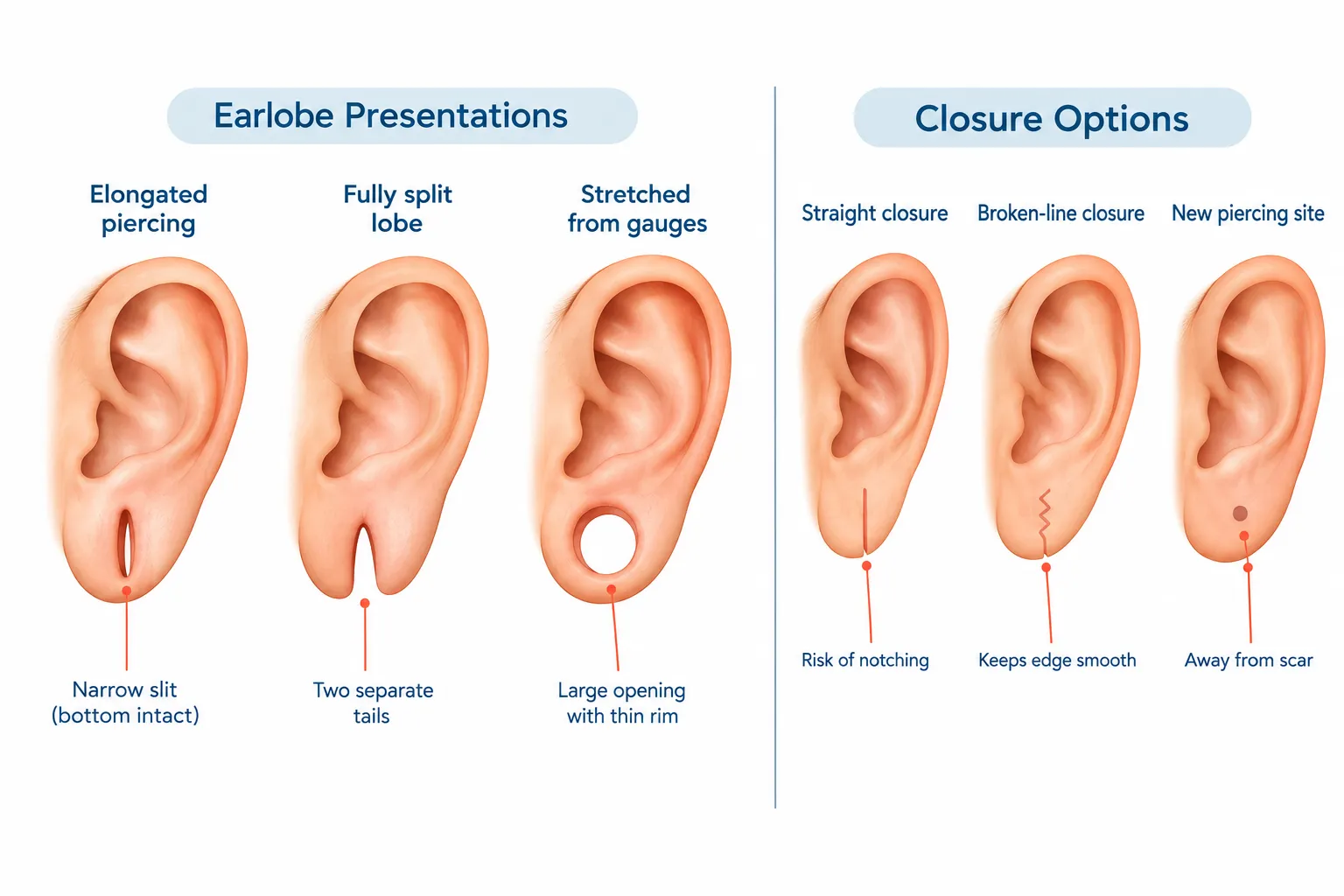
Three different problems get called the same thing: an elongated piercing, a fully split lobe, and a stretched or gauged lobe. Each needs a different repair.
The single biggest factor in how the result looks is how the bottom edge of the lobe is closed, not how large the tear was.
A fine line scar always remains. It usually becomes hard to see over several months, but results vary from person to person.
Re-piercing is usually possible later, through healthy tissue next to the scar, never through the scar itself.
Both lobes are commonly repaired in the same visit, under local anaesthetic, and you go home the same day.
Earlobe repair done for appearance is generally not covered by OHIP. Fees are quoted at the consultation and should be given to you in writing.
If there's a firm lump on or behind the lobe, it needs to be looked at in person before any repair is planned, it may be a keloid, a hypertrophic scar or something else entirely.
Three Different Problems, Three Different Repairs
"Earlobe repair" is used to describe at least three separate operations. Which one you need depends entirely on where the tissue has given way, and that's decided by looking at the lobe.
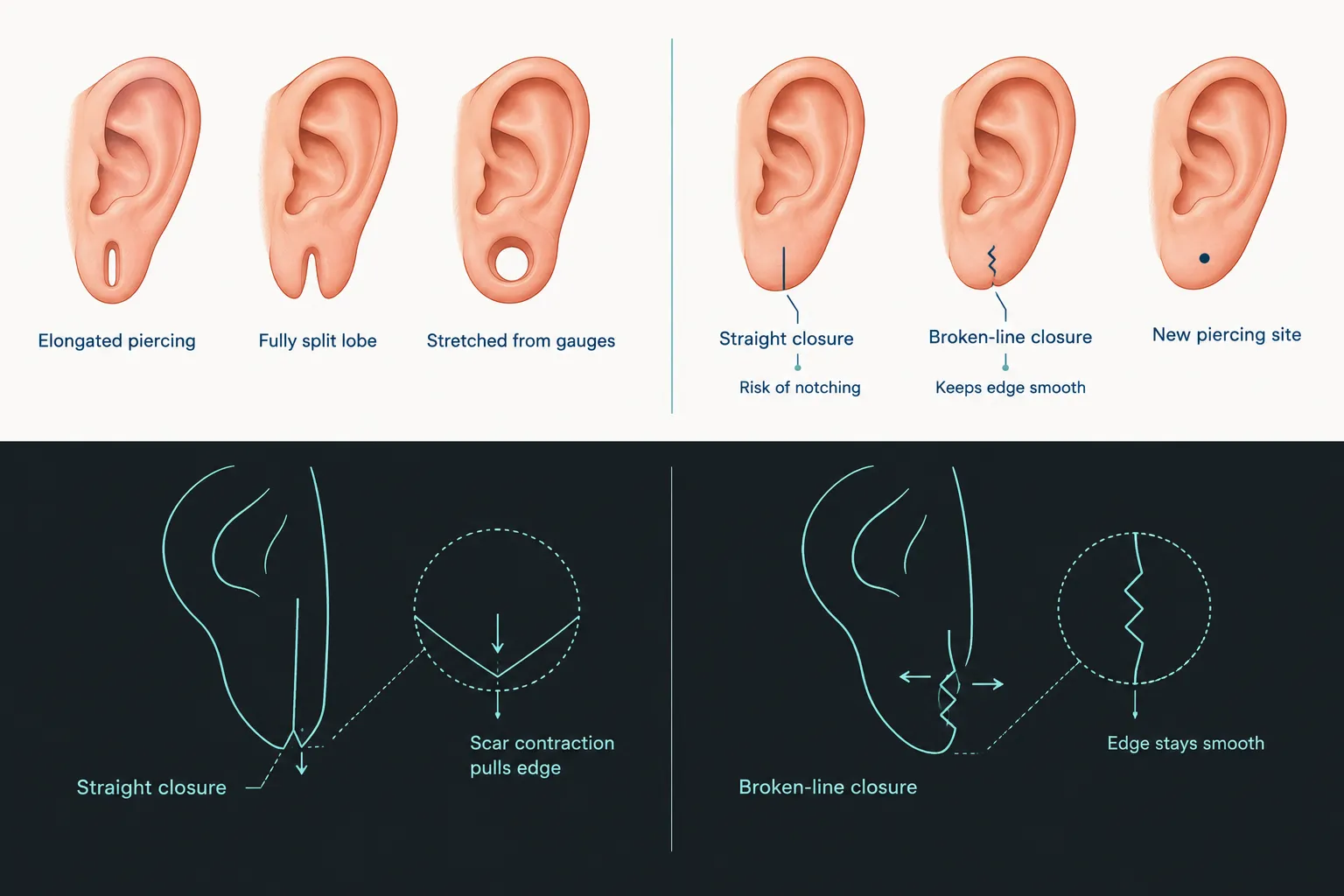
An elongated piercing. The hole has slowly migrated downward over years of heavier earrings until it's a vertical slit, but the rim at the bottom of the lobe is still continuous. This is the simplest of the three. The tract is excised as a narrow ellipse and the lobe is closed in layers, with no need to rebuild the free border. Because the edge is untouched, the cosmetic result here tends to be the most predictable.
A fully split lobe. The tear has come all the way through the bottom edge, leaving two tails. This is the classic sweater snag, seatbelt catch or grabbed-by-a-toddler injury, and it can also be the end point of an elongated piercing that finally gave way. The repair is more demanding because the free border of the lobe has to be reconstructed, not just stitched. Our detailed walkthrough of how a split earlobe is repaired covers the steps in more depth, and if you're not certain which category yours falls into, the comparison of a split earlobe versus a stretched earlobe is a good place to start.
A stretched or gauged lobe. After plugs or tapers, what's left is a ring of thinned, stretched skin plus genuine excess tissue. Closing it isn't simply a matter of pulling the edges together; the redundant tissue has to be trimmed and the lobe reshaped so it sits in proportion with the other side. This is the most involved of the three, and if the opening is very large, it's occasionally staged. There's a fuller discussion in our article on stretched earlobe repair after gauges.
Decision rule: if you can still feel an intact band of tissue below the hole, you likely have an elongated piercing. If your finger passes straight through to the bottom edge, it's a full split. If the opening is round and the surrounding skin feels thin and papery, it's a stretch injury.
Why the Closure Shape Matters More Than the Stitches
If a fully split lobe is closed as a straight line running down to the bottom edge, that scar contracts as it matures and can pull the border inward into a small V-shaped notch. That notch is the most common reason people are disappointed with a repair, not infection, not the scar itself.
Scars shorten slightly as they heal. A straight line perpendicular to a free edge has nowhere to go but inward. So surgeons break the line up. A small zig-zag or Z-shaped closure at the rim redirects the pull sideways instead of upward. Another approach deliberately leaves the border slightly full, so that when contraction happens, the edge settles level rather than dipping.
The tear you can see is the easy part. The bottom edge you'll be looking at in a mirror for the next twenty years is the part that needs planning.
This is why the technique isn't chosen from a description over the phone. Lobe thickness, how far the split extends, how much tissue was lost and whether the two sides are already asymmetric all change the answer. Where an earlier repair has already notched, the fix is a revision rather than a repeat closure, and the same principles that apply to scar revision surgery apply here.
Keloid-Prone Ears and Piercing Bumps
Not every lump on an earlobe is a keloid, and no one should be told which it is without an in-person look. There are three common possibilities, and they behave very differently.
An irritation bump. Often soft, sometimes pink, appearing in the weeks after a new piercing. It's a reaction to friction, jewellery metal or minor infection, and it frequently settles once the cause is removed.
A hypertrophic scar. Raised and firm, but it stays within the footprint of the original wound. These often flatten slowly over many months.
A true keloid. Scar tissue that grows beyond the original injury and can end up considerably larger than the piercing that started it, sometimes as a firm ball behind the lobe. Keloids after ear piercing are common. They're more likely in people with a personal or family history of them, and more likely in darker skin tones, a well-documented pattern, not a personal failing.
That distinction changes the plan. Cutting out a keloid on its own carries a meaningful chance that it comes back, so treatment is usually combined with something to lower that risk: steroid injection, pressure therapy with a clip or magnet after surgery, silicone, or a combination, planned before anyone picks up a scalpel. Our page on keloid removal in Toronto explains those combined approaches.
Being keloid-prone doesn't rule out earlobe repair. It means the repair is designed differently, follow-up is closer, and you're told honestly that recurrence is possible.
Can You Wear Earrings Again, and When?
Usually yes, but not straight away. The repaired tissue needs time to gain strength, which typically means waiting some months rather than a few weeks, with the exact timing set by your surgeon based on how the scar is settling.
The detail that matters most: the new piercing should not go through the scar. Scar tissue is less elastic and weaker than the skin around it, so a hole placed in it is more likely to stretch or tear again. The new piercing is sited in healthy tissue beside or above the repair line, and some surgeons will mark the spot for you. There's more on timing in our guide to re-piercing your ears after earlobe repair.
Practical habits that protect a repaired lobe:
Start with light studs rather than hoops or drops.
Save heavy or dangling earrings for short occasions, not twelve-hour days.
Use larger, flatter earring backs that spread the load across the lobe.
Take earrings out for sleep, sport and anything involving a pullover.
Be careful around infants and toddlers, who reach for anything that catches light.
The lobe is examined and marked, local anaesthetic is injected, the healed edges of the tear are freshened back to raw tissue, and the lobe is closed in layers so the deeper tissue carries the tension instead of the skin. A small dressing goes on and you leave.
Only the injection is felt, as a brief sting and pressure. After that the lobe goes numb and you feel pulling but not pain. A single straightforward lobe is quick; a gauged lobe requiring reshaping takes longer, and both ears are commonly done in the same appointment.
For recovery, keep the area clean and dry as directed, sleep off the treated side for the first while, and avoid anything that tugs at the lobe. Sutures usually come out within about a week to ten days, depending on the closure used. The lobe looks slightly firm and pink at first; that softens over the following weeks. Our article on how long earlobe repair takes to heal sets out the week-by-week picture.
Be clear on one point: a fine line scar remains permanently. It usually becomes difficult to notice over several months, and results vary. Sun protection on the new scar and consistent scar care, silicone and gentle massage once the wound is closed and your surgeon says to start, genuinely help the final appearance.
Is Earlobe Repair Covered by OHIP?
Earlobe repair performed to improve appearance is considered cosmetic and is generally not an insured service in Ontario, so it isn't covered by OHIP.
A repair carried out as part of treating an acute injury, or a problem causing genuine symptoms such as recurrent infection or a painful lesion, may be assessed differently. That determination depends on the clinical findings, not on how the request is phrased.
Some private extended health plans and health spending accounts will contribute. Ask for any fee in writing before you book, and confirm your own coverage situation at the consultation.
Getting Assessed in Toronto
Earlobe repair Toronto appointments at The Minor Surgery Center are at 2920 Dufferin Street, Suite 202, Toronto. Additional locations include 85 Scarsdale Road, Unit 101 in York Mills (North York), plus Vaughan, Mississauga at 1224 Dundas Street West, and Oakville. Phone 647-614-1611, weekdays 9 a.m. to 4 p.m. No referral is required.
Procedures are performed by plastic surgeons, which matters here for a specific reason: this is a small operation judged almost entirely on how one edge of tissue looks afterwards, in a spot people see every day. If you're weighing up whether this warrants a surgeon at all, our piece on when to see a plastic surgeon for a minor procedure is a reasonable read. A broader list of what's handled in clinic is on the Toronto procedures page.
To prepare: come with earrings out, hair tied back, and mention any history of keloids or thickened scars anywhere on your body. Bring a list of your medications, including blood thinners, fish oil and anti-inflammatories. Both lobes are usually treated in one visit, so plan for that.
Frequently Asked Questions
Does earlobe repair hurt? The local anaesthetic injection stings briefly. After that the lobe is numb and you'll feel pressure rather than pain. Most people need nothing stronger than paracetamol afterwards.
How long does the procedure take? A single straightforward repair is short. A gauged lobe needing tissue trimmed and reshaped takes longer. Either way it's an outpatient visit and you drive yourself home.
Will there be a visible scar? Yes, a fine line scar is permanent. It typically fades to something hard to see over several months, helped by sun protection and scar care, but the outcome varies between individuals.
When can I re-pierce? Usually after several months, once your surgeon confirms the scar has matured. The new hole should be placed in healthy tissue next to the scar, not through it.
Can both ears be done at once? Yes. Bilateral repair in one visit is common and doesn't lengthen recovery meaningfully.
What if I'm prone to keloids? Repair is still possible, but the plan changes, usually surgery combined with steroid injection, pressure therapy or silicone, plus closer follow-up. Tell the surgeon at the consultation.
Can a gauged lobe be closed? Yes. Excess and thinned tissue is trimmed and the lobe reshaped. Very large openings are sometimes addressed in stages, and the final shape won't be identical to a never-stretched lobe.
Can a torn earlobe heal on its own? No. Once the tear edges have lined themselves with skin, they can't fuse back together. Closing the gap requires the edges to be surgically freshened first.
When can I return to work or the gym? Most people return to desk work the next day. Sweaty exercise, contact sport and anything that pulls a top over your head should wait until your surgeon clears it, typically a couple of weeks.
The Bottom Line
A torn, elongated or stretched earlobe is a small problem with a dependable fix. What separates a good result from a disappointing one isn't the size of the tear, it's how carefully the bottom edge is closed and how the scar is looked after in the first few months.
If you'd like it assessed, call 647-614-1611 or visit 2920 Dufferin Street, Suite 202, Toronto, weekdays 9 a.m. to 4 p.m. No referral needed.
This article is general information and is not a substitute for individual medical advice. An earlobe or an ear lump should be assessed in person before any treatment decision is made.
References
American Society of Plastic Surgeons, Ear Surgery (Otoplasty)
Canadian Society of Plastic Surgeons, Find a Plastic Surgeon / Patient Information
Cleveland Clinic, Keloids: Causes, Symptoms and Treatment
DermNet, Keloid and Hypertrophic Scar
American Academy of Dermatology Association, Keloid Scars: Diagnosis and Treatment
The Minor Surgery Center’s York Mills clinic, located at 85 Scarsdale Rd, Unit 101 in North York, offers convenient access to specialized surgical care for a range of skin and hand conditions. Our Plastic Surgeons provide treatment for skin cancer, suspicious moles, cysts, lipomas, carpal tunnel syndrome and trigger finger, with a focus on timely care and personalized treatment. In many cases, patients may be able to have their consultation and treatment completed during the same visit when medically appropriate. For expert care in a welcoming clinical setting, contact our York Mills team at (647) 614-1611.
We are the experts in the field of Minor Surgery. All our Surgeons have completed 5 years of post Medical School Surgical Residencies. They are all Board Certified by the Royal College of Physicians and Surgeons of Ontario.They have been trained at Institutions including McGill, McMaster, Queen's, University of British Columbia, University of Toronto, University of Western Ontario, The Mayo Clinic, University of Pennsylvania, University of Southern California, Yale University, and Oxford.
In many clinics, you could wait months—sometimes over a year—for a procedure like cyst or lipoma removal, mole removal, or even carpal tunnel release. But at TMSC, we prioritize fast access to care. In many cases, we can schedule and complete your minor surgery on the same day as your initial consultation—no extra runaround required.
Our clinics are designed with your comfort, safety, and efficiency in mind. We use strict sterilization protocols to minimize any infection risk, and our advanced surgical equipment meets hospital-grade standards. Yet, you’ll never feel like you’ve stepped into a stark, clinical space—our friendly staff ensures you’re welcome and supported the moment you walk through the door.
Cosmetic results matter—even for the smallest procedures. Skin lesions can be excised by non surgeons in Ontario. Furthermore, any MD with 2 years of post graduate training even outside of a surgical field can perform removal. At TMSC we only have Surgeons under our roof. They are trained well above the level of the procedures we offer to ensure the surgery goes smoothly with minimal scaring and preserving your natural contours. Our Surgeons are trained to ensure both function and aesthetics are always front and center.
At TMSC, we specialize in surgical treatment of both benign and malignant skin lesions, as well as minor hand conditions. We offer significantly reduced wait times often allowing you to schedule your surgery on the same day as your consultation.
You can book your free consultation with The Minor Surgery Center in three easy ways: online through Cortico, by phone, or by requesting a callback from our team.
The initial consultation is free. During this consultation, one of our board certified surgeons will examine your condition and recommend a suitable solution.
Directly Online
Request a Callback
By Phone
By Text
Hours
Sunday
Closed
Monday
9 am — 4 pm
Tuesday
9 am — 4 pm
Wednesday
9 am — 4 pm
Thursday
9 am — 4 pm
Friday
9 am — 4 pm
Saturday
Toronto & Oakville Open Vaughan & Mississauga Closed



.avif)
%20(600%20x%20600%20px)%20(2).avif)
.avif)
%20(8).avif)
%20(7).avif)

.png)