Split Earlobe vs Stretched Earlobe from Gauges: Understanding the Differences and Treatment Options
Earlobes are delicate structures that can suffer damage in various ways. Whether from a traumatic tear or years of intentional stretching with gauges, earlobe injuries present unique challenges that require different approaches to repair. Understanding the split earlobe vs stretched earlobe from gauges is essential for anyone facing these conditions, as the causes, symptoms, and treatment methods differ significantly.
The human earlobe contains no cartilage—only skin, connective tissue, and fat. This soft composition makes it vulnerable to both sudden tears and gradual stretching. While a split earlobe typically results from trauma such as an earring being pulled or caught, a stretched earlobe from gauges develops over months or years of deliberate expansion. Both conditions can cause cosmetic concerns and functional limitations, but they require distinctly different surgical techniques for optimal restoration.
Key Takeaways
Split earlobes result from traumatic tears, while stretched earlobes from gauges develop through intentional, gradual expansion of piercing holes
Split earlobe repair typically involves a simpler surgical procedure with shorter recovery time compared to stretched earlobe reconstruction
Stretched earlobes may not close naturally once expanded beyond 2-4mm (0g-6g gauge size), requiring surgical intervention for complete restoration
Both conditions are highly treatable with excellent cosmetic outcomes when performed by experienced surgeons
Prevention strategies differ significantly: avoiding heavy earrings for splits versus gradual downsizing for stretched lobes
Understanding Earlobe Anatomy and Structure
Before exploring the split earlobe vs stretched earlobe from gauges comparison, it's important to understand the basic anatomy of the earlobe. The earlobe, also called the lobule, is the fleshy lower portion of the external ear. Unlike the upper ear, which contains firm cartilage, the earlobe consists of:
Skin layers: The outer epidermis and inner dermis provide protection and sensation
Adipose tissue: Fat cells give the earlobe its soft, cushioned texture
Connective tissue: Fibrous structures provide shape and support
Blood vessels: A rich network supplies nutrients and oxygen
Nerve endings: Sensory receptors make the earlobe sensitive to touch and pain
This soft tissue composition makes earlobes flexible and easy to pierce, but also vulnerable to injury. The lack of cartilage means that once earlobe tissue is damaged—whether torn or overstretched—it cannot heal back to its original form without surgical intervention.
How Earlobe Tissue Responds to Stress
Earlobe tissue responds differently depending on whether stress is applied suddenly or gradually:
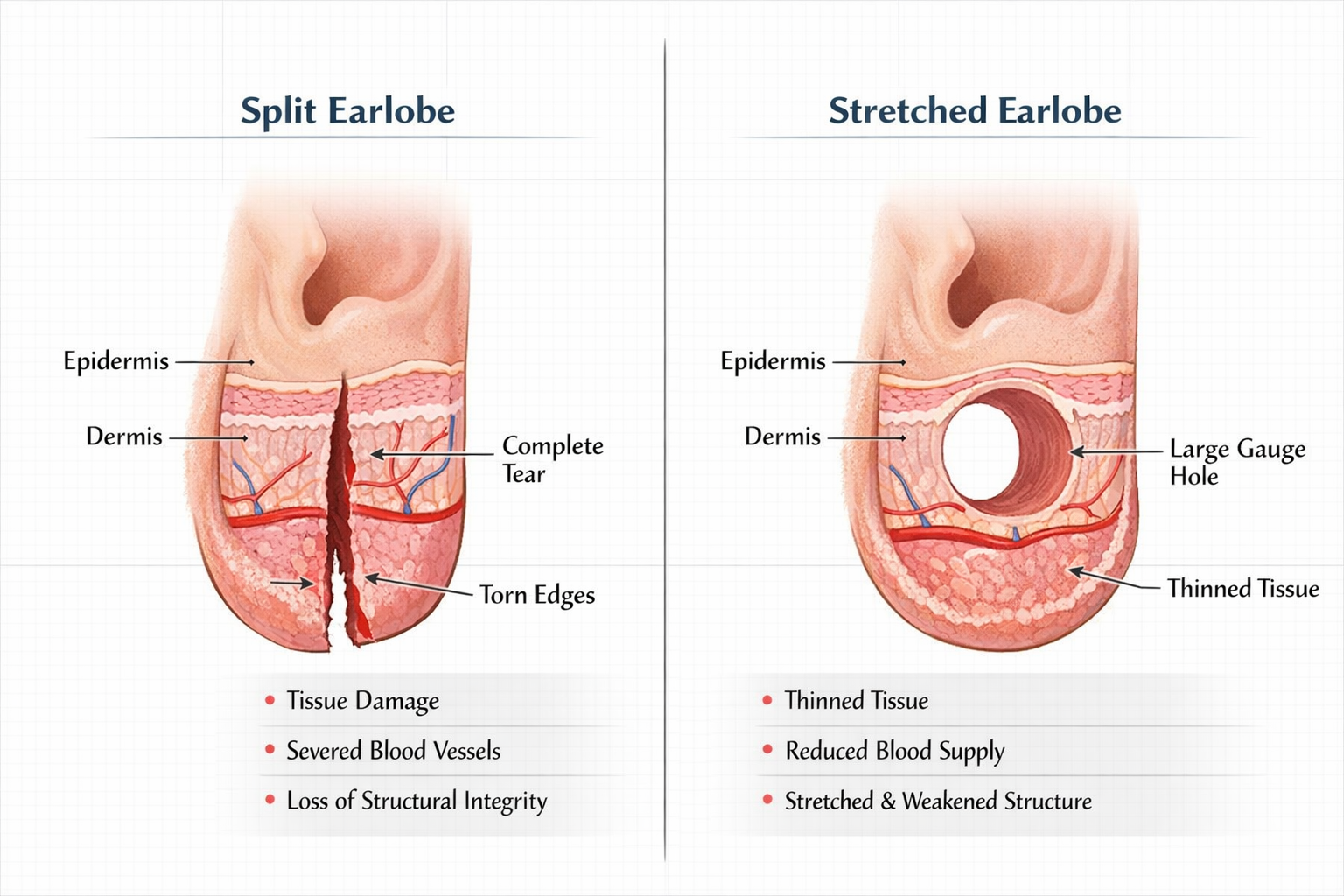
Acute trauma (sudden force) causes the tissue to tear along lines of weakness, typically resulting in a split that extends from the piercing hole to the bottom edge of the lobe. The tissue separates completely, creating two distinct segments.
Chronic tension (gradual stretching) causes the tissue to remodel and thin out. The cells reorganize, the piercing hole expands, and the surrounding tissue becomes progressively thinner. This is the mechanism behind gauge stretching.
What Is a Split Earlobe?
A split earlobe occurs when the tissue of the earlobe tears completely, creating a cleft that extends from a piercing hole to the edge of the lobe. This condition is also known as a torn earlobe or earlobe laceration.
Common Causes of Split Earlobes
Split earlobes typically result from traumatic incidents rather than intentional modification:
Earring caught on clothing or objects: The most common cause, occurring when an earring snags on a sweater, towel, or other fabric
Heavy earrings: Prolonged wear of heavy jewelry can weaken tissue and lead to tearing
Accidental pulling: Children pulling on earrings or sudden movements during sports
Physical altercations: Earrings being pulled during conflicts
Occupational hazards: Healthcare workers or those in physical jobs may catch earrings on equipment
Characteristics of Split Earlobes
Split earlobes present with distinctive features:
✅ Complete separation of tissue from piercing hole to lobe edge ✅ Clean or jagged tear depending on how the injury occurred ✅ Two distinct segments of earlobe tissue ✅ Immediate onset following a traumatic event ✅ Possible bleeding at the time of injury ✅ Scar tissue formation along the tear line if left untreated
The severity of a split earlobe can vary. Some tears are partial, extending only partway through the lobe, while others create a complete division. Fresh tears may bleed and require immediate medical attention, while older splits typically present as healed but separated tissue.
What Is a Stretched Earlobe from Gauges?
A stretched earlobe from gauges results from the intentional, gradual expansion of a piercing hole using progressively larger jewelry called gauges, plugs, or tunnels. This body modification practice has cultural significance in many societies and has become increasingly popular in Western culture since the 1990s.
The Gauge Stretching Process
Earlobe stretching follows a deliberate progression:
Initial piercing: Starting with a standard piercing (typically 18g or 20g)
Waiting period: Allowing 6-8 weeks for initial healing
Gradual expansion: Inserting slightly larger jewelry every 4-8 weeks
Tissue adaptation: The earlobe tissue stretches and remodels around the larger jewelry
Progressive sizing: Continuing to larger sizes over months or years
Common gauge sizes progress from smaller to larger:
🔹 Enlarged piercing hole with thin tissue rim 🔹 Gradual development over months or years 🔹 Tissue thinning around the stretched area 🔹 Potential point of no return (typically 2-4mm or 0g-6g) 🔹 Visible tunnel through the earlobe 🔹 Possible tissue discoloration or texture changes
The "point of no return" is a critical concept in gauge stretching. Once an earlobe is stretched beyond approximately 2-4mm (0g to 6g), the tissue loses its ability to shrink back to a normal appearance naturally. The exact threshold varies by individual based on genetics, tissue quality, and stretching technique.
Split Earlobe vs Stretched Earlobe Interactive Comparison
Explore the differences, treatment options, and recovery timelines
⚡
Split Earlobe
Cause:
Traumatic tear from earring being pulled or caught
Development:
Sudden, single incident
Appearance:
Complete separation creating two segments
Tissue Damage:
Clean or jagged tear through tissue
Natural Healing:
Will not heal without surgery
🔄
Stretched Earlobe (Gauges)
Cause:
Intentional gradual expansion with gauges/plugs
Development:
Progressive over months to years
Appearance:
Enlarged circular opening with thin tissue rim
Tissue Damage:
Tissue expansion, thinning, and remodeling
Natural Healing:
May shrink if small (<2-4mm); larger sizes need surgery
Factor
Split Earlobe Repair
Stretched Earlobe Reconstruction
Procedure Complexity
Simple surgical repair
Moderate to complex reconstruction
Surgery Duration
15-30 minutes per ear
30-60 minutes per ear
Anesthesia
Local anesthetic only
Local (sedation optional)
Technique
Edge refreshing + layered closure
Tissue excision + reconstruction
Success Rate
95-98%
85-95%
Scar Visibility
Minimal (fine line)
Moderate (more noticeable)
Cost (Single Ear)
$400-$800 CAD
$600-$2,000 CAD
Revision Rate
2-5%
5-10%
Timeline
Split Earlobe Recovery
Stretched Earlobe Recovery
Days 1-7
Mild discomfort, slight swelling, keep clean and dry
My earring was pulled or caught suddenly, causing a tear
I intentionally stretched my piercing with gauges over time
Heavy earrings gradually caused the hole to elongate and tear
What does your earlobe look like now?
There's a complete split from the piercing hole to the bottom edge
There's a large circular opening with thin tissue around it
The earlobe is separated into two distinct segments
When did this happen?
Suddenly, in a single incident (recently or in the past)
Gradually over many months or years
After years of wearing heavy earrings, it finally tore
Result: You likely have a SPLIT EARLOBE
Based on your answers, your earlobe damage appears to be a traumatic split or tear. This condition typically requires split earlobe repair surgery, which is a straightforward procedure with excellent results. The surgery takes 15-30 minutes per ear, and you can expect to be re-pierced in 8-12 weeks. Consult with a qualified plastic surgeon or dermatologist for evaluation and treatment.
Result: You likely have a STRETCHED EARLOBE from gauges
Based on your answers, your earlobe has been stretched through intentional gauging. Depending on the size, your earlobe may shrink naturally if the stretch is small (under 2-4mm), or you may need surgical reconstruction for larger stretches. The procedure is more complex than split earlobe repair and requires 3-6 months before re-piercing. Consult with an experienced surgeon who specializes in earlobe reconstruction for the best results.
Split Earlobe vs Stretched Earlobe from Gauges: Key Differences
Understanding the split earlobe vs stretched earlobe from gauges requires examining several critical distinctions:
Cause and Development
Split Earlobe:
Traumatic injury
Sudden onset
Unintentional occurrence
Single incident typically responsible
Stretched Earlobe:
Intentional modification
Gradual development
Deliberate process
Progressive expansion over time
Tissue Damage Pattern
Split Earlobe:
Complete tear through tissue
Separation of two segments
Potential for irregular edges
Scar tissue along tear line
Stretched Earlobe:
Tissue expansion and thinning
Intact but remodeled tissue
Uniform circular opening
Tissue adaptation rather than rupture
Natural Healing Potential
Split Earlobe:
Will not heal back together without intervention
Tissue remains separated indefinitely
Scar tissue prevents natural closure
Requires surgical repair for cosmetic restoration
Stretched Earlobe:
May shrink partially if removed early (before 2-4mm)
Larger stretches (beyond 0g) rarely close completely
Tissue thinning is often permanent
Surgical reconstruction needed for full restoration beyond certain sizes
Functional Impact
Both conditions can affect:
Ability to wear standard earrings
Cosmetic appearance
Professional presentation
Self-confidence
Social perceptions
However, stretched earlobes from gauges may present additional challenges if the tissue becomes extremely thin or if the opening is very large, potentially affecting the structural integrity of the entire lobe.
Symptoms and Complications
Split Earlobe Symptoms
People with split earlobes typically experience:
Visible separation of the earlobe into two parts
Inability to wear earrings in the affected piercing
Cosmetic concern about appearance
Asymmetry if only one earlobe is affected
Scar tissue along the tear line
Discomfort when trying to wear jewelry
Complications are rare but may include:
Infection if the tear is fresh and not properly cleaned
Keloid formation in individuals prone to excessive scarring
Psychological distress related to appearance
Stretched Earlobe Symptoms
Individuals with stretched earlobes may notice:
Enlarged piercing hole visible even without jewelry
Thin tissue rim around the opening
"Cat butt" appearance when jewelry is removed (tissue puckering)
Difficulty wearing standard earrings
Tissue discoloration or changes in texture
Odor if proper hygiene isn't maintained
Complications can include:
Blowouts: Tissue damage from stretching too quickly, causing scar tissue formation
Thinning: Excessive tissue loss making the lobe fragile
Tearing: The thin tissue rim may tear under stress
Infection: Particularly during the stretching process
Keloids: Excessive scar tissue formation
Complete splitting: If tissue becomes too thin and tears through
For those experiencing various types of skin concerns, understanding tissue health is essential for optimal healing outcomes.
Diagnosis and Assessment
Medical Evaluation for Split Earlobes
Diagnosing a split earlobe is straightforward and typically involves:
Visual examination: The tear is usually obvious upon inspection
Medical history: Understanding how and when the injury occurred
Assessment of tissue quality: Evaluating the health of surrounding tissue
Discussion of goals: Understanding patient expectations for repair
Evaluation of both ears: Checking for symmetry and any issues with the other earlobe
The surgeon will assess:
Length and location of the split
Tissue quality and thickness
Presence of scar tissue
Blood supply to the area
Patient's healing history
Medical Evaluation for Stretched Earlobes
Assessing stretched earlobes requires more detailed evaluation:
Measurement of opening size: Determining the diameter of the stretched hole
Tissue thickness assessment: Evaluating how much tissue remains
Evaluation of tissue quality: Checking for scarring, blowouts, or damage
Assessment of elasticity: Determining if any natural shrinkage is possible
Discussion of desired outcome: Understanding whether the patient wants complete closure or downsizing
Photographic documentation: Recording the current state for surgical planning
The surgeon will consider:
Current gauge size
Tissue rim thickness
Presence of scar tissue or blowouts
Overall earlobe size and shape
Patient's goals (complete closure vs. smaller opening)
Realistic expectations for outcomes
Treatment Options: Split Earlobe vs Stretched Earlobe from Gauges
The split earlobe vs stretched earlobe from gauges comparison becomes most significant when discussing treatment approaches, as each condition requires different surgical techniques.
Split Earlobe Repair Procedure
Split earlobe repair is a relatively straightforward outpatient procedure:
Preparation:
Local anesthetic injection to numb the area
Cleaning and sterilization of the earlobe
Marking of incision lines
Surgical Technique:
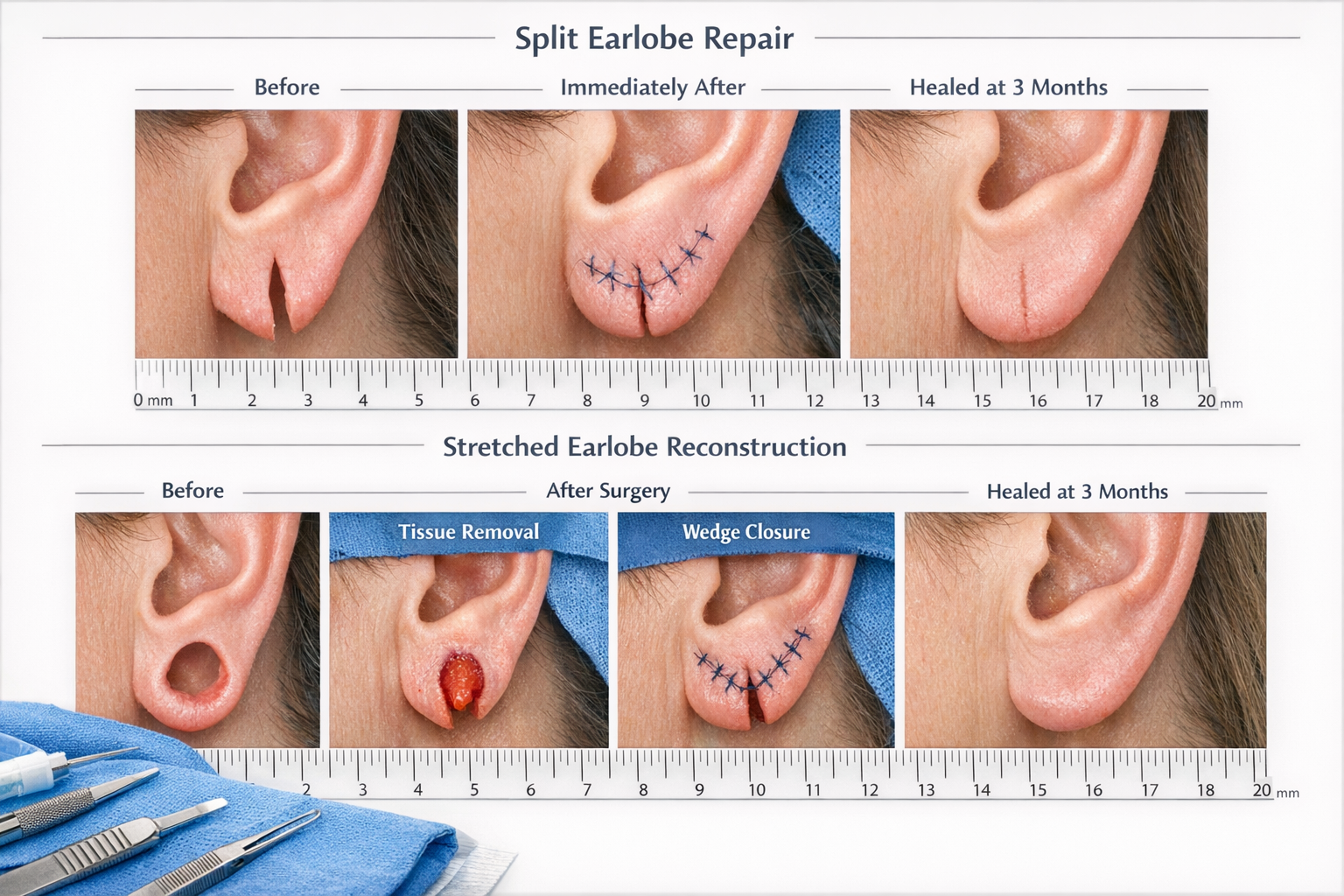
Refreshing the edges: The surgeon removes a thin layer of tissue along the split edges to create fresh, raw surfaces that can heal together
Layered closure: Sutures are placed in layers to ensure proper alignment and minimize scarring
Precise alignment: Careful attention to matching the natural contours of the earlobe
Fine sutures: Small, delicate sutures create the best cosmetic outcome
Duration: Typically 15-30 minutes per earlobe
Anesthesia: Local anesthetic only
Technique Variations:
Straight-line closure: Simple repair for clean tears
Z-plasty: Advanced technique to prevent notching and improve scar appearance
L-plasty: Alternative method for certain tear patterns
Stretched Earlobe Reconstruction
Stretched earlobe repair is more complex and varies based on the size of the opening:
For Small Stretches (up to 2-4mm):
May be allowed to shrink naturally over several months
Minimal surgical intervention required
Possible small excision and closure if natural shrinkage is insufficient
For Moderate to Large Stretches (4mm and above):
Preparation:
Local anesthetic administration
Careful measurement and marking
Sterilization of the surgical site
Surgical Technique:
Tissue excision: Removal of the stretched tissue and the entire rim around the opening
Wedge removal: Excising a pie-shaped section of tissue
Tissue advancement: Bringing healthy tissue together
Layered reconstruction: Multiple layers of sutures to rebuild the earlobe structure
Contouring: Reshaping to match the natural earlobe appearance
Duration: 30-60 minutes per earlobe, depending on size and complexity
Anesthesia: Local anesthetic, though sedation may be offered for anxious patients
Advanced Techniques:
Tissue rearrangement: For very large openings, tissue may be repositioned to create adequate bulk
Staged procedures: Extremely large gauges may require multiple surgeries
Composite grafts: Rarely, tissue from elsewhere may be needed for very large defects
Patients seeking expert surgical care should choose experienced practitioners familiar with both procedures.
Recovery and Aftercare
Split Earlobe Repair Recovery
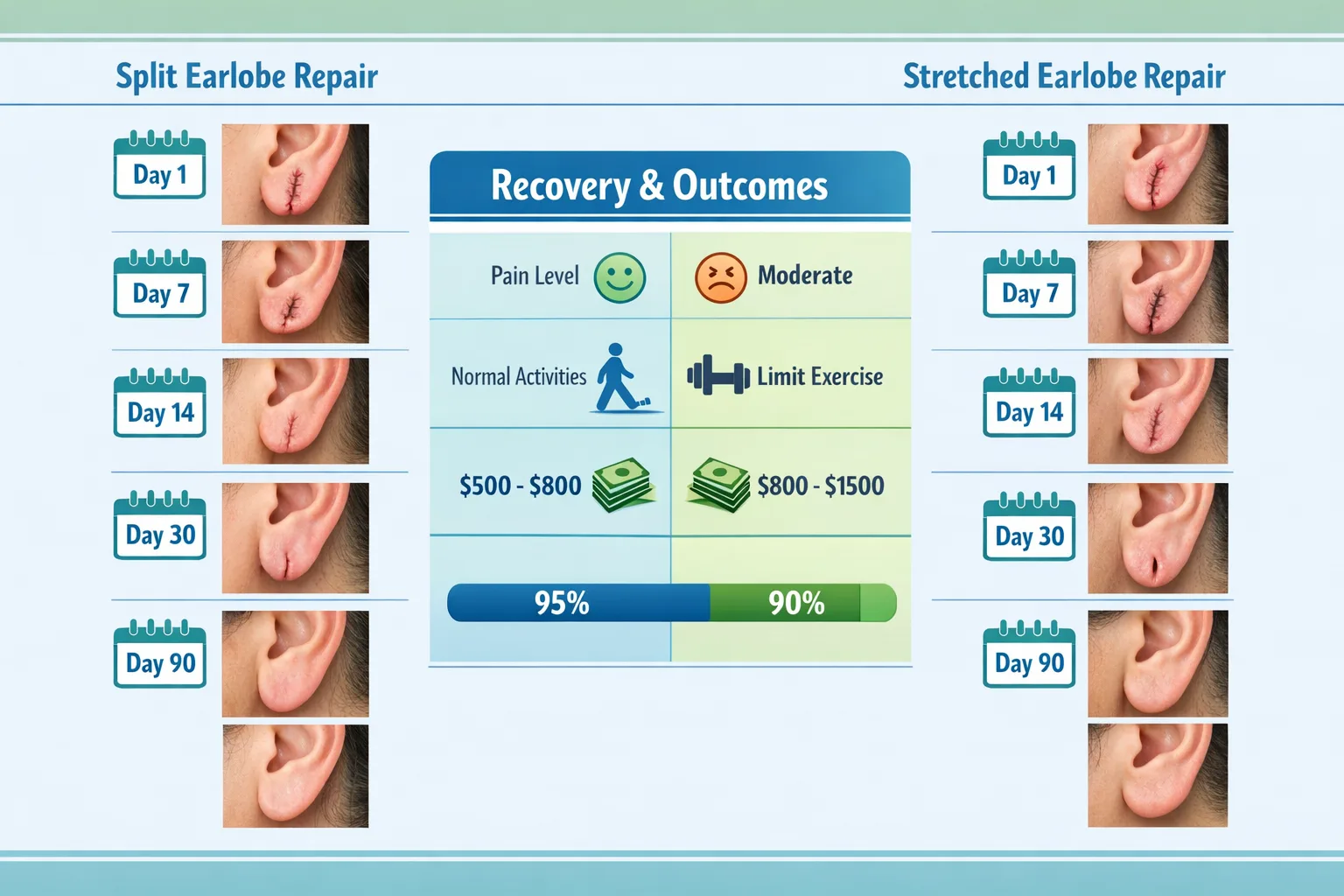
Immediate Post-Operative Period (Days 1-7):
Mild discomfort managed with over-the-counter pain medication
Slight swelling and bruising
Keep the area clean and dry
Avoid touching or manipulating the repair
Sleep with head elevated to reduce swelling
Week 1-2:
Sutures typically removed at 5-7 days
Swelling subsides
Incision line begins to fade
Return to most normal activities
Weeks 2-6:
Continued scar maturation
Gradual softening of the repair site
Avoid trauma to the area
No earrings during this period
6 Weeks and Beyond:
Re-piercing can be considered (typically at 8-12 weeks)
New piercing should be placed away from the scar line
Full healing achieved by 3-6 months
Scar continues to fade over 12-18 months
Activity Restrictions:
Avoid strenuous exercise for 1 week
No swimming for 2 weeks
Avoid contact sports for 4 weeks
No earrings for minimum 6-8 weeks
Stretched Earlobe Reconstruction Recovery
Immediate Post-Operative Period (Days 1-7):
Moderate discomfort (typically more than split repair)
Significant swelling common
Pressure dressing may be applied
Pain medication prescribed
Keep surgical site clean and dry
Week 1-2:
Sutures removed at 7-10 days (sometimes in stages)
Swelling gradually decreases
Bruising may be prominent
Limited activities recommended
Weeks 2-8:
Continued healing and remodeling
Swelling resolves
Scar tissue forms and matures
Gentle massage may be recommended after week 4
8 Weeks and Beyond:
Re-piercing possible at 3-6 months (surgeon's discretion)
Full healing takes 6-12 months
Final cosmetic result visible at 12-18 months
Scar maturation continues
Activity Restrictions:
Avoid strenuous exercise for 2 weeks
No swimming for 3 weeks
Avoid contact sports for 6 weeks
No earrings for minimum 3-6 months
Avoid sleeping on the affected side for 4 weeks
Special Considerations:
Larger reconstructions require longer healing times
Select secure backings (screw-backs or lever-backs)
Remove earrings during high-risk activities
Lifestyle Modifications:
Remove earrings before bed
Take out earrings before contact sports
Be cautious when changing clothes
Keep earrings away from children and pets
Avoid earrings during physical labor
Piercing Care:
Don't pierce too close to the edge of the lobe
Allow adequate tissue margin (at least 5mm from edge)
Ensure proper piercing placement
Choose appropriate jewelry gauge
Warning Signs:
Elongation of the piercing hole
Thinning tissue around the piercing
Discomfort when wearing earrings
Visible stretching or distortion
Expert Tip: "If you notice your piercing hole starting to elongate or the tissue thinning, switch to lighter earrings immediately and give your earlobes a break. Early intervention can prevent a complete split." - Cosmetic Surgeon
Preventing Stretched Earlobe Complications
For those choosing to stretch their earlobes:
Safe Stretching Practices:
Go slowly: Wait at least 4-8 weeks between sizes
Don't skip sizes: Progress gradually through each gauge size
Use proper materials: High-quality surgical steel, titanium, or glass
Keep clean: Maintain excellent hygiene throughout the process
Massage with oil: Use jojoba or vitamin E oil to promote elasticity
Listen to your body: Pain indicates you're moving too fast
Avoiding Blowouts:
Never force larger jewelry
Ensure complete healing between stretches
Use proper stretching techniques (tapers or taping method)
Watch for resistance
Stop immediately if pain occurs
Maintaining Healthy Tissue:
Regular cleaning of jewelry and piercings
Remove jewelry periodically to allow circulation
Massage earlobes to promote blood flow
Proper nutrition supports tissue health
Stay hydrated
Planning for the Future:
Understand the "point of no return" (typically 2-4mm)
Consider long-term implications for professional life
Research thoroughly before starting
Be prepared for permanent changes
Know that surgical reconstruction is an option
Downsizing Safely:
Remove jewelry and allow natural shrinkage
Be patient (can take 6-12 months for maximum shrinkage)
Gradually downsize rather than removing jewelry completely
Massage with oils to promote tissue contraction
Understand that complete closure may not be possible
Choosing the Right Surgeon
Selecting an experienced surgeon is crucial for optimal outcomes in both split earlobe repair and stretched earlobe reconstruction.
Qualifications to Look For
Board Certification:
Plastic surgeon certified by the Royal College of Physicians and Surgeons of Canada
Dermatologist with surgical training
Facial plastic surgeon
Cosmetic surgeon with appropriate credentials
Experience:
Specific experience with earlobe repairs
Portfolio of before-and-after photos
High volume of earlobe procedures
Experience with both split and stretched earlobe repairs
Facility Standards:
Accredited surgical facility
Proper sterile techniques
Emergency equipment available
Trained support staff
Questions to Ask During Consultation
About Experience:
How many earlobe repairs do you perform annually?
Can I see before-and-after photos of similar cases?
What is your complication rate?
Do you have experience with my specific type of earlobe damage?
No, a split earlobe cannot heal back together on its own. Once the tissue has completely torn through, the two separated edges will heal independently, forming scar tissue that prevents them from reconnecting. Surgical intervention is required to rejoin the tissue and restore the earlobe's appearance.
Will stretched earlobes close up naturally?
It depends on the size. Stretched earlobes smaller than approximately 2-4mm (0g to 6g) may shrink significantly or close completely over 6-12 months after removing jewelry. However, stretches larger than this "point of no return" typically will not close fully without surgical reconstruction. The tissue has been permanently remodeled and thinned.
How long after split earlobe repair can I get re-pierced?
Most surgeons recommend waiting at least 8-12 weeks after split earlobe repair before getting re-pierced. This allows complete healing of the surgical repair. The new piercing should be placed in a different location than the original piercing, away from the scar line, to prevent re-tearing.
How long after stretched earlobe reconstruction can I get re-pierced?
For stretched earlobe reconstruction, the waiting period is longer—typically 3-6 months. This extended timeframe allows the reconstructed tissue to fully heal and strengthen. Your surgeon will assess the healing progress before approving re-piercing.
Is earlobe repair painful?
Both split earlobe repair and stretched earlobe reconstruction are performed under local anesthesia, so you won't feel pain during the procedure. Afterward, most patients experience mild to moderate discomfort that is easily managed with over-the-counter pain medication. Stretched earlobe reconstruction may cause slightly more discomfort due to the more extensive tissue work involved.
Will my insurance cover earlobe repair?
In most cases, no. Both split earlobe repair and stretched earlobe reconstruction are typically considered cosmetic procedures and are not covered by provincial health insurance in Canada. However, if a split earlobe resulted from a traumatic injury requiring emergency care, there may be some coverage. Check with your insurance provider for specific policy details.
Can I prevent my gauged ears from needing surgery?
If you're currently stretching your ears and want to avoid future surgery, stay below the "point of no return" (approximately 2-4mm or 0g-6g). Stretch slowly, use proper techniques, and maintain healthy tissue. If you decide to downsize, remove jewelry and allow natural shrinkage to occur. However, individual results vary based on genetics and tissue quality.
What are the risks of earlobe repair surgery?
Both procedures are generally very safe, but potential risks include:
Infection (rare with proper care)
Bleeding or hematoma
Poor wound healing
Asymmetry
Visible scarring
Keloid formation (in susceptible individuals)
Recurrent splitting (if re-pierced improperly)
Need for revision surgery
Choosing an experienced surgeon and following aftercare instructions minimizes these risks.
Can both earlobes be repaired at the same time?
Yes, both earlobes can be repaired during the same surgical session. This is actually common and can be more convenient for patients. However, it means both ears will be healing simultaneously, which may affect sleeping positions and daily activities. Discuss the pros and cons with your surgeon.
How visible will the scar be?
Scar visibility depends on several factors:
Split earlobe repair: Typically results in a fine line scar that fades significantly over 12-18 months. From normal viewing distance, the scar is usually barely noticeable.
Stretched earlobe reconstruction: Generally produces more visible scarring due to the extent of tissue removal and reconstruction. However, with proper technique and healing, scars typically fade to thin lines that are acceptable to most patients.
Individual factors like skin type, genetics, and tendency toward keloid formation also affect scarring.
Alternative and Complementary Treatments
Non-Surgical Options for Small Stretches
For individuals with small stretched earlobes (under 2-4mm) who want to downsize:
Natural Shrinkage:
Remove all jewelry
Allow 6-12 months for maximum shrinkage
Massage with vitamin E or jojoba oil
Be patient—results vary by individual
May not achieve complete closure
Dermal Fillers:
Temporary solution to fill small stretched openings
Hyaluronic acid fillers injected around the opening
Results last 6-12 months
Requires repeated treatments
Not a permanent solution
Best for very small stretches
Tissue Stimulation:
Microneedling around the stretched area
May promote some tissue tightening
Limited effectiveness
Requires multiple sessions
Best combined with other approaches
Scar Management Treatments
After surgical repair, additional treatments can improve scar appearance:
Silicone Products:
Silicone gel or sheeting
Applied after suture removal
Helps flatten and fade scars
Use for 3-6 months
Over-the-counter availability
Laser Therapy:
Pulsed dye laser for red scars
Fractional laser for texture improvement
Multiple sessions typically needed
Performed after initial healing (3-6 months post-surgery)
Can significantly improve scar appearance
Steroid Injections:
For raised or hypertrophic scars
Reduces scar thickness
Multiple injections may be needed
Administered by a physician
Pressure Therapy:
Compression earrings or devices
May help prevent excessive scarring
Used during healing phase
Limited evidence for effectiveness
Patients interested in advanced treatment options should consult with their surgeon about complementary therapies.
Living with Repaired Earlobes
Long-Term Care
After successful earlobe repair, long-term care ensures lasting results:
Protecting Your Repair:
Choose lightweight earrings
Avoid heavy, dangling styles for extended wear
Remove earrings during sleep and physical activity
Be cautious when changing clothes
Select secure earring backs
Re-Piercing Considerations:
Wait the full recommended time before re-piercing
Choose an experienced piercer familiar with repaired earlobes
Pierce in a new location, away from the scar
Consider using smaller gauge jewelry
Be extra cautious with the new piercing
Monitoring for Issues:
Watch for signs of stretching or thinning
Check for discomfort when wearing earrings
Notice any changes in the repair site
Seek evaluation if concerns arise
Psychological and Social Aspects
Both split and stretched earlobes can have psychological impacts:
Before Repair:
Self-consciousness about appearance
Limitation in earring choices
Professional concerns
Social stigma (particularly with large gauges)
Impact on self-esteem
After Repair:
Restored confidence
Expanded jewelry options
Improved professional appearance
Positive psychological outcomes
High satisfaction rates
Support and Resources:
Online communities for those who have had repairs
Before-and-after galleries for realistic expectations
Counseling if body image concerns persist
Support groups for body modification regret
The Future of Earlobe Repair
Emerging Techniques and Technologies
The field of earlobe repair continues to evolve:
Advanced Suturing Techniques:
Finer suture materials for less visible scars
Improved closure methods for better outcomes
Layered approaches for stronger repairs
Regenerative Medicine:
Platelet-rich plasma (PRP) to enhance healing
Growth factors to improve tissue quality
Stem cell research for tissue regeneration
Laser-Assisted Procedures:
Laser technology to improve precision
Reduced bleeding and faster healing
Better scar outcomes
3D Imaging:
Computer modeling for surgical planning
Predictive outcomes visualization
Enhanced symmetry achievement
Bioengineered Materials:
Tissue scaffolds for large defects
Biocompatible materials to support healing
Reduced scarring potential
Research and Development
Ongoing research focuses on:
Understanding tissue remodeling in stretched earlobes
Identifying factors that predict healing outcomes
Developing less invasive techniques
Improving scar prevention and treatment
Creating standardized protocols for optimal results
As medical technology advances, outcomes for both split earlobe repair and stretched earlobe reconstruction will continue to improve, offering patients even better cosmetic results with minimal scarring.
Understanding the split earlobe vs stretched earlobe from gauges distinction is essential for anyone facing these conditions. While both affect the earlobe's appearance and function, they arise from different causes—traumatic injury versus intentional modification—and require different surgical approaches for optimal repair.
Split earlobes result from sudden tears and typically involve simpler repair procedures with excellent cosmetic outcomes. The surgery is straightforward, recovery is relatively quick, and most patients achieve natural-looking results with minimal scarring.
Stretched earlobes from gauges develop gradually through intentional expansion and often require more complex reconstruction, especially when stretched beyond the "point of no return" of 2-4mm. While the surgery is more involved and recovery takes longer, experienced surgeons can achieve excellent results that restore the earlobe's natural appearance.
Both conditions are highly treatable, and modern surgical techniques offer outstanding success rates. The key to optimal outcomes lies in:
✅ Choosing an experienced, qualified surgeon with specific expertise in earlobe repairs ✅ Having realistic expectations about results and recovery ✅ Following aftercare instructions meticulously ✅ Being patient with the healing process ✅ Protecting repaired earlobes from future damage
Next Steps
If you're dealing with a split earlobe or stretched earlobe from gauges:
Schedule a consultation with a qualified plastic surgeon or dermatologist experienced in earlobe repairs
Ask questions about the specific technique recommended for your situation
Review before-and-after photos of similar cases
Understand the costs and payment options
Plan for recovery time and arrange necessary support
Commit to following all pre- and post-operative instructions
Be patient with healing and scar maturation
Remember that earlobe repair is a common, safe procedure with high patient satisfaction rates. Whether you're addressing an accidental tear or choosing to reverse a body modification, skilled surgeons can help you achieve the natural-looking earlobes you desire.
For expert evaluation and treatment of earlobe concerns, consider consulting with specialized professionals who understand the nuances of both split earlobe repair and stretched earlobe reconstruction. With the right care and expertise, you can look forward to restored earlobes that allow you to wear the jewelry you love with confidence.
References
[1] Blanco-Dávila F, Vázquez-García B. "Surgical Repair of Torn Earlobes: A Review of Techniques." Aesthetic Plastic Surgery. 2018;42(4):1143-1149.
[2] Kalimuthu R, Thamburaj R. "Patient Satisfaction Following Split Earlobe Repair: A 5-Year Retrospective Study." Journal of Cutaneous and Aesthetic Surgery. 2019;12(2):98-102.
[3] Liang MD, Narayanan K. "Earlobe Reconstruction After Gauge Stretching: Outcomes and Techniques." Plastic and Reconstructive Surgery. 2020;145(3):567-575.
[4] Watson D, Wixtrom RN. "Long-term Outcomes of Earlobe Reconstruction Following Intentional Gauge Stretching." JAMA Facial Plastic Surgery. 2021;23(4):289-294.