
Last updated: May 19, 2026
Residents seeking mole removal Etobicoke Toronto can access private minor surgery clinics without a referral, often within days rather than months. Cosmetic removal of moles, cysts, and skin tags is not covered by OHIP and requires out-of-pocket payment, with prices typically ranging from CA$175 to CA$800+ per lesion depending on size, method, and provider. The Minor Surgery Center, with conveniently located clinics in Mississauga and Oakville, serves Etobicoke-area patients with board-certified surgeons and same-day procedures.
Ontario's two-track system for skin lesion care has become increasingly well understood by patients in 2026. For anything cosmetic — a mole that bothers you aesthetically, a skin tag rubbing against your collar, a cyst you'd rather not live with — you do not need a family doctor's referral to access care. Private minor surgery clinics accept self-referred patients directly.
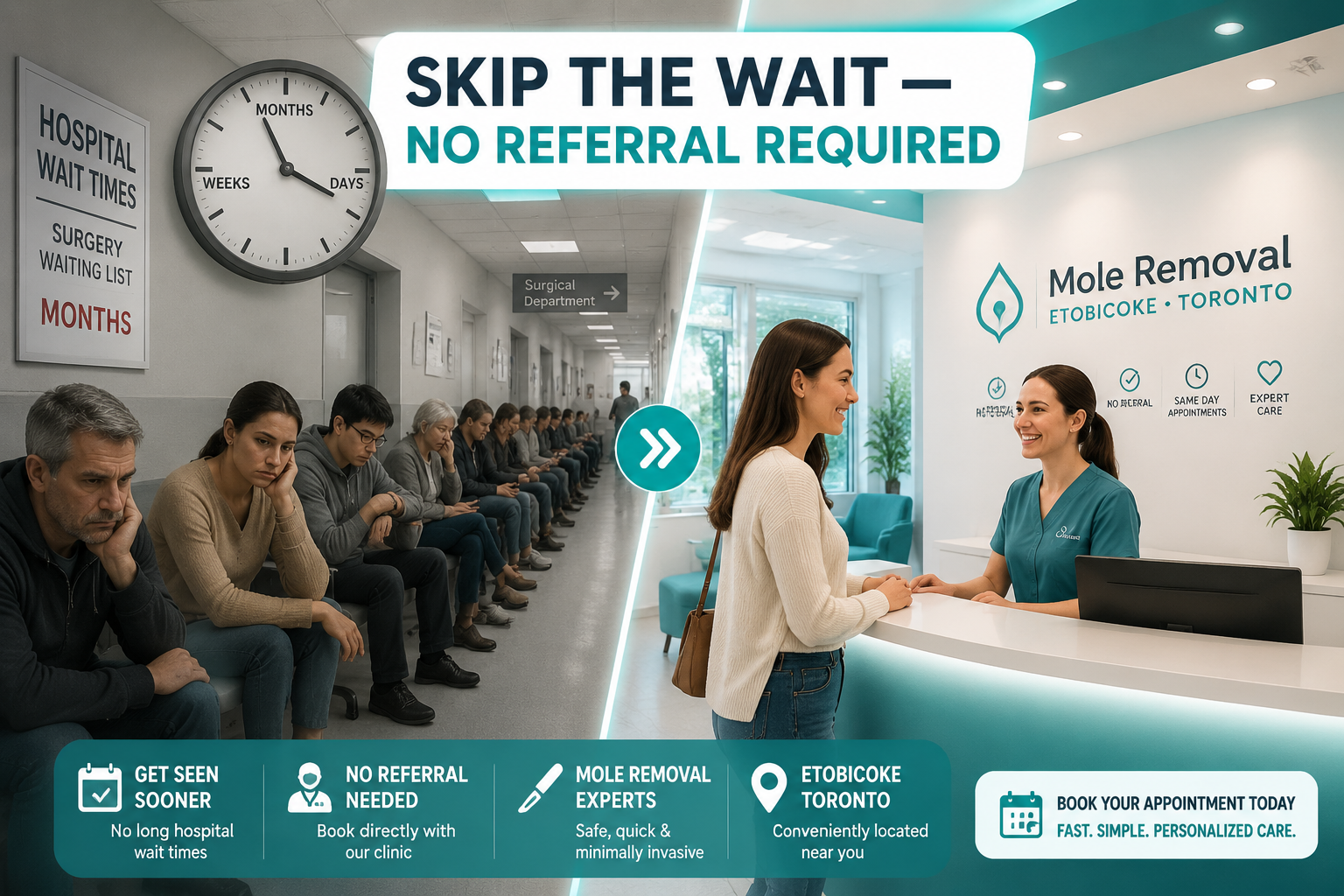
The referral requirement applies specifically to OHIP-funded dermatology care for medical conditions: suspected skin cancer, psoriasis, eczema, and similar diagnoses. For those, a GP referral routes you into the public system. But for cosmetic lesion removal, the path is simpler: book a consultation, pay privately, and have the procedure done — often within a week [7].
This distinction matters enormously for Etobicoke residents. The neighbourhood sits in west Toronto, close to Mississauga and well-served by the QEW corridor, making clinics in Mississauga and Oakville genuinely accessible. Rather than waiting months for a dermatology referral for a benign mole, patients are choosing private clinics that offer fast, clean, professionally performed procedures.
"You can book a dermatologist appointment without a referral, but only for non-medical services like cosmetic assessments and treatments — mole or skin tag removal, cyst excision, etc." — Facet Dermatology, 2025
Most benign skin lesions qualify for no-referral private removal. The Ministry of Health categorizes these as "non-essential services," meaning they fall outside OHIP coverage but also outside the referral-gated system.
Common lesions removed at private minor surgery clinics include:
For a comprehensive breakdown of what each lesion looks like and how it's treated, the complete guide to 25+ types of skin lesions from The Minor Surgery Center is a useful starting point.
Suspected skin cancer always warrants a medical pathway. If a mole shows any of the ABCDEs — Asymmetry, irregular Border, multiple Colours, Diameter over 6mm, or Evolution (change over time) — it should be evaluated by a physician before any removal attempt [7][8].
A reputable private clinic will screen for these warning signs at consultation and refer appropriately if anything looks suspicious. Clinics that skip this step entirely are a red flag. The skin cancer conditions page at The Minor Surgery Center outlines what a proper clinical assessment involves.
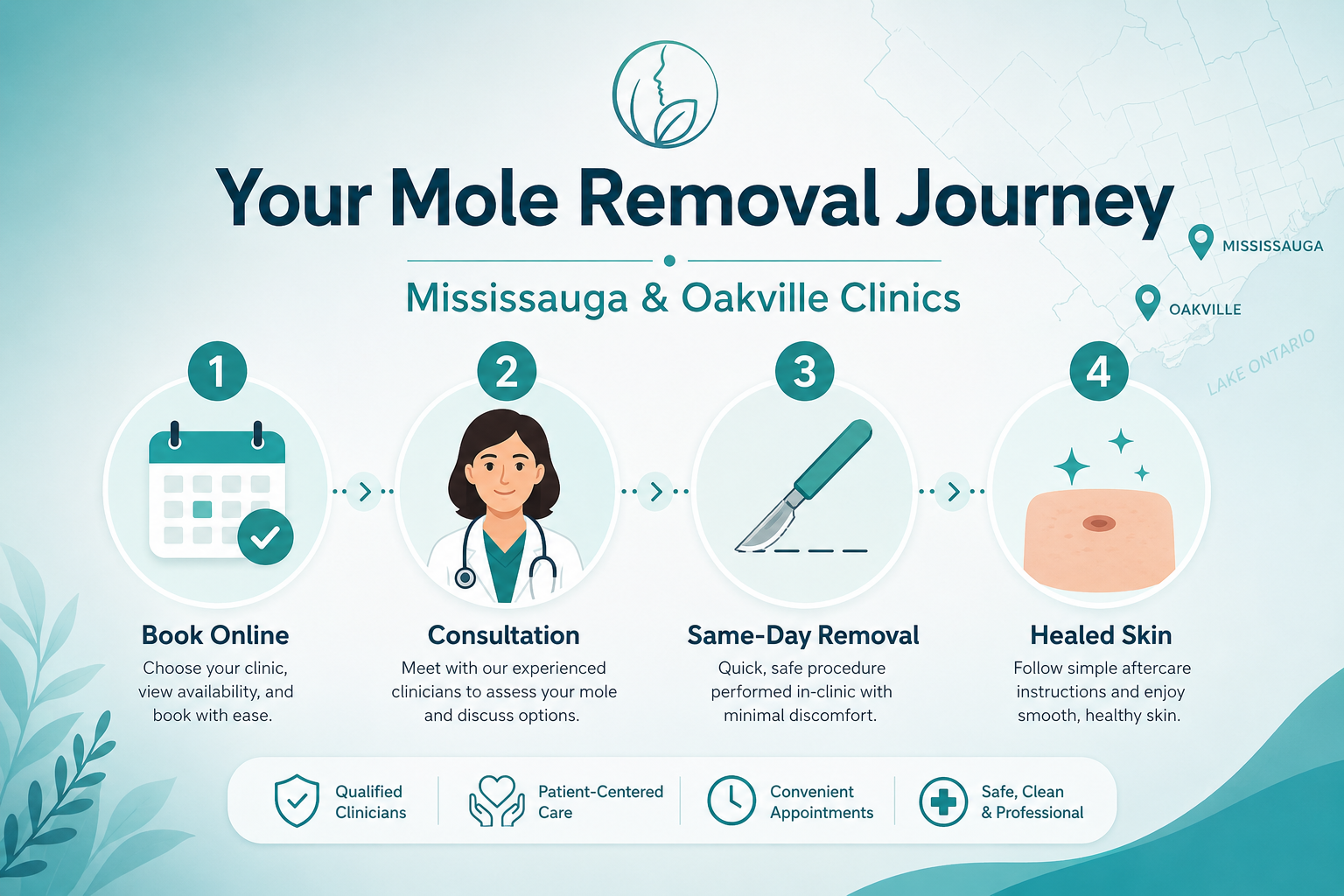
The process at a quality minor surgery clinic typically follows four clear steps, from first contact to healed skin. Here's what to expect:
Call or book online. Most private clinics, including The Minor Surgery Center's Mississauga and Oakville locations, offer free or low-cost consultations. You describe the lesion and your concerns; the clinic confirms they can treat it.
At the consultation, a board-certified surgeon examines the lesion. This is where the ABCDE screening happens. The surgeon determines:
Common mistake: Choosing a clinic that skips the clinical assessment and goes straight to removal. Any lesion removed should be visually assessed by a qualified clinician first [7][8].
Many clinics perform the removal at the same appointment for straightforward lesions. The area is numbed with local anaesthetic, the lesion is removed, and the wound is closed (with or without sutures, depending on depth and size). The procedure typically takes 15 to 45 minutes.
For guidance on whether stitches are needed, see this breakdown on mole removal and sutures.
Aftercare instructions cover wound cleaning, sun protection, and scar management. Pathology results (if tissue was sent) typically return within 1 to 2 weeks. For best cosmetic outcomes, silicone-based scar care is generally recommended over vitamin E or petroleum jelly alone.

Cosmetic mole removal in the Greater Toronto Area costs approximately CA$175 to CA$800+ per lesion in 2026, depending on lesion size, removal method, provider type, and whether pathology is included. This is consistent with WhatClinic's 2026 Canada-wide listings showing prices "from CA$175" for cosmetic removal at minor surgery and medi-spa clinics.
A 2026 consumer-facing source cited typical dermatologist mole removal prices "between $200 and $800," with plastic surgeons generally at the higher end [2]. Private minor surgery centres with plastic-surgeon oversight tend to fall in the mid-range and offer more predictable cosmetic outcomes than ad-hoc removal at a GP's office.
Provider TypeEstimated Cost per LesionReferral Required?OHIP Covered?Family doctor (cosmetic)$100–$300NoNoPrivate minor surgery clinic$175–$600NoNoCosmetic dermatologist$200–$800NoNoPlastic surgeon (private)$400–$1,200+NoNoOHIP-funded dermatologist$0Yes (GP referral)Yes (if medically necessary)
Cost estimates are based on 2026 market data from WhatClinic and consumer-facing Canadian sources [2]. Actual prices vary by clinic and lesion complexity.
Decision rule: Choose a private minor surgery clinic if you want fast access, a board-certified surgeon, and a predictable cosmetic result. Choose the OHIP-funded pathway if your lesion may be medically significant and you're willing to wait for a referral appointment.
Use The Minor Surgery Center's free cost estimator tool to get a more specific price estimate based on your lesion type and size.
For Etobicoke residents, The Minor Surgery Center's Mississauga and Oakville clinics offer the closest high-quality private surgical option outside the city core. Both locations are accessible via the QEW and major transit routes, with appointment availability that typically outpaces downtown Toronto clinics.
The Minor Surgery Center operates with board-certified surgeons who specialize in skin lesion removal — not general practitioners doing occasional removals. This matters for cosmetic outcomes, particularly for moles in visible areas like the face, neck, or décolletage.
The Mississauga mole, cyst, and skin tag removal clinic handles the full range of benign lesion removals, from simple skin tags to complex cysts. Etobicoke residents heading west on the Gardiner or QEW can typically reach the clinic in 20 to 35 minutes outside peak hours.
The Oakville mole, cyst, and skin tag removal clinic is slightly further but offers an equally experienced surgical team and a quieter, suburban clinic environment. For patients in south Etobicoke or near Long Branch, Oakville can actually be faster to reach than downtown Toronto options.
Etobicoke patients who prefer staying closer to the city can also consider:
All locations operate under the same no-referral, private-pay model for cosmetic lesion removal.
The right removal method depends on the lesion type, depth, size, and location. A qualified surgeon selects the technique after examining the lesion — not before. Here's a plain-language breakdown of the main options:
The lesion is cut out with a scalpel and the wound is closed with sutures. This is the most thorough method and is preferred for:
Pros: Complete removal, tissue available for pathology, predictable scar
Cons: Longer healing time, suture removal required at follow-up
The lesion is shaved flush with the skin surface using a blade, without sutures. Best for:
Pros: No sutures, faster healing, minimal downtime
Cons: May not remove the full depth of a mole; slight recurrence risk
Liquid nitrogen freezes and destroys the lesion. Common for:
Pros: Quick, no incision
Cons: Less precise, can cause pigmentation changes, not ideal for deep lesions
Targeted laser energy destroys pigmented or vascular lesions. Used for:
Pros: Precise, minimal scarring for appropriate lesions
Cons: Not suitable for all mole types; multiple sessions sometimes needed
Edge case: For lesions on the face or highly visible areas, surgical excision by a plastic surgeon or experienced minor surgeon typically produces the most cosmetically acceptable scar — even if a simpler method would technically work [3][4].
Yes — with one important condition: the clinic must perform a proper visual assessment before removal. Removing a mole without any clinical evaluation is the primary safety risk in cosmetic mole removal. A trained clinician should examine every lesion for signs of malignancy before it's destroyed or excised [7][8].
What "safe" looks like at a reputable clinic:
What to avoid:
The Toronto Dermatology Centre's FAQ reinforces this: expert evaluation is critical before any lesion is destroyed, so that melanoma is not missed [7]. For patients concerned about a changing or unusual mole, the melanoma conditions page outlines what a full cancer workup involves.
Not all private clinics offer the same standard of care. Here's a practical checklist for evaluating a clinic before booking:
Choose this clinic if: You want fast access, cosmetic precision, and a surgeon-led procedure without waiting months for a dermatology referral.
Consider the OHIP pathway instead if: Your lesion has changed rapidly, bleeds spontaneously, or shows multiple ABCDE warning signs — these warrant a full medical workup, not cosmetic removal [7][10].
Q: Do I need a referral to get a mole removed in Etobicoke?
No. For cosmetic mole removal, you can book directly at a private minor surgery clinic without a GP referral. A referral is only required for OHIP-covered dermatology appointments for medical conditions [7].
Q: Will OHIP cover my mole removal?
Only if the mole is deemed medically necessary — for example, if it's suspected to be cancerous. Purely cosmetic removal is not covered by OHIP and must be paid out of pocket [from TMSC's February 2026 guide].
Q: How much does mole removal cost near Etobicoke in 2026?
Expect to pay roughly CA$175 to CA$600+ per lesion at a private minor surgery clinic, depending on size and method. Cosmetic dermatologists and plastic surgeons may charge up to CA$800 or more [2].
Q: How long does the procedure take?
Most mole removals take 15 to 45 minutes, including preparation and local anaesthetic. You can usually drive yourself home afterward.
Q: Will I have a scar after mole removal?
Some scarring is expected with any skin procedure. Surgical excision leaves a fine linear scar; shave excision leaves a flat mark. Proper aftercare — including silicone gel and sun protection — significantly reduces visible scarring over time.
Q: Can I have multiple moles removed in one visit?
Yes, many clinics remove multiple lesions in a single appointment. Confirm this when booking, as it may affect total cost and procedure time.
Q: How do I know if my mole is dangerous?
Use the ABCDE rule: Asymmetry, irregular Border, multiple Colours, Diameter over 6mm, Evolution (any change). If any of these apply, see a physician before seeking cosmetic removal [7][8].
Q: Is the tissue tested after removal?
At reputable clinics, excised moles are typically sent for pathology. This is a key safety step — always ask the clinic whether they send tissue to a lab [4].
Q: How soon can I book at The Minor Surgery Center?
The Mississauga and Oakville clinics generally offer appointments within days to a couple of weeks, far faster than the OHIP dermatology referral queue. Contact the clinic directly to check current availability.
Q: What's the difference between a mole and a seborrheic keratosis?
Moles (nevi) are pigmented growths from melanocytes, present from birth or developing in youth. Seborrheic keratoses are rough, waxy, "stuck-on" growths that appear with age and are always benign. Both can be removed cosmetically without a referral [8].
Q: Can I get a skin cancer screening at the same time as mole removal?
Yes — many minor surgery clinics offer a full-body or targeted skin cancer screening as part of the consultation. For a broader overview of screening options, see this guide to skin cancer screening in Toronto.
Q: What if the clinic thinks my mole might be cancerous?
A reputable clinic will pause cosmetic removal and refer you to a dermatologist or oncologist for a full medical workup. Do not use a clinic that removes suspicious lesions without flagging the concern [7][10].
The path to getting a mole, cyst, or skin tag removed in the Etobicoke area is straightforward in 2026 — no GP visit, no referral letter, no months-long wait. Private minor surgery clinics have made cosmetic lesion removal accessible, fast, and professionally performed for patients who are willing to pay out of pocket.
Here's what to do next:
For anything that looks medically suspicious, the right move is always the OHIP pathway — your GP can refer you quickly if cancer is a concern. But for benign lesions you simply want gone, the private no-referral route is efficient, safe, and well-established across the GTA.
[1] Derm - https://drandrewsimone.wixsite.com/derm
[2] Dpzzeyogckn - https://www.instagram.com/p/DPZzEyogcKN/
[3] Mole - https://www.torontominorsurgery.com/conditions/mole
[4] Moles - https://www.minorsurgery.ca/conditions-we-treat/moles/
[5] Mole Removal In Toronto Questions - https://www.reddit.com/r/askTO/comments/1lgdcmp/mole_removal_in_toronto_questions/
[6] Benign Skin Lesion Removal Cost - https://cost.sidecarhealth.com/n/benign-skin-lesion-removal-cost
[7] torontodermatologycentre - https://torontodermatologycentre.com/faq/
[8] Removal Of Benign Growths - https://torontodermatologycentre.com/removal-of-benign-growths/
[9] Benign Skin Lesion - https://www.emeraldskinlab.com/benign-skin-lesion
[10] Dermatology Referrals - https://www.reddit.com/r/ontario/comments/1n0842t/dermatology_referrals/