

Last updated: June 24, 2026
Skin cancer on the lip is most commonly squamous cell carcinoma, accounting for over 90% of lip cancer cases, and it typically appears on the lower lip as a non-healing sore, white patch, or firm lump. [1] It is caused primarily by cumulative UV exposure and tobacco use. When caught early and confined to the lip, the 5-year survival rate exceeds 94%. [2] Any persistent change on the lip lasting more than two to three weeks warrants prompt evaluation by a physician or dermatologist.
Skin cancer on the lip develops when DNA damage in lip cells causes them to grow abnormally. The most significant driver is cumulative ultraviolet (UV) radiation exposure, which is why the lower lip — more directly exposed to the sun — is the site of roughly 88–95% of all lip cancers. [1]
Primary risk factors include:
Common mistake: Many people assume lip balm with no SPF provides sun protection. Standard lip balm without an SPF rating offers no UV defense. Choose a lip product with SPF 30 or higher.
Men are diagnosed with lip cancer at significantly higher rates than women, partly due to historically higher rates of tobacco use and greater occupational sun exposure. [1] The risk increases with age, with most diagnoses occurring after age 50. [7]
Highest-risk profile:
People with any combination of these factors should be especially vigilant about lip changes and should discuss regular skin checks with their physician. For those in the Toronto area, a skin cancer clinic offering rapid access without a referral can be a practical starting point.

Skin cancer on the lip does not always look dramatic in its early stages, which is why it is frequently mistaken for a cold sore, chapped skin, or a minor injury. The appearance varies by cancer type and stage.
Common visual signs by type:
Cancer TypeTypical Appearance on LipSquamous cell carcinomaFlat or raised scaly patch, non-healing ulcer, firm lump, crustingBasal cell carcinomaPearly or waxy bump, rolled border, may bleed easilyMelanomaDark or multicolored irregular patch, may extend onto surrounding skinActinic keratosis (precancerous)Rough, scaly, or dry patch; may feel sandpaper-like
Key visual warning signs:
For a broader look at how early-stage skin cancers appear across the body, the early-stage skin cancer visual guide provides helpful reference images and descriptions.
Early lip cancer often causes few or no symptoms beyond a visible change on the lip surface. This is both a challenge and an opportunity: because the lips are visible and easy to self-examine, early detection is more achievable than with cancers on hidden body surfaces. [6]
Early symptoms to watch for:
Later-stage symptoms may include difficulty eating, speaking, or moving the lips; swollen lymph nodes in the neck; and significant pain. [3]
If any of these signs are present for more than two to three weeks, do not wait. Early detection is the single most powerful factor in improving outcomes. Understanding whether skin cancer hurts can also help people recognize that painlessness does not mean a lesion is safe.
Most spots on the lip are not cancer. Cold sores (herpes simplex virus), canker sores, chapped lips, and minor trauma account for the vast majority of lip changes. However, there are clear distinguishing features that can help differentiate a benign lesion from a potentially cancerous one.
Comparison: Cancer vs. Common Benign Causes
FeatureLikely BenignPossible CancerDurationResolves within 1–2 weeksPersists beyond 3 weeksPainOften painful (cold sore, canker)Often painless, especially earlyAppearanceFluid-filled blister, shallow ulcerFirm lump, raised edge, white/red patchResponse to treatmentImproves with antiviral or OTC careDoes not respond to standard treatmentRecurrenceRecurs in same pattern (cold sores)New, unusual, or changing lesion
Decision rule: If a spot on the lip is painless, firm, does not blister, and has not resolved after three weeks despite basic care, treat it as suspicious until a clinician says otherwise. Do not self-diagnose.
For related context on oral growths that may appear similar, the article on understanding oral growths and skin tags under the tongue covers benign oral lesions in detail.
Lip cancer shares the same cellular origins as other skin cancers but has several clinically important differences. The lip sits at the junction of skin and mucous membrane (the vermilion border), which gives it unique biological behavior and exposure patterns. [1]
Key differences:
For a detailed breakdown of how squamous cell carcinoma compares to basal cell carcinoma in general, see the BCC vs. SCC comparison guide.
Yes, melanoma can develop on the lip, though it is far less common than squamous cell carcinoma. Lip melanoma accounts for a small minority of lip cancers overall, but it is disproportionately serious because it tends to be diagnosed at a later stage and has a higher metastatic potential. [1]
Melanoma on the lip typically appears as a dark, irregularly bordered patch or nodule. It may be brown, black, or even pink if it is an amelanotic (non-pigmented) variant. The ABCDE criteria used for moles apply here: Asymmetry, Border irregularity, Color variation, Diameter over 6mm, and Evolution (change over time).
For anyone with a dark or changing spot on the lip, prompt evaluation is critical. The guide to melanoma moles versus benign moles explains how clinicians differentiate the two.
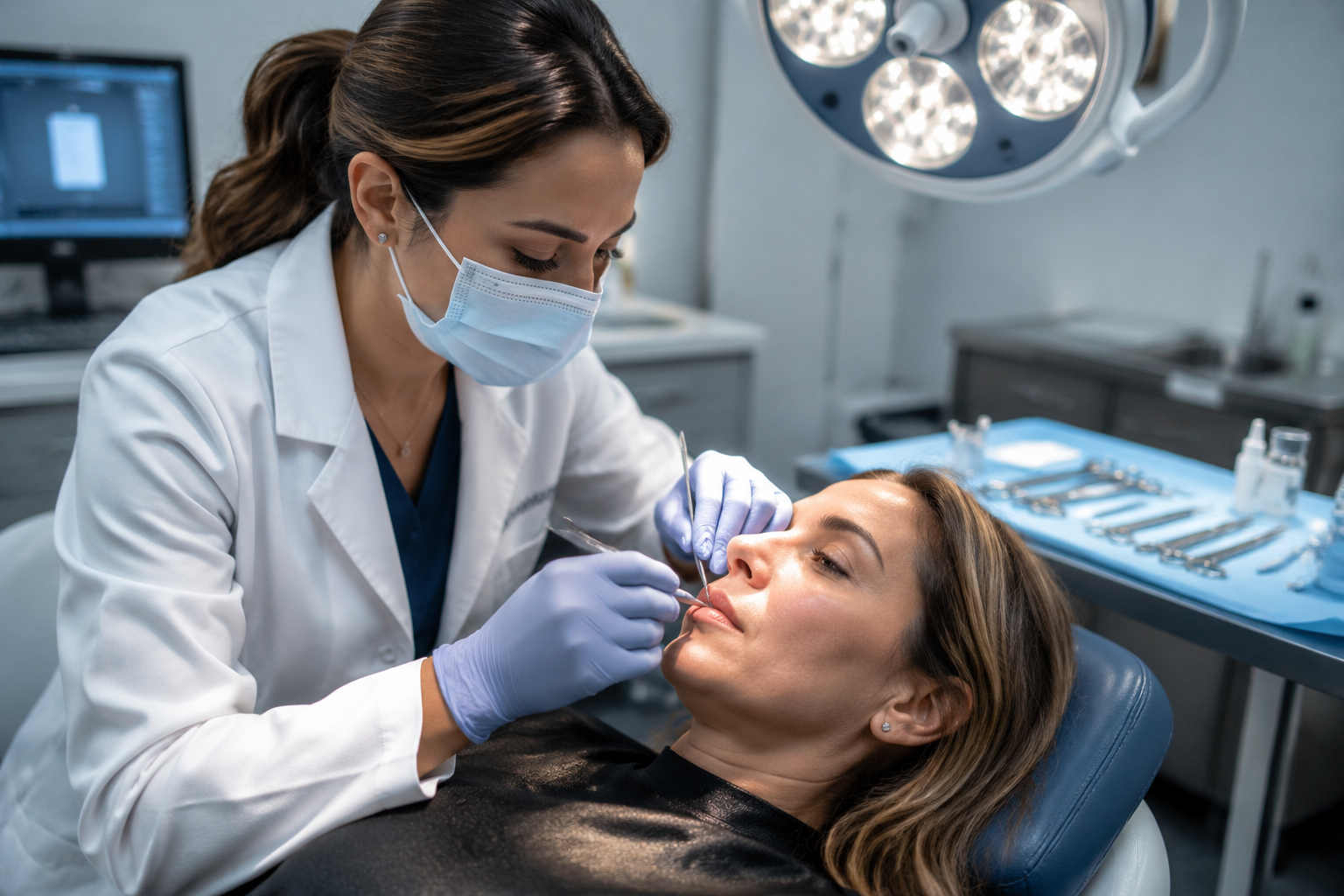
Diagnosis of skin cancer on the lip begins with a clinical examination and is confirmed by biopsy. No amount of visual inspection alone is sufficient to diagnose cancer definitively. [8]
Diagnostic steps:
Edge case: Actinic cheilitis (chronic sun damage to the lip) is a precancerous condition that can look like dry, scaly lips. It requires biopsy to determine whether dysplasia (abnormal cell changes) is present, because it can progress to squamous cell carcinoma if untreated. [3]
Treatment for skin cancer on the lip depends on the cancer type, size, location, and stage. Most early-stage lip cancers are treated surgically, with excellent outcomes. [8]
Main treatment options:
Choose surgical excision if: The lesion is small (under 2 cm), well-defined, and located where adequate margins can be achieved without major functional compromise.
Choose radiation if: The patient cannot undergo surgery, the tumor involves critical structures, or surgery would result in significant loss of lip function.
For context on what recovery looks like after removal of a skin cancer lesion, the basal cell carcinoma recovery guide outlines what patients can expect post-procedure.
Lip cancer is generally more serious than basal cell carcinoma found elsewhere on the body, but comparable in seriousness to squamous cell carcinoma at other high-risk sites. The location creates specific challenges: functional impact, proximity to lymph nodes, and the risk of spread to the oral cavity. [6]
Survival data by stage (SEER database): [2]
The overall 5-year survival rate across all stages is approximately 90.3%. [2] These numbers underscore why early detection matters so much: a person diagnosed at the localized stage has roughly twice the survival probability of someone diagnosed at the regional stage.
What makes lip cancer uniquely serious:
Treatment costs vary significantly depending on the stage at diagnosis, the treatment modality, geographic location, and whether the patient has insurance coverage.
General cost ranges (estimates for Canada/US, 2026):
Important note: These figures are general estimates. Actual costs depend on individual clinical circumstances, provincial coverage rules, and the specific facility. Patients should contact their provincial health authority and the treating clinic directly for accurate cost information. In Ontario, medically necessary cancer treatment is covered under OHIP.
Lip cancer is one of the more preventable skin cancers because its primary causes — UV exposure and tobacco use — are modifiable. [3] No prevention strategy is 100% effective, but consistent habits significantly reduce risk.
Evidence-based prevention strategies:
For broader guidance on how nutrition and lifestyle support skin health, the diet and skin health guide covers evidence-based dietary factors that may reduce skin cancer risk.
For average-risk adults, a full skin examination including the lips should be part of a routine annual check-up with a primary care physician or dermatologist. High-risk individuals — those with a history of skin cancer, precancerous lesions, heavy sun exposure, or tobacco use — should be checked every six months. [7]
Self-examination frequency: Monthly. The lips are easily visible and accessible. Any change that persists beyond two to three weeks should prompt a professional evaluation rather than a "wait and see" approach.
For those in the Greater Toronto Area, the list of top skin cancer screening clinics in Toronto is a practical resource for finding accessible, no-referral screening options.
Untreated skin cancer on the lip will typically grow, invade deeper tissues, and eventually spread to regional lymph nodes and distant organs. The consequences are serious and worsen with each stage of progression. [3]
Progression timeline (general):
There is no stage at which lip cancer becomes "too late to treat," but the complexity, cost, and physical toll of treatment increase dramatically with each stage of progression. Early action is always the better path.
Skin cancer on the lip is a serious but highly treatable condition when identified early. The lower lip is the most common site, squamous cell carcinoma is the most common type, and UV exposure combined with tobacco use accounts for the majority of cases. A 5-year survival rate approaching 95% for localized disease drops sharply once cancer spreads to lymph nodes — which is why the two- to three-week rule matters: any persistent, unexplained change on the lip that does not resolve within that window deserves professional evaluation.
Actionable next steps:
The lip is one of the easiest parts of the body to monitor. Taking two minutes each month to examine it could be the decision that catches cancer at its most curable stage.
Q: Can lip cancer spread to the throat?
Yes. Advanced lip cancer can spread to the oral cavity, oropharynx, and regional lymph nodes in the neck. This is more likely with squamous cell carcinoma that is left untreated or diagnosed at a late stage. [3]
Q: Is the upper lip or lower lip more commonly affected?
The lower lip is affected in the vast majority of cases — roughly 88–95% of lip cancers — because it receives more direct UV exposure than the upper lip. [1]
Q: Can lip cancer come back after treatment?
Yes. Recurrence is possible, particularly if surgical margins were not clear or if the patient continues to use tobacco or has ongoing UV exposure. Regular follow-up appointments after treatment are essential.
Q: Does lip cancer always require surgery?
No. Radiation therapy is an effective primary treatment for some lip cancers, particularly when surgery would cause significant functional loss. The choice depends on tumor size, location, and patient factors. [8]
Q: How long does it take for lip cancer to develop?
Lip cancer typically develops over years, often progressing from chronic sun damage or actinic cheilitis (a precancerous condition) to frank carcinoma. There is no fixed timeline, as progression speed varies by individual factors. [3]
Q: Is lip cancer hereditary?
Lip cancer does not have a strong hereditary component compared to some other cancers. Most cases are driven by environmental factors (UV, tobacco, alcohol) rather than inherited genetic mutations. [7]
Q: Can a dentist detect lip cancer?
Yes. Dentists routinely examine the lips and oral mucosa during check-ups and are often the first clinicians to identify suspicious lesions. Regular dental visits are an underutilized screening opportunity.
Q: What is actinic cheilitis and is it cancer?
Actinic cheilitis is a precancerous condition caused by chronic UV damage to the lip. It is not cancer, but it can progress to squamous cell carcinoma if untreated. It appears as dry, scaly, or cracked lips that do not improve with moisturizer. [3]
Q: Does wearing lipstick protect against lip cancer?
Lipstick provides minimal UV protection unless it contains SPF. Darker, more opaque lipsticks may offer slightly more protection than clear gloss, but SPF-rated lip products are the only reliable option for UV defense.
Q: At what age should I start getting my lips checked?
Adults of any age with risk factors (tobacco use, significant sun exposure, fair skin) should begin regular skin checks. For average-risk individuals, annual skin examinations starting in the mid-30s to 40s are a reasonable baseline.
[1] Lip Cancer - https://www.hopkinsmedicine.org/health/conditions-and-diseases/lip-cancer
[2] SEER Cancer Statistics: Lip Cancer - https://seer.cancer.gov/statfacts/html/lip.html
[3] Mayo Clinic: Lip Cancer Symptoms and Causes - https://www.mayoclinic.org/diseases-conditions/lip-cancer/symptoms-causes/syc-20355079
[4] PubMed: Lip Cancer Research - https://pubmed.ncbi.nlm.nih.gov/41420349/
[5] ResearchGate: Subcutaneous Tissue Pedicle Flap for Lower Lip Reconstruction - https://www.researchgate.net/publication/400593434_Application_of_a_subcutaneous_tissue_pedicle_flap_combined_with_a_labial_mucosa_flap_for_reconstruction_of_full-thickness_lower_lip_defects_a_prospective_observational_study
[6] Cancer Treatment Centers of America: Lip Cancer - https://www.cancercenter.com/cancer-types/oral-cancer/types/lip-cancer
[7] WebMD: Lip Cancer - https://www.webmd.com/cancer/lip-cancer
[8] Mayo Clinic: Lip Cancer Diagnosis and Treatment - https://www.mayoclinic.org/diseases-conditions/lip-cancer/diagnosis-treatment/drc-20355080