
Last updated: June 24, 2026
Skin cancer on the arm is one of the most common locations for skin cancer to develop because arms receive frequent, cumulative sun exposure throughout a person's lifetime. The three main types — basal cell carcinoma, squamous cell carcinoma, and melanoma — each look different and carry different levels of risk. When caught early, the cure rate for arm skin cancer is very high, often exceeding 95% for non-melanoma types.
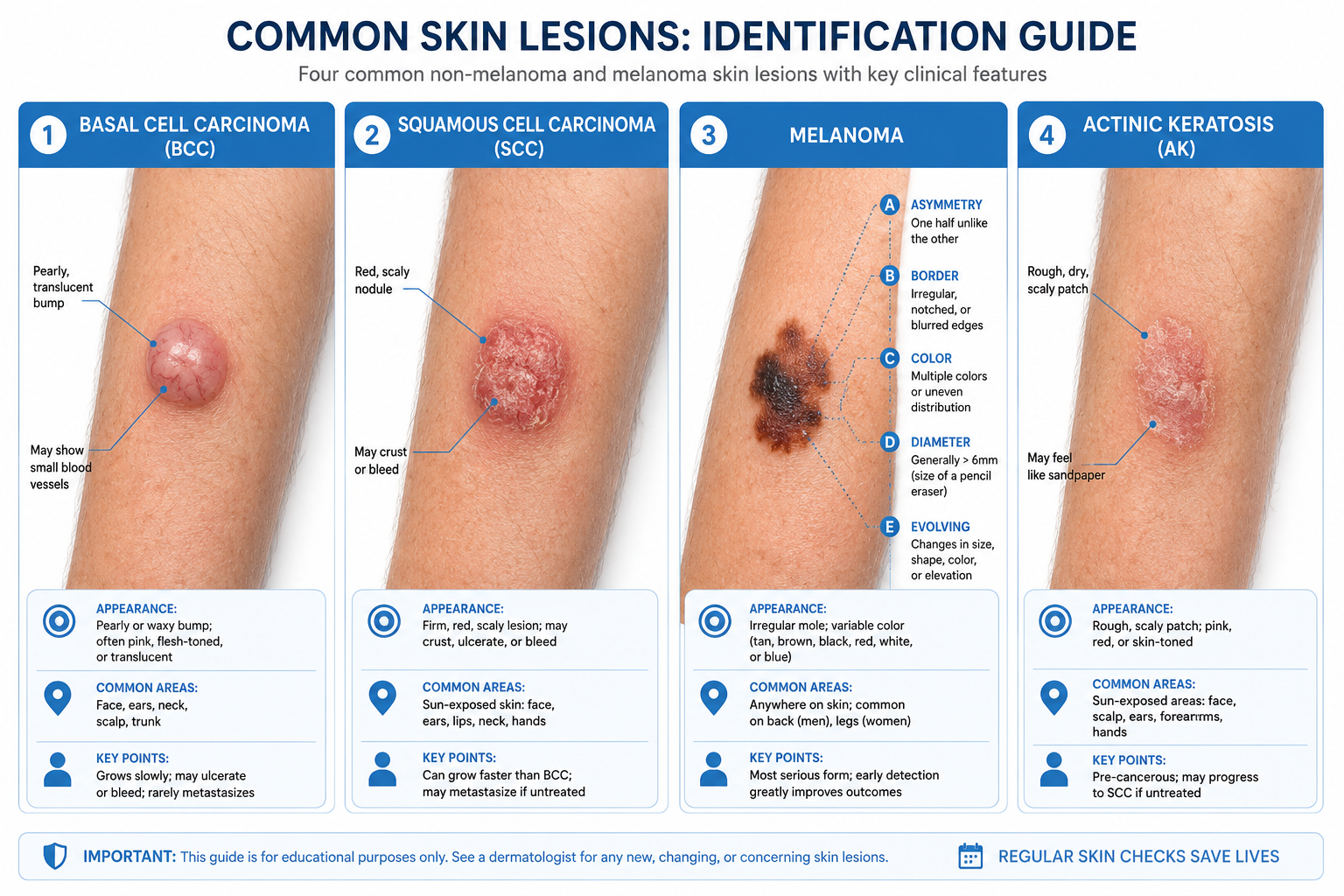
Skin cancer on the arm does not have one universal appearance. Its look depends heavily on the type of cancer and how long it has been developing. Knowing the visual differences between types is the first step toward catching a problem early.
Basal cell carcinoma (BCC) is the most common skin cancer overall [1]. On the arm, it typically appears as:
BCC rarely spreads beyond the original site, but it can grow deeper into surrounding tissue if ignored.
Squamous cell carcinoma (SCC) is the second most common type and tends to appear in areas with a history of heavy sun exposure, including the forearms and the backs of the hands [1]. Look for:
SCC carries a higher risk of spreading than BCC, particularly in people who are immunocompromised.
Melanoma is the least common but most dangerous form. On the arm, it may present as [3]:
For a visual reference on early presentations, see first stages of skin cancer pictures for documented clinical examples.
No self-exam can definitively diagnose skin cancer — only a dermatologist or physician can do that. However, the ABCDE rule gives a reliable framework for deciding whether a spot needs professional attention [6]:
LetterStands ForWhat to Look ForAAsymmetryOne half does not match the otherBBorderEdges are ragged, notched, or blurredCColorMultiple shades of brown, black, red, white, or blueDDiameterLarger than 6mm (about the size of a pencil eraser)EEvolvingAny change in size, shape, color, or a new symptom like bleeding or itching
Additional warning signs specific to arm spots:
If a spot checks even one of the ABCDE boxes, or if it simply looks or feels "wrong," book a professional evaluation. For more context on whether skin cancer causes discomfort, the resource on whether skin cancer hurts covers this question in detail.
Three primary types of skin cancer commonly appear on the arm, and each behaves differently [1] [2]:
1. Basal Cell Carcinoma (BCC)
The most common type. Grows slowly, rarely spreads to other organs, but can cause significant local tissue damage if untreated. The arms and face are among the most frequent sites.
2. Squamous Cell Carcinoma (SCC)
More aggressive than BCC. Can spread to nearby lymph nodes, especially in people with weakened immune systems. Chronic sun exposure on the forearms is a major driver.
3. Melanoma
The most dangerous type. Can develop from an existing mole or appear as a new lesion. Melanoma on the arm can spread (metastasize) to lymph nodes, lungs, liver, and brain if not caught early.
Less common but worth knowing:
For a detailed comparison of the two most common non-melanoma types, see BCC vs SCC: what's the difference.
Yes, and it is the primary cause. UV radiation from the sun is the leading risk factor for all three major types of skin cancer, and the arms are particularly vulnerable because they are exposed during everyday activities — driving, outdoor work, sports, and gardening — often without any sun protection [2].
Key risk factors for arm skin cancer include:
The forearms and the backs of the hands tend to accumulate the most UV damage over a lifetime, which is why these areas are so frequently affected [7].
The most critical warning signs of skin cancer on the arm are changes. A stable, unchanged spot that has looked the same for years is less concerning than a new spot or one that is actively shifting in appearance [3] [6].
High-priority warning signs:
Common mistake: Many people dismiss persistent scaly patches as dry skin or eczema. If a rough patch does not respond to moisturizer within two to three weeks, it warrants a professional look — it may be an actinic keratosis or early SCC.
For information on what early-stage presentations look like, the early stage skin cancer guide provides additional clinical context.
For non-melanoma skin cancers, the arm is not considered a high-risk anatomical site compared to the face, ears, or scalp, where tumors tend to grow more aggressively and are harder to fully remove [6]. Arm skin cancers are generally easier to excise with clear margins and carry a lower recurrence risk.
However, location on the arm matters within the arm itself:
For melanoma, location matters less than depth. A melanoma on the arm that has grown deeper than 1mm (Breslow thickness) carries a meaningfully higher risk of spreading than a thin melanoma, regardless of where on the body it sits [3].
The bottom line: arm skin cancer caught at an early stage is among the most treatable presentations. The concern rises when any type is left to grow for months or years without treatment.
The speed of spread depends entirely on the type [1] [6]:
Practical takeaway: For BCC and SCC, a delay of a few weeks to schedule an appointment is unlikely to change outcomes significantly. For a rapidly changing, dark, or irregularly bordered lesion that might be melanoma, faster evaluation matters considerably.
For a deeper look at how basal cell carcinoma specifically behaves over time, see does basal cell carcinoma spread.
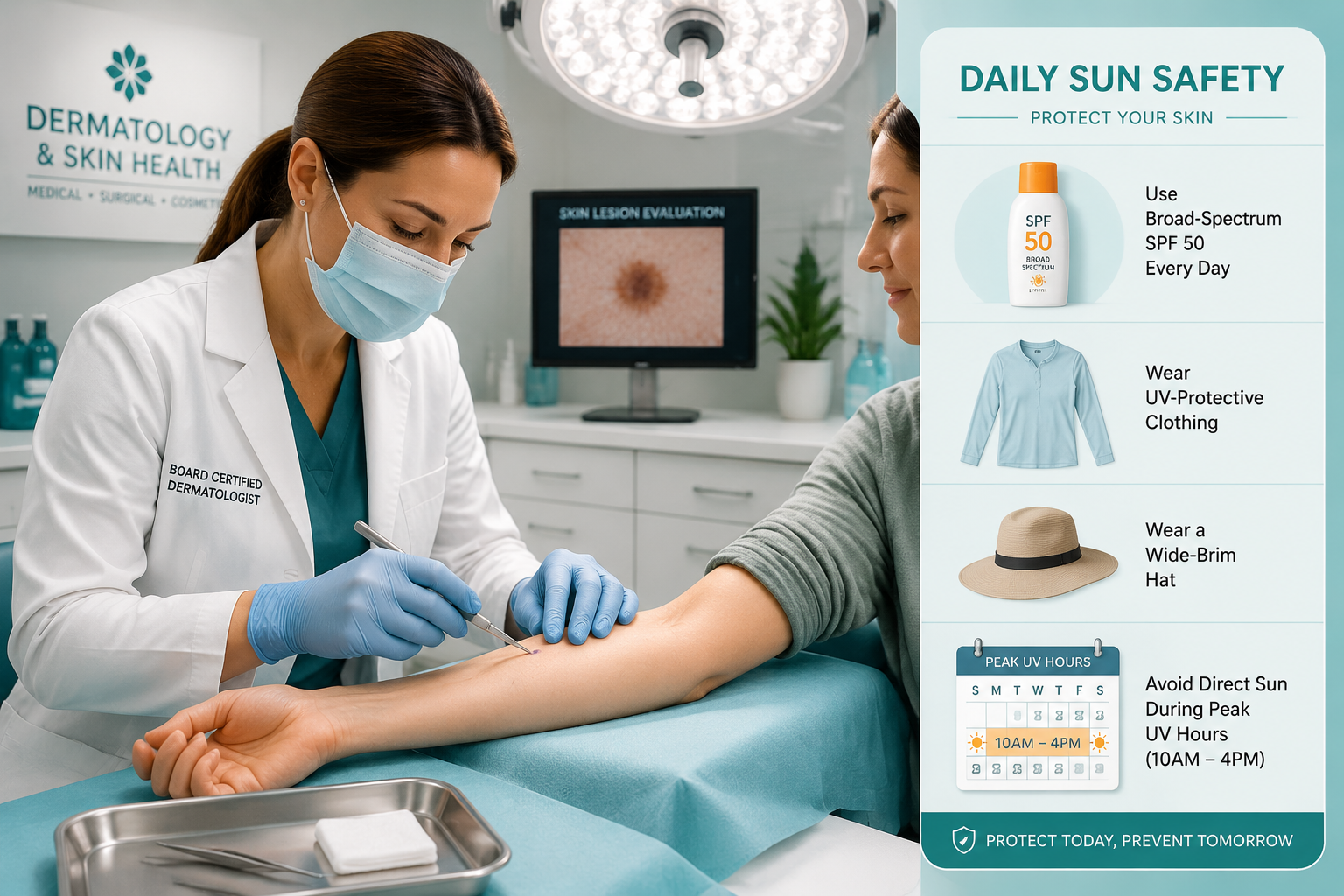
Finding a suspicious spot on your arm warrants a clear, step-by-step response rather than either panic or dismissal.
Step 1: Document the spot
Take a clear, well-lit photo of the spot next to a ruler or coin for scale. Note when you first noticed it and any changes since then.
Step 2: Apply the ABCDE rule
Run through the checklist described above. Even one positive criterion is sufficient reason to seek evaluation.
Step 3: Book an appointment promptly
See a dermatologist, family physician, or a specialized skin cancer clinic. In Canada, many clinics — including those listed among the best skin cancer screening and treatment clinics in Toronto — accept patients without a referral, which speeds up access significantly.
Step 4: Do not attempt self-removal
Do not cut, burn, or apply over-the-counter acids to an undiagnosed spot. Self-treatment can obscure the lesion's borders and make accurate diagnosis harder.
Step 5: Prepare for a possible biopsy
If the physician is concerned, they will likely perform a skin biopsy — a quick, minimally invasive procedure that removes a small sample for laboratory analysis. This is the only definitive way to diagnose skin cancer [6].
Step 6: Follow up on results
Biopsy results typically return within one to two weeks. If cancer is confirmed, the physician will discuss staging and treatment options.
Treatment for skin cancer on the arm depends on the type, size, depth, and location of the lesion, as well as the patient's overall health [6].
The most common treatment. The surgeon removes the tumor along with a margin of healthy surrounding tissue. For arm skin cancers, this is often performed under local anesthesia as an outpatient procedure. The skin cancer clinic at The Minor Surgery Center provides rapid access to surgical excision without the wait times typical of hospital referrals.
Used for larger, recurrent, or high-risk lesions. The surgeon removes the cancer layer by layer, examining each layer under a microscope before proceeding. Mohs achieves the highest cure rates for BCC and SCC (reported at 99% for primary BCC) while preserving the maximum amount of healthy tissue [6].
Liquid nitrogen freezes and destroys small, superficial lesions. Commonly used for actinic keratoses and very early BCCs. Not appropriate for deeper or larger tumors.
Used when surgery is not possible due to the tumor's location, size, or the patient's health. Also used as adjuvant therapy after surgery for high-risk SCC.
For very superficial lesions, prescription creams such as imiquimod or 5-fluorouracil can be applied directly to the skin. These are typically reserved for actinic keratoses and superficial BCCs.
For advanced or metastatic melanoma, systemic treatments including checkpoint inhibitors (such as pembrolizumab) and BRAF-targeted therapies have significantly improved outcomes in recent years [1].
The cost of skin cancer removal on the arm varies based on the procedure type, clinic setting, and whether the patient is covered by provincial health insurance in Canada.
In Canada (Ontario as a reference):
Procedure-specific considerations:
For patients in the Greater Toronto Area, clinics like The Minor Surgery Center offer access to board-certified plastic surgeons who specialize in skin cancer removal and reconstruction, often with shorter wait times than hospital-based programs.
Yes, and the prognosis is excellent for most types when detected at an early stage. Early detection is the single most powerful factor in determining outcome [1] [6].
The word "cure" in oncology typically means no evidence of disease for five years after treatment. For BCC and early SCC, recurrence after proper treatment is uncommon. For melanoma, long-term follow-up remains important even after successful treatment of an early-stage tumor.
The key variable is time. A melanoma that is 0.5mm thick at diagnosis is in a fundamentally different category than one that has grown to 4mm and reached the lymph nodes. This is why annual skin checks and prompt evaluation of new or changing spots matter so much.
Prevention of skin cancer on the arm is straightforward in principle and requires consistent habit-building over years [2] [3].
Daily habits that reduce risk:
Monitoring habits:
Diet and skin health: While sunscreen and clothing are the primary defenses, some evidence suggests that a diet rich in antioxidants (vitamins C and E, carotenoids) may support skin health. For more on this topic, see diet and skin health: can nutrition prevent skin problems.
See a doctor promptly if any of the following apply [3] [6]:
Do not wait if a lesion is rapidly growing, darkening, or developing satellite spots nearby. These are signs that warrant urgent evaluation rather than a routine appointment.
For Canadians who want rapid access without a referral, a skin cancer clinic with no referral needed can significantly reduce the time between noticing a spot and getting a diagnosis.
Q: Can skin cancer appear on the inner arm, not just the outer arm?
Yes. While the outer forearm and upper arm receive more direct sun exposure, skin cancer can develop anywhere on the arm, including the inner arm, particularly in people with a history of tanning beds or significant reflected UV exposure.
Q: Is a dark spot on my arm automatically a melanoma?
No. Dark spots on the arm are more often seborrheic keratoses, lentigines (sun spots), or benign moles. However, any dark spot that is new, changing, or meets ABCDE criteria should be evaluated by a physician.
Q: How long does recovery take after skin cancer removal on the arm?
For a simple excision, most people return to normal activity within one to two weeks. Larger excisions requiring skin grafts may take four to six weeks for full healing. Arm wounds generally heal well due to good blood supply.
Q: Does skin cancer on the arm hurt?
Most early skin cancers are painless. Some lesions, particularly SCC, may be tender or sore. Itching is also reported with certain types [4]. The absence of pain does not mean a lesion is benign.
Q: Can children get skin cancer on their arms?
Skin cancer in children is rare but not impossible. Children with xeroderma pigmentosum or other genetic conditions face elevated risk. Severe sunburns in childhood increase lifetime adult risk, making sun protection in youth critically important [2].
Q: What is the difference between a sunspot and skin cancer on the arm?
Sunspots (solar lentigines) are flat, evenly pigmented brown spots with smooth, well-defined borders. They do not change rapidly. Skin cancer lesions tend to have irregular borders, multiple colors, or active changes. When in doubt, a dermatologist can distinguish them quickly, often with a dermatoscope.
Q: Can skin cancer on the arm spread to the lymph nodes?
Yes, particularly SCC and melanoma. The lymph nodes most at risk from arm skin cancer are those in the armpit (axillary lymph nodes). Swelling or a new lump in the armpit alongside a suspicious arm lesion warrants urgent evaluation.
Q: Is Mohs surgery available for arm skin cancer in Canada?
Yes, Mohs surgery is available at select dermatology and surgical centers in Canada. It is typically reserved for larger, recurrent, or high-risk lesions where tissue preservation is important.
Q: How often should I get my arms checked professionally?
For average-risk adults, once a year is the standard recommendation. People with a personal or family history of skin cancer, or those with many moles, may benefit from checks every six months.
Q: Can a tattoo on the arm hide skin cancer?
Yes, this is a documented concern. Tattoo ink can obscure the appearance of moles and new lesions, making self-detection harder. People with tattoos on their arms should be particularly diligent about professional skin checks.
Q: What is actinic keratosis and should I be worried?
Actinic keratosis is a rough, scaly patch caused by years of UV exposure. It is precancerous — meaning it is not cancer yet, but a small percentage progress to SCC if untreated [7]. Treatment is simple and effective when addressed early.
Q: Does removing a suspicious mole cause cancer to spread?
No. This is a common myth. Properly performed surgical excision of a cancerous lesion does not cause it to spread. Delaying removal out of this fear is far more dangerous than prompt treatment. For more on this topic, see does removing a mole cause cancer.
Skin cancer on the arm is common, visible, and — when caught early — highly treatable. The arms' constant exposure to UV radiation makes them a prime site for basal cell carcinoma, squamous cell carcinoma, and melanoma, but that same visibility works in a patient's favor: arm lesions are easy to monitor and relatively straightforward to treat when identified promptly.
Actionable next steps:
The gap between a curable early-stage lesion and a more complex advanced case is often measured in months of inaction. Consistent self-monitoring, professional evaluation, and daily sun protection are the three habits that close that gap.
[1] Skin Cancer - https://www.cancer.org/cancer/types/skin-cancer.html?utm_source=openai
[2] Skin Cancer On Arm - https://www.medicalnewstoday.com/articles/skin-cancer-on-arm?utm_source=openai
[3] Syc 20377605 - https://www.mayoclinic.org/diseases-conditions/skin-cancer/symptoms-causes/syc-20377605?utm_source=openai
[4] Skin Cancer Does It Make Your Skin Itch - https://health.clevelandclinic.org/skin-cancer-does-it-make-your-skin-itch?utm_source=openai
[6] 15818 Skin Cancer - https://my.clevelandclinic.org/health/diseases/15818-skin-cancer?utm_source=openai
[7] What Does Skin Cancer Look Like On Your Arm - https://biologyinsights.com/what-does-skin-cancer-look-like-on-your-arm/?utm_source=openai