
Every year, millions of people sit in a dermatologist's chair and hear the same recommendation: "That mole should come off." What happens next—the method chosen to remove it—can affect everything from scarring and healing time to whether a cancer diagnosis is caught early enough to save a life. Understanding the difference between shave removal vs excision for moles is not just a matter of medical trivia; it is a decision that directly impacts health outcomes and cosmetic results.
Whether a mole is bothersome, cosmetically unwanted, or medically suspicious, the removal technique matters enormously. Shave removal and surgical excision are the two most common procedures performed in clinics across Canada and around the world in 2026, yet many patients walk into their appointment with little understanding of how these methods differ—or why a doctor might recommend one over the other. This comprehensive guide breaks down both techniques in plain language so that anyone facing mole removal can make an informed, confident choice.
Before diving into the specifics of shave removal vs excision for moles, it helps to understand what moles actually are.
Moles—medically called nevi—are clusters of pigmented cells (melanocytes) that appear as small, dark spots on the skin. Most adults have between 10 and 40 moles, and the vast majority are completely harmless [4]. Moles can be flat or raised, round or irregular, and range in color from flesh-toned to dark brown or even blue-black. For a deeper look at different mole presentations, see this guide on benign moles explained.
ReasonDescriptionCosmetic concernThe mole is in a visible area (face, neck) and affects self-confidence.Irritation or discomfortThe mole catches on clothing, jewelry, or razors.Suspicious changesThe mole has changed in size, shape, color, or border (ABCDE criteria).Medical recommendationA dermatologist identifies atypical features during a skin check.Preventive removalA patient with a strong family history of melanoma opts for proactive removal.
Regardless of the reason, the technique used to remove the mole is a critical clinical decision. Let's explore both methods in detail.
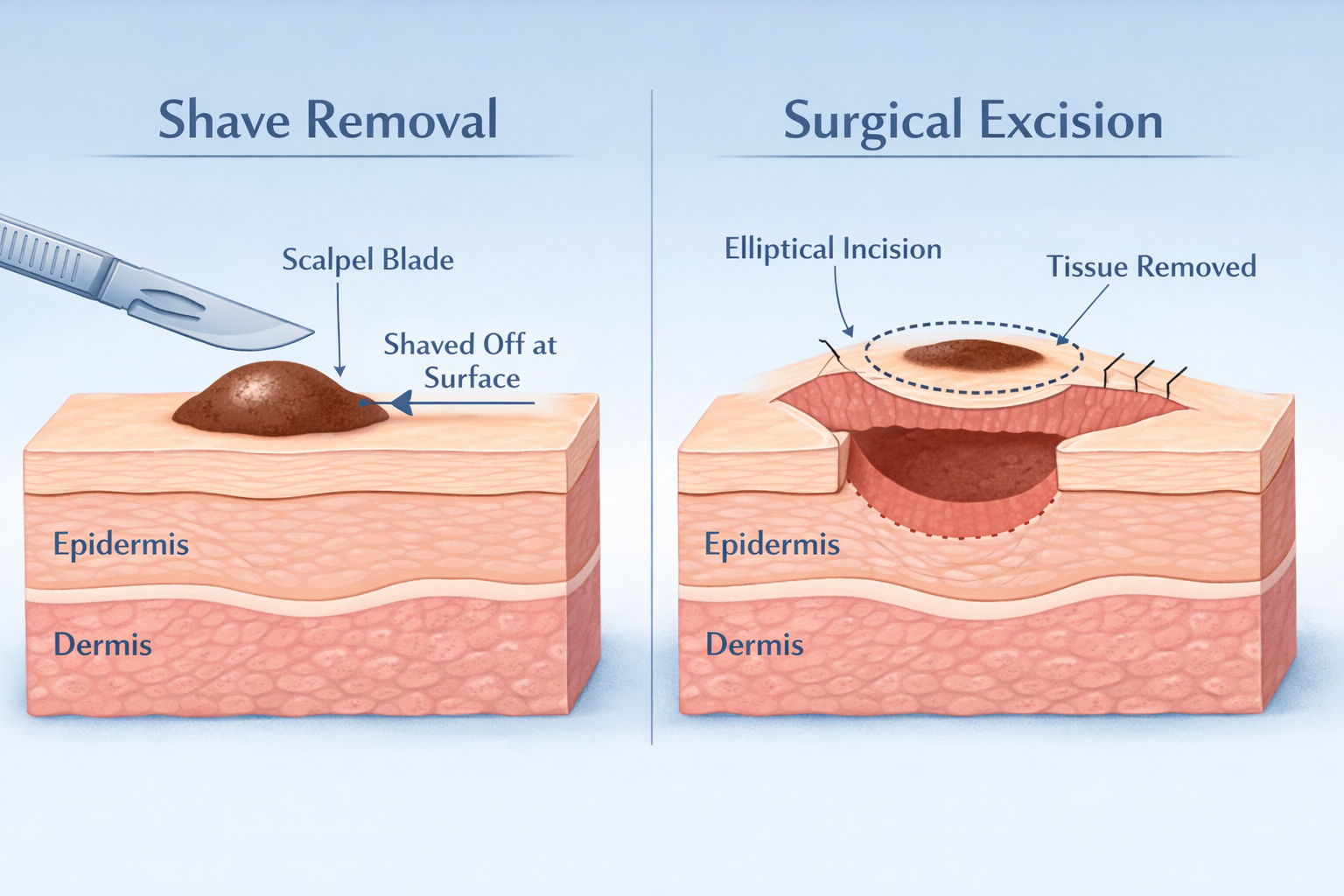
Shave removal—also called shave excision or tangential excision—is a procedure in which a clinician uses a thin, sharp blade (often a DermaBlade or scalpel) to shave the mole off at or just below the surface of the surrounding skin [1][3]. The goal is to remove the visible, protruding portion of the mole without cutting deep into the underlying tissue.
Because the incision is superficial, no stitches are needed. The wound is typically treated with a topical solution (such as aluminum chloride) to stop bleeding, and a simple bandage is applied [8].
💡 Did You Know? Shave removal achieves a one-time clearance rate of approximately 95–99%, making it highly effective for benign, raised moles [1][4].
Shave removal works best for:
If the goal is primarily cosmetic—achieving smooth, even skin—shave removal is often the technique of choice. Learn more about cosmetic mole removal for achieving smooth, even skin.
Shave removal heals fastest among surgical mole removal methods, typically within 3–4 weeks [1][3]. Here is a general timeline:
StageTimeframeWhat to ExpectImmediateDays 1–3Mild redness, slight oozing, bandage requiredScabbingDays 3–10A protective scab forms; keep the area clean and moistNew skin formationWeeks 2–3Pink, new skin appears beneath the scabMaturationWeeks 3–6+Scar fades; may leave a flat, pale mark or slight indentation
The resulting scar is usually smaller than one from excision, though the final appearance depends on skin type, mole location, and aftercare [3]. For a detailed breakdown of what to expect during recovery, check out our article on how long mole removal takes to heal.
Despite its advantages, shave removal has notable drawbacks:
Surgical excision—often called excisional biopsy or elliptical excision—is a procedure in which the entire mole is cut out along with a margin of healthy surrounding tissue. The wound is then closed with stitches (sutures), resulting in a linear scar [2][4][6].
This method goes deeper than shave removal, extending through the full thickness of the skin (epidermis and dermis) and sometimes into the subcutaneous fat layer. This ensures that all mole cells are removed, leaving virtually no chance of regrowth.
🩺 Important: Excision with stitches provides the highest cure rate and most predictable results with minimal chance of mole regrowth [4][6].
Excision is recommended for:
For anyone who has received a pathology report and wants to understand the results, this guide on demystifying your pathology report after mole removal is an excellent resource.
Because excision involves cutting deeper and closing the wound with stitches, the healing process is longer and more involved [2][3]:
StageTimeframeWhat to ExpectImmediateDays 1–3Swelling, tenderness, bandage over suturesSuture removalDays 7–14Stitches removed (timing depends on location)Wound closureWeeks 2–4Incision line closes; pink or red scar visibleScar maturationMonths 2–12+Scar gradually fades from red to pale; may flatten over time
The scar from excision is typically a thin, linear line. While it is longer than a shave removal scar, skilled surgeons place the incision along natural skin tension lines (Langer's lines) to minimize visibility [5][7].
The following table provides a comprehensive side-by-side comparison to help clarify when each method is most appropriate.
FeatureShave RemovalSurgical ExcisionBest forRaised, benign molesSuspicious, flat, or deep molesDepth of removalSuperficial (epidermis/upper dermis)Full-thickness (through dermis + margin)Stitches required?❌ No✅ YesHealing time3–4 weeks [1][3]4–6 weeks [2][3]Scar typeFlat, round, pale markLinear, thin lineRecurrence riskHigher (~1–5%) [1][4]Very low (near 0%) [4][6]Pathology analysisPartial specimenComplete specimen with marginsProcedure time10–15 minutes20–45 minutesAnesthesiaLocalLocalCostGenerally lowerGenerally higherIdeal locationsFace, neck, trunk (cosmetic)Anywhere, especially high-risk areasClearance rate95–99% [1][4]~100% [4][6]
📌 Bottom Line: When choosing between shave removal vs excision for moles, the decision hinges on whether the mole is benign and cosmetic (shave) or suspicious and requiring complete removal (excision).
For patients whose primary concern is appearance, shave removal is often the preferred method. It is quick, leaves a smaller scar, and requires no stitches [1][2]. Common scenarios include:
Patients interested in cosmetic options can explore our detailed guide on cosmetic mole removal.
Raised moles in areas subject to friction—such as the bra line, waistband, underarms, or scalp—are excellent candidates for shave removal. The procedure quickly eliminates the source of irritation with minimal recovery time.
Shave removal can be performed in as little as 10–15 minutes, making it ideal for patients with busy schedules or those who are anxious about longer procedures. If fear of the procedure is a concern, this article on overcoming fear of mole removal offers helpful strategies.
If a dermatologist has examined the mole with dermoscopy and confirmed it is benign, shave removal is a safe and effective option. The removed tissue can still be sent for pathology as a precaution [1][5].
This is the most important indication for excision. If a mole displays any of the ABCDE warning signs, excision is strongly recommended:
Surgical excision allows the pathologist to examine the entire mole plus a margin of healthy tissue, which is essential for diagnosing melanoma or other skin cancers [2][4][6]. For more on atypical moles and what to watch for, see our guide on atypical moles.
Flat moles sit flush with the skin surface, making them poor candidates for shave removal. Excision is the preferred method because it can remove the full depth of pigmented cells [2][6]. Understanding the differences between flat moles and raised moles in terms of skin cancer risk can help patients recognize when excision is warranted.
When a mole grows back after a previous shave removal, excision is typically recommended for the second procedure. Recurrent moles can sometimes show pseudomelanoma (benign pigment changes that mimic melanoma under the microscope), which complicates future pathological interpretation [4].
Some moles have a deep dermal component that extends well below the skin surface. Shave removal would only address the superficial portion, leaving behind cells that could regrow or—in rare cases—harbor atypical changes. Excision removes the mole in its entirety.
In any situation where a definitive diagnosis is needed—whether to rule out melanoma, confirm a dysplastic nevus, or assess margins—excision is the method of choice [2][6].
Scarring is one of the biggest concerns patients have when considering mole removal. Here is how the two methods compare:
FactorImpactSkin typeDarker skin tones may be more prone to keloid or hypertrophic scarringLocationScars on the chest and shoulders tend to be more visible; facial scars often heal wellAftercareKeeping the wound clean, moist, and protected from the sun improves outcomesSurgeon skillAn experienced clinician produces better cosmetic results regardless of methodPatient ageYounger skin heals faster but may scar more prominently; older skin scars less but heals slower
While this article focuses on shave removal vs excision for moles, it is worth briefly mentioning other techniques that patients may encounter.
Laser removal uses focused light energy to break down pigment cells. It is best for flat, superficial, cosmetically unwanted moles and offers fast healing (7–10 days) with minimal scarring [1][2]. However, laser removal:
Cryotherapy (freezing) is occasionally used for superficial skin lesions but is not a standard method for mole removal. It does not allow for histological examination and carries a risk of incomplete removal.
Over-the-counter products like mole removal creams and pens are widely marketed but carry significant risks, including scarring, infection, and—most dangerously—the potential to mask a cancerous mole without proper diagnosis. Medical professionals strongly advise against these products. Learn why in our article on whether mole removal creams actually work.
One of the most critical differences between shave removal and excision relates to pathological analysis—the laboratory examination of removed tissue under a microscope.
Even moles that look completely benign to the naked eye can occasionally harbor atypical or malignant cells. Sending the removed tissue to a pathology lab is a crucial safety step [2][4][6].
⚠️ Critical Point: If there is any suspicion of malignancy, excision is the only appropriate method. Shave removal and laser removal cannot guarantee complete removal of potentially cancerous tissue [2][4][6].

Cost is a practical factor for many patients. While prices vary by clinic, region, and complexity, here is a general comparison:
Cost FactorShave RemovalSurgical ExcisionProcedure feeLowerHigherPathology feeStandardStandardFollow-up visitsUsually noneSuture removal visit requiredTotal estimated cost$150–$400 per mole$300–$800+ per moleInsurance coverageMay be covered if medically necessaryMore likely covered if suspicious
💡 Tip: Moles removed for medical reasons (suspicious features, irritation, bleeding) are more likely to be covered by provincial health plans or private insurance than moles removed purely for cosmetic reasons. For more details on pricing, visit our guide on how much mole removal costs.
This is one of the most frequently asked questions, and the answer depends on the method used.
Because shave removal only addresses the superficial portion of the mole, there is a higher chance of recurrence. Studies suggest that while the one-time clearance rate is 95–99%, a small percentage of moles will regrow—sometimes with altered pigmentation [1][4].
Excision removes the entire mole including its deepest cells, resulting in a near-zero recurrence rate [4][6]. This is one of the primary reasons excision is preferred for atypical or suspicious moles.
If a mole recurs after removal, it should be re-evaluated by a clinician. In most cases, a follow-up excision is recommended to ensure complete removal and to obtain a definitive pathological diagnosis.
Choosing between shave removal and excision can feel overwhelming. Here is a simple decision framework:
✅ The mole is raised or dome-shaped ✅ A dermatologist has confirmed it is benign ✅ The primary concern is cosmetic ✅ The patient wants a quick procedure with minimal downtime ✅ The mole is causing physical irritation (catching on clothing)
✅ The mole is flat or has a deep component ✅ There are suspicious features (ABCDE criteria) ✅ A complete pathological specimen is needed ✅ The mole has recurred after a previous shave removal ✅ The clinician recommends excision based on dermoscopic findings ✅ There is a family history of melanoma or personal history of skin cancer
Always defer to the clinical judgment of a qualified healthcare provider. A skilled clinician will consider the mole's appearance, location, patient history, and risk factors before recommending the most appropriate technique.
Regardless of the method chosen, here is what patients can generally expect:
For patients wondering about discomfort, our article on whether mole removal hurts provides reassuring, detailed information.
The skill and experience of the clinician performing the procedure is arguably the most important factor in achieving a good outcome—both medically and cosmetically. When selecting a clinic, consider:
For patients in the Greater Toronto Area, choosing the best mole removal clinic is an essential first step toward a safe and satisfying experience.
Both procedures are performed under local anesthesia, so neither should be painful during the procedure. Patients may feel a brief sting from the anesthetic injection. Post-procedure discomfort is generally mild for both methods, though excision sites may be slightly more tender due to the deeper incision and stitches [8].
Patients can express their preferences, but the final recommendation should come from the clinician based on clinical assessment. If a mole is suspicious, excision is medically necessary regardless of patient preference [2][6].
Coverage depends on whether the removal is deemed medically necessary. Suspicious moles, moles causing symptoms (bleeding, irritation), and moles recommended for removal by a physician are more likely to be covered. Purely cosmetic removals are typically not covered by provincial health plans.
Use the ABCDE rule as a guide:
Any mole that meets one or more of these criteria should be evaluated by a professional promptly.
Yes. Shave removal is frequently performed on the face for raised, benign moles and often produces excellent cosmetic results. However, if there is any concern about the mole's nature, excision may be recommended even on the face [1][5].
If atypical or malignant cells are found in a shave biopsy specimen, the patient will typically need a follow-up excision to ensure all cancerous cells are removed with clear margins. This is one reason why excision is preferred upfront for suspicious lesions [4][6].
The debate around shave removal vs excision for moles ultimately comes down to a few key factors: the mole's characteristics, the level of suspicion for malignancy, cosmetic goals, and the clinician's expert assessment.
Shave removal is an excellent, efficient option for raised, benign moles where cosmetic outcome and quick recovery are priorities. It boasts an impressive clearance rate and minimal downtime, making it the go-to choice for straightforward cosmetic removals.
Surgical excision is the definitive procedure for any mole that raises even a hint of concern. It provides a complete tissue specimen for pathological analysis, ensures near-zero recurrence, and is the only appropriate method when melanoma or other skin cancers must be ruled out.
Your skin is your body's largest organ—and moles deserve the same careful attention as any other health concern. Whether the right choice is a quick shave removal or a thorough surgical excision, the most important step is taking action and partnering with a trusted healthcare provider to protect both appearance and health.
[1] Laser Removal Vs Shave Excision Which Mole Removal Method Is Right For You - https://www.perfectimageconsultants.co.uk/laser-removal-vs-shave-excision-which-mole-removal-method-is-right-for-you/
[2] Laser Mole Removal Vs Surgical Excision Which Is Better - https://londonskinclinic.london/blog/laser-mole-removal-vs-surgical-excision-which-is-better/
[3] Understanding Shave Mole Removal Healing Stages What To Expect - https://www.harleystreetskinclinic.com/articles/understanding-shave-mole-removal-healing-stages-what-to-expect/
[4] Mole Removal - https://melasmaclinic.com.au/mole-removal/
[5] Mole Removal - https://www.drhilinski.com/procedures/mole-removal/
[6] Mole Removal - https://drdavinlim.com/mole-removal/
[7] Mole Removal In Los Angeles Understanding The Different Methods And Their Benefits - https://www.drardesh.com/blogs/mole-removal-in-los-angeles-understanding-the-different-methods-and-their-benefits
[8] Do You Need Stitches For Mole Removal - https://www.theminorsurgerycenter.com/blog/do-you-need-stitches-for-mole-removal