
Last updated: October 13, 2026
This article is general information, not medical advice. See a doctor, dermatologist, or qualified piercer for assessment of any specific bump.
Most piercing bumps are irritation bumps caused by pressure, movement, or snagging jewelry, and they settle once the cause is removed. An infected piercing looks red, feels hot and painful, and may leak pus. A keloid is firm, keeps growing past the edge of the piercing, does not resolve on its own, and needs medical treatment such as a corticosteroid injection or surgical excision.
A piercing bump is any small lump that forms at or next to a piercing site; it is a descriptive term, not a medical diagnosis, and can represent several different conditions.[2][3][5][11][14] The bump might be an irritation bump, a granuloma (a small cluster of inflamed tissue reacting to the jewelry), a hypertrophic scar, a localized infection, or in some people, a keloid.
These bumps are usually pink, red, or flesh-coloured, and can be itchy or tender to the touch.[3][11][14] They appear at or beside the piercing channel, most commonly on earlobe, helix, tragus, and nose piercings, where jewelry contact and movement are highest.
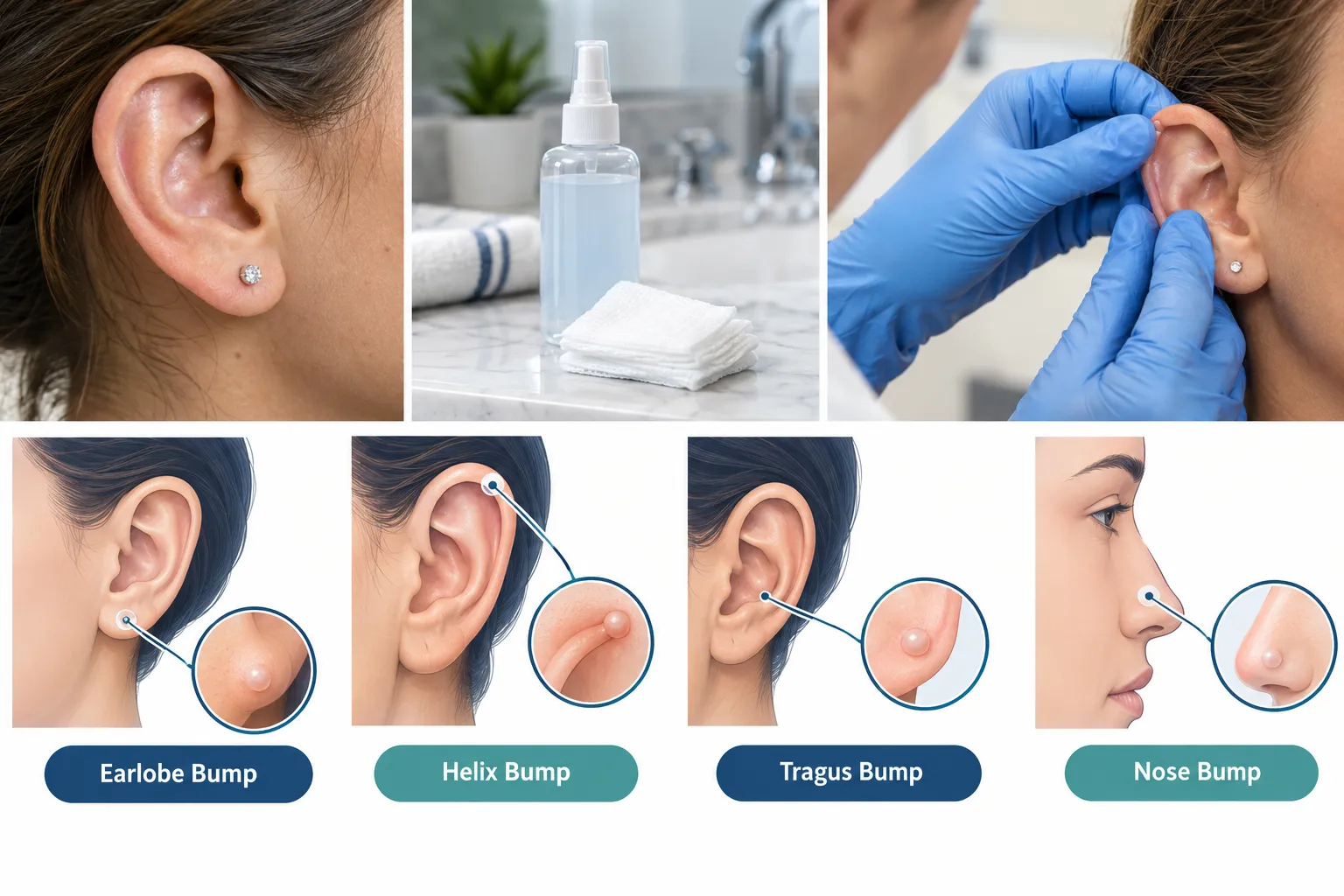
A simple irritation bump often starts shrinking within one to two weeks once the irritating cause is removed, and a hypertrophic scar typically improves gradually over several weeks to months with consistent aftercare.[3][11] A true keloid behaves differently: it tends to keep growing for months and does not go away on its own, which is one reason it is treated as a separate condition from an ordinary piercing bump. See piercing bump vs keloid for a side-by-side look at how timing and appearance differ.
A bump that appears in the first few weeks after piercing is usually part of normal healing, irritation, or early infection, since the wound tract is still closed. A bump that appears on a piercing that healed months or years ago is more likely to be a granuloma from a recent jewelry change, an allergic reaction to a new metal, or in predisposed skin, a keloid starting late. Choose home care first for a new, mild bump; choose medical evaluation first for any bump on an old, previously healed piercing, since that pattern is less typical of ordinary irritation.
These four causes of a piercing bump differ mainly in timing, firmness, pain level, and whether the bump stays within the piercing border or spreads beyond it.[3][11][13] The table below summarizes the practical differences used to tell them apart.
FeatureIrritation bumpInfectionHypertrophic scarKeloidWhen it appearsDays to a few weeks after piercing or jewelry changeDays to 2 weeks, can appear fasterWeeks to a few monthsWeeks to 12 months[3][11]Look and feelSmall, soft to firm, skin-coloured or pinkRed, warm, swollen, shiny skinRaised, pink/red, confined to wound edges[3]Firm, raised over 4 mm, pink, purple, spreads past the piercing[11]PainMild tendernessIncreasing pain, throbbingMild, sometimes itchyOften itchy, sometimes painful[11]Grows beyond the piercing?NoNo, but swelling can spreadNo, stays within the original site[3]Yes, by definition[11][13]Goes away alone?Often, with careNo, needs treatmentUsually improves slowly[3]Rarely[11][12]Typical treatmentSaline, downsizing jewelry, hands-offCleaning, sometimes antibiotics[1][6]Time, saline, pressure, sometimes steroid[3]Corticosteroid injection, surgical excision[11][12][13]
For more detail on separating ordinary scarring from true keloid tissue, see keloid vs irritation bump and keloid vs hypertrophic scar after ear piercing.
Quick self-check (not a diagnosis)
Choose the row that matches the bump, then read the matching column above.
Piercing bumps are caused mainly by trauma to the skin during healing, ongoing pressure or friction from jewelry, allergic reactions to metal, bacterial contamination, or in predisposed individuals, abnormal scar tissue growth.[9][10][13] Any break in the skin creates a wound that must heal through the same stages as a cut or surgical incision.
Common contributing factors include:
A bump on the side of the nose can also follow this pattern; related guidance is covered in bump on nose.
Most simple irritation bumps improve within one to two weeks using consistent, gentle aftercare, not aggressive treatment. The following steps reflect widely used professional piercer and dermatology guidance for a non-infected, non-keloid bump.[2][3][5]
A sea salt or sterile saline soak is the most widely recommended home measure for an irritation bump, and it works by gently cleaning the area and reducing inflammation without harsh chemicals.[2][3][5] It is not a treatment for infection or keloid tissue on its own. Use a wound-wash saline product or a mix of non-iodized sea salt dissolved fully in distilled or cooled boiled water, applied as a warm compress for five to ten minutes, once or twice daily; over-soaking or using too strong a salt mix can irritate skin further.
No. Piercing bumps should not be popped, squeezed, or picked at, since this can push bacteria deeper, cause scarring, and turn a minor irritation bump into an infection or a larger lump.[1][6][8] This applies even when the bump looks like it has a visible white or clear centre.
A single small pustule beside a piercing is sometimes treated by professional piercers with warm compresses and very gentle massage to help it drain on its own, continued for at least two weeks after it appears to resolve, rather than manual popping.[5] If a bump is firm, deep, or recurring, home popping risks making it worse and delays finding out whether it is actually a granuloma or early keloid.
Jewelry should generally stay in place for an irritation bump or a suspected infection, since removing it can trap infection under closing skin and increase the risk of an abscess.[5][6][8] An exception is a confirmed metal allergy, where switching to implant-grade titanium (not full removal) is usually the better fix.
Removing jewelry is reasonable mainly when:
Taking jewelry out of a cartilage piercing such as a helix or tragus during apparent infection can be riskier than leaving it, since the opening can close over trapped bacteria.[5][9]
There is no strong clinical evidence supporting tea tree oil, aspirin paste, or crushed aspirin for treating a piercing bump, and professional aftercare guidance does not recommend them.[2][3][5] Sterile saline remains the first-line, evidence-informed option for irritation bumps.
Reasons to avoid these home remedies:
A piercing bump that has not improved after two to three weeks of consistent saline care, or one that keeps getting larger, needs reassessment rather than continued home treatment. At that point, the likely explanations shift from simple irritation toward infection, a persistent granuloma, a hypertrophic scar, or a developing keloid.[2][3][11]
Useful next steps:
The most consistently recommended product for a piercing bump is a sterile saline wound wash, used as directed, alongside implant-grade titanium or nickel-free jewelry.[2][3][5] Chamomile compresses are sometimes suggested as an additional comfort measure, though this is based on general expert consensus rather than large clinical trials.[2] Products to avoid include alcohol-based cleansers, hydrogen peroxide, and makeup or hair products applied directly over the area, all of which can dry out or irritate healing skin. For cartilage-specific guidance, see how to heal a helix piercing bump.
A piercing bump is likely infected, rather than simple irritation, when pain increases instead of improving, the area feels hot, and there is thick yellow, green, or grey discharge, sometimes with fever or chills.[1][2][6][8] These signs call for medical assessment rather than continued home soaking.
Red flags that mean see a doctor promptly:
Government health guidance from Australia and Canada both advise prompt medical review for these signs, noting that untreated infection can progress to abscess or, rarely, more serious systemic illness.[6][8] Most infected piercings are treated with proper cleaning and, when needed, oral or topical antibiotics prescribed by a doctor.[1][6]
Keloids from piercings typically need active medical treatment, since they do not shrink on their own and can keep enlarging for months.[11][12][13] The two main evidence-based options are corticosteroid injection and surgical excision, sometimes combined with other measures to reduce recurrence.
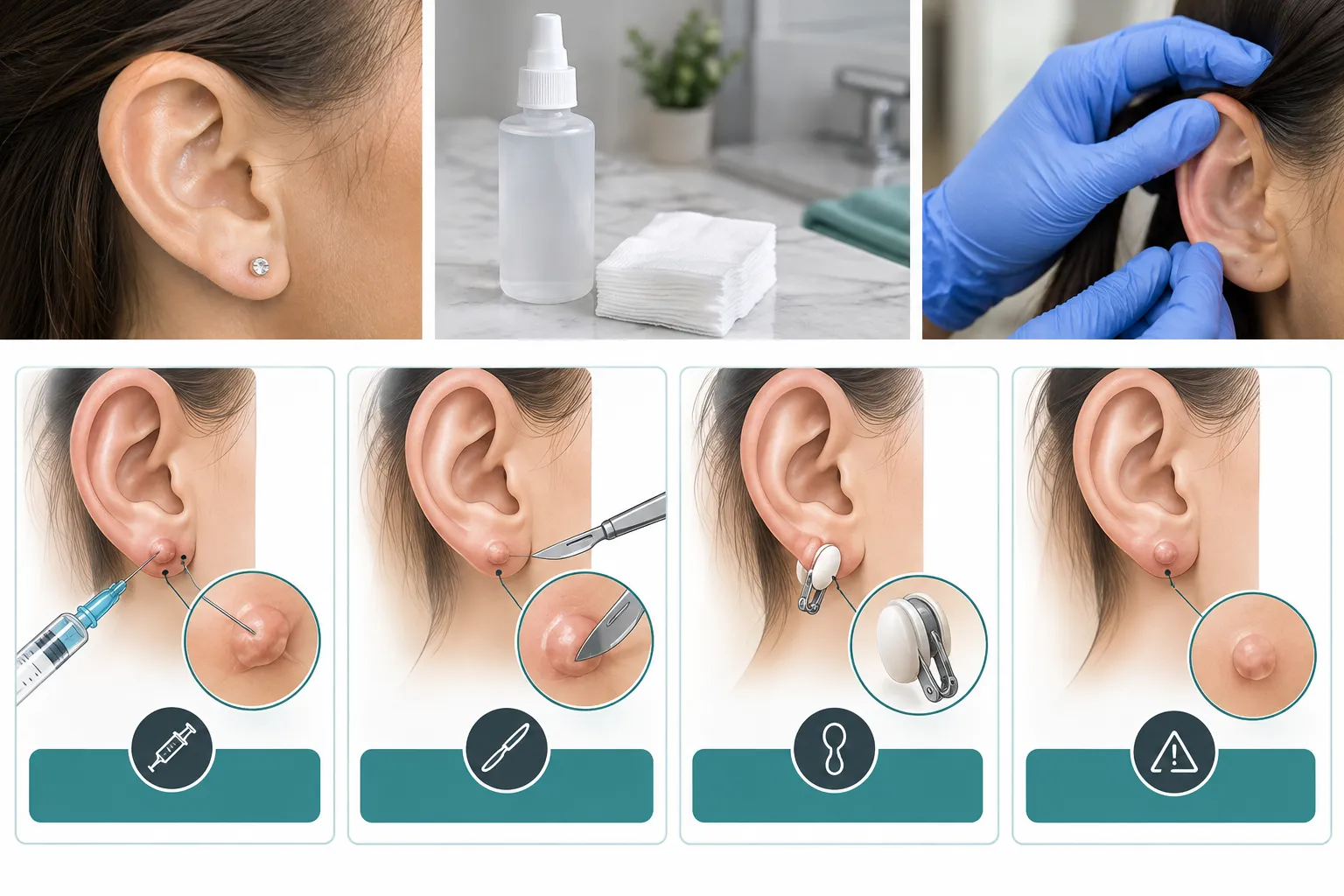
The Minor Surgery Center treats ear keloids and repairs torn or stretched earlobes at its GTA clinics; more information is available on ear keloid removal in Toronto and on the keloid scar condition page. Earlobe splitting from heavy earrings or a torn piercing is a related but separate problem, covered at earlobe repair in Toronto.
An irritation bump or hypertrophic scar is usually not permanent and improves with time and proper care, while an untreated keloid can be effectively permanent, since it rarely resolves without medical intervention.[3][11][12] Prevention is possible for some risk factors but not all, since genetic predisposition to keloids cannot be changed.
Practical prevention steps:
Is a piercing bump the same as a keloid?
No. A piercing bump is a general term for any small lump near a piercing, while a keloid is a specific type of raised scar that grows beyond the original piercing site and needs medical treatment.[3][11]
Can a piercing bump be a sign of infection?
Yes, if it is accompanied by warmth, worsening pain, spreading redness, or pus; a simple irritation bump does not usually cause fever or thick discharge.[1][6][8]
How long should I try home care before seeing a doctor?
Two to three weeks of consistent saline care is a reasonable trial for a mild, non-infected bump; a bump that worsens at any point, or shows no change after a month, warrants a medical check.[2][3]
Is it safe to cover a piercing bump with makeup or ointment?
It is best avoided; makeup, petroleum-based ointments, and thick creams can trap bacteria and slow healing, whereas sterile saline is the standard first-line care.[2][3]
Do cartilage piercings get bumps more often than earlobe piercings?
Cartilage sites such as the helix and tragus tend to heal more slowly and are more prone to both irritation bumps and, rarely, chondritis, compared with earlobe piercings.[2][9]
Will a piercing bump come back after treatment?
An irritation bump generally will not return once the trigger (pressure, poor-quality metal, friction) is corrected; keloids, in contrast, carry a known risk of recurrence even after treatment.[11][12][13]
A piercing bump is a symptom, not a single diagnosis, and the right response depends on which of four patterns it matches: irritation, infection, hypertrophic scar, or keloid. Most bumps are mild and respond to sterile saline, correct jewelry material, and patience over a few weeks. The signs that change the plan are clear: worsening pain, pus, fever, or a bump that grows beyond the piercing border and keeps enlarging over months. In those cases, see a doctor, dermatologist, or an experienced piercer rather than continuing home treatment alone, and ask specifically whether the tissue looks like a hypertrophic scar or a true keloid, since the treatment paths (time and saline versus corticosteroid injection or surgical excision) are different.
[1] Art 20047317 - https://www.mayoclinic.org/healthy-lifestyle/adult-health/in-depth/piercings/art-20047317
[2] Cartilage Piercing Bump - https://www.healthline.com/health/cartilage-piercing-bump
[3] Hypertrophic Scar Piercing - https://www.healthline.com/health/hypertrophic-scar-piercing
[5] Troubleshooting Print - https://www.safepiercing.org/wp-content/uploads/2020/05/Troubleshooting_Print.pdf
[6] Piercings - https://www.betterhealth.vic.gov.au/health/conditionsandtreatments/piercings
[8] Body Piercing Problems - https://www.healthlinkbc.ca/healthwise/body-piercing-problems
[9] Body Piercing - https://dermnetnz.org/topics/body-piercing
[10] Wij1 5 19 21 - https://woundsinternational.com/wp-content/uploads/2023/02/wij1-5-19-21.pdf
[11] Hypertrophic Scar Piercing - https://www.healthline.com/health/hypertrophic-scar-piercing
[12] Cartilage Piercing Bump - https://www.healthline.com/health/cartilage-piercing-bump
[13] Nbk537336 - https://www.ncbi.nlm.nih.gov/books/NBK537336/
[14] Cartilage Piercing Bump - https://www.healthline.com/health/cartilage-piercing-bump
How does it feel? Small and soft Hot, swollen, painful Firm, raised, past the hole
Any discharge? None or clear crusting Yellow/green/grey pus
How long has it been there? Under 3 weeks Over a month, still growing
General information only, not a diagnosis. See a doctor or piercer for assessment.