
Last updated: August 18, 2026
Quick Answer: Any full-thickness mole removal leaves a permanent mark. The goal is a fine, flat, pale line, not an invisible result. Most mole removal results take 6 to 12 months to fully settle, and the scar commonly looks worse before it looks better. Knowing this in advance makes the process far less alarming.
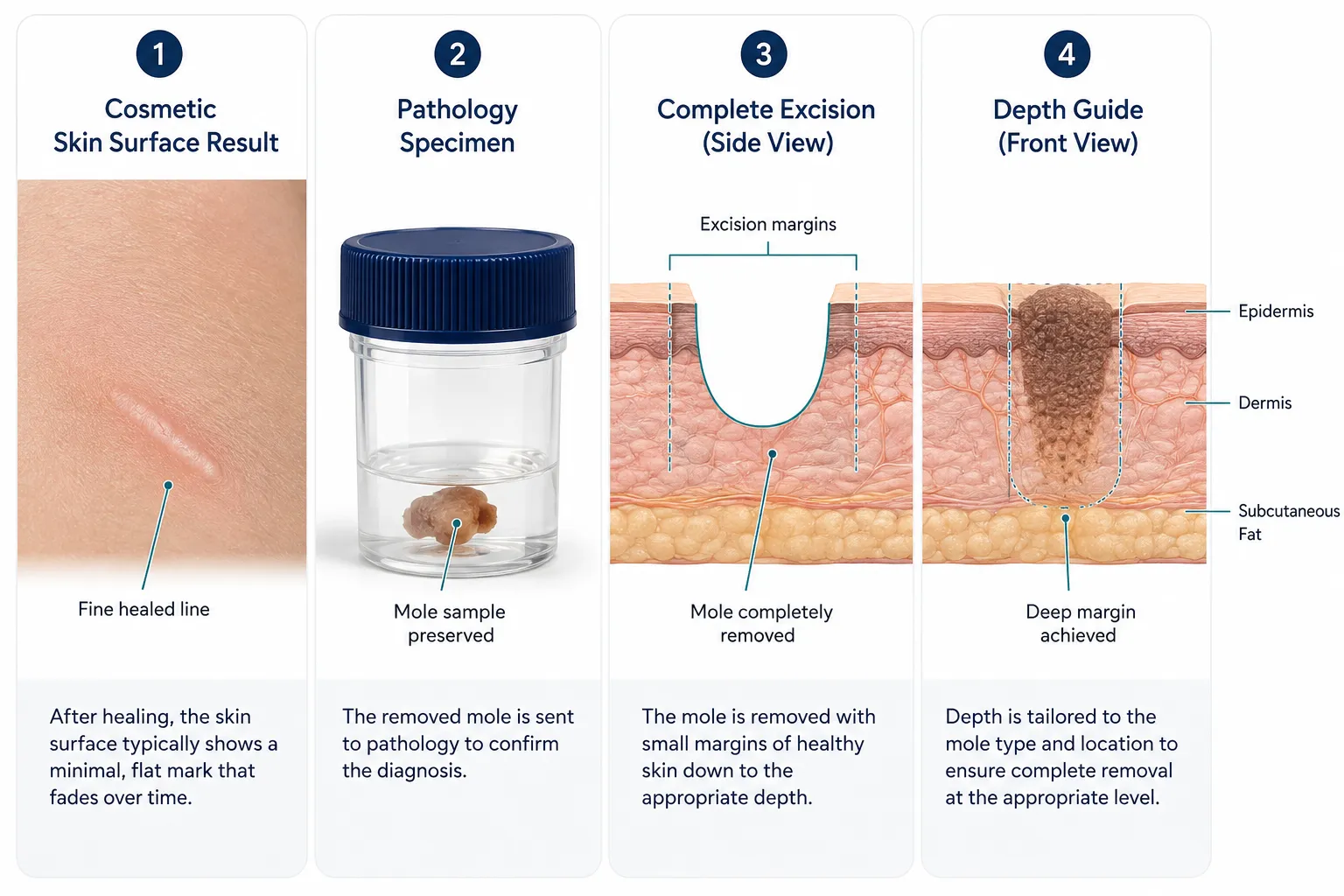
Most people searching for mole removal results are thinking about one thing: will there be a visible scar? But the word "results" actually covers three separate outcomes, each with its own timeline and definition of success. Conflating them causes unnecessary anxiety.
This is how the skin looks once healing is complete. The cosmetic result depends on technique, body site, skin type, and aftercare. The goal is a scar that is flat, pale, and narrow, something that fades into the surrounding skin over time. That goal is achievable in many cases, but it is never guaranteed. Any procedure that removes a mole to its full depth will leave a permanent mark of some kind.
Complete removal means the mole is fully excised with clear margins, no mole cells left behind at the edges. Shave excision intentionally leaves the base of the mole in place, which is appropriate for benign raised moles but carries a small risk of partial regrowth. Elliptical excision removes the full thickness and is used when complete removal is the priority. Your surgeon will discuss which approach is right for your specific mole before the procedure.
When tissue is sent to a lab, the pathology report tells you what the mole was made of and whether the margins were clear. This result typically comes back within a few weeks of the procedure. It is separate from how the skin looks, a cosmetically excellent result can still come back with a finding that requires follow-up. For more on reading your report, see Demystifying Your Pathology Report After Mole Removal.
Final mole removal results take 6 to 12 months to fully develop. The skin goes through predictable stages, and understanding each one prevents unnecessary alarm, particularly during the weeks when the scar looks its worst.
First 24 hours: The wound is closed, covered with a dressing, and tender. Some oozing and mild swelling are normal.
Days 2 to 7: Redness and mild swelling continue. A crust or scab may form. Keep the site clean and moist as directed. Do not pick at any crust.
Days 7 to 14: Sutures (if present) are typically removed during this window. The wound edges should be closed. The site may still look red and slightly raised.
Weeks 3 to 8, the phase that surprises most people: The scar often becomes pinker, firmer, and more raised during this period. This is normal collagen remodelling and does not mean something has gone wrong. Patients who are not warned about this phase frequently become alarmed at exactly this point. The scar is not getting worse permanently, it is going through an active phase before it softens and fades. For a detailed breakdown of each stage, see Mole Removal Healing Stages Explained.
Months 3 to 6: The scar begins to soften and flatten. Redness fades. Scar massage and silicone products (if recommended) are most effective during this window.
Months 6 to 12: The scar continues to mature and pale. Most scars reach their final appearance somewhere in this range. Some take longer, particularly on the chest, back, or shoulders.
For a full guide on what to expect at each stage, see What Does Normal Healing Look Like After Mole Removal.
The technique used is one of the strongest predictors of what the scar will look like. Each method suits a different type of mole.
TechniqueTypical UseExpected ResultShave excisionRaised, benign moles that sit above the skin surfaceFlat pale patch; no linear scar; small risk of partial regrowth if mole cells remain at the basePunch excisionSmall, deep moles with a defined circular borderSmall round scar, usually closed with one or two sutures; complete full-thickness removalElliptical excisionLarger moles, suspicious lesions, or any case requiring full-thickness removal with clear marginsLinear scar that is noticeably longer than the mole was wide, this is intentional and necessary to close the defect cleanly without puckering
One point worth stating plainly: an elliptical excision produces a scar that is significantly longer than the mole itself. This surprises many patients. The elliptical shape is required to allow the wound edges to come together under even tension. A circular wound cannot be closed flat, it creates a "dog ear" at each end. The length of the resulting scar is not a sign of poor technique; it is a consequence of basic wound geometry.
For a detailed comparison of approaches, see Laser vs Traditional Mole Removal.
Several factors influence the final scar, and some of them are within your control.
Body location is one of the most significant. The face heals with the finest scars because the skin is thin, well-vascularised, and under relatively low tension. The back, chest, and shoulders consistently produce wider, thicker scars because the skin is under more tension and collagen production in those areas tends to be more aggressive. The upper chest is a particularly high-risk site for hypertrophic or keloid scarring.
Size and depth matter because a larger wound requires more tissue movement to close, which increases tension on the scar edges.
Skin tone and keloid tendency are important variables. People with darker skin tones have a higher baseline risk of post-inflammatory hyperpigmentation (a dark patch at the scar site) and, in some individuals, keloid formation. This does not mean the procedure should not be done, it means the surgeon needs to plan accordingly and the patient needs to know what to watch for. See the section below on results in darker skin tones.
Age affects healing speed. Younger skin heals faster but sometimes scars more actively. Older skin heals more slowly but often produces finer scars.
Smoking impairs circulation and slows wound healing. Stopping smoking before and after the procedure genuinely improves outcomes.
Sun exposure during healing is one of the most controllable factors. UV light hitting a healing scar causes permanent darkening (hyperpigmentation). Strict sun protection during the first year is not optional if a good cosmetic result matters to you.
Aftercare compliance, keeping the wound moist, protecting it from trauma, applying silicone as directed, and attending follow-up, directly affects the final result. For a full aftercare guide, see Mole Removal Aftercare: Top Tips for a Smooth Recovery.
Surgical factors that your surgeon controls include closure technique, suture choice, placement of the incision along skin tension lines (Langer's lines), and tension management. These genuinely change outcomes, which is why technique and surgeon experience matter.
Complications and poor outcomes are real. Naming them here means you will recognise them early and know what to do.
What a poor cosmetic result can look like:
What can be done:
For more detail on scar management options, see Mole Removal Scars: How to Minimize and Treat Them Effectively.
When to contact the clinic: Do not wait for a scheduled appointment if you notice increasing redness, warmth, swelling, discharge, or fever, these are signs of infection that need prompt attention. See Signs of Infection After Mole Removal for a full list of warning signs. Similarly, contact the clinic if the wound reopens, if you have concerns about the healing trajectory, or if the pathology result raises questions. Raising a concern early is always better than waiting.
People with darker skin tones face two specific risks that lighter-skinned patients are less likely to encounter: post-inflammatory hyperpigmentation (PIH) and keloid formation. Neither is a reason to avoid the procedure, but both require planning.
PIH appears as a dark patch at the wound site after healing. It is caused by excess melanin production triggered by inflammation. It is not a permanent scar in the structural sense, but it can persist for many months and is worsened significantly by sun exposure. Strict, consistent sun protection during healing is especially important.
Keloid risk varies by individual and family history, not simply by skin tone. If you or a close relative has developed keloids after a cut or previous surgery, tell your surgeon before the procedure. Placement of the incision, suture technique, and post-operative management can all be adjusted to reduce the risk.
Before and after photos are useful, but only if you know how to read them. A gallery of carefully selected images can create unrealistic expectations. When assessing any clinic's photo gallery, look for:
Will mole removal leave a scar?
Yes. Any procedure that removes a mole to its full depth leaves a permanent mark. The goal is a scar that is flat, pale, and narrow, but a completely invisible result is not a realistic expectation. Shave excision of a raised mole leaves a flat pale patch rather than a linear scar, but it too leaves a mark.
How long until the scar fades?
Most scars reach their final appearance between 6 and 12 months after the procedure. Some, particularly on the chest or back, continue to improve for up to 24 months. The scar will typically look worse between weeks 3 and 8 before it begins to soften and fade, this is a normal part of healing.
Does mole removal hurt?
The procedure itself is performed under local anaesthetic, so you should feel pressure but not pain during the removal. Some tenderness and mild discomfort in the days following are normal. For a full explanation, see Does Mole Removal Hurt.
Can a mole grow back after removal?
A mole removed by elliptical or punch excision with clear margins is very unlikely to recur. Shave excision intentionally leaves the base of the mole in place, so partial regrowth is possible. If a mole appears to return after removal, contact the clinic, it should be assessed promptly.
When can I wear makeup over the site?
Makeup should not be applied to an open wound or over sutures. Once the wound is fully closed and sutures are out, your surgeon will advise when it is safe to cover the area. Generally, this is not until the skin surface is intact and dry.
Can I go in the sun after mole removal?
Direct sun exposure to a healing scar causes hyperpigmentation that can be permanent. The healing site should be covered or protected with a high-SPF sunscreen for at least 12 months after the procedure. This applies even on cloudy days.
What if I am not happy with the result?
Contact the clinic and describe your concern. Do not wait. Options depend on the type of problem and how long it has been since the procedure, early intervention is usually more effective. Scar massage, silicone products, steroid injections, and surgical revision are all possible depending on the situation.
Do you send the mole for pathology?
At The Minor Surgery Center, excised tissue is routinely sent for pathological analysis. The report confirms what the mole was and whether the margins were clear. Results are typically communicated to you within a few weeks of the procedure.
Cost and coverage are two of the most common practical questions. In Ontario, mole removal for cosmetic reasons is not covered by OHIP. Removal that is medically indicated, for example, a suspicious lesion requiring biopsy, may be partially covered, but this depends on the specific circumstances and OHIP's criteria at the time of the procedure. For a detailed breakdown of what to expect, see How Much Does Mole Removal Cost in Toronto and Is Mole Removal Covered by OHIP.
Pricing at TMSC varies by technique, mole size, and location. No referral is needed for most procedures. You can reach the clinic at (647) 614-1611 or visit locations in North York/Toronto (2920 Dufferin St), Oakville, Vaughan, Mississauga, and York Mills.
Mole removal results are shaped by biology, technique, body location, and what happens during healing, not by any single factor. The honest summary is this: a fine, flat, pale scar is the goal, and it is achievable in many cases, but it is not guaranteed. The final result takes up to 12 months to appear, and the weeks in between, particularly weeks 3 to 8, are often the most alarming even when everything is going normally.
If you are considering mole removal in Toronto or the GTA, the practical next steps are straightforward:
The Minor Surgery Center's board-certified plastic surgeons see patients across the GTA with no referral required for most procedures. Call (647) 614-1611 or visit any of the clinic's locations to book a consultation.
Related reading: