

Last updated: September 23, 2026
A lipoma on the shoulder is a soft, slow-growing fatty lump that sits under the skin and is almost always benign. Most shoulder lipomas need no treatment unless they grow large, press on nerves, restrict movement, or bother a person cosmetically. Surgical excision remains the standard treatment when removal is needed, and the risk of a shoulder lipoma turning cancerous is very low but not zero, so any lump that changes quickly or feels firm and fixed deserves a medical check.
A lipoma is a benign tumor made of mature fat cells (adipocytes) that grows in a thin fibrous capsule just under the skin. It forms when fat cells multiply in a localized area for reasons that are not always clear, though genetics, minor trauma, and metabolic factors are all suspected contributors [2][7].
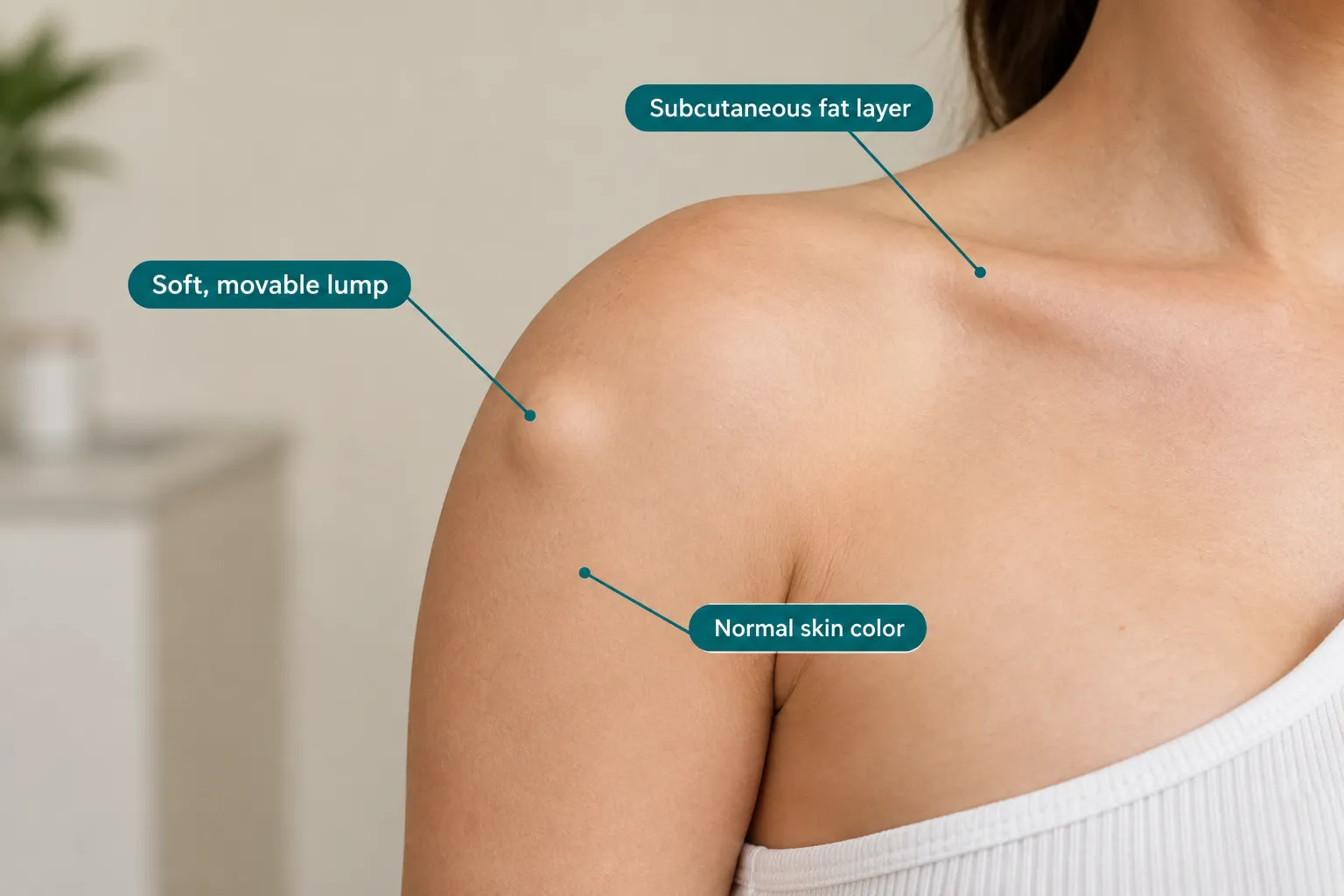
Lipomas are the most common type of soft-tissue tumor in adults, and they can appear almost anywhere fat tissue exists, but the neck, back, arms, and shoulders are especially frequent locations [2][6]. On the shoulder specifically, lipomas tend to sit in the subcutaneous layer, though some grow deeper into muscle (intramuscular lipomas) or along nerve pathways.
What makes a shoulder lipoma distinct:
Decision rule: if a lump on the shoulder is soft, painless, slow-growing, and moves freely when pressed, it fits the classic lipoma pattern. If it feels hard, fixed to deeper tissue, or grows over weeks instead of months, that is not typical and needs medical evaluation rather than a self-diagnosis.
A typical lipoma on the shoulder is not dangerous and is not cancer. The overwhelming majority stay benign for life, but a small subset of deep, atypical, or fast-changing lumps can be liposarcoma (a rare fat-cell cancer) or an atypical lipomatous tumor, which is why unusual features should never be ignored [1][8].
Case series on deep-seated lipomatous tumors of the shoulder have documented atypical lipomas that mimic ordinary lipomas on the surface but show different growth patterns under imaging and pathology [1]. These atypical cases are uncommon, but they explain why doctors sometimes recommend imaging or biopsy for shoulder lumps that do not behave in a classic way.
Warning signs that raise concern about a shoulder lump include:
Edge case: giant shoulder lipomas reported in recent case literature have grown large enough to distort the shoulder contour and interfere with joint movement, requiring more complex surgical planning than a routine small lipoma removal [3]. This is uncommon, but it illustrates why size and depth both matter when a doctor decides whether watching, imaging, or removing is the right next step.
For readers specifically worried about malignant transformation, the article on whether a lipoma can turn into cancer breaks down the distinction between ordinary lipomas, atypical lipomas, and liposarcoma in more detail.
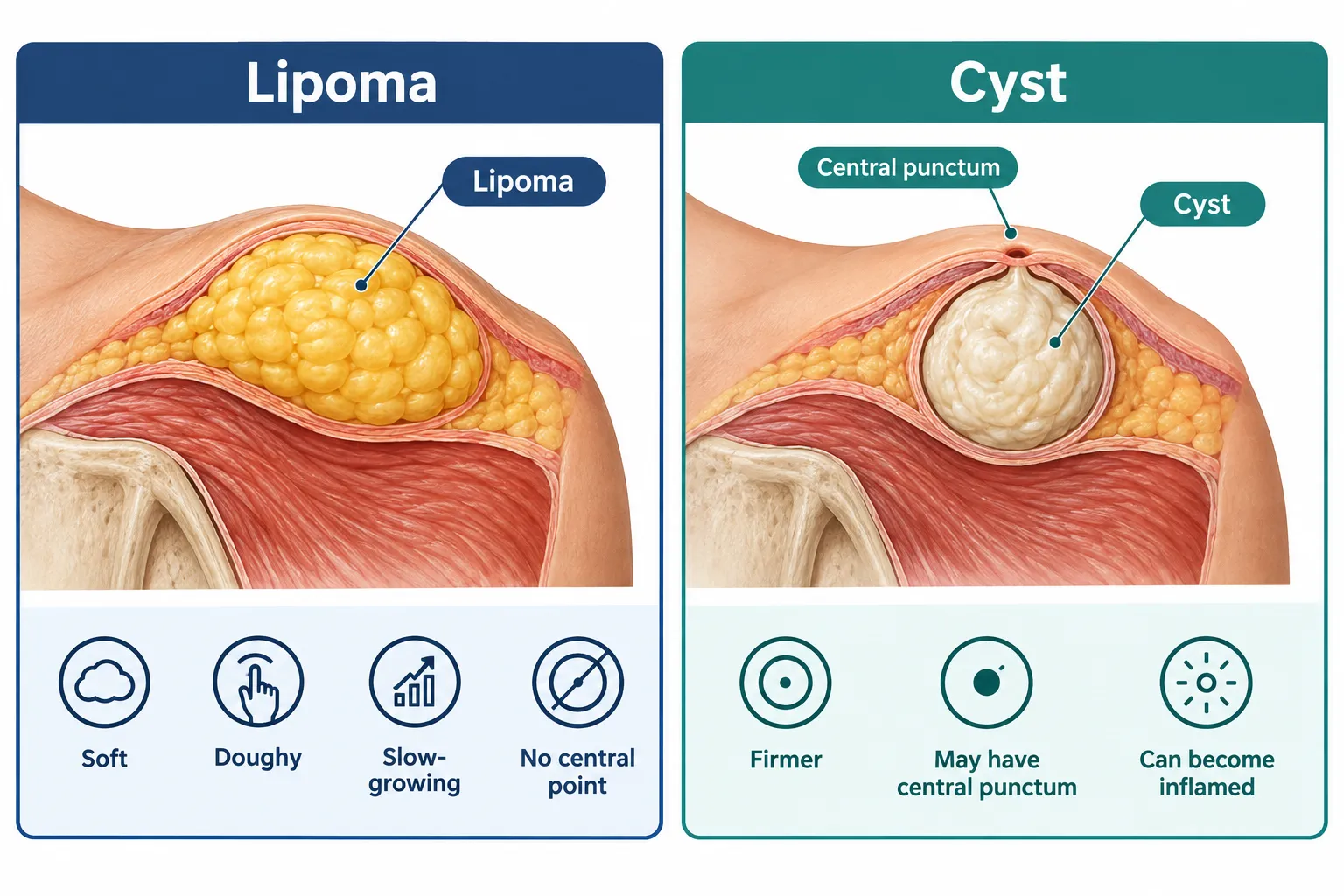
A lipoma feels soft, doughy, and mobile under the skin, while a cyst is often firmer, may have a small visible central pore, and can become red or tender if infected. Other shoulder lumps, such as fibromas, neuromas, or muscle knots, have their own texture and behavior patterns that a clinical exam can usually sort out quickly [7][6].
Because several types of bumps can appear on the shoulder, comparing their features side by side helps clarify what you might be dealing with before seeing a doctor.
FeatureLipomaSebaceous/Epidermoid CystMuscle Knot or FibromaTextureSoft, doughy, rubberyFirmer, sometimes has a central punctumFirm, tender to touchMobilityMoves freely under skinOften less mobile, attached to skinFixed within muscle tissueGrowth speedVery slow, months to yearsCan appear or enlarge over weeksUsually stable, tied to muscle usePainUsually painlessPainful if infected or inflamedOften achy or soreSkin surfaceNormal, unchangedMay have a visible dark dot or openingNormalTypical actionWatch or excise if bothersomeDrain if infected, excise capsuleMassage, physical therapy, or excise
Common mistake: assuming any soft shoulder lump is automatically a lipoma. Cysts, especially epidermoid cysts, can feel deceptively similar at first touch. The clearest distinguishing clue is a central punctum (a tiny dark pore) on a cyst, which lipomas never have [7].
For a deeper breakdown of how clinicians distinguish lipomas from other soft-tissue masses using imaging and exam findings, see differentiating lipomas from other soft tissue masses.
Lipomas develop when fat cells cluster and multiply abnormally in one spot, but the exact trigger is often unknown. Genetics plays a documented role: some people inherit a tendency toward multiple lipomas across the body, a condition called familial multiple lipomatosis [7][2].
Known and suspected contributing factors:
Why the shoulder specifically: the shoulder region has substantial subcutaneous fat and overlying muscle, both of which are recognized locations for lipomas and their variants, including spindle cell lipoma and intramuscular lipoma [1][10]. There is no single reason the shoulder is targeted more than other areas, it is simply a common site along with the back, neck, arms, and thighs.
Decision rule: if you have one soft shoulder lump and no family history of similar lumps, this is likely an isolated, sporadic lipoma. If you notice several lumps forming on different parts of your body over time, mention this pattern to a doctor, since it may point to a hereditary tendency worth tracking.
Shoulder lipomas typically grow very slowly, often taking years to reach a noticeable size, and they do not go away on their own once formed. Unlike a cyst that might drain or an inflamed lump that might resolve, a lipoma's fibrous capsule and fat content stay in place unless physically removed [6][8].
Typical growth pattern:
Can a shoulder lipoma shrink or disappear without treatment? In practice, no. Lipomas do not respond to weight loss, exercise, or diet changes because they are a distinct fatty tumor with its own capsule, not simply stored body fat. Readers curious about this specific question can review whether exercise or diet can shrink lipomas for a fuller explanation of why lifestyle changes do not reduce lipoma size.
Quick example: a person notices a pea-sized lump on the shoulder at age 40. By age 50, it may have grown to the size of a golf ball, having grown gradually the entire time with no pain. This slow, steady pattern is the hallmark of a benign lipoma, distinct from a mass that doubles in size within a month.
See a doctor about a shoulder lump if it grows quickly, feels hard or fixed, causes pain or numbness, or simply makes you unsure what it is. A clinical exam is quick, usually painless, and is the fastest way to separate a routine lipoma from something that needs closer attention [6][8].
Book an appointment if any of these apply:
Major health information portals, including national health services and hospital-affiliated clinics, consistently recommend a clinical exam as the first step for any new soft-tissue lump, followed by imaging such as ultrasound or MRI only if the exam findings are atypical [6][8]. This staged approach avoids unnecessary imaging costs for lumps that are obviously typical lipomas on physical exam, while still catching the rarer cases that need closer investigation.
Edge case worth knowing: deep or intramuscular shoulder lipomas can occasionally compress nearby nerves. A recent case discussion involving suprascapular nerve entrapment linked to a shoulder-area fatty mass illustrates how a lipoma sitting in the wrong location can cause disproportionate symptoms, weakness or pain out of scale with the lump's size, even though the tumor itself remains benign [4]. This is a specific reason doctors take new nerve-type symptoms near a shoulder lump seriously.
Yes, a lipoma can be removed from the shoulder, and surgical excision is the standard, most reliable treatment when removal is medically needed or personally wanted. The procedure is typically done under local anesthesia in an outpatient setting and involves removing the fatty mass along with its capsule [5][8].

Main treatment paths for a shoulder lipoma:
Choose surgical excision if: the lipoma is bothersome, growing, pressing on a nerve, or you simply want it permanently gone. Choose watchful waiting if: the lump is small, stable, and not causing any functional or cosmetic concern.
Deciding who should perform the removal also matters. A general surgeon or dermatologist may both be qualified depending on the lipoma's size, depth, and location, and clinics offering minor surgery services in York Mills or comparable regional centers typically outline which specialist handles which case complexity during a consultation.
For readers weighing where to have the procedure done, a broader comparison of lipoma removal clinics across Toronto, including costs, surgeons, and techniques, can help set expectations before booking a consultation.
Non-surgical treatment options for a shoulder lipoma exist, but none match the reliability of surgical excision, and most carry a higher chance of the lipoma returning. Steroid injections and liposuction are the two most commonly discussed non-surgical routes [5][8].
Non-surgical options and their trade-offs:
Common mistake: attempting to squeeze, cut, or drain a shoulder lipoma at home. This is not the same as draining a pimple or cyst, since a lipoma has a fibrous capsule and sits deeper in tissue; home attempts commonly cause infection, scarring, and incomplete removal, all without actually eliminating the lipoma. Anyone tempted by this route should read about the real dangers of DIY lipoma removal before attempting anything at home.
Decision rule: choose a non-surgical option if the lipoma is small, not bothersome, and you mainly want modest size reduction without downtime. Choose surgical excision if you want the lipoma permanently gone with the lowest chance of recurrence.
Lipoma removal surgery cost varies by lipoma size, depth, location, and whether the procedure is done in a clinic, hospital, or private surgical center, and prices differ significantly by region and provider. Because pricing structures change and depend heavily on individual case complexity, getting a direct quote from a clinic after an in-person or virtual assessment is the most accurate way to know actual costs.
Factors that influence the price of shoulder lipoma removal:
Clinics specializing in minor surgical procedures, such as those offering lipoma removal services in Mississauga, Woodbridge and Vaughan, or Whitby, typically provide individualized quotes during a consultation once they have assessed the lipoma's exact size and depth. This is the most reliable way to get an accurate number rather than relying on general estimates found online.
Removing a shoulder lipoma carries the standard risks of any minor surgery, including infection, bleeding, scarring, and rare nerve irritation, and a lipoma can come back if the capsule is not fully removed. Recurrence is more common with intramuscular or infiltrating lipomas than with simple lipomas confined to the fat layer under the skin [10][8].
Documented risks of shoulder lipoma removal:
A detailed breakdown of what can go wrong and how often is covered in complications from lipoma removal, which outlines both common and rare surgical outcomes in more depth.
Edge case: giant or deep shoulder lipomas that have grown large enough to affect joint function sometimes require a more extensive surgical approach, occasionally involving a specialist familiar with shoulder anatomy, since the surgery must protect surrounding muscle, nerves, and blood vessels rather than simply lifting out a small fatty lump [1][3].
Common mistake: assuming removal guarantees the lipoma will never return. Simple subcutaneous lipomas removed with clear margins rarely recur, but intramuscular and infiltrating variants have a documented higher recurrence rate because their borders blend into muscle tissue, making complete removal more difficult even for an experienced surgeon [10].
To see realistic outcomes and healing timelines, the before and after lipoma removal overview shows what typical recovery and scarring look like at different stages after the procedure.
Is a lipoma on the shoulder always benign?
Most lipomas on the shoulder are benign, but a small number of atypical or deep lesions can mimic liposarcoma. Any lump that grows quickly, feels fixed, or is unusually large should be evaluated with imaging or biopsy rather than assumed benign without a check [1][8].
Can a shoulder lipoma affect arm movement?
Yes, if it grows large enough or sits in a location that presses on a nerve or muscle, a shoulder lipoma can limit range of motion or cause weakness. This is more common with deep intramuscular lipomas than small surface ones [3][10].
Do shoulder lipomas hurt?
Most shoulder lipomas are painless. Pain can develop if the lipoma presses on a nerve, grows rapidly, or is a variant like angiolipoma, which contains blood vessels and tends to be more tender than a typical lipoma.
How is a shoulder lipoma diagnosed?
Diagnosis usually starts with a physical exam checking texture, mobility, and size. If findings are atypical, doctors may order an ultrasound or MRI, and occasionally a biopsy, before confirming the diagnosis [6][8].
Is shoulder lipoma removal an outpatient procedure?
Yes, most shoulder lipoma removals are outpatient procedures done under local anesthesia, allowing the person to go home the same day. Larger or deeper lipomas may occasionally require a more involved surgical setting.
Will insurance cover shoulder lipoma removal?
Coverage depends on medical necessity. A lipoma causing pain, nerve symptoms, or restricted movement is more likely to be considered medically necessary than one removed purely for appearance, but coverage rules vary by provider and region.
Can a lipoma on the shoulder turn into cancer over time?
This is extremely rare. Ordinary lipomas do not typically transform into cancer, but atypical lipomatous tumors and liposarcoma can resemble a lipoma at first glance, which is why unusual growth patterns warrant medical evaluation [1][8].
How long does recovery take after shoulder lipoma removal?
Recovery from a straightforward shoulder lipoma excision generally involves a short healing period of one to two weeks for the incision, with full resolution of swelling and bruising often taking a few weeks longer, depending on lipoma size and depth.
A lipoma on the shoulder is, in nearly every case, a harmless fatty growth that develops slowly under the skin and stays soft, mobile, and painless. The practical path forward is straightforward: watch small, stable lipomas that cause no symptoms, and seek a clinical evaluation for any lump that grows quickly, feels hard or fixed, or comes with pain, numbness, or weakness in the arm. Surgical excision remains the most reliable removal method when treatment is needed, offering the lowest recurrence rate compared with liposuction or steroid injections, though deep intramuscular lipomas require more careful surgical planning and carry a higher chance of returning.
Next steps: if a shoulder lump has changed recently, is affecting movement, or is simply something you want assessed, book a clinical exam rather than guessing based on how it looks or feels. A short consultation can confirm whether it fits the classic lipoma pattern or needs imaging, and it gives a clear plan for whether watching, non-surgical management, or excision is the right choice for your specific case.
[1] Atypical Deep Seated Lipomatous Tumors Of The Shoulder A Case Series - https://www.gavinpublishers.com/article/view/atypical-deep-seated-lipomatous-tumors-of-the-shoulder-a-case-series
[2] Lipoma - https://dermnetnz.org/topics/lipoma
[3] Giant Lipoma Of Unusual Part Of The Body In A 62yearold Post Menopausal Woman A Case Report 115086 - https://www.internationalscholarsjournals.com/articles/giant-lipoma-of-unusual-part-of-the-body-in-a-62yearold-post-menopausal-woman-a-case-report-115086.html
[4] pubmed.ncbi.nlm.nih.gov - https://pubmed.ncbi.nlm.nih.gov/40980795/
[5] Lipoma Removal Treatment Options - https://www.westlakedermatology.com/blog/lipoma-removal-treatment-options/
[6] Lipoma - https://www.healthdirect.gov.au/lipoma
[7] Lipoma Leaflet - https://patient.info/skin-conditions/lipoma-leaflet
[8] Drc 20374474 - https://www.mayoclinic.org/diseases-conditions/lipoma/diagnosis-treatment/drc-20374474
[9] Wjbphs 2024 0340 - https://wjbphs.com/sites/default/files/fulltext_pdf/WJBPHS-2024-0340.pdf
[10] 23907 Intramuscular Lipoma - https://my.clevelandclinic.org/health/diseases/23907-intramuscular-lipoma