
Last updated: November 4, 2026
Yes, a skin biopsy is covered by OHIP when a physician orders it to diagnose a medical concern, such as a suspicious mole or a lesion that might be skin cancer. OHIP does not cover biopsies performed purely for cosmetic reasons, like removing a benign mole someone simply dislikes the look of. The deciding factor is always medical necessity, not the biopsy technique itself.
A skin biopsy is a short procedure where a doctor removes a small piece of skin tissue to examine it under a microscope. It is the only reliable way to confirm whether a mole, growth, or patch of skin is benign or cancerous.
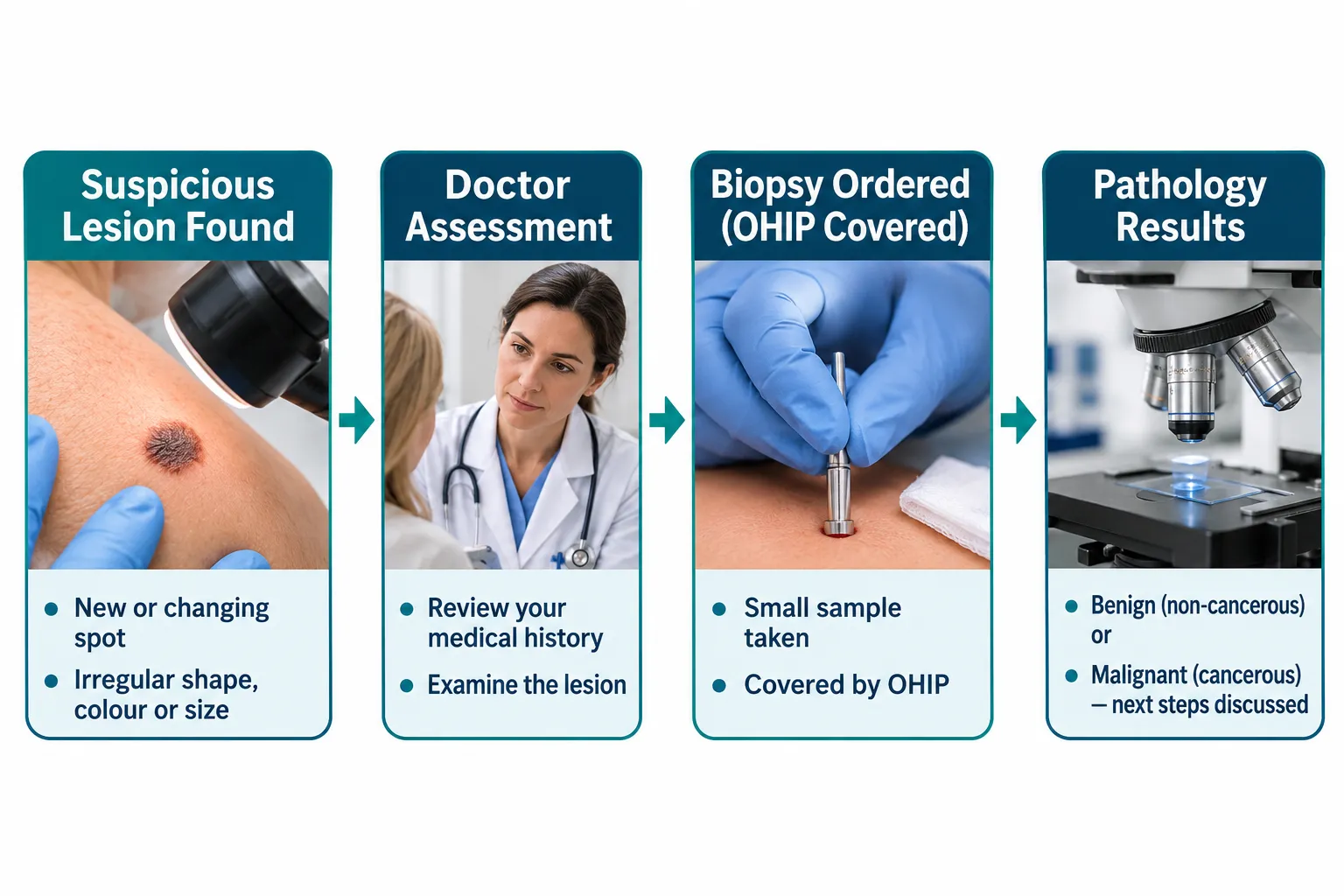
Doctors recommend a biopsy when a lesion shows warning signs: irregular borders, uneven color, rapid growth, bleeding, or a change in shape. A visual exam alone cannot confirm cancer. The tissue sample has to go to a pathology lab for a definitive answer.
Common reasons a biopsy gets ordered:
If you are unsure whether a spot needs this kind of attention, a suspicious spot assessment is the first practical step before any biopsy decision is made.
Yes. When a physician identifies a mole or lesion as clinically suspicious for melanoma or another skin cancer, OHIP covers the assessment, the biopsy itself, and the pathology analysis in full.[1] There is typically no out-of-pocket cost to the patient who holds a valid Ontario health card.
This coverage rule follows directly from OHIP's medical necessity standard. Physician services, including dermatology consultations and minor surgical procedures, are insured when they are required to diagnose or treat a health problem.[2][5][7] Cosmetic or purely elective procedures fall outside that rule and are excluded from coverage.
Example: A 58-year-old patient notices a mole on his shoulder has darkened and grown over six months. His family doctor examines it, documents the asymmetry and color change, and refers him for a biopsy. Because the clinical picture suggests possible melanoma, OHIP covers the biopsy, the lab work, and any follow-up excision if the result comes back cancerous.
Decision rule: choose to pursue OHIP-covered biopsy pathways if a physician has flagged a lesion as suspicious based on changes in size, shape, color, or texture. If the lesion is stable and you simply want it gone for appearance, expect to pay privately.
If a biopsy is medically necessary and billed by an OHIP-eligible physician, it costs the patient nothing out of pocket.[1][2][3] Costs only appear when the procedure is cosmetic, when the patient lacks OHIP eligibility, or when it happens at a private clinic outside the insured system.
The OHIP physician fee schedule includes specific billing codes for skin biopsy procedures, such as Z113 for a skin biopsy and Z116 for a skin biopsy combined with sutures.[2][3] These codes exist precisely because biopsies are recognized as insured diagnostic services when medically indicated.
Situations where you might pay out of pocket:
Common mistake: assuming that because a biopsy happened at a private-sounding "skin clinic," it must be an out-of-pocket expense. In reality, many private clinics still bill OHIP for the physician's medically necessary work, even if the clinic itself operates as a private business.[5] Coverage depends on medical necessity and provider eligibility, not the name or setting of the clinic. For a full breakdown of how diagnosis, biopsy, and removal costs interact, see this guide on skin cancer removal costs in Ontario.
Not always. A family doctor can often perform an initial skin exam and biopsy directly, without a referral. If the case is complex or requires a specialist, your family doctor typically sends a referral to a dermatologist or surgical clinic.[5]
The referral requirement depends on who performs the biopsy:
ProviderReferral neededWho typically handles thisFamily doctorNoRoutine suspicious spotsDermatologistUsually yesComplex or ambiguous lesionsMinor surgery clinicVaries by clinicConfirmed or suspected skin cancer
Edge case: some minor surgery and skin cancer clinics accept direct self-referral for suspicious lesion assessment, skipping the usual family doctor step. It is worth calling ahead to confirm intake rules before booking.
Wait times vary widely depending on urgency and location. A lesion flagged as highly suspicious for melanoma is usually seen within days to a couple of weeks, while a routine dermatology referral for a less urgent concern can take several weeks to a few months.
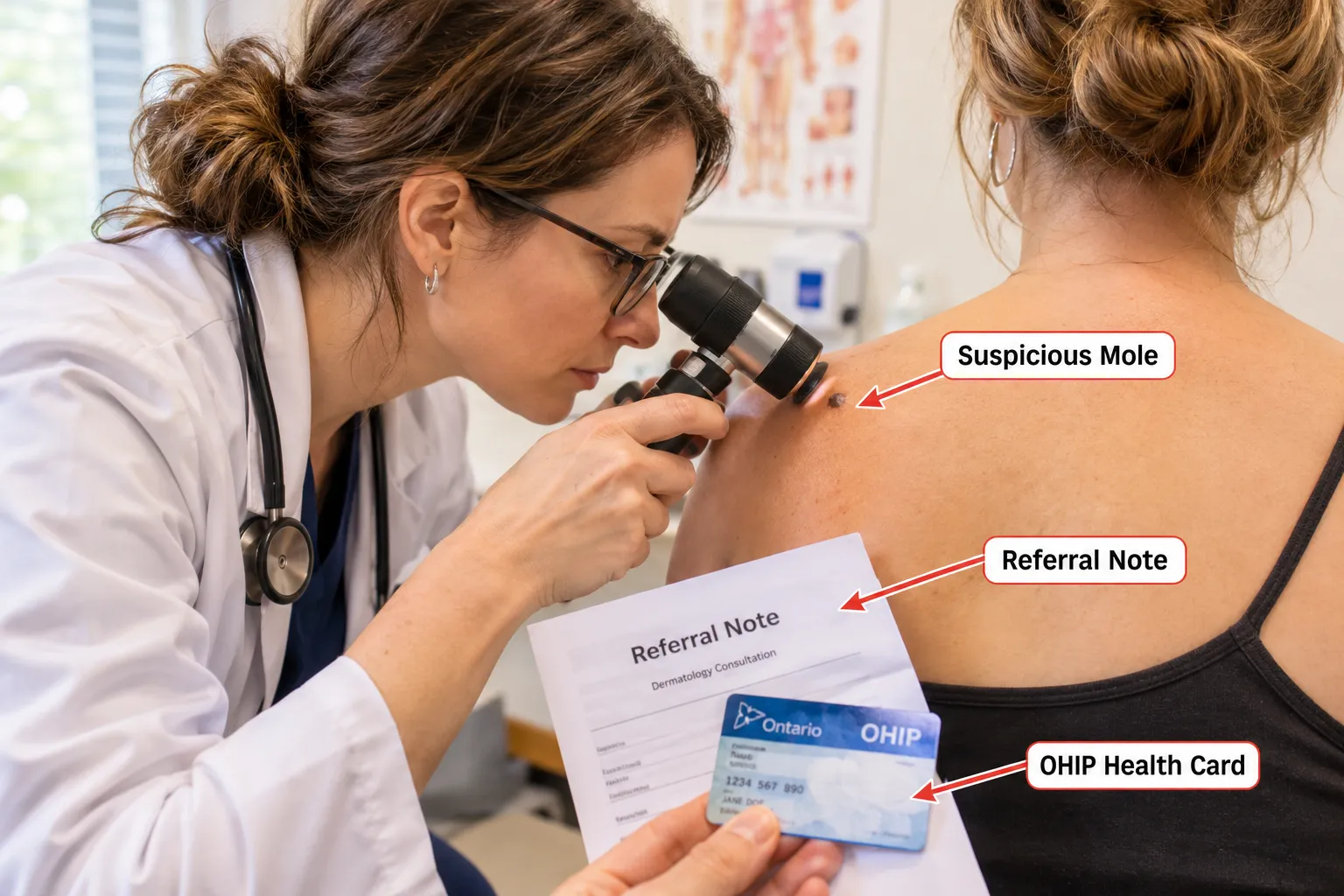
Factors that affect wait times:
Quick example: a patient with a rapidly growing, irregular mole will typically be prioritized over a patient with a stable, long-standing lesion that simply looks a bit odd. Clinics generally triage based on how the lesion's features map to cancer warning signs.
If you are trying to get seen faster, look into dedicated skin cancer clinics in your area, since many offer faster turnaround for assessment and biopsy than a general dermatology waitlist.
OHIP covers the standard biopsy techniques used to diagnose skin conditions, including punch biopsy, shave biopsy, and incisional biopsy, when a physician orders them for a medical reason.[2][8][9]
Here is how the main types compare:
All four are billable under OHIP's physician and laboratory schedules when medically indicated.[2][7][8][9] The choice of technique depends on the lesion's size, location, and how deep the suspicious tissue extends, not on insurance rules. To understand what actually happens during the appointment, see this walkthrough of what happens during a mole biopsy.
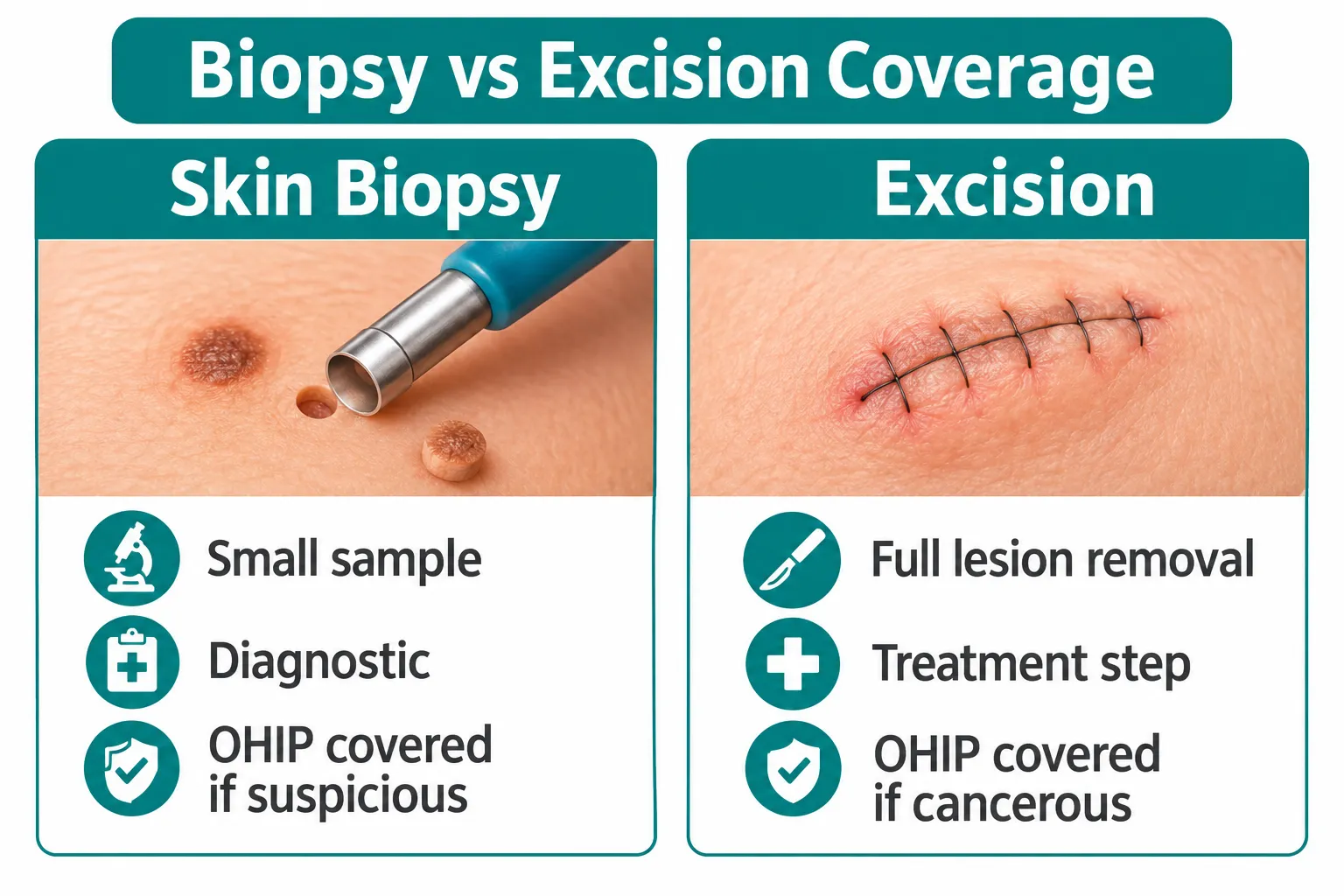
OHIP pays for both, as long as each step is medically necessary. A biopsy diagnoses the problem; an excision removes it, often as treatment once the diagnosis is confirmed. They serve different purposes in the same care pathway.
A simple way to think about it:
If the biopsy shows a benign result and the patient wants the remaining tissue removed purely for looks, that follow-up removal is billed privately. If the biopsy confirms cancer, the excision is covered as medically necessary treatment.[1] Learn more about this covered pathway through our page on OHIP-covered skin cancer removal.
Yes. If a biopsy is cosmetic, or if you want faster access than the public system currently allows, private clinics can perform the procedure for a fee. This is a legitimate option, though it will not be reimbursed by OHIP.
Reasons people choose the private route:
Choose the private pay option if your main driver is convenience or appearance rather than a genuine medical concern. If there's any clinical suspicion of cancer, there is rarely a reason to pay privately, since OHIP already covers the medically necessary version of the same procedure.[1] For a side-by-side look at how these paths differ, read OHIP vs private clinic for minor surgery in Ontario.
OHIP typically declines coverage when the biopsy or removal is classified as cosmetic rather than medically necessary, or when the patient does not hold valid OHIP coverage at the time of service.[1][4]
Common denial scenarios:
Common mistake: patients sometimes assume that because a growth is uncomfortable or annoying (like a skin tag that catches on clothing), it automatically counts as medically necessary. Discomfort alone does not guarantee coverage; the clinical assessment has to point to an actual health risk. For background on this distinction in general minor surgery, see OHIP coverage vs private pay.
Most pathology results come back within one to three weeks after the sample is sent to the lab. More complex cases, or labs with higher volume, can take longer.
What affects turnaround time:
While waiting, avoid picking at the biopsy site and keep the area clean and covered as instructed. If you haven't heard back within three weeks, it's reasonable to call the clinic for an update rather than assume no news is good news.
Skipping a recommended biopsy means the lesion stays undiagnosed, which carries real risk if it turns out to be cancerous. Early-stage skin cancers are generally easier to treat than those caught later, so delay can allow a treatable problem to progress.
Risks of declining a recommended biopsy:
If cost or access is the reason for hesitation, remember that medically necessary biopsies are covered by OHIP, so cost should rarely be the deciding factor.[1] If anxiety about the procedure is the concern, ask the clinic to explain exactly what the appointment involves; most biopsies are quick and well tolerated. You can also review self-exam guidance through this skin cancer self-exam check to track changes while deciding.
A family doctor can perform a basic skin biopsy for straightforward cases. More complex or ambiguous lesions, or cases needing specialized equipment, usually go to a dermatologist or a minor surgery clinic experienced in skin lesion work.
How the two roles typically split:
Choose your family doctor first if the lesion looks relatively straightforward and you want the fastest path to a biopsy. Choose a dermatologist or specialty clinic if the lesion is ambiguous, in a tricky location, or if your family doctor recommends specialist review.
Most skin biopsies involve only mild discomfort because the area is numbed with local anesthetic beforehand. Scarring is usually minor and fades over time, though the exact outcome depends on biopsy type, location, and individual healing.
What to expect:
Edge case: biopsies on the face, chest, or back sometimes heal with a slightly more visible mark due to skin tension in those areas. If scarring is a concern, mention it before the procedure so the physician can choose a technique and closure method that minimizes visible marks. For a detailed look at the biopsy procedure itself, see what happens during a mole biopsy.
No. OHIP does not cover biopsies or removals done purely to improve appearance when there is no underlying medical concern. This includes removing benign moles, skin tags, or other growths simply because the patient dislikes how they look.[1][4]
How clinics generally apply this rule in practice:
If you're unsure which category your situation falls into, a proper clinical assessment is the right first step, since it clarifies whether OHIP will apply before any procedure happens. Explore options for cosmetic removal and OHIP-covered care through our cosmetic mole removal guide and our skin lesion assessment service in Toronto.
Does OHIP cover a punch biopsy?
Yes, a punch biopsy is covered by OHIP when a physician orders it to diagnose a suspicious lesion. It is billed under the standard skin biopsy codes used for medically necessary procedures.[2][3]
What is the skin biopsy cost without insurance in Ontario?
If the biopsy is cosmetic or the patient lacks OHIP eligibility, costs vary by clinic and are set privately. Medically necessary biopsies for OHIP-eligible patients cost nothing out of pocket.[1]
Does OHIP cover a biopsy for a mole that might be melanoma?
Yes. When a physician suspects melanoma based on a lesion's appearance or changes, OHIP covers the assessment, biopsy, and pathology review in full.[1]
Do I need a referral for a skin biopsy in Ontario?
Not always. A family doctor can often perform the biopsy directly. A dermatologist usually requires a referral unless the clinic accepts self-referrals.[5]
How long do skin biopsy results take in Ontario?
Most results come back within one to three weeks, though timing depends on lab workload and case complexity.
Is a skin biopsy covered by OHIP if it's for a skin tag?
No, removing a benign skin tag purely for comfort or appearance is generally billed privately, since it does not meet the medical necessity standard.[1]
Can a walk-in clinic do a skin biopsy covered by OHIP?
Some walk-in clinics can perform basic biopsies if a physician determines it is medically necessary. More complex cases are usually referred to a dermatologist or specialty clinic.
Does OHIP cover a full-body skin check before a biopsy?
Routine full-body screening without a specific concern is generally not covered. If a specific lesion found during that exam is deemed suspicious, the follow-up assessment and biopsy are typically covered.[5][6]
A skin biopsy is covered by OHIP when a physician determines it is medically necessary, typically because a mole or growth shows signs that could indicate skin cancer. Cosmetic removals and biopsies done purely for appearance fall outside that coverage and are billed privately. The deciding line is always medical necessity, not the specific biopsy technique or the clinic's branding.
If you've noticed a changing mole, a sore that won't heal, or any growth that concerns you, the practical next step is a proper clinical assessment rather than guessing from home. Book a suspicious spot assessment to find out whether your situation qualifies for OHIP-covered biopsy and, if needed, learn more about the full pathway to OHIP-covered skin cancer removal.