
Last updated: October 7, 2026
Basal cell carcinoma grows slowly, so a wait of a few weeks to arrange assessment and removal rarely changes the outcome for a small, low-risk lesion. Waiting many months to years is a different matter: the tumor keeps enlarging, can damage nearby skin, nerves, or cartilage, and becomes harder to remove with a simple procedure. In Ontario, basal cell carcinoma removal is covered by OHIP and is often completed in a single clinic visit once a diagnosis is confirmed.
A small, low-risk basal cell carcinoma, such as a superficial or nodular subtype away from the face, can often wait up to about three months for treatment without materially worsening outcomes, according to pandemic-era specialist consensus guidance, and some guidance extends this to three to six months for carefully selected, low-risk cases [9]. This window is not a target to aim for; it describes the outer edge of what has been considered acceptable when delay is unavoidable.
The "safe to wait" window depends heavily on three factors:
Choose a cautious, shorter timeline (weeks, not months) if the lesion is growing visibly, located near the eye, nose, or ear, or if a biopsy has not yet confirmed the subtype. For context on how specialists classify these risk categories, see this comparison of high-risk vs low-risk BCC.
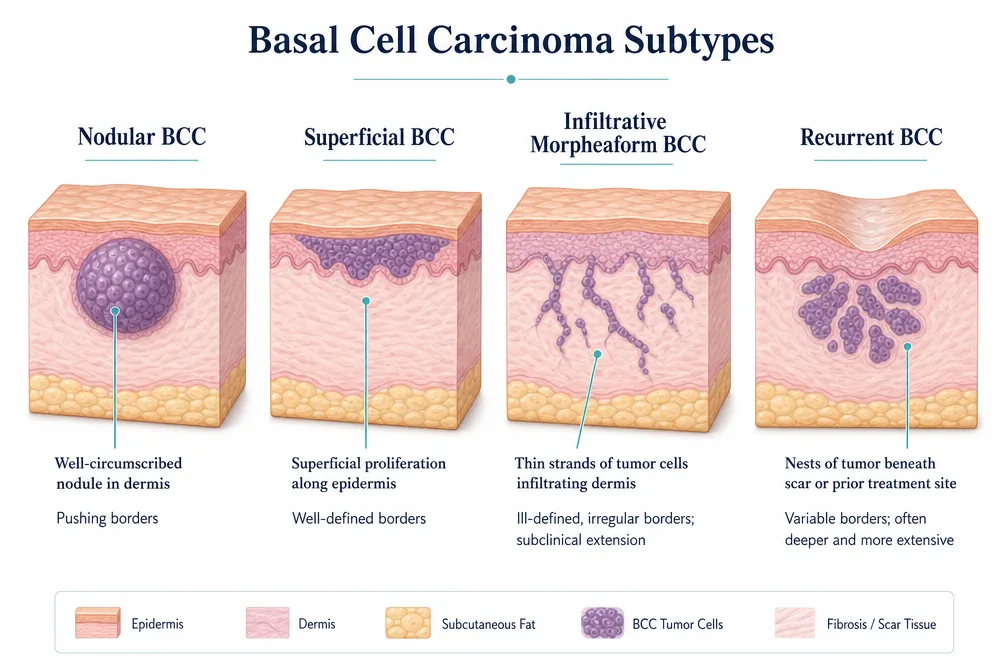
Basal cell carcinoma typically grows slowly compared with many other cancers, with some watchful-waiting research cohorts measuring growth of roughly 1 millimetre per year for certain subtypes [4]. Growth rate is not uniform, however, and varies by subtype, with infiltrative and morpheaform forms tending to extend more aggressively beneath the visible skin surface than their size on the surface suggests [5].
Clinical overviews describe BCC as having a "slow but destructive" growth pattern: the tumor may look unchanged for months, yet continue to erode tissue beneath the surface [6]. This is why size alone is a poor guide to urgency. A lesion that appears stable on the skin surface can still be advancing along nerves or into cartilage, particularly on the nose or ear.
Common mistake: assuming a BCC that "hasn't gotten bigger" in a few months is safe to ignore indefinitely. Surface appearance can lag behind what is happening in deeper tissue layers [6].
Certain basal cell carcinomas should be treated promptly rather than monitored, specifically infiltrative or morpheaform subtypes, lesions on the face (especially the nose, ear, eyelid, or lip), recurrent tumors, and BCC in patients who are immunosuppressed. These categories carry a higher risk of deeper tissue invasion or treatment failure if removal is delayed [5][7].
SituationWhy timing matters moreSuggested actionInfiltrative or morpheaform BCCTends to extend beneath the skin beyond visible borders, making margins harder to judgeSeek assessment and treatment promptly, ideally within weeksFace, nose, ear, or eyelid locationLimited tissue and proximity to critical structures raise the stakes of any delayPrioritize early referral; consider Mohs surgery evaluationRecurrent BCC (previously treated)Scar tissue can mask the true extent of the tumorTreat without extended watchful waitingImmunosuppressed patientsTumors can behave more aggressively and heal less predictablyAvoid deferring beyond a few weeksSmall, low-risk superficial or nodular BCC on trunk/limbLower risk of rapid local damageMay be reasonable to wait up to about 3 months for scheduling [9]
A short, self-contained decision rule: if the lesion sits on the central face or has features suggestive of an infiltrative pattern on biopsy, do not wait for a routine opening months away; ask about earlier options. For a broader look at how dermatologists distinguish these categories, see early-stage basal cell carcinoma.
An untreated basal cell carcinoma continues to grow locally, can ulcerate and bleed, and may invade underlying structures such as muscle, nerve, or bone over months to years. Case reports and clinical reviews describe morbidity rising sharply with prolonged neglect, particularly for tumors on the scalp, nose, and ears where there is less tissue to spare [6].
What tends to happen as a BCC is left alone for years:
Edge case: a very slow-growing superficial BCC on the back might remain small-looking for a long period, but this does not mean it is safe to leave permanently. Clinical guidance is consistent that the goal is complete removal, with timing individualized to the patient, not indefinite observation [1][10]. Recovery expectations after treatment are covered in basal cell carcinoma recovery: what to expect after removal.
Basal cell carcinoma rarely spreads to distant organs, which distinguishes it from melanoma and from more aggressive skin cancers, but it can still cause significant local tissue destruction if left untreated [1][6]. Distant metastasis is considered uncommon, but local invasion into nerves, cartilage, and bone is well documented in neglected cases [6].
This is the central difference between basal cell and melanoma urgency: melanoma has a meaningful risk of spreading through the lymphatic or bloodstream to other organs relatively early, which is why suspected melanoma is treated as a more time-sensitive emergency. Basal cell carcinoma, by contrast, is usually described as a local problem that should be treated promptly but is not typically classified as an oncologic emergency in the way an aggressive melanoma can be [1]. A detailed explanation of local invasion patterns is available at does basal cell carcinoma spread.
Basal cell carcinoma is not usually a medical emergency, but it is also not something to set aside indefinitely; it sits in a middle category where prompt assessment matters even though same-day treatment is rarely required. Major cancer organizations describe prompt treatment as "vital" even for low-risk tumors, while acknowledging that a reasonable scheduling window exists [1][9].
Decision rule: treat it as urgent (seek assessment within days to a couple of weeks) if there is rapid growth, new bleeding, pain, or numbness. Treat it as routine-but-important (seek assessment within weeks to a few months) if the lesion is small, stable, and in a low-risk location [5][7][9].
Basal cell carcinoma does not resolve on its own and requires active treatment to achieve removal, according to standard dermatologic and oncologic guidance [1][10]. It may appear to shrink temporarily after minor trauma or crusting over, but this is not resolution; the tumor persists beneath the surface and typically continues to grow [6].
Do you have to remove it, or can you simply monitor it? For a confirmed BCC, monitoring without any plan for eventual treatment is not standard practice. Active surveillance for a strictly limited period can be reasonable for carefully selected low-risk lesions under physician supervision, but this differs from indefinite "watch and wait" with no endpoint [9].
There is no fixed safe limit, but published consensus guidance for low-risk cases suggests delays of up to roughly three months, and in select situations three to six months, are generally considered acceptable when treatment cannot be arranged sooner [9]. Beyond that range, the balance of evidence favours treating rather than continuing to wait, particularly as growth and local tissue involvement accumulate over time [4][6].
What happens if basal cell carcinoma is left alone for years is well described in case literature: lesions can grow substantially, ulcerate, bleed intermittently, and in advanced neglected cases invade deep structures, sometimes requiring extensive reconstructive surgery [6]. This outcome is avoidable with timely assessment, which is why most clinical guidance frames the goal as complete removal on an individualized but not indefinite timeline [1][10].
Location matters significantly for timing: basal cell carcinoma on the face, especially near the nose, ear, eyelid, or lip, warrants faster action than a similar lesion on the trunk or limb, because there is less healthy tissue margin and the cosmetic and functional stakes are higher. Authoritative clinical overviews note strong support for early detection and prompt management specifically for facial and other cosmetically sensitive sites [7].
A BCC on the back or thigh that is small, superficial, and stable may fit within the longer end of an acceptable waiting window. The same size and subtype of lesion on the nasal tip carries higher urgency because local anatomy leaves little room for the tumor to expand before it reaches cartilage or threatens nearby structures [7].
Basal cell carcinoma is treated with one of several established methods, including surgical excision, Mohs surgery, or curettage and electrodesiccation, with the choice depending on subtype, size, and location; in Ontario, these procedures are generally covered by OHIP when medically necessary [10]. Mohs surgery is typically reserved for higher-risk tumors, including those on the face or with infiltrative features, because it allows the surgeon to check margins layer by layer during the same procedure [10].
A brief comparison:
TreatmentBest suited forKey featureSurgical excisionMost nodular and superficial BCCsRemoves lesion plus a margin, sent for pathologyMohs surgeryHigh-risk, recurrent, or facial BCCMargin-checked layer by layer during surgeryCurettage and electrodesiccationSmall, low-risk superficial BCCScraping and heat treatment of the lesion base
For a full breakdown of how pricing and OHIP coverage work in practice, see skin cancer (BCC/SCC) removal cost in Ontario.
Yes, removal of a confirmed or strongly suspected basal cell carcinoma is generally covered by OHIP in Ontario, because it is treated as a medically necessary procedure rather than a cosmetic one [10]. Coverage typically applies to the assessment, the removal procedure itself (excision, curettage and electrodesiccation, or Mohs surgery where indicated), and the pathology review of the removed tissue.
The Minor Surgery Center removes basal cell carcinoma with OHIP coverage in GTA community clinics, and no referral is needed for an initial assessment; details are available on the skin cancer removal in York Mills page and the basal cell carcinoma condition overview.
The timeline for removing a basal cell carcinoma in Ontario depends on the referral pathway chosen: a routine dermatology referral can take up to roughly 18 weeks for suspected skin cancer, while a community minor surgery clinic that accepts self-referral can often arrange assessment and removal considerably sooner [2]. This difference matters most for lesions that fall into the "should not wait long" category described earlier.
Two common pathways:
For more detail on how wait times for dermatology appointments are trending in Ontario, see how long is the wait to see a dermatologist in Ontario.
While waiting for a scheduled assessment or removal, watch for rapid growth, bleeding that does not stop or recurs repeatedly, new pain or numbness, or an open sore that will not heal, as these are signs that the situation may be progressing faster than expected. Any of these changes warrants contacting the treating physician promptly rather than waiting for the originally scheduled appointment [1][6].
Red flags that should prompt earlier contact:
How long can you wait to remove basal cell carcinoma without risk?
A small, low-risk BCC may reasonably wait up to about three months, based on consensus guidance from the pandemic period, though earlier assessment is always preferable when it can be arranged [9].
Can basal cell carcinoma wait six months?
Some guidance allows a three-to-six-month window for carefully selected, low-risk lesions under physician supervision, but this is not appropriate for facial, recurrent, or infiltrative BCC [5][9].
Is basal cell carcinoma more urgent than melanoma?
No. Melanoma carries a higher risk of spreading to distant organs and is generally treated with greater urgency; basal cell carcinoma is a local problem that should be treated promptly but rarely spreads internally [1].
What happens if basal cell carcinoma is not removed for years?
It typically continues to grow, can ulcerate and bleed, and may invade deeper structures such as nerve, cartilage, or bone, according to clinical case reviews [6].
Does basal cell carcinoma on the face need faster treatment than on the body?
Yes. Facial lesions, especially near the nose, ear, or eyelid, have less tissue margin and higher functional and cosmetic stakes, so clinical guidance supports earlier management [7].
Is basal cell carcinoma removal covered by OHIP in Ontario?
Yes, when it is medically necessary, assessment, removal, and pathology review of basal cell carcinoma are generally covered under OHIP [10].
This article provides general information and is not medical advice. Decisions about how long to wait before removing a specific basal cell carcinoma should be made together with the treating physician.
[1] Basal Cell Carcinoma - https://www.aad.org/public/diseases/skin-cancer/basal-cell-carcinoma
[2] Skin Cancer - https://www.macmillan.org.uk/cancer-information-and-support/skin-cancer
[4] Pmc7301000 - https://www.ncbi.nlm.nih.gov/pmc/articles/PMC7301000/
[5] academic.oup - https://academic.oup.com/bjd/article/174/6/1258/6617056
[6] Nbk482439 - https://www.ncbi.nlm.nih.gov/books/NBK482439/
[7] Basal Cell Carcinoma - https://www.pcds.org.uk/patient-info-leaflets/basal-cell-carcinoma
[9] Treatment Of Most Common Skin Cancer Can Sometimes Wait - https://www.radboudumc.nl/en/news-items/2021/treatment-of-most-common-skin-cancer-can-sometimes-wait
[10] Drc 20354193 - https://www.mayoclinic.org/diseases-conditions/basal-cell-carcinoma/diagnosis-treatment/drc-20354193