
Last updated: September 22, 2026
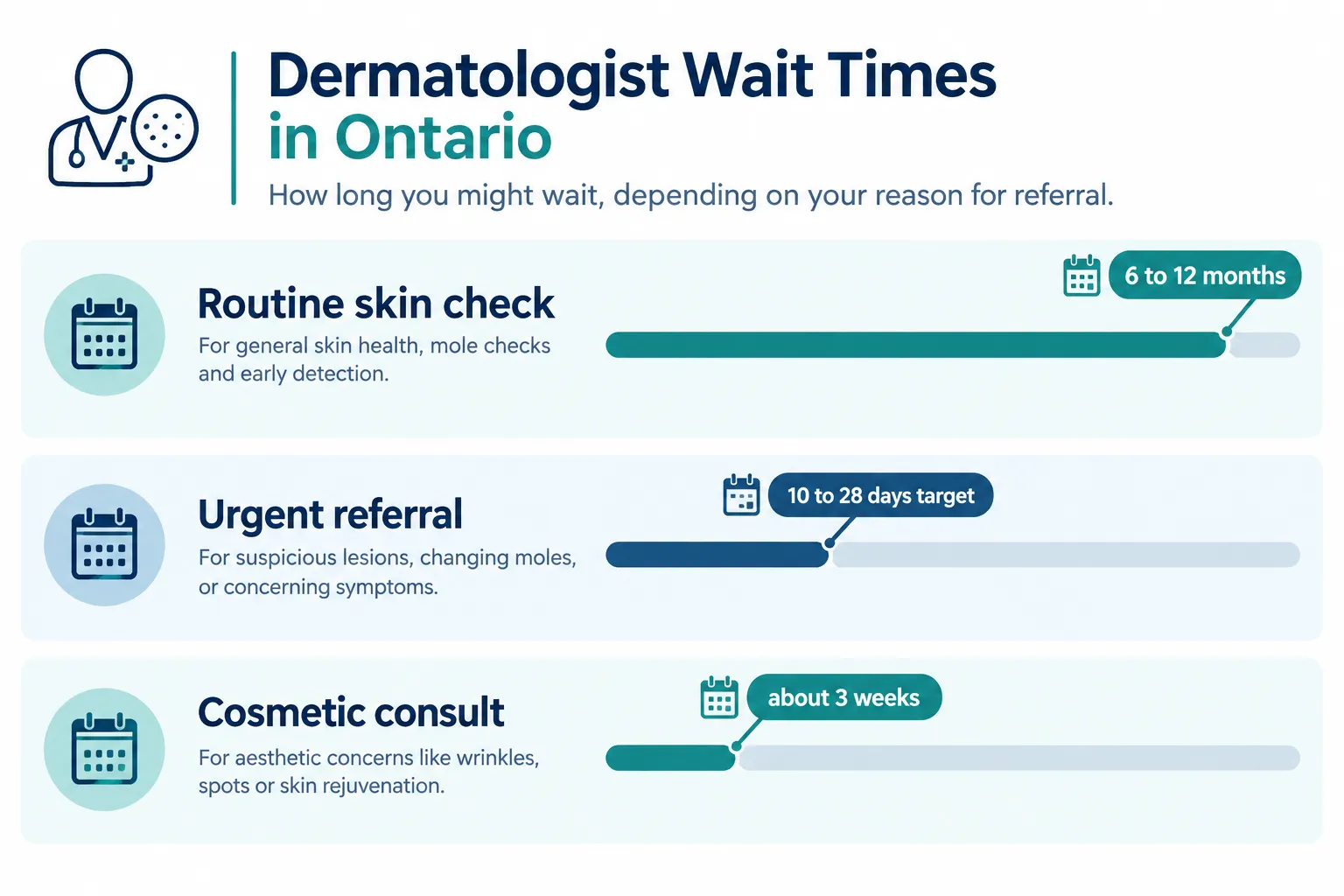
How long is the wait to see a dermatologist in Ontario in 2026? For a routine, non-urgent referral, most patients wait somewhere between 6 and 12 months, though the exact number depends heavily on region, urgency, and whether care is public or private [1][4][7]. Urban centres like Toronto and Ottawa tend to sit at the shorter end (3 to 8 months), while rural and northern communities regularly see waits of 12 to 20 months [4][7][9][10]. Patients who need a quick answer on a suspicious mole or lesion have faster options, including no-referral private clinics and telemedicine, that can shrink the wait to days rather than months.
The average dermatologist wait time in Ontario in 2026 for a routine referral is between 6 and 12 months, with a system-wide average closer to 4 months when urgent and semi-urgent cases are blended into the calculation [7][1][4]. Ontario's broader specialist wait time, covering all specialties, sits at roughly 19.2 weeks from the day a family doctor sends a referral to the day treatment actually happens, and dermatology tracks closely with that provincial pattern [1][9].
These numbers are not static. They shift depending on:
Pilot data tracking Ontario referral-to-appointment times found median waits around 78 to 90 days (11 to 13 weeks) in urban centres, 110 days in rural southern Ontario, and 130 days in northern Ontario [2][3][9]. Patient advocacy groups and skin health resources continue to describe "about six months" as a reasonable average expectation for a first dermatologist appointment for a non-urgent skin condition, with rural patients often exceeding that figure [5][1][4].
Choose the 6-to-12-month estimate if you have a stable, non-urgent skin condition and your family doctor is referring you through the standard OHIP pathway. Expect the shorter end (3 to 6 months) if you live in the GTA or Ottawa and your referral is flagged as semi-urgent. Expect the longer end (12+ months) if you live in a rural or northern community and your condition is classified as cosmetic or low-priority.
A common mistake patients make is assuming all dermatology visits are treated equally. A referral for a new, irregular mole should never sit in the same queue as an acne follow-up, but without a doctor explicitly marking urgency on the referral form, it often does.
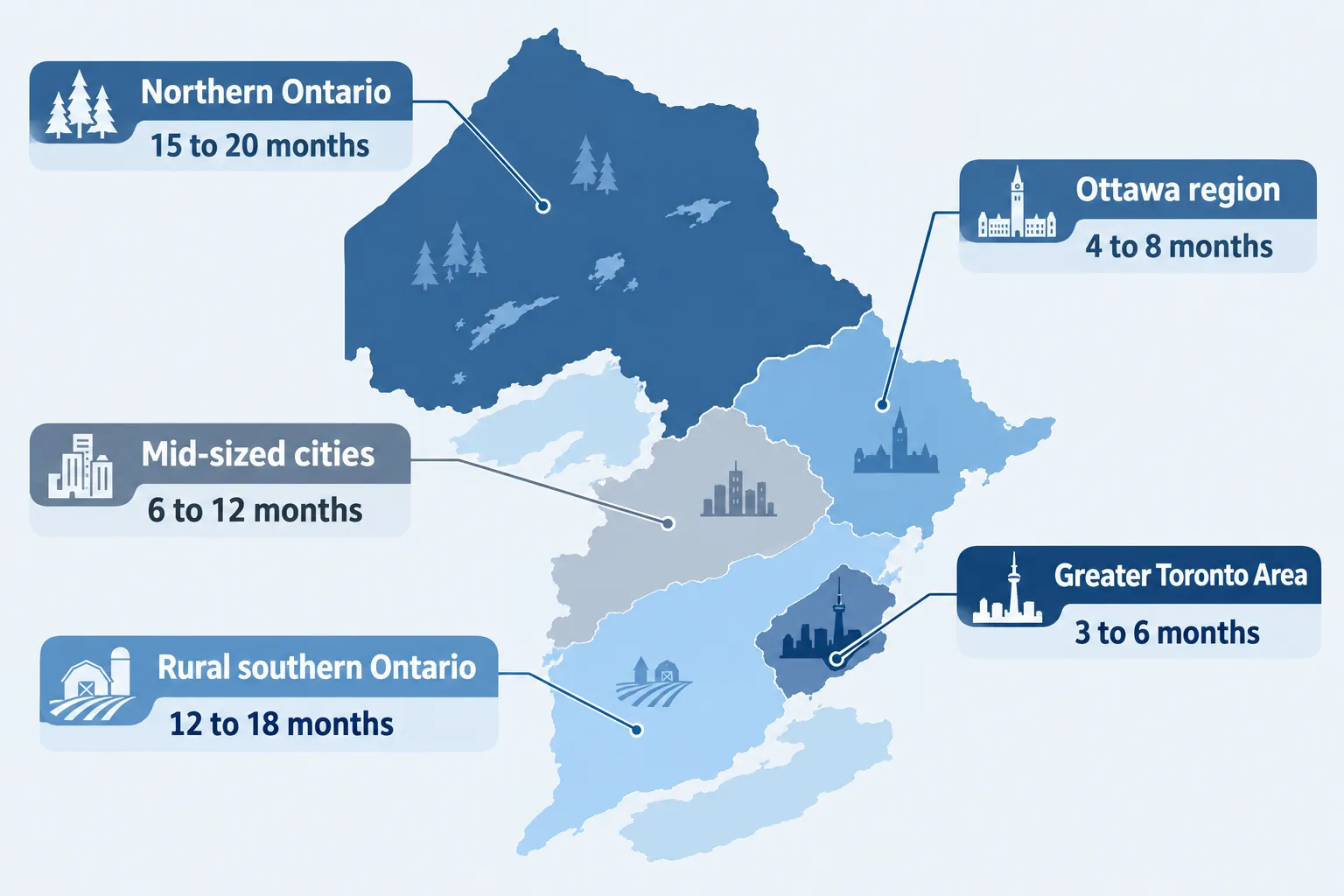
Dermatologist wait times in Ontario vary enormously by region, ranging from about 3 months in parts of the Greater Toronto Area to as long as 20 months in some northern communities [4][7][9][10]. Geography is one of the single biggest factors determining how quickly a patient gets seen.
Here is how the regional picture generally breaks down in 2026, based on practice-level access data and pilot program findings [2][3][4][7][9][10]:
RegionTypical wait for routine referralNotesGreater Toronto Area3 to 6 monthsMost dermatologists per capita, but also highest demandOttawa and surrounding area4 to 8 monthsModerate supply, growing population pressureMid-sized Ontario cities (e.g., Guelph, Kitchener-Waterloo, Barrie)6 to 12 monthsFewer specialists relative to population growthRural southern Ontario12 to 18 monthsLong travel distances compound scheduling delaysNorthern Ontario15 to 20 months (occasionally longer)Severe specialist shortage; some areas report waits of a year or more
Northern Ontario deserves special attention. Reporting on the region shows waits commonly running 4 to 6 months in cities like Sudbury, but patients elsewhere in the north have described waits of "at least a year," which has pushed many toward online dermatology services offering appointments within about two weeks [10][1][4].
Edge case: a patient in a mid-sized city who travels regularly to Toronto for work may be able to register with a GTA-based dermatology clinic and access shorter urban wait times, even without living there permanently. This is a practical workaround many Ontarians use, since OHIP coverage isn't restricted by home address for specialist visits.
If you're trying to find a dermatologist in a specific city, resources like Find a Dermatologist in Toronto or a broader directory such as Find the Best Dermatologist in Toronto can help identify which clinics currently have shorter booking windows. Patients in the west GTA may also want to check listings for a best dermatologist in Brampton.
Long dermatologist wait times in Ontario are caused mainly by a shortage of practicing dermatologists relative to population growth, combined with rising referral volumes for skin cancer screening and chronic skin conditions [1][9][10]. The problem is structural, not seasonal, and it has been building for years.
The main contributing factors include:
Common mistake: assuming a long wait means the referral was lost or mishandled. In most cases, the delay simply reflects queue position and geographic supply, not an administrative error. That said, it is reasonable to call the dermatologist's office after 4 to 6 weeks to confirm the referral was received and to ask where you sit in the queue.
Ontario is facing a genuine dermatologist shortage in 2026, and this shortage is the single largest reason routine wait times remain long across most of the province [1][9][10]. The shortage is most severe outside the GTA and Ottawa corridor.
Key characteristics of the 2026 shortage:
Quick example: a patient in Sudbury with a stable but concerning mole might wait 4 to 6 months for a public dermatology appointment, while a patient in downtown Toronto with the same concern might wait 3 to 4 months for a public visit but only 1 to 2 weeks for a private or virtual skin check.
Private dermatology and skin check services in Ontario typically offer appointments within days to two weeks, while public OHIP-covered dermatology referrals average 4 to 12 months depending on region and urgency [7][10][1]. The gap between the two pathways has widened noticeably in 2026 as public wait lists have grown.
Quick comparison: public vs private dermatology access in Ontario
Decision rule: choose the public OHIP pathway if your condition is stable, not urgent, and you are comfortable waiting several months. Choose a private or no-referral option if you have a new or changing mole, a family history of melanoma, or simply cannot tolerate months of uncertainty about a suspicious spot.
Patients specifically weighing whether to wait for the public system or pay for private care with a suspicious skin lesion often compare this decision directly with minor skin surgery vs waiting to see a dermatologist, which lays out the tradeoffs of each path in more depth. For a broader look at reputable private options, see this guide to the best private dermatologist near me in Ontario.
The fastest way to get a dermatologist appointment in Ontario is to have your family doctor mark the referral as urgent when medically justified, and to simultaneously explore no-referral private or virtual clinics that do not require going through the standard OHIP queue. Combining both strategies gives patients the best odds of being seen quickly.
Practical steps that actually move the needle:
Common mistake: waiting weeks to follow up because "the doctor's office will call when it's ready." In a system this backlogged, being proactive and calling the clinic yourself is often the difference between a 4-month wait and a 9-month wait.
For anyone who wants to shortcut the referral process entirely for a mole or spot check, a mole check without a referral in Toronto is a direct route to a professional skin assessment without waiting on the family doctor pipeline.
Yes, it is possible to skip the standard public referral queue in Ontario by booking directly with a private clinic or a walk-in skin assessment service that does not require a family doctor referral for the initial evaluation. This does not bypass OHIP rules improperly; it simply uses a parallel, patient-paid pathway that exists alongside the public system.
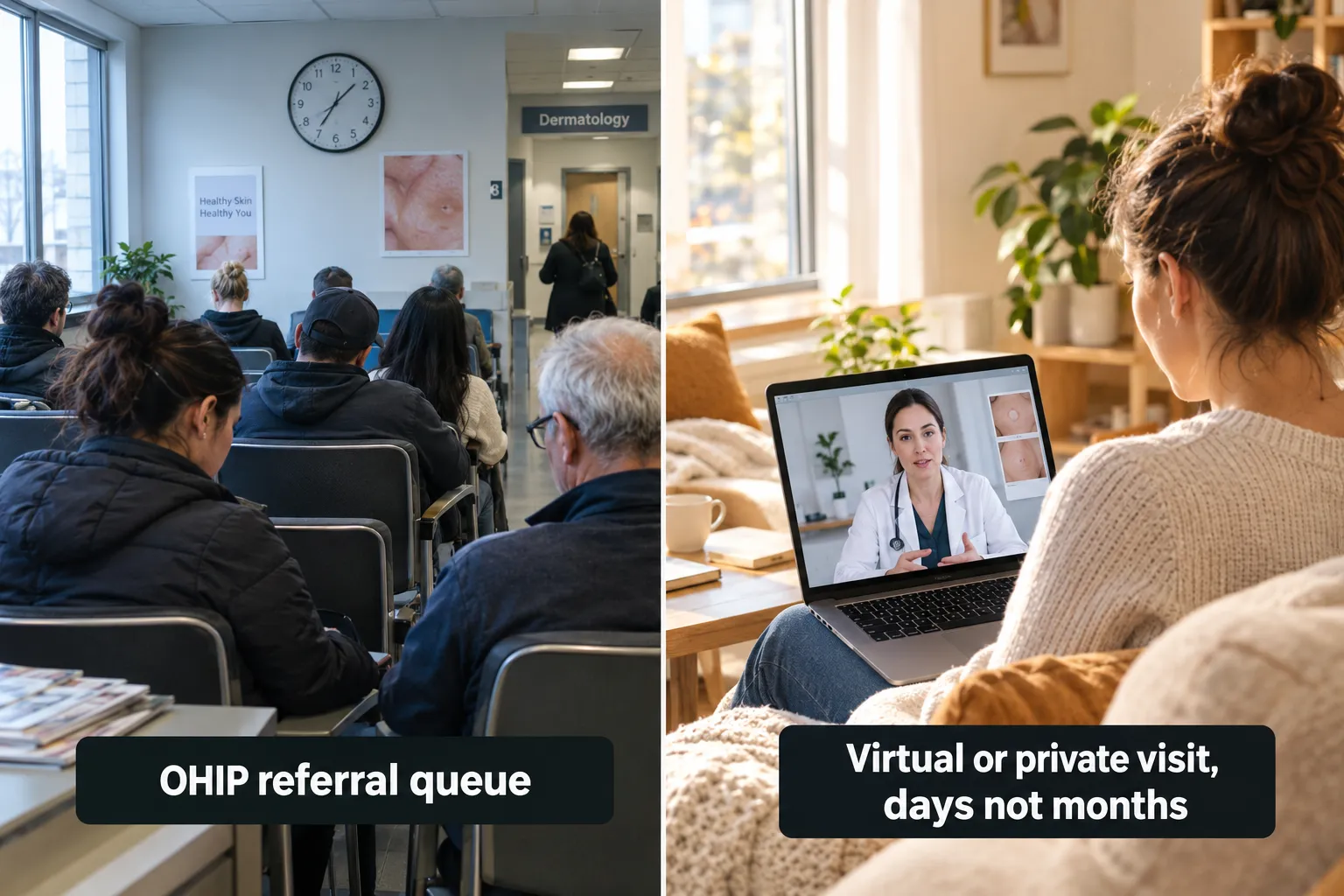
How this works in practice:
Edge case: patients with OHIP coverage but no family doctor at all are increasingly common in Ontario given the primary care shortage. For these patients, a no-referral private skin check is often the only realistic way to get a mole or lesion evaluated in a reasonable timeframe, since they cannot even start the standard referral process.
Anyone specifically concerned about a mole, freckle, or skin growth should look at a dedicated skin lesion assessment in Toronto, which is built around fast, no-referral evaluation rather than the standard months-long dermatology queue.
Patients with a genuinely urgent skin concern, such as a rapidly changing mole, sudden severe rash, or suspected skin infection, do not have to wait months in Ontario, because urgent pathways and private walk-in options exist specifically to handle time-sensitive cases. The key is recognizing when a concern qualifies as urgent and knowing which door to walk through.
Signs that justify seeking urgent (not routine) dermatology care:
For any of these, the recommended path is: see a family doctor or walk-in clinic immediately, ask for the referral to be explicitly marked urgent, and in parallel book a private or no-referral skin check so the concern is assessed within days rather than the 10 to 28 day target window that public urgent referrals often miss [2][3][9]. Patients dealing with lumps under the skin rather than pigmented lesions may also want to review whether they need a dermatologist or a general surgeon for lipoma removal, since the right specialist depends on the type of growth.
Common mistake: assuming urgent means automatic same-week access through OHIP. In reality, urgent referrals are prioritized relative to other urgent cases, not guaranteed a specific date, which is why many patients with genuinely concerning lesions still choose a private path for speed and certainty.
Walk-in dermatology clinics and telemedicine services in Ontario can often provide an assessment within days, compared to months for standard OHIP referrals, making them a practical option for patients who need answers quickly [10][7]. These services are not a replacement for the public system for complex or surgical cases, but they excel at fast triage and mole or lesion checks.
What to expect from each option:
If the concern involves a mole specifically, comparing app-based screening tools can also help patients decide what level of care they need before booking; see this review of the best mole check app in 2026 for context on what these tools can and cannot replace.
Decision rule: use a walk-in or telemedicine option if your main need is reassurance, triage, or a quick professional opinion. Return to the standard OHIP dermatology pathway (or a private surgical clinic) if the lesion needs to be removed, biopsied, or monitored long-term as part of ongoing specialist care.
A private dermatology consultation in Ontario generally costs somewhere in the range of a modest flat consult fee, though the exact amount varies by clinic, and many medically necessary procedures performed afterward can still be billed to OHIP. The upfront consult fee is the main cost difference between public and private access.
Points to understand about private dermatology costs in Ontario:
Patients evaluating cost against the value of speed sometimes also research related minor procedure pricing, such as this breakdown of cyst removal cost in Ontario, to understand how private and OHIP billing typically interact for common skin procedures.
Example: a patient pays a private consult fee to have a mole evaluated within a week. The dermatologist determines the mole shows concerning features and needs removal. The removal itself, being medically necessary, is billed to OHIP, meaning the only out-of-pocket cost was the initial fast-tracked consultation.
There is no single guaranteed "best" month to book a dermatologist in Ontario, but early winter (January through March) and early autumn (September) tend to have slightly shorter booking windows because summer vacation backlogs and back-to-school scheduling pressure have eased. This is a general pattern, not a guarantee, since regional shortages matter far more than seasonality.
Seasonal patterns worth knowing:
Common mistake: delaying a referral because "it's not the right season." Waitlists in Ontario are long enough (often 6 to 12 months) that the difference between booking in March versus June is usually marginal compared to the benefit of simply starting the referral process as early as possible.
Patients located in specific communities such as King City, Georgina, or Erin Mills who are weighing minor surgery timing alongside dermatology referrals may find it useful to review location-specific guides like mole removal in King City Ontario, mole removal near Georgina Ontario, or minor surgery and mole removal in Erin Mills, Mississauga, since local clinic availability can matter more than the calendar month.
How long is the wait to see a dermatologist in Ontario right now?
For a routine, non-urgent referral in 2026, expect a wait of roughly 6 to 12 months in most of Ontario, with shorter waits (3 to 6 months) in Toronto and Ottawa and longer waits (12 to 20 months) in rural and northern regions [4][7][9][10].
Is the wait shorter for urgent skin concerns?
Urgent referrals are supposed to be seen within 10 to 28 days, but these targets are frequently missed due to overall system strain, so many patients with urgent concerns still seek private or walk-in options for faster certainty [2][3][9].
Do I need a referral to see a dermatologist in Ontario?
For OHIP-covered specialist visits, yes, a family doctor referral is generally required. Private and no-referral clinics offer an alternative pathway for initial consultations and mole or lesion checks without that referral step.
Why are dermatologist wait times so long in Ontario in 2026?
Long waits stem mainly from a dermatologist shortage relative to population growth, uneven regional distribution of specialists, and rising demand for skin cancer screening [1][9][10].
Can a walk-in clinic check a mole instead of a dermatologist?
A walk-in or no-referral skin check clinic can assess a mole using dermoscopy and clinical judgment, and can refer for biopsy or removal if needed, often within days rather than months.
Is private dermatology in Ontario expensive?
Private consultations involve an upfront fee, but medically necessary follow-up treatment is often still billed to OHIP, keeping total costs lower than many patients expect.
Does living in northern Ontario mean a longer wait?
Yes. Northern Ontario often sees waits of 15 to 20 months for routine referrals, and some patients report waits of a year or more, which has driven growth in telemedicine dermatology use in the region [10][1][4].
What is the fastest legitimate way to get a dermatologist appointment in Ontario?
Getting the referral marked urgent, submitting it to multiple offices, and booking a private or no-referral skin check in parallel is the fastest combined strategy for most patients.
Waiting to see a dermatologist in Ontario in 2026 usually means somewhere between 6 and 12 months for a routine concern, and considerably longer in rural or northern communities, while urban centres and urgent cases sit at the shorter end of that range [1][4][7][9][10]. The shortage driving these numbers is structural and unlikely to resolve quickly, which is exactly why parallel pathways, private consults, telemedicine, and no-referral skin checks, have become a practical part of how Ontarians access dermatology care.
For anyone with a mole, spot, or lesion that needs attention sooner rather than later, the most useful next step is not to simply wait for the public queue to move. Confirm the referral has been received, ask directly about urgency and cancellation lists, and consider a mole check without a referral in Toronto to get a professional opinion within days instead of months. Speed matters most when a lesion is changing, and having a clear answer quickly is almost always worth pursuing.
[1] Dermatologist Wait Times Ontario - https://giniehealth.com/blog/dermatologist-wait-times-ontario
[2] Reducing Dermatology Wait Times Ontario Pilot Findings - https://www.dermadex.ca/blog/reducing-dermatology-wait-times-ontario-pilot-findings
[3] The State Of Dermatology Access In Canada In 2024 - https://www.dermadex.ca/blog/the-state-of-dermatology-access-in-canada-in-2024
[4] Minor Skin Surgery Vs Waiting To See A Dermatologist - https://www.theminorsurgerycenter.com/blog/minor-skin-surgery-vs-waiting-to-see-a-dermatologist
[5] Seeingdermatologist - https://www.skinsupport.ca/seeingdermatologist
[6] Skin Specialist Wait Time In Ontario - https://www.reddit.com/r/ontario/comments/19ekywl/skin_specialist_wait_time_in_ontario/
[7] Hair Loss Dermatologist Toronto - https://www.myhairline.ai/blog/hair-loss-dermatologist-toronto
[8] Referring Dermatology - https://medicine.dal.ca/departments/department-sites/medicine/patient-care/for-referring-physicians/referring-dermatology.html
[9] Year In Review Dermadex 2025 - https://www.dermadex.ca/blog/year-in-review-dermadex-2025
[10] Dermatologist Shortage In Northern Ont Pushes Patients To Seek Online Solutions 1 - https://northernontario.ctvnews.ca/dermatologist-shortage-in-northern-ont-pushes-patients-to-seek-online-solutions-1.6978063