
Last updated: September 22, 2026
Cyst removal surgery works one of two ways: excision, where a surgeon cuts out the entire cyst wall so it cannot refill, or drainage (incision and drainage), where fluid or debris is released through a small opening while the capsule stays behind. Understanding how cyst removal surgery works, excision vs drainage, matters because only excision offers a lasting cure for most true cysts, drainage is mainly a short-term fix for infected or painful lumps. In Toronto, most minor surgery clinics recommend excision under local anesthetic as the standard approach for epidermoid, sebaceous, and pilar cysts once they are no longer acutely infected.
The core difference is what gets removed. Excision takes out the entire cyst, including its capsule wall, while drainage only releases the fluid or paste-like contents and leaves the wall in place. This single distinction explains almost everything else about how cyst removal surgery works, excision vs drainage, from healing time to the odds of the lump coming back.
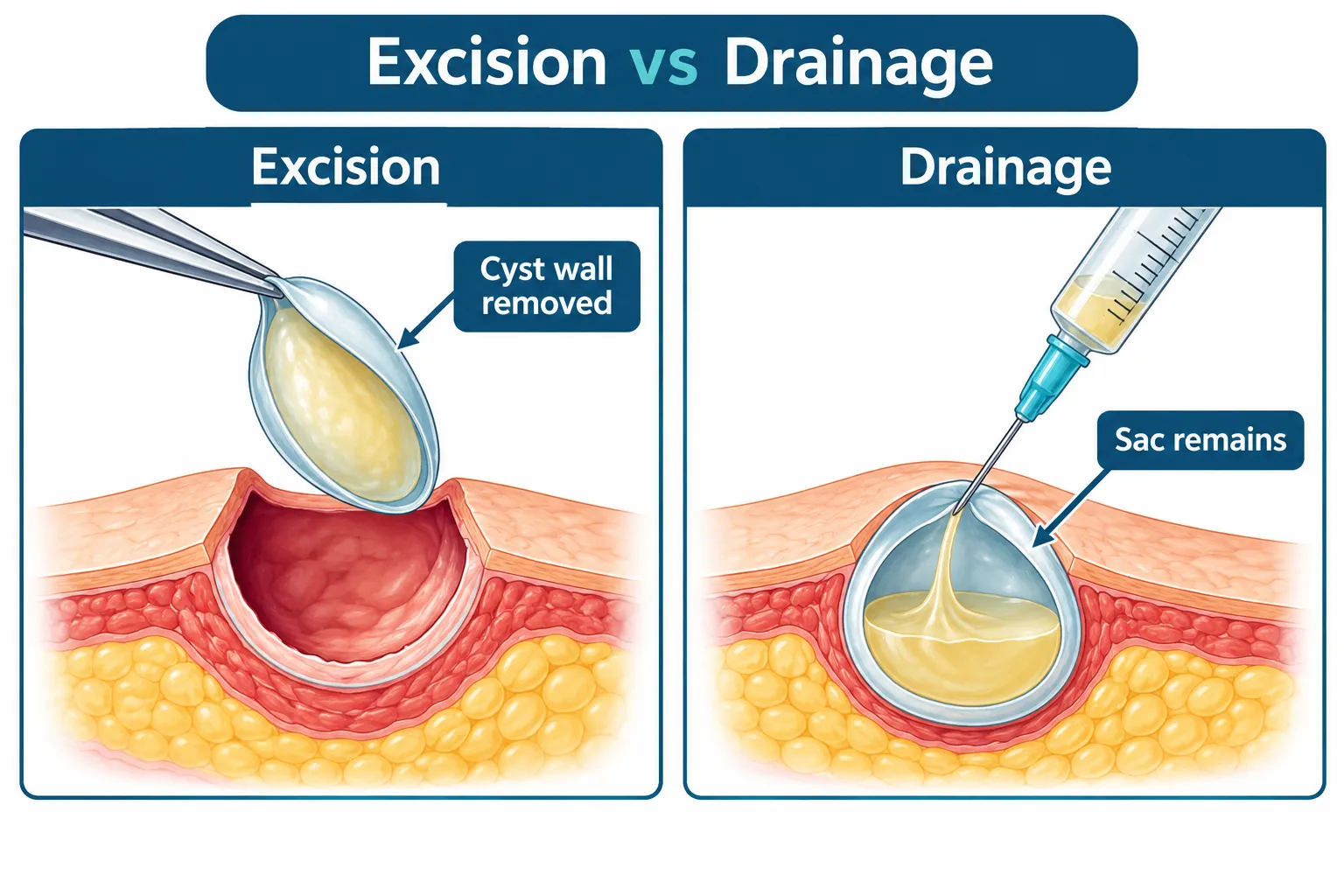
A cyst is essentially a small sac with a lining that continues to produce material even after it is emptied. Think of the wall as a tiny factory: draining the cyst clears the current stock, but the factory keeps running unless it is physically taken out [1]. That is why clinicians describe excision as the "definitive" treatment and drainage as a temporary or symptom-focused measure.
Key practical differences:
Common mistake: Assuming that because a cyst has been "drained" once, it is gone for good. In most cases, drainage without removing the wall is a stopgap, not a cure, the same lump often returns within weeks or months.
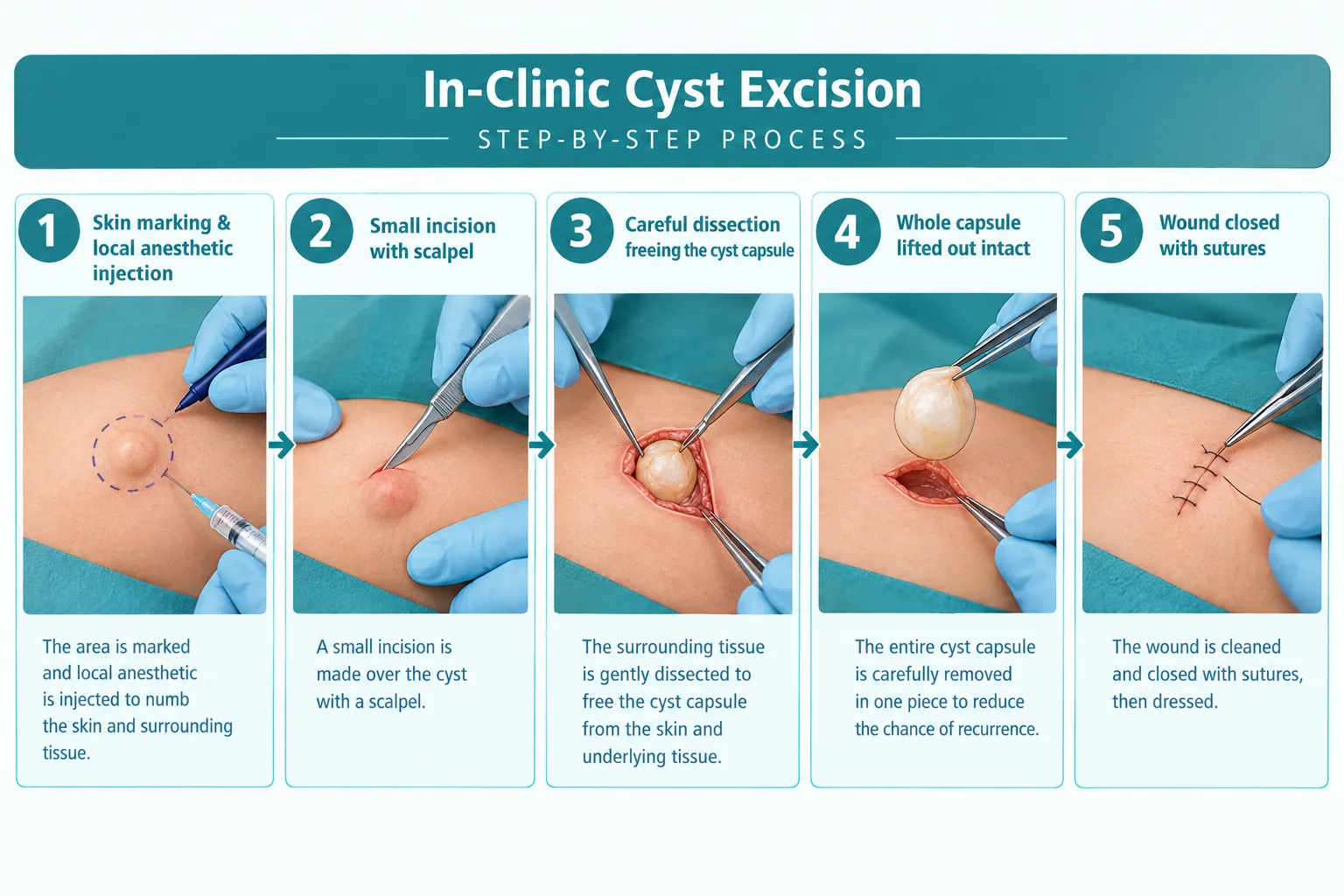
Both procedures follow a similar pattern in a Toronto minor surgery setting: numb the area, open the skin, deal with the cyst, then close and dress the wound. The details differ because excision involves careful dissection around the capsule, while drainage is a quicker, more limited procedure.
Typical excision workflow:
Typical drainage workflow:
For a more detailed walkthrough of what happens on the day of surgery, see this breakdown of cyst removal surgery step by step. Clinics that specialize in minor procedures, including Toronto's mole, cyst, lipoma and carpal tunnel surgery centers, generally follow this same sequence with only minor variations based on cyst location and size.
Edge case: Very large or deep cysts, or ones near sensitive structures like nerves or joints, may require imaging beforehand or referral to a specialist rather than a standard in-office excision.
A straightforward cyst excision under local anesthetic usually takes between 15 and 45 minutes, depending on the cyst's size, depth, and location. Drainage alone is often faster, sometimes under 15 minutes, because there is no need to dissect around a capsule.
Factors that affect how long the procedure takes:
Patients typically spend more time on paperwork, anesthetic setup, and dressing than on the cutting itself. Total time in the clinic, including check-in and recovery observation, is usually well under an hour for a single small to medium cyst.
Quick example: A 1.5 cm epidermoid cyst on the back of the neck with no prior infection might take about 20 minutes from first incision to final dressing. A similar-sized cyst that has been infected twice before could take closer to 40 minutes because of adhesions.
For most stable, non-infected cysts, excision is the better long-term choice because it removes the cyst wall and prevents regrowth. Drainage is the better short-term choice when a cyst is acutely infected, painful, or abscessed and needs immediate relief before a planned excision.
The two approaches are not really competing options for the same situation, they usually serve different moments in the same patient's care.
FactorExcisionDrainage (I and D)GoalRemove cyst wall permanentlyRelieve pressure/pain, empty contentsBest used whenCyst is calm, not acutely infectedCyst is red, hot, swollen, or abscessedRecurrence riskLow if wall fully removed [9]High, since lining remains [1][8]Procedure time15 to 45 minutes typicallyOften under 15 minutesScarringSmall linear scarUsually smaller opening, sometimes less predictable healingPathology possibleYes, tissue sent to labRarely, fluid usually discardedFollow-up surgery neededUsually not, if done cleanlyOften yes, once infection settles
Decision rule: Choose drainage first if the cyst is acutely infected, swollen, and painful, cutting into an inflamed capsule to remove it whole is harder and riskier at that stage. Choose excision as the definitive step once any infection has cleared, ideally within a few weeks, to prevent the same cyst from flaring up again.
This staged approach, drain first if infected, excise later, is a well-recognized pattern in general and dermatologic surgery, and it is echoed in guidance comparing cyst removal versus cyst drainage as distinct but complementary steps rather than interchangeable alternatives.
Most fluid-filled or infected cysts can be drained for temporary relief, but drainage works best on cysts that are inflamed, abscessed, or under painful pressure rather than calm, well-formed lumps. The most common candidates are infected epidermoid cysts, sebaceous cysts with abscess formation, and some ganglion cysts.
Cysts commonly treated with drainage as an initial step:
Cysts that generally respond poorly to drainage alone and are better suited to excision from the start:
Common mistake: Repeatedly draining the same cyst every time it flares up instead of scheduling a proper excision once the acute episode settles. This cycle can continue for years, with the cyst gradually growing larger and scarring more each time.
Cyst removal surgery is generally recommended when a cyst grows, becomes painful, gets infected more than once, or bothers a patient cosmetically or functionally. Small, stable, symptom-free cysts can often be safely monitored rather than removed right away.
Signs surgery is a reasonable next step:
Signs watchful waiting may be reasonable:
When to see a doctor rather than decide alone: Any cyst that changes color, becomes hard, grows rapidly, bleeds, or develops an open sore should be assessed promptly rather than watched. A clinician can distinguish a straightforward epidermoid cyst from other lumps that need different management, and can flag any features that warrant a biopsy or referral.
Decision rule: Choose monitoring if the cyst has been stable and symptom-free for over a year with no red flags. Choose a surgical consultation if it has grown, hurts, or has become infected even once, a single infection often signals it will recur.
For location-specific patterns, guides on cyst removal on the back and cyst removal on the scalp walk through what to expect for those common sites.
Leaving a cyst alone is usually safe if it stays small and symptom-free, but many cysts slowly enlarge, and some eventually become inflamed or infected without warning. The risk is not usually urgent, but it tends to build gradually over months or years.
Possible outcomes of not removing a cyst:
Edge case: Occasionally, a lump that looks like a simple cyst turns out to be something else on closer exam or after removal and pathology review [9]. This is one reason clinicians are cautious about assuming every lump is "just a harmless cyst" without at least an initial assessment.
Example: A person notices a small, painless lump on the back for two years with no change. It may be entirely reasonable to leave it alone. But if that same lump suddenly turns red and throbs after minor trauma, that is a sign of infection, not a reason to panic, it usually means the cyst wall has been irritated, and prompt drainage followed by later excision is the standard path forward.
Draining a cyst at home is not recommended and can make things worse. Squeezing, popping, or lancing a cyst without sterile technique raises the risk of infection, deeper scarring, and incomplete removal that leads to faster recurrence.
Reasons home drainage is risky:
When a doctor should be involved instead: Any cyst that is painful, growing, infected, or in a sensitive area (face, groin, near joints) should be assessed and treated by a trained clinician rather than handled at home. Same-day, no-referral minor surgery clinics in Toronto exist specifically so patients do not have to wait months or resort to DIY methods, see this overview of no-referral, same-day minor surgery in Toronto for how quickly professional care can be arranged.
Common mistake: Using a needle or pin at home to "just release the pressure." Even if this brings temporary relief, it does not address the underlying capsule and often introduces bacteria, setting the stage for a more serious infection.
Cyst removal surgery is generally not painful during the procedure because it is done under local anesthetic, which numbs the area completely. Most patients feel pressure or tugging rather than sharp pain, and mild soreness for a few days afterward is normal.

What patients typically experience:
Decision rule: If a cyst is in a sensitive area (scalp, groin, near a joint) or unusually large, discuss additional numbing options or a slightly longer anesthetic protocol with the clinician beforehand rather than assuming discomfort is unavoidable.
Edge case: Drainage of an actively infected, abscessed cyst can be more uncomfortable than a planned excision on calm tissue, because inflamed skin is more sensitive and harder to fully numb. This is one reason clinicians often prefer to let acute infection settle with antibiotics or initial drainage before scheduling the full excision.
Cyst removal is a low-risk procedure overall, but like any surgery it carries some chance of bleeding, infection, scarring, or recurrence. Serious complications are uncommon when the procedure is done by a trained provider using sterile technique.
Main risks to be aware of:
Common mistake: Picking at a healing incision or exposing it to sun, sweat, or friction too early, which raises infection risk and can worsen the eventual scar.
Toronto patients considering cosmetic outcomes often ask specifically about scarring before booking; clinics discuss realistic expectations upfront, including how incision placement along natural skin lines and proper aftercare, such as choosing dissolvable versus non-dissolvable stitches, can influence the final result.
Yes, a cyst commonly comes back after drainage alone because the capsule wall that produces its contents is left behind. Recurrence after drainage without excision is one of the most predictable outcomes in cyst treatment, which is why drainage is usually framed as a temporary measure rather than a cure [1][8].
Why recurrence happens:
Can excision also recur? Yes, but far less often. If even a small fragment of the cyst wall is left behind during excision, the cyst can regrow from that remnant. This is why clinicians emphasize complete removal of the sac as the key technical goal, a point covered in detail in this explanation of why it's crucial to remove the entire cyst sac.
Quick example: A patient has a cyst drained twice over one year for infection relief. Each time, it refills within a few months. On the third visit, the surgeon recommends a full excision once inflammation has settled, and the cyst does not return at that same site.
Decision rule: If a cyst has recurred even once after drainage, that is generally a strong signal to schedule a proper excision rather than continuing to drain it repeatedly.
Most patients return to light daily activity within a few days after cyst removal surgery, with the wound largely healed on the surface within 7 to 14 days. Full internal healing and scar maturation can take several weeks to a few months, depending on cyst size and location.
Typical recovery timeline:
Aftercare basics:
Decision rule: Return to a clinic promptly if pain, redness, or swelling worsen after the first few days instead of improving, that pattern suggests infection rather than normal healing.
For a deeper dive into what affects healing speed by body location, see this guide on cyst removal recovery time. Patients often also want a realistic picture of the end result; what to actually expect from cyst removal results covers scar appearance and timeline in more detail.
Cyst removal cost in Toronto depends on whether the procedure is covered by OHIP, done as a private minor surgery, or bundled with a cosmetic consultation, and it varies with cyst size and complexity. There is no single fixed price across the city, so getting a direct quote after an in-person or virtual assessment is the most reliable way to know the cost for a specific case.
Factors that influence price:
Common mistake: Assuming every cyst removal is automatically free under OHIP. Coverage generally depends on medical necessity, not simply on wanting a lump gone, so it is worth clarifying coverage before booking.
A detailed breakdown of pricing factors across the province is available in this guide to cyst removal cost in Ontario, which is a useful starting point before contacting a specific clinic for a personalized quote.
The best choice for cyst removal in Toronto is generally a provider who specializes specifically in minor skin surgery, offers same-day or rapid-access booking, and routinely performs full excisions rather than repeated drainage. Toronto and the surrounding GTA have several dedicated minor surgery centres built around exactly this kind of rapid-access model [3][5][7].
What to look for when choosing a provider:
Toronto and the wider GTA have multiple neighborhood-level options, from downtown Toronto mole and cyst removal to clinics serving North York, Scarborough, and surrounding regions, so patients can typically find a rapid-access option reasonably close to home rather than waiting for a distant hospital referral.
Decision rule: Choose a dedicated minor surgery or dermatologic surgery clinic over a general walk-in setting whenever the cyst is large, recurrent, or in a technically tricky location, since experience with capsule dissection directly affects both cosmetic outcome and recurrence risk.
Is drainage the same as cyst removal?
No. Drainage empties the cyst's contents but leaves the wall behind, so the lump can refill. True cyst removal means excising the entire capsule so it cannot regenerate.
Does insurance or OHIP cover cyst removal in Toronto?
Coverage depends on medical necessity. Cysts that are infected, painful, or diagnostically uncertain are more likely to qualify under OHIP, while purely cosmetic removals are often billed privately.
How long is the incision after a cyst excision?
Incision length depends on cyst size, but most straightforward excisions leave a small linear scar, often placed along natural skin folds to help it fade over time.
Can a cyst turn into something serious if left alone?
Most cysts stay benign, but any lump that changes color, grows rapidly, bleeds, or develops an open sore should be checked by a clinician promptly rather than assumed to be a harmless cyst.
Do I need stitches after cyst removal?
Excision usually requires sutures to close the incision, while small drainage procedures often heal without stitches since the opening is minimal.
How soon can I shower after cyst removal surgery?
Most clinics allow gentle showering within a day or two, avoiding direct soaking or scrubbing of the wound until it has closed over, based on individual aftercare instructions.
Will the cyst leave a visible scar?
Some scarring is expected with any incision, but final visibility depends on cyst size, location, skin type, and how well aftercare instructions are followed.
Can I go back to work the same day as cyst removal?
Many patients with desk-based jobs return to light duties the same day or the next, while physically demanding roles may need several days off, depending on the cyst's location.
What is sent to the lab after removal?
The excised cyst wall and contents are typically sent for pathology review to confirm the diagnosis and rule out anything unexpected.
Is a ganglion cyst treated the same way as a skin cyst?
Not exactly. Ganglion cysts near joints or tendons are sometimes managed with aspiration first, but excision is often needed for a lasting result, similar in principle to how skin cysts are treated.
Cyst excision and drainage solve different problems. Drainage brings fast relief from pressure, pain, or infection, but it leaves the cyst's lining behind, so recurrence is common. Excision takes longer and involves a slightly bigger incision, but it removes the entire capsule and offers a genuinely lasting result for most benign cysts. Understanding how cyst removal surgery works, excision vs drainage, helps set realistic expectations about timing, scarring, and the odds of the lump returning.
For most Toronto patients, the practical path looks like this: if a cyst is infected and painful right now, drainage or antibiotics come first to calm things down. Once that settles, a scheduled excision under local anesthetic is the step that actually closes the door on that specific cyst. If a cyst is small, stable, and symptom-free, monitoring it is often reasonable, but any growth, repeated infection, or new symptoms are a signal to get it assessed rather than wait indefinitely.
The next step is straightforward: get an in-person assessment from a provider experienced in minor skin surgery, ask directly whether excision or drainage fits the current state of the cyst, and confirm what aftercare and follow-up will look like before booking. That single conversation usually clarifies cost, timing, and the realistic outcome far better than guessing based on general information alone.
[1] Skin Cysts - https://www.minorsurgery.ca/conditions-we-treat/skin-cysts/
[3] Cyst Removal - https://rapidaccessminorsurgery.com/cyst-removal/
[5] Cysts - https://www.canadiansurgery.com/rapid-access-skin-centre/minor-surgery/cysts/
[7] rapidaccessminorsurgery - https://rapidaccessminorsurgery.com/
[8] Cyst Removal - https://fcpdermatology.com/cyst-removal/
[9] Pmc12945473 - https://pmc.ncbi.nlm.nih.gov/articles/PMC12945473/