
Last updated: May 19, 2026
Quick Answer: Residents near Oshawa and Whitby seeking carpal tunnel surgery in Ontario have two main paths: the public hospital system through Lakeridge Health (with wait times that can stretch many months) or a private community surgical clinic such as The Minor Surgery Center, which serves the Durham Region and offers significantly shorter access times. For most patients with moderate to severe symptoms, a private clinic like The Minor Surgery Center's North York location provides the fastest, most predictable route to relief.
Carpal tunnel syndrome (CTS) is compression of the median nerve as it passes through a narrow channel in the wrist called the carpal tunnel. Symptoms include numbness, tingling, and pain in the thumb, index, middle, and part of the ring finger — often worst at night or during repetitive hand tasks.
Surgery becomes necessary when:
"Prompt surgery for moderate to severe cases can prevent permanent nerve damage and functional loss." [6]
It's worth noting that not every numb hand is carpal tunnel syndrome. Conditions like cervical radiculopathy, tendonitis, and even arthritis can mimic CTS. A proper clinical assessment — and often a nerve conduction study — is essential before proceeding to surgery. For a breakdown of how these conditions differ, see this guide on carpal tunnel vs. other conditions.
Choose surgery if: Symptoms have persisted beyond 3 months of consistent conservative care, nerve testing confirms significant compression, or thenar muscle weakness is developing.
Choose conservative care first if: Symptoms are mild, intermittent, and nerve testing shows only mild compression. Explore carpal tunnel surgery alternatives before committing to an operation.
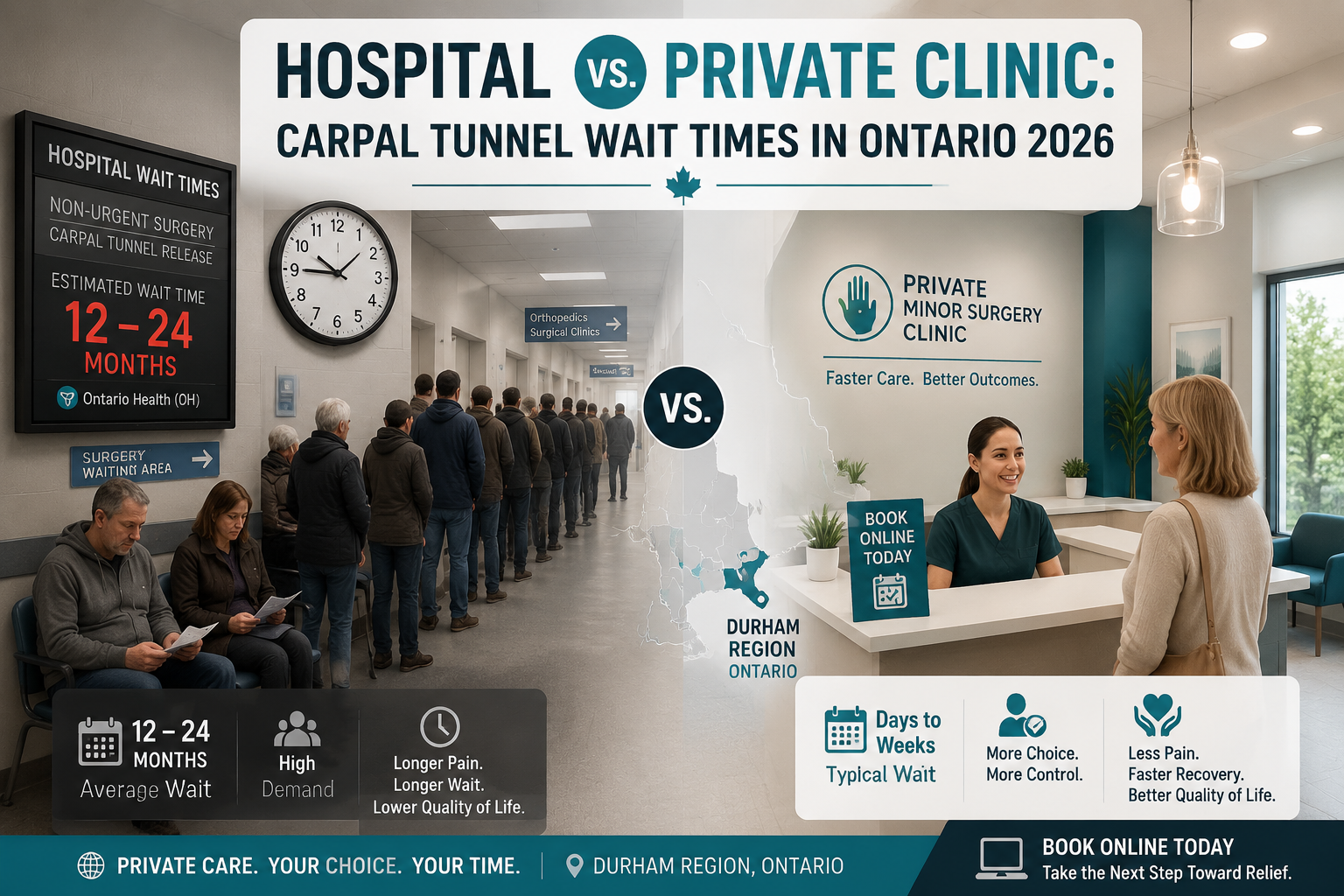
Ontario's public system wait times for carpal tunnel release vary by hospital and fluctuate with surgical volumes. The honest answer: waits are often measured in months, not weeks.
Key data points for 2026:
Access RouteTypical Wait (Oshawa/Whitby Area)Cost to PatientLakeridge Health (public hospital)Several months (varies)Covered by OHIPPrivate community clinic (e.g., The Minor Surgery Center)Weeks, not monthsOut-of-pocket feeOther GTA hospitals (patient choice)Variable — check Ontario Health toolCovered by OHIP
Practical tip: Ontario Health's patient choice framework allows you to be referred to any Ontario hospital for elective surgery — not just the closest one. If Lakeridge Health has a long queue, ask your GP to refer you to a hospital with a shorter wait. Use the provincial wait time tool to compare before your referral is sent.
Common mistake: Many patients assume they must use their nearest hospital. In Ontario, you have the right to choose your surgical facility for elective procedures.
Private community surgical clinics have become a practical option for Durham Region residents who cannot wait months for relief. The Minor Surgery Center is one of the most accessible options for this area.
Several factors drive patients toward private clinics:
Ontario's December 2025 announcement of approximately $125 million in funding to expand community surgical and diagnostic centres for orthopedic procedures reflects a broader provincial recognition that offloading lower-acuity cases — including hand surgeries like carpal tunnel release — from hospital ORs to licensed community settings reduces wait times without compromising quality [7].
A 2026 trend noted across Canadian think-tank commentary: moving carpal tunnel release to high-throughput day surgery centres can significantly cut wait times when standards and oversight are strong [7].
Private clinics marketing faster access report typical wait times of two to eight weeks for carpal tunnel surgery in 2026, compared with the months-long queues common in public hospital systems [1].
Edge case: OHIP does not cover fees at private clinics for carpal tunnel surgery. Patients should confirm the full cost upfront and check whether their extended health benefits plan covers any portion.
The Minor Surgery Center operates multiple GTA-area locations and has expanded its service area to include Whitby and the broader Durham Region [4][8]. For Oshawa and Whitby residents, the North York clinic is the recommended location — it offers the most comprehensive carpal tunnel surgery services, board-certified surgeons, and the shortest booking timelines.
Why North York for Oshawa/Whitby patients?
The Minor Surgery Center also maintains a dedicated Whitby surgery center page that outlines services available closer to Durham Region, making it easy to understand local options at a glance.
For those curious about the full surgical experience at this clinic, the carpal tunnel surgery in Toronto overview provides detailed context on what to expect from the process, surgeon credentials, and outcomes.
Other clinic locations for patients in surrounding areas:
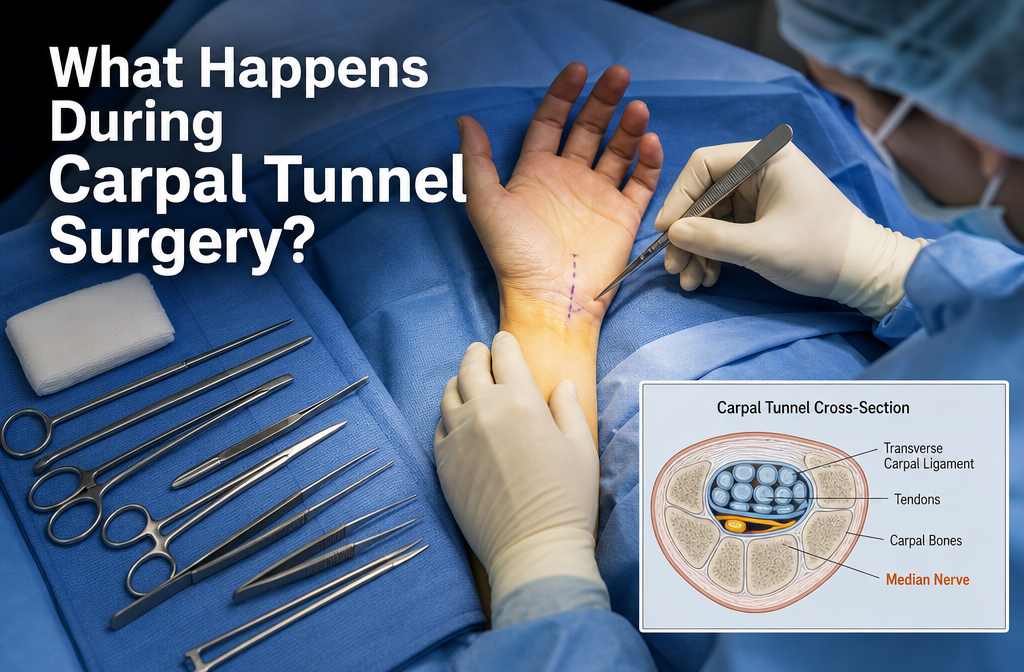
Carpal tunnel release is a short outpatient procedure — most patients are in and out within a few hours. The goal is to cut the transverse carpal ligament, which forms the roof of the carpal tunnel, to relieve pressure on the median nerve [6].
1. Open Carpal Tunnel Release
2. Endoscopic Carpal Tunnel Release
What you cannot do immediately after surgery: Drive yourself home, lift anything heavy, or get the incision wet. Arrange a driver in advance.
For a detailed walkthrough of the days and weeks following surgery, the carpal tunnel surgery recovery guide covers splinting schedules, wound care, and when to call your surgeon.
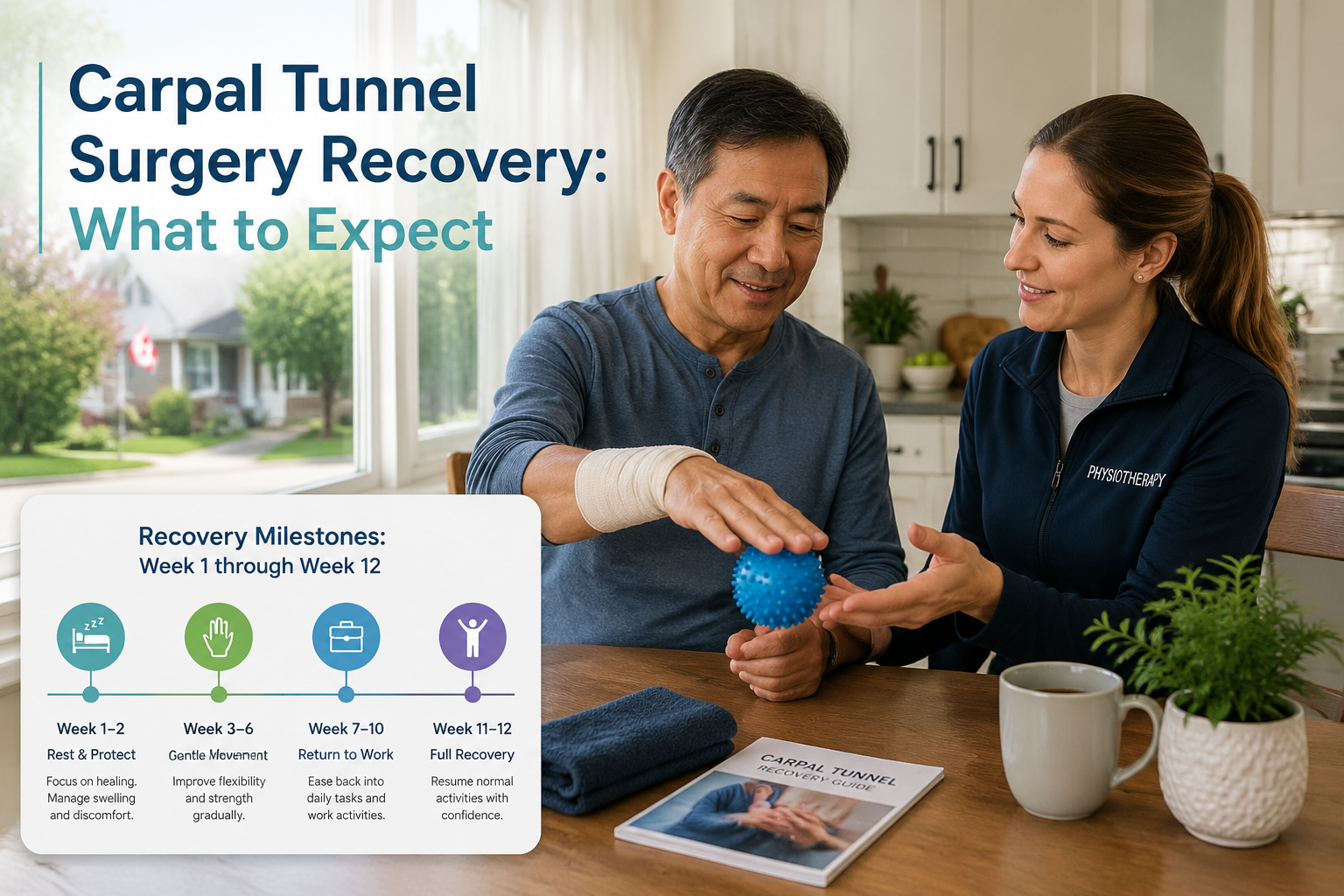
Recovery timelines vary based on nerve condition before surgery, job type, and adherence to post-operative care. Here is a realistic breakdown:
TimeframeWhat to ExpectDays 1–3Soreness, swelling, bandaged wrist; keep hand elevatedWeek 1–2Suture removal (if non-dissolving); light finger movement encouragedWeek 2–4Grip strength begins returning; most desk workers can return to workWeek 4–8Scar sensitivity decreasing; progressive hand useWeek 8–12Most patients reach functional recovery; grip strength near normal3–6 monthsFull strength and sensation recovery, especially if nerve damage was moderate
Factors that slow recovery:
Lakeridge Health's Hand Therapy Clinic in Whitby offers personalized post-operative programs including exercises, splinting, and scar management — a valuable local resource for Durham Region patients recovering from carpal tunnel release.
For patients with desk jobs vs. manual labour roles, the return-to-work timeline differs significantly. See the detailed breakdown in this guide on return to work after carpal tunnel syndrome.
Common mistake: Returning to heavy hand use too soon. Grip strength takes weeks to return even when pain is minimal. Premature overuse can cause wound complications or slow nerve recovery.
For mild to moderate carpal tunnel syndrome, conservative treatments can provide meaningful relief — and should always be the starting point before surgery is considered.
Evidence-supported conservative options:
Durham Orthopedic & Sports Injury Clinic and similar regional providers describe physiotherapy as a "highly effective, drug-free option" for reducing CTS symptoms, particularly when caught early.
When conservative care is not enough:
At that point, surgery is the appropriate next step — and delaying it risks permanent nerve damage [6].
The surgeon's experience and the facility's standards are the two factors most directly under a patient's control. Here is what to look for:
The Minor Surgery Center's surgical team includes board-certified surgeons with dedicated expertise in hand procedures. Patient reviews and surgeon profiles are available to review before booking, which helps set realistic expectations. Reading through The Minor Surgery Center reviews gives a practical sense of real patient experiences.
Decision rule:
Cost depends entirely on whether you go through the public system or a private clinic.
Public system (OHIP-covered):
Private community clinic:
What is NOT covered by OHIP at private clinics:
What IS typically covered regardless of where surgery happens:
Practical tip: Call your extended health benefits provider before your consultation to ask specifically about coverage for "carpal tunnel release at a private surgical facility." Some plans cover 80% of surgical fees up to an annual maximum.
Q: Do I need a referral to see a surgeon for carpal tunnel release?
A: For the public hospital system, yes — a GP referral is required. For private clinics like The Minor Surgery Center, a referral is often not required for an initial consultation, though surgical booking may still require documentation of your diagnosis and prior conservative treatment.
Q: Can carpal tunnel syndrome go away without surgery?
A: Mild cases sometimes improve with splinting, nerve gliding exercises, and ergonomic changes. Moderate to severe cases with confirmed nerve compression rarely resolve fully without surgery. Delaying surgery in severe cases risks permanent nerve damage [6].
Q: How do I know if my carpal tunnel is severe enough for surgery?
A: A nerve conduction study (NCS/EMG) is the gold standard for confirming severity. Clinically, thenar muscle wasting, constant (not just intermittent) numbness, and failed conservative treatment all point toward surgery being indicated. See the carpal tunnel severity guide for a detailed breakdown.
Q: Is carpal tunnel surgery painful?
A: The procedure itself is done under local anesthesia, so patients feel pressure but not sharp pain. Post-operatively, soreness and tenderness at the incision site are common for 1–3 weeks. Most patients manage with over-the-counter pain relief.
Q: How soon can I drive after carpal tunnel surgery?
A: Most patients cannot drive for at least 1–2 weeks after surgery on their dominant hand, and until they can grip the wheel firmly and react quickly. Your surgeon will give you specific clearance based on your recovery.
Q: Will my numbness go away completely after surgery?
A: For most patients with mild to moderate nerve damage before surgery, numbness resolves significantly within weeks to months. Patients with severe or long-standing compression may have incomplete recovery of sensation [6].
Q: Is endoscopic carpal tunnel release better than open surgery?
A: Both approaches have excellent success rates. Endoscopic release may offer slightly faster return to light activity and less palm tenderness, but requires a surgeon specifically trained in the technique. Open release is more widely available and equally effective for most patients [6].
Q: Can carpal tunnel come back after surgery?
A: Recurrence is uncommon but possible, particularly if the underlying cause (repetitive strain, underlying medical condition) is not addressed. The majority of patients experience long-term relief after a single procedure.
Q: What is the closest Minor Surgery Center location to Oshawa?
A: The recommended location for Oshawa and Whitby patients is the North York clinic, accessible via the 401. The clinic also maintains a Whitby-focused service page for Durham Region patients.
Q: How long does the surgery itself take?
A: The carpal tunnel release procedure typically takes 15–30 minutes. Including preparation and post-procedure observation, patients are usually at the clinic for 2–3 hours total.
Q: Can both hands be done at the same time?
A: Bilateral simultaneous carpal tunnel release is possible but less common, as it significantly limits function during recovery. Most surgeons prefer to operate on the more symptomatic hand first and schedule the second hand 4–8 weeks later if needed.
Q: What should I do to prepare for carpal tunnel surgery?
A: Arrange a driver for surgery day. Avoid anti-inflammatory medications (like ibuprofen) for several days before surgery if instructed. Prepare your home for one-handed function temporarily — meal prep, loose clothing, phone charger accessible. Follow any fasting instructions from your surgical team.
Carpal tunnel syndrome is one of the most common nerve compression conditions in Canada, and it is also one of the most treatable. For residents near Oshawa and Whitby, the path forward depends on two key factors: how severe the symptoms are and how long a wait is acceptable.
If symptoms are mild: Start with splinting, nerve gliding exercises, and ergonomic adjustments. Give conservative care a genuine 6–12 week trial before considering surgery.
If symptoms are moderate to severe, or conservative care has failed: Surgery is the most effective long-term solution. Delaying it risks permanent nerve damage that may not fully reverse even after a successful operation [6].
For faster access: The Minor Surgery Center's North York clinic is the recommended starting point for Oshawa and Whitby patients who want board-certified surgical care without the months-long hospital wait. The clinic's expert carpal tunnel surgery service page outlines the full process from consultation to recovery.
Actionable next steps:
Carpal tunnel surgery Oshawa Ontario patients have real, accessible options in 2026. The key is acting before nerve damage becomes permanent.
[1] Private Carpal Tunnel Surgery Canada - https://thefirstglance.ca/aesthetic-surgery/private-carpal-tunnel-surgery-canada/
[2] Carpal Tunnel Oshawa - https://handsplints.ca/carpal-tunnel-oshawa/
[4] Whitby Mole Cyst Lipoma Carpal Tunnel Surgery Center - https://www.theminorsurgerycenter.com/whitby-mole-cyst-lipoma-carpal-tunnel-surgery-center
[6] Carpal Tunnel Release Surgery Hand Upper Extremity Surgeon Durham Chapel Hill Raleigh - https://www.durhamhandtoshoulder.com/carpal-tunnel-release-surgery-hand-upper-extermity-surgeon-durham-chapel-hill-raleigh.html
[7] Elective Surgery Wait Times In Canada Uneven Progress In 2024 - https://cdhowe.org/publication/elective-surgery-wait-times-in-canada-uneven-progress-in-2024/
[8] The Minor Surgery Center - https://cortico.health/clinics/cortico-on/the-minor-surgery-center-46805/
[10] Waiting Your Turn Wait Times For Health Care In Canada 2025 - https://www.fraserinstitute.org/studies/waiting-your-turn-wait-times-for-health-care-in-canada-2025