Xanthelasma Removal in Toronto: What Those Yellow Eyelid Patches Mean and How They Are Treated
Last updated: September 8, 2026
Quick Answer
Xanthelasma are soft yellowish cholesterol deposits in the skin of the eyelids, most often at the inner corner of the upper lid. They are harmless in themselves, but they are worth treating as a prompt to have your blood lipids and overall cardiovascular risk reviewed by your family physician, including if your cholesterol comes back normal. Removal is a cosmetic procedure with several methods, and adults across Toronto and the GTA can be assessed at The Minor Surgery Center without a referral.
Key Takeaways
Xanthelasma are lipid deposits in eyelid skin. They don't hurt, don't affect vision, and don't go away on their own.
Anyone who develops them should have a fasting lipid panel and a general cardiovascular risk review with their family physician.
A normal cholesterol result does not make the finding meaningless. It's still worth mentioning to your doctor.
Removing the patches changes appearance only. It does nothing to the underlying lipid picture.
Several eyelid conditions look similar, milia, syringoma, sebaceous hyperplasia, and they're treated differently, so colour alone doesn't settle the diagnosis.
Recurrence after treatment is common, especially with multiple plaques or an untreated lipid disorder.
Removal is generally considered cosmetic in Ontario and is not an insured OHIP service; fees are quoted at consultation and should be given in writing.
What Xanthelasma Actually Is, and Why It Forms
Xanthelasma are flat or slightly raised yellowish plaques made of lipid-laden cells that have collected in the skin. They sit most commonly on the upper eyelid near the inner corner, and they're frequently symmetrical on both sides.
They form when cholesterol-carrying particles leak from small blood vessels into the dermis and are taken up by immune cells called macrophages. Eyelid skin is thin and mobile, which is why the deposits become visible there before anywhere else. Contributing factors include raised LDL cholesterol, low HDL, inherited lipid disorders, diabetes, liver and thyroid conditions, and certain medications, though some people develop them with no identifiable abnormality at all.
They typically appear from middle age onward and are more common in women. They grow slowly, they don't resolve spontaneously, and they generally enlarge over time. If you're catching it early, our note on early-stage xanthelasma on the eyelid covers what to watch for.
Why This Is a Health Signal, Not Just a Cosmetic One
Xanthelasma is frequently associated with abnormal blood lipids, so anyone who develops it should have a fasting lipid panel. That's the single most useful thing to do after noticing it, before deciding anything about appearance.
Here's the part most pages skip. Xanthelasma has also been linked to higher cardiovascular risk somewhat independently of whether lipid levels come back within range. So a normal panel doesn't make the finding irrelevant. It simply shifts the conversation from cholesterol numbers alone to overall risk: blood pressure, blood sugar, weight, smoking status, and family history of early heart disease.
None of this means you have heart disease. It means you have a visible, easily noticed prompt to sit down with your family physician and review the whole picture once, something many people in their forties and fifties haven't done. If you want the practical version of that conversation, see our guide on cholesterol, xanthelasma and whether you need a blood test.
Two things worth saying plainly. Cardiovascular risk management belongs with your family physician, not with a surgical clinic. And lowering your cholesterol, whether through diet or medication, usually does not make existing plaques disappear, the deposits already in the skin generally stay put. Removal treats the appearance and nothing else.
Is It Definitely Xanthelasma?
Not necessarily. Several common eyelid lesions look similar at arm's length, and they respond to completely different treatments, which is why an in-person look with magnification is what settles it.
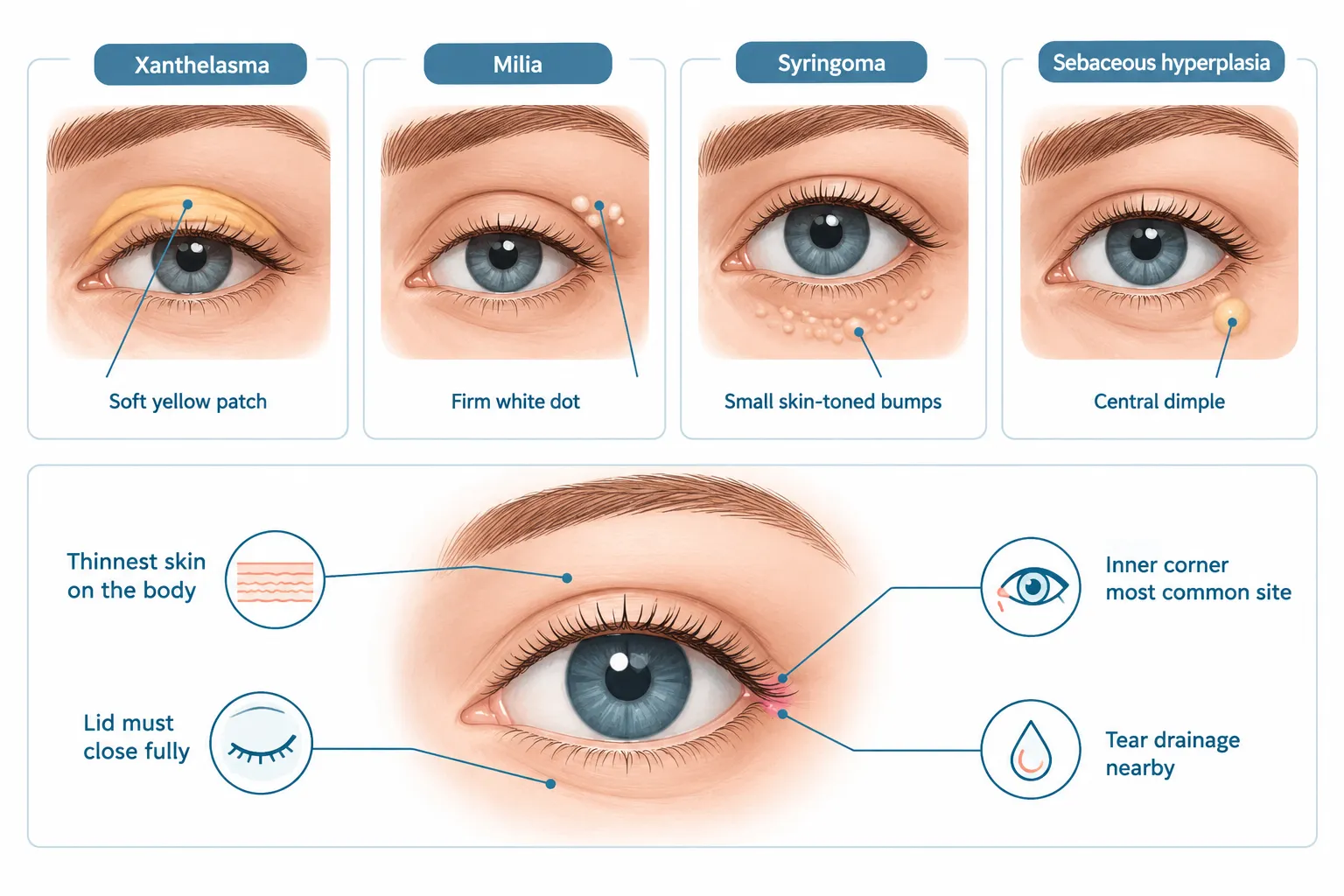
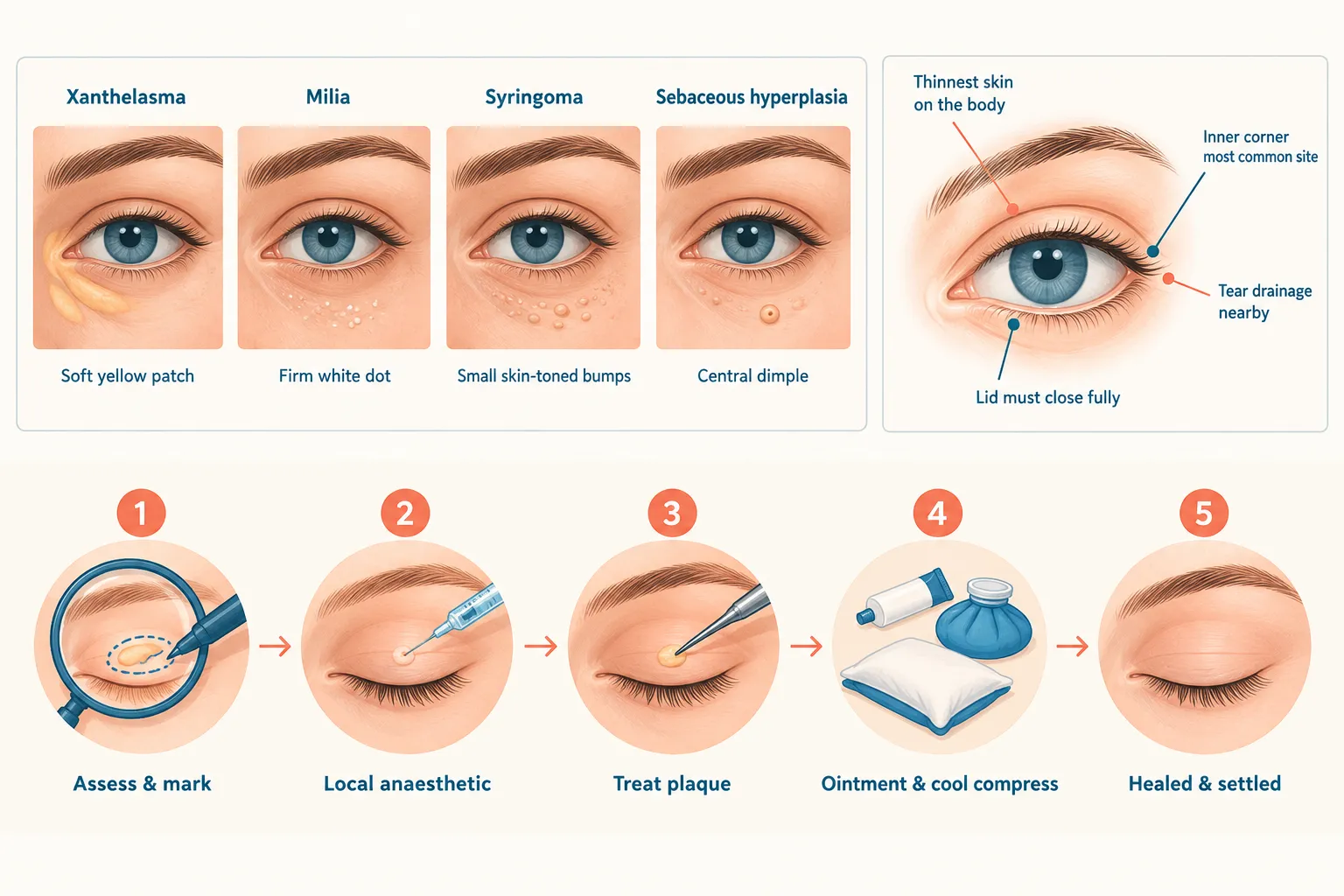
Milia are small, firm, white or cream keratin cysts sitting just beneath the surface. They feel like tiny beads, they're usually round rather than plaque-like, and they're removed with a simple extraction rather than surgery. Our complete guide to milia removal explains that difference in more detail.
Syringoma are multiple small skin-coloured or slightly translucent bumps arising from sweat glands, typically clustered under the lower lids. They tend to be numerous and evenly distributed, which xanthelasma rarely is.
Sebaceous hyperplasia presents as soft yellowish bumps, often with a small central dimple, more commonly across the face than at the lid margin. The yellow tone fools people regularly.
Xanthomas elsewhere on the body, over the elbows, knees, buttocks or tendons, point more strongly toward a lipid disorder and warrant a broader medical look, not just a cosmetic one.
Colour is not diagnostic. Location, texture, borders and distribution are what distinguish these, and a magnified assessment takes a couple of minutes.
Why Eyelid Skin Changes the Whole Conversation
Eyelid skin is the thinnest on the body. That's exactly why xanthelasma shows there, and it's also why treatment on the lid is judged far more finely than on the arm or back.
The practical consequences matter. Only a limited amount of eyelid skin can be removed before the lid is pulled out of position, so large or deep plaques are sometimes treated in stages rather than all at once. Lesions near the inner corner sit close to the tear drainage structures and demand more care. Anything crossing the lid margin is more demanding again. And the lid has to close completely afterwards, that isn't negotiable, because incomplete closure dries the eye.
So the assessment isn't really "can this patch be removed." It's how much can safely be taken in one sitting, by what method, and in how many stages. That judgment is why the eyelid is a place to see a surgeon rather than to improvise, and it's the same logic behind seeing a plastic surgeon for a minor procedure on any cosmetically sensitive area.
Xanthelasma Removal Methods in Toronto: Laser vs Surgery, Honestly Compared
There's no single best method. The choice depends on plaque thickness, size, location on the lid, and your skin tone, and each option trades something for something else.
Surgical excision is the most definitive approach for well-defined, thicker plaques. The lesion is cut out and the skin closed with fine sutures, which gives the most complete clearance in one visit. The trade-off is a fine linear scar, usually placed to sit in a natural lid crease, plus bruising for a period afterwards.
Trichloroacetic acid (TCA) application is a controlled chemical treatment that works well for thin, superficial lesions and avoids an incision altogether. It usually needs more than one session, and it carries a real risk of lightening or darkening of the treated skin.
Laser (including CO2) and electrodesiccation ablate superficial deposits layer by layer with no incision and no sutures. They suit flatter lesions, may need repeat sessions for thicker ones, and carry similar pigment-change and textural risks to TCA.
Cryotherapy is less commonly favoured on eyelid skin, because freezing is harder to control precisely so close to the eye and pigment loss is more likely.
One point that matters a great deal in a city as diverse as Toronto: ablative and chemical methods carry a higher risk of post-inflammatory pigment change in richer skin tones. That should be discussed explicitly before a method is chosen, not discovered afterwards.
And to be direct about home options, over-the-counter creams, garlic, castor oil and apple cider vinegar do not remove xanthelasma. We've covered whether xanthelasma removal creams work at length. Applying acids near the eye at home is genuinely dangerous, and corneal injury from a runaway drop is not a recoverable mistake.
Does Xanthelasma Come Back After Removal?
Frequently, yes. Recurrence is common, and it's more likely when lesions are multiple, involve all four lids, or where an underlying lipid disorder remains untreated.
This should be part of the conversation before treatment rather than a surprise months later. Removal clears what's there; it doesn't change the process that put it there. Addressing lipids and general risk factors with your family physician is the part that plausibly influences whether new deposits form. Repeat treatment is usually possible, and second treatments on already-treated eyelid skin need the same careful judgment about how much skin remains. Our article on whether xanthelasma can come back after removal goes further into what raises the odds.
What Removal Involves, Whether It Hurts, and How Long Healing Takes
The procedure is done in the office under local anaesthetic and usually takes around half an hour. Discomfort is limited mainly to the freezing injection; after that the area is numb.
The sequence is straightforward: assessment and magnified examination, marking of the lesion borders while you're sitting upright, local anaesthetic into the lid, the chosen treatment, then ointment and a small dressing. Both eyes are commonly treated in the same visit for symmetry.
Recovery on eyelid skin looks more dramatic than it feels. Expect bruising and swelling around the eye for roughly one to two weeks, sometimes spreading below the eye with gravity. Sleeping with your head elevated for the first few nights helps. Sutures, if used, come out within about a week. Makeup generally goes back on once the skin is fully closed, and your surgeon will give you a date rather than a guess.
Sun protection matters more here than people expect, because ultraviolet exposure on freshly treated skin is a main driver of lasting pigment change. The treated area continues to fade and soften for several months, so early appearance is not final appearance. Before-and-after results vary with plaque size, method and skin type, and no responsible clinic will promise a scar-free outcome, the same scar-maturation principles we describe for minimising scars after skin lesion removal apply on the lid.
Is Xanthelasma Removal Covered by OHIP?
Generally, no. Removal of xanthelasma is considered a cosmetic service in Ontario and is not an insured benefit under OHIP.
There's a useful distinction to draw, though. The blood work and cardiovascular risk assessment prompted by the finding is ordinary medical care through your family physician and is handled entirely separately from the cosmetic removal. So the investigation side of this and the appearance side of this sit in two different systems.
Some private extended health plans and health spending accounts contribute toward procedures like this; that depends on your specific plan. Ask for any fee in writing before booking, and confirm your own coverage situation at the consultation.
Getting Assessed for Xanthelasma Removal in Toronto
You don't need a referral, and you don't need to go through a walk-in clinic. Walk-in clinics can look at an eyelid lesion and offer an opinion, but they don't perform eyelid procedures, so you'd be referred onward anyway.
The Minor Surgery Center's Toronto clinic is at 2920 Dufferin Street, Suite 202, with additional locations at 85 Scarsdale Road, Unit 101 in York Mills (North York), plus Vaughan, Mississauga at 1224 Dundas Street West, and Oakville. Phone 647-614-1611, weekdays 9 a.m. to 4 p.m. Procedures are performed by plastic surgeons, which matters on the eyelid specifically because the limiting factor is skin availability and lid position, not just lesion clearance. Some people prefer to start with a dermatologist instead; if so, our page on how to find a dermatologist in Toronto is a reasonable starting point, and no-referral walk-in dermatology options are listed as well.
To prepare: come without eye makeup, bring recent blood work if you have any, mention blood thinners or fish oil, and flag any history of thickened scars or pigment change after skin injury. Both sides are usually treated together so the lids match.
Frequently Asked Questions
Does xanthelasma mean I have high cholesterol? Not always, but it's common enough that a fasting lipid panel is warranted. Some people with xanthelasma have entirely normal lipids.
Is xanthelasma dangerous? The plaques themselves are not dangerous. They don't turn into cancer and they don't affect vision. Their significance is as a prompt to review lipids and general cardiovascular risk with a family physician.
Will it go away on its own? No. Xanthelasma doesn't resolve spontaneously, and lowering cholesterol usually doesn't clear deposits already in the skin.
Does removal hurt? The main discomfort is the local anaesthetic injection into the lid. The procedure itself is done on numb skin, and afterwards the area is typically tender rather than painful.
Will it leave a scar? Any treatment that removes tissue leaves some mark. Excision leaves a fine line usually placed in a natural crease; chemical and laser methods avoid an incision but can leave pigment or texture change. Results vary.
How much bruising should I expect? Bruising and swelling around the eye for about one to two weeks is normal on eyelid skin and often looks worse than it feels. Head elevation and cool compresses help early on.
Will it come back? Recurrence is common, particularly with multiple plaques or an untreated lipid disorder. Repeat treatment is usually possible.
Do removal creams work? No over-the-counter cream reliably removes xanthelasma, and applying acids near the eye at home risks serious injury to the cornea.
Do I need a referral? No. You can book an assessment directly.
The Bottom Line
The patches on your eyelids are harmless and removable, and being self-conscious about them is a perfectly good reason to have them treated. But the more useful response is to do two things in order: book a lipid panel and a risk review with your family physician, then decide about appearance separately and without pressure.
If you'd like the lesion looked at properly, an assessment at The Minor Surgery Center can be booked at 2920 Dufferin Street, Suite 202, Toronto, by calling 647-614-1611 weekdays between 9 a.m. and 4 p.m.
This article is general information only and is not a diagnosis or medical advice. Any lesion on the eyelid should be assessed in person, and questions about cholesterol or cardiovascular risk should be discussed with your family physician.
References
DermNet, Xanthelasma palpebrarum
Cleveland Clinic, Xanthelasma
American Academy of Dermatology Association, Cholesterol Deposits and Skin Signs of Heart Disease
American Academy of Ophthalmology (EyeWiki), Xanthelasma
Heart and Stroke Foundation of Canada, Cholesterol
Canadian Cardiovascular Society, Guidelines for the Management of Dyslipidemia for the Prevention of Cardiovascular Disease in Adults
Government of Ontario, What OHIP Covers
Meta title: Xanthelasma Removal Toronto: Causes, Methods and Recovery
Meta description: Xanthelasma removal in Toronto explained by plastic surgeons: what those yellow eyelid patches mean for cholesterol, treatment options, recovery and recurrence.
Tags: xanthelasma removal Toronto, xanthelasma, eyelid cholesterol deposits, xanthelasma causes, cholesterol and xanthelasma, eyelid surgery Toronto, milia vs xanthelasma, syringoma, xanthelasma recurrence, OHIP coverage, plastic surgeon Toronto, cardiovascular risk
The Minor Surgery Center’s York Mills clinic, located at 85 Scarsdale Rd, Unit 101 in North York, offers convenient access to specialized surgical care for a range of skin and hand conditions. Our Plastic Surgeons provide treatment for skin cancer, suspicious moles, cysts, lipomas, carpal tunnel syndrome and trigger finger, with a focus on timely care and personalized treatment. In many cases, patients may be able to have their consultation and treatment completed during the same visit when medically appropriate. For expert care in a welcoming clinical setting, contact our York Mills team at (647) 614-1611.
We are the experts in the field of Minor Surgery. All our Surgeons have completed 5 years of post Medical School Surgical Residencies. They are all Board Certified by the Royal College of Physicians and Surgeons of Ontario.They have been trained at Institutions including McGill, McMaster, Queen's, University of British Columbia, University of Toronto, University of Western Ontario, The Mayo Clinic, University of Pennsylvania, University of Southern California, Yale University, and Oxford.
In many clinics, you could wait months—sometimes over a year—for a procedure like cyst or lipoma removal, mole removal, or even carpal tunnel release. But at TMSC, we prioritize fast access to care. In many cases, we can schedule and complete your minor surgery on the same day as your initial consultation—no extra runaround required.
Our clinics are designed with your comfort, safety, and efficiency in mind. We use strict sterilization protocols to minimize any infection risk, and our advanced surgical equipment meets hospital-grade standards. Yet, you’ll never feel like you’ve stepped into a stark, clinical space—our friendly staff ensures you’re welcome and supported the moment you walk through the door.
Cosmetic results matter—even for the smallest procedures. Skin lesions can be excised by non surgeons in Ontario. Furthermore, any MD with 2 years of post graduate training even outside of a surgical field can perform removal. At TMSC we only have Surgeons under our roof. They are trained well above the level of the procedures we offer to ensure the surgery goes smoothly with minimal scaring and preserving your natural contours. Our Surgeons are trained to ensure both function and aesthetics are always front and center.
At TMSC, we specialize in surgical treatment of both benign and malignant skin lesions, as well as minor hand conditions. We offer significantly reduced wait times often allowing you to schedule your surgery on the same day as your consultation.
You can book your free consultation with The Minor Surgery Center in three easy ways: online through Cortico, by phone, or by requesting a callback from our team.
The initial consultation is free. During this consultation, one of our board certified surgeons will examine your condition and recommend a suitable solution.
Directly Online
Request a Callback
By Phone
By Text
Hours
Sunday
Closed
Monday
9 am — 4 pm
Tuesday
9 am — 4 pm
Wednesday
9 am — 4 pm
Thursday
9 am — 4 pm
Friday
9 am — 4 pm
Saturday
Toronto & Oakville Open Vaughan & Mississauga Closed




.avif)
%20(600%20x%20600%20px)%20(2).avif)
.avif)
%20(8).avif)
%20(7).avif)

.png)