

Last updated: November 3, 2026
This article is educational only and not medical advice. Talk to a doctor about any changing spot on your skin.
Fresh snow can reflect over 80% of UV rays back at your face, according to Environment and Climate Change Canada [1]. That single fact explains why skiers get "goggle tan" and why your nose can burn on a cloudy January day in Ontario. Winter sun skin cancer ontario snow UV exposure is a real, measurable risk, not a myth built on a technicality.
Yes, you can get sun damage in an Ontario winter. UV is lower than in summer, but snow reflects much of it back up, altitude adds more, and winter trips south expose pale skin to strong UV. Wear broad-spectrum SPF 30+ on exposed skin, protect your lips and eyes, and use the season to check your skin for new or changing spots.
Yes. Skin damage from UV rays does not stop because the temperature drops. The sun still emits UVA and UVB rays in January, and Ontario's winter landscape, snow, ice, bright open sky over frozen lakes, adds reflected exposure on top of direct sunlight.
Health Canada notes that UV exposure remains possible in fall and winter, particularly when sunlight reflects off fresh snow [2]. The agency gives a concrete example: a reported UV Index of 4 during late-March skiing can produce an effective exposure comparable to roughly UV Index 7 because of snow reflection [2]. That's the difference between "low risk" and "moderate-to-high risk" skin exposure, just from the ground glowing white underneath you.
Common mistake: assuming cold air equals low UV. Temperature and UV strength are unrelated. A -10°C day with full sun and snow cover can deliver more effective UV to your face than a cloudy, humid 20°C day.
The UV Index in southern Ontario during winter months is typically low (categories 1-2) compared with summer's moderate-to-very-high range, but "low" doesn't mean zero. Protection is generally advised once the UV Index reaches 3 or higher [3].
Key points on how the UV Index works in Ontario winters:
For a full breakdown of what each UV Index category means, see the complete UV index guide, and for specifics on the lowest bands, the UV index 0-2 explainer and understanding UV index 3-5.
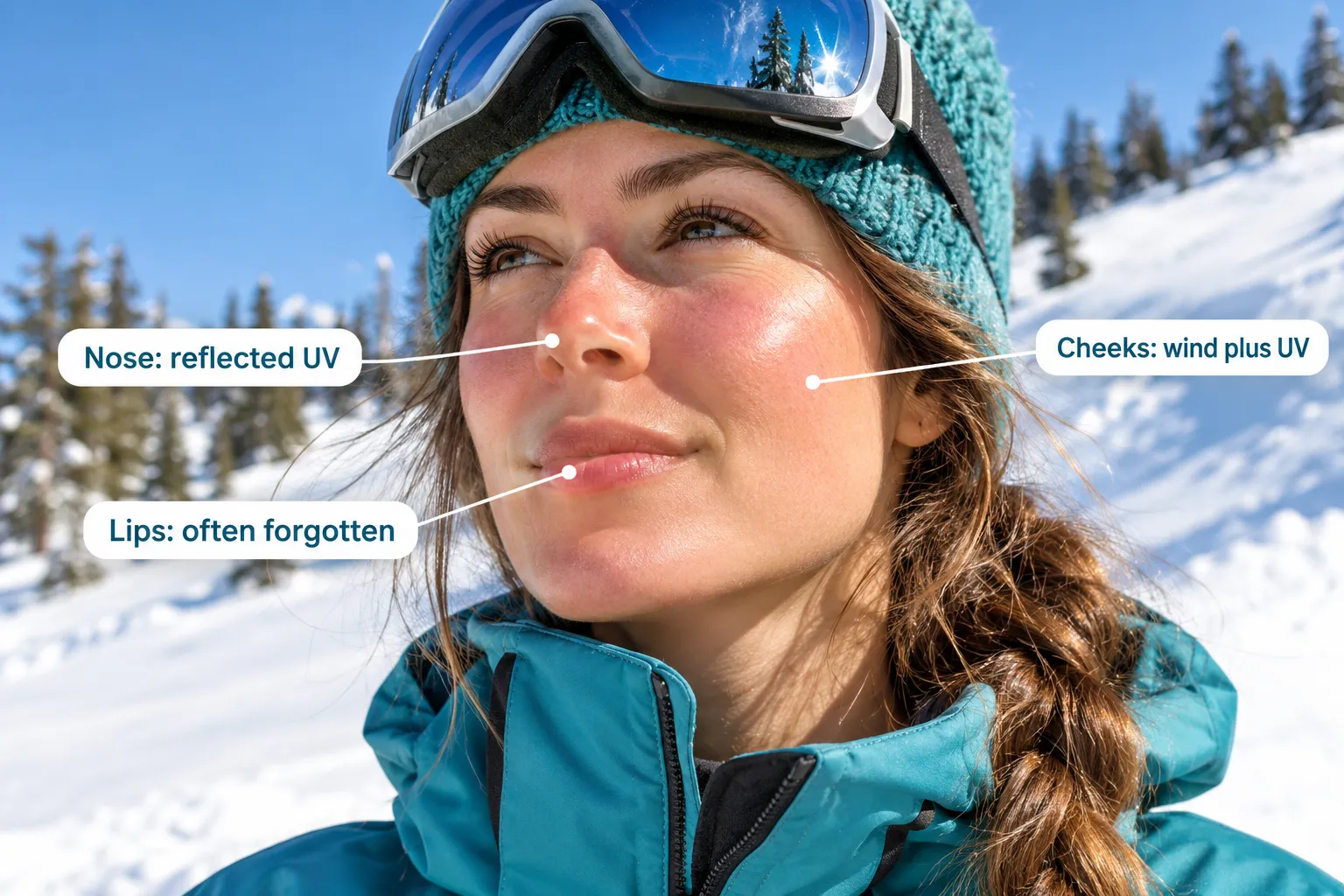
Snow reflection is the single biggest reason winter sun catches Ontarians off guard. Fresh white snow can reflect more than 80% of UV radiation back up toward your face, almost doubling the UV your skin actually receives compared with the ambient reading alone [1][3].
This matters most for:
The City of Hamilton specifically advises wearing sunscreen on exposed skin in winter because snow can almost double UV strength [4]. This is why experienced skiers get sunburned on the underside of the chin and nostrils, areas normally shaded from direct summer sun but hit by upward-reflected light in winter.
Related reading: the different wavelengths behind this risk are explained in what are the types of UV rays.
Yes. UV radiation increases with altitude because there's less atmosphere to absorb it. Outdoor-sports research estimates roughly a 2-3% increase in UV irradiance per 100 metres of elevation gain in alpine settings [5].
A few practical notes for Ontario skiers:
Winter vacations to sunny, southern destinations carry a real sunburn and UV risk, often higher than what Ontarians experience locally in January. UV strength increases closer to the equator, and WHO/Health Canada guidance confirms that tropical and subtropical destinations deliver much stronger UV year-round than Canada does in winter [2][3].
This is a common edge case worth naming directly: a Canadian who hasn't seen strong sun in months lands in Mexico, the Caribbean, or Florida with pale, winter skin and spends the first afternoon by the pool. That combination, unconditioned skin plus strong tropical UV plus reflective water or sand, is a recipe for a bad sunburn within an hour or two.
Tips specific to this scenario:
For a broader seasonal comparison, see prevent sun damage and skin cancer this summer.
Yes. Clouds block visible light more than they block UV rays, so a grey winter day in Ontario can still deliver meaningful UV exposure, especially with snow on the ground.
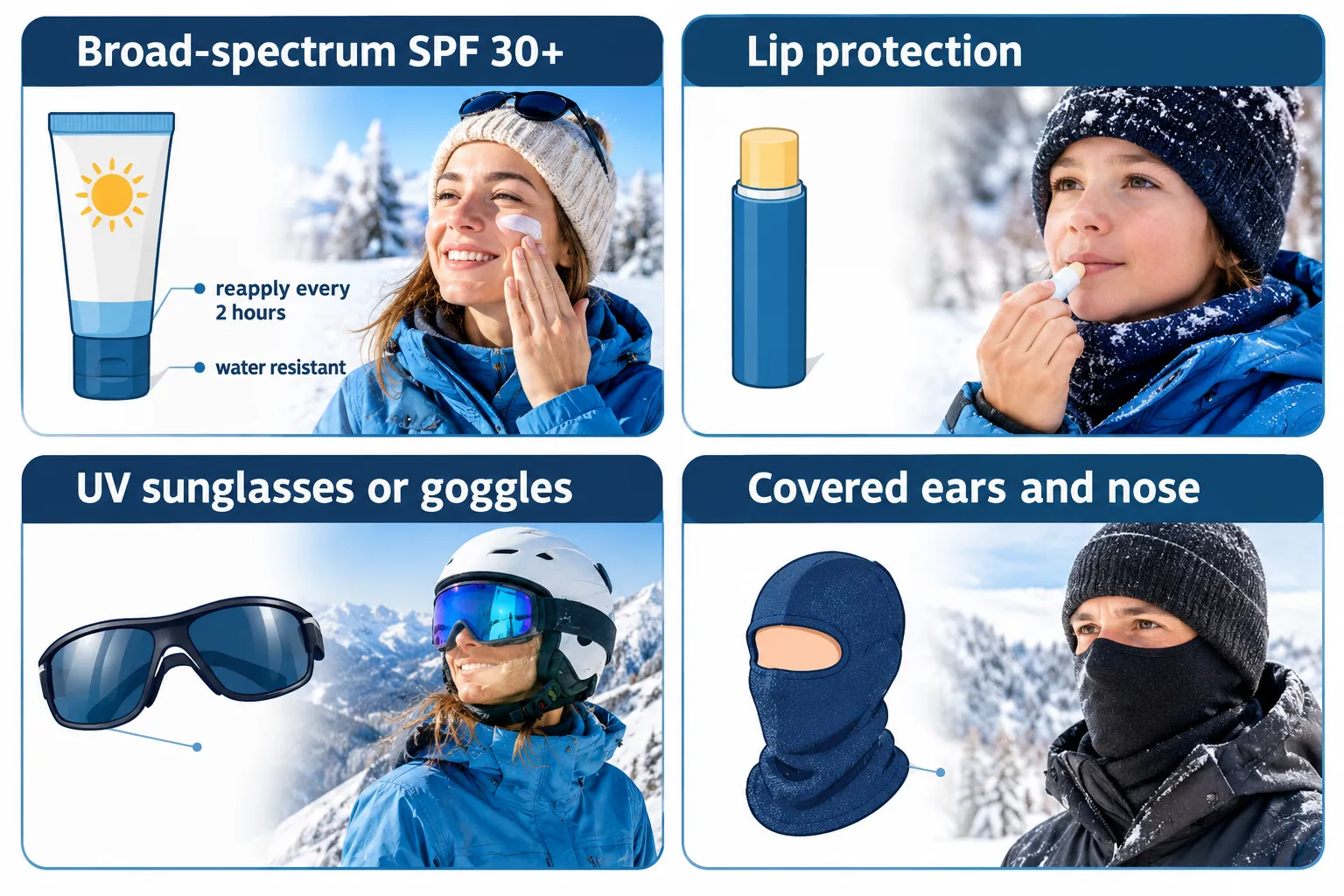
Protecting skin from winter sun skin cancer ontario snow UV risk takes a layered approach: sunscreen, clothing, and timing together, not any single step alone. The Canadian Dermatology Association recommends shade, protective clothing, a hat, UV-protective sunglasses and broad-spectrum SPF 30 or higher as a combined strategy, noting that snow, water and sand intensify reflected exposure [6].
Use a broad-spectrum sunscreen rated SPF 30 or higher on all exposed skin before heading outdoors, and reapply after sweating, wind exposure, or roughly every two hours during long outdoor sessions [4][6]. Melanoma Canada specifically recommends water-resistant, broad-spectrum SPF 30+ for exposed skin during outdoor activity [4].
Health Canada's sunscreen monograph was updated in February 2026, revising directions around peak sun-exposure periods and allowing the broad-spectrum filter bemotrizinol (PARSOL Shield) in secondary sunscreen products up to 6% concentration [7][8]. This may expand the range of SPF-containing daily moisturizers and cosmetics available in Canada, but such products are not a substitute for a dedicated, water-resistant sunscreen during skiing or long outdoor exposure [7][8].
Lips, ears and the nose are among the most commonly missed spots and also common sites for skin cancer. Use an SPF lip balm, and don't skip the tips of the ears or the bridge of the nose when applying sunscreen.
See detailed guidance on skin cancer on the lip, skin cancer on the ear, and skin cancer on the nose.
Wear sunglasses or ski goggles with UV protection whenever you're outside in bright, snowy conditions. Snow glare affects the eyes just as much as the skin, and UV-rated eyewear is part of the Canadian Dermatology Association's recommended layered protection approach [6].
Cover as much skin as practical with hats, neck gaiters and gloves, and limit long unprotected exposure during the brightest midday hours. Combine clothing coverage with sunscreen on anything left exposed, face, neck, hands, for the most complete protection.
❄️ Winter sun checklist
Winter is a practical time for a skin check because you're already covering up and can spot changes that summer tans might hide, and because dermatology and clinic wait times often differ from the busy summer season. Checking your skin regularly is part of good year-round skin health, not a one-time task.
Learn how to do this properly with the skin cancer self-exam check guide, or book a skin cancer screening in Toronto if you'd rather have a professional look.
The clearest warning signs follow the ABCDE rule for melanoma and specific patterns for basal cell carcinoma (BCC): Asymmetry, Border irregularity, Color variation, Diameter over 6mm, and Evolving size, shape or color, plus any pearly, non-healing bump.
⚠️ See a doctor if a spot:
For a visual walk-through, see the ABCDEs of melanoma guide. If you have a suspicious spot, The Minor Surgery Center operates five GTA clinics, Toronto/North York, York Mills, Vaughan, Mississauga and Oakville, staffed by board-certified plastic and reconstructive surgeons who assess suspicious spots and remove BCC, SCC and melanoma, all OHIP-covered with no referral needed. Free consultations are available; call (647) 614-1611.
Do I need sunscreen in winter in Canada?
Yes, especially on bright, snowy days or during outdoor activities like skiing, since snow reflection can nearly double your UV exposure [1][3]. Daily winter UV is generally lower than summer, but it's not zero.
Can you get sunburned skiing?
Yes. Skiers face UV from the sky plus UV reflected off snow, and research on alpine skiing has measured meaningful daily UV-B exposure in skiers' skin [5]. Sunburn on the nose, cheeks and chin is common after a full day on the slopes without sunscreen.
Does snow reflect UV?
Yes, fresh white snow can reflect more than 80% of the sun's UV rays, according to Environment and Climate Change Canada [1]. This reflection adds to direct sunlight, increasing overall exposure for anyone outdoors.
What SPF should I use for skiing?
Use a broad-spectrum, water-resistant sunscreen rated SPF 30 or higher, reapplied every couple of hours or after heavy sweating [4][6]. Don't forget lip SPF and UV-protective goggles or sunglasses.
Can you get skin cancer from winter sun?
Yes, repeated winter sun exposure, from skiing, outdoor work, or winter vacations, contributes to cumulative UV damage linked to skin cancer risk over time [5]. Winter sunburns count toward lifetime UV exposure just like summer ones.
Is winter a good time to get a skin check?
Yes, many people find it a convenient time to check for new or changing spots since skin is often covered and easier to inspect systematically. It's also a good time to book a professional mole check without a referral in Toronto.
Winter sun skin cancer ontario snow UV risk is real, even if it's easy to ignore when it's -5°C outside. Snow reflection, altitude on ski trips, and strong UV during winter getaways down south all add up to meaningful exposure that cold temperatures don't cancel out. The fix is simple: broad-spectrum SPF 30+, lip and eye protection, sensible timing, and a habit of checking your skin regardless of season.
If you notice a new or changing spot, don't wait for summer. The Minor Surgery Center's five GTA clinics offer free consultations for suspicious spots, with OHIP-covered removal of BCC, SCC and melanoma and no referral required. Call (647) 614-1611 to book, or learn more about skin cancer conditions and treatment options.