

Last updated: October 28, 2026
The smell comes from keratin and dead skin cells breaking down inside a closed pocket under the skin, often mixed with bacteria that enter through the cyst's tiny surface opening. A smell by itself does not always mean infection, but redness, heat, swelling, or pus usually do. Squeezing the cyst pushes material deeper and raises infection risk. Removing the entire cyst wall, not just draining it, is what actually stops the smell and the cyst from returning.
Most cysts that people call "sebaceous cysts" are technically epidermoid cysts, filled with keratin rather than oily sebum [1][2]. That naming mix-up matters because it changes what the smell actually is and how the cyst should be treated.

The material inside most of these cysts is keratin, a tough protein found in skin, hair, and nails, not sebum (skin oil). Mayo Clinic describes the contents as a thick, cheesy substance that can leak out and produce a smell [2].
Epidermoid cysts form when skin cells that should shed from the surface instead move inward and keep multiplying in a closed pocket [2]. Those trapped cells form a wall around themselves and keep producing keratin, which has nowhere to go. Over months or years, this slow buildup is what creates the lump under the skin.
This is different from a true sebaceous cyst (a steatocystoma), which does contain sebum and is far less common [1][3]. For a side-by-side breakdown of these differences, see our guide on epidermoid vs. sebaceous cysts.
Quick example: a cyst on the back that's been there for two years and suddenly releases a thick, yellowish, odd-smelling paste is releasing built-up keratin, not sweat or oil in the usual sense.
The odor comes from organic material decomposing in a low-oxygen pocket, sometimes worsened by bacteria. This happens whether or not the cyst is infected, because keratin and lipids can smell unpleasant simply from sitting and breaking down.
Keratin and cellular debris accumulate slowly inside the cyst wall. Chemical breakdown of this material over time can generate the sulfur-like or cheesy smell many people notice. DermNet's dermatologist-reviewed material describes the expressed substance as "foul-smelling cheesy debris" that comes out through a small central opening called a punctum [4].
The punctum is a tiny dark opening on the cyst's surface, often barely visible, that connects the cyst to the outside skin. Surface bacteria can travel through this opening and interact with the trapped keratin, which can add to the smell or trigger inflammation. This is one reason cysts with a visible punctum are more prone to odor and occasional drainage than deeper lumps without one.
Common mistake: assuming a stronger smell always signals a worsening infection. In many cases, it just means more material has broken down or the cyst has partly ruptured under the skin, releasing contents that were previously sealed in.
No. A smelly cyst is not automatically infected, odor alone is common even in cysts with no infection. MedlinePlus notes that a foul smell can occur without infection, and that infection is more likely when odor appears together with redness, warmth, pain, swelling, or fever [3].
SituationSignsWhat to doUrgencySmelly but not infectedOdor, cheesy or pasty discharge, little pain, no rednessKeep clean, avoid squeezing, book a routine consultLow, plan removal when convenientInfectedRedness, warmth, tenderness, swelling, possible feverSee a doctor promptly, do not drain at homeModerate to urgentRuptured or inflamedSudden yellow or stinky drainage, rapid swelling, pain spikeClean gently, cover, seek same-week medical reviewModerate to urgent
Cleveland Clinic specifically notes that ruptured cysts can leak yellow, often "stinky," drainage, which is a normal (if unpleasant) part of a cyst breaking open rather than proof of bacterial infection [1]. Learn more about what happens when a cyst ruptures in our article on what happens if a sebaceous cyst bursts.
Usually not, in the strict medical sense. Most lumps called "sebaceous cysts" by patients are epidermoid cysts, filled with keratin rather than sebaceous gland oil [1][2].
True sebaceous cysts (steatocystomas) are less common and do contain sebum [1][3]. Pilar cysts, common on the scalp, are another related but distinct type, formed from hair follicle cells rather than surface skin cells. For a fuller comparison, read epidermoid vs. sebaceous vs. pilar cyst: how they differ and our dedicated page on sebaceous cysts.
Decision rule: if the lump has a visible central pore and produces thick, cheesy material, it is almost certainly an epidermoid cyst. If it feels smooth with no visible pore and sits on the scalp, it may be a pilar cyst instead.
Squeezing or popping a cyst at home does not remove the cyst, it only pushes some contents out through the punctum while leaving the wall behind. Cleveland Clinic and Mayo Clinic both advise against squeezing, puncturing, or cutting a cyst yourself, since this can cause infection, scarring, rupture of the capsule, and recurrence [1][2].
Don't squeeze it, see a doctor if:
Based on guidance from Cleveland Clinic [1] and Mayo Clinic [2].
Squeezing also raises the odds that the cyst wall ruptures internally, which can spread inflamed material into surrounding tissue. See our related post on what can go wrong when you try to draw out a sebaceous cyst at home.
Safe home care focuses on hygiene and comfort, not drainage. These steps won't remove the cyst, but they can reduce irritation and odor while you arrange proper care.
Edge case: if the cyst is behind the ear or on the scalp and hard to keep clean, loosely cover it rather than leaving hair or fabric trapped against leaking material, which can worsen odor.
Yes, if the cyst wall is still there, the smell can return, because the lining keeps producing keratin for as long as it remains in the skin. Draining contents or letting a cyst rupture on its own only empties it temporarily.
DermNet and NCBI's StatPearls both note that complete excision of the cyst and its wall is the approach favored for definitive treatment, since partial drainage leaves the capsule behind and allows recurrence [4][5]. If your cyst has already popped once, see what tends to happen next in sebaceous cyst popped on its own.
Repeated cysts usually happen because the underlying cause, skin cells migrating inward instead of shedding normally, can occur at more than one spot, and because any cyst wall left behind from a previous drainage can regrow [2][5]. Some people are also more prone to forming these cysts due to skin type, acne history, or prior skin injury.
Common reasons cysts recur:
For more detail on this pattern, see why do cysts come back after removal. There's no proven way to fully prevent new cysts from forming, though keeping skin clean and avoiding repeated injury to the same area may help in some cases.
Treatment ranges from monitoring small, symptom-free cysts to removing them surgically when they're painful, infected, growing, or bothersome. A clinician will examine the cyst and, if infection is suspected, may use culture testing to confirm it [3].
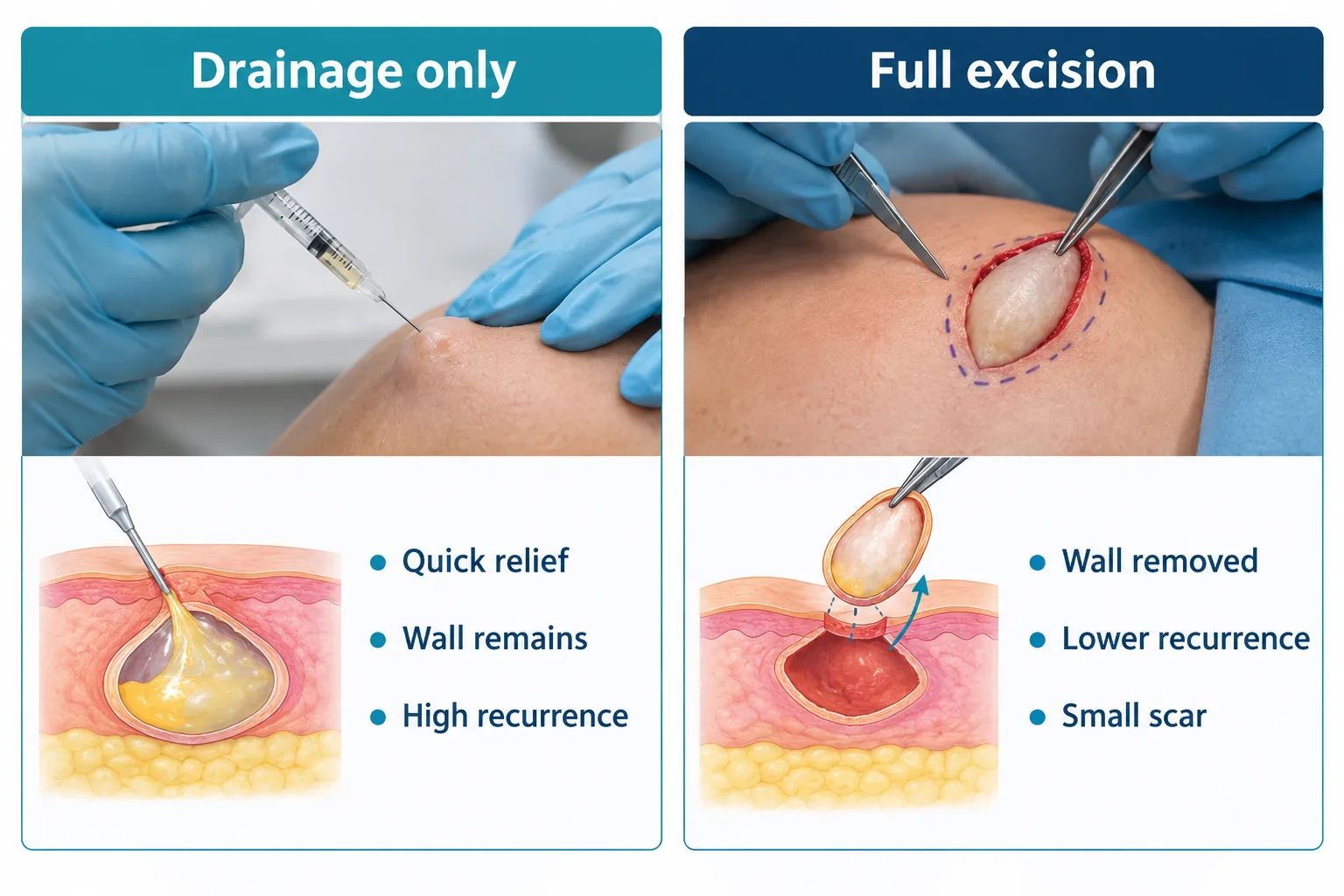
Draining relieves pressure from an inflamed or infected cyst but does not remove the capsule, so the cyst commonly returns. Full excision removes the entire cyst wall and is generally associated with lower recurrence [4][5].
ApproachWhat's removedRecurrenceScarWhen usedDrainageFluid/keratin contents onlyCommon, since wall remains [5]Minimal, but reopening possibleActive infection or abscess needing urgent reliefFull excisionEntire cyst and wallLower, when wall fully removed [4]Small linear scarDefinitive treatment once infection has settled
Compare these approaches in more depth at cyst drainage vs. full excision: recurrence risk explained, and read about scarring expectations at does cyst removal leave a scar.
The Minor Surgery Center, with clinics across Toronto/North York, York Mills, Vaughan, Mississauga, and Oakville, offers surgical excision of sebaceous and pilar cysts under local anesthetic, performed by board-certified plastic and reconstructive surgeons and co-founders Dr. Kunaal Jindal and Dr. Roberto Tutino. Removal starts at $695, is not OHIP-covered, requires no referral, and includes a free consultation. The clinic does not drain active infections or prescribe antibiotics; those situations are handled by a physician first. Learn more about the procedure on the sebaceous cyst removal page, or call (647) 614-1611 to ask about a consultation.
See a doctor promptly if the cyst is painful, growing quickly, red, warm, draining pus, or near sensitive areas like the face or groin. Also see a doctor if a cyst keeps coming back after previous drainage, since that usually means the wall was left behind [3][5].
Leaving a cyst untreated long-term carries its own risks worth understanding; see what happens if you leave a cyst untreated for more. If you're unsure whether what you're dealing with is a cyst at all, our cyst location challenges article covers how presentation can vary by body site, including behind the ear, scalp, and groin.
Why does my cyst smell like cheese?
The smell comes from keratin and dead skin cell debris that builds up inside the closed cyst over time. Mayo Clinic describes this material as a thick, cheesy substance that can leak out and smell [2].
Does a smelly cyst mean infection?
Not necessarily. MedlinePlus notes that odor can occur without infection, and infection is more likely when redness, warmth, pain, swelling, or fever are also present [3].
Can I squeeze a sebaceous cyst?
No. Squeezing can push material deeper, cause infection, and increase the chance the cyst returns, according to Cleveland Clinic and Mayo Clinic [1][2].
Will a cyst stop smelling on its own?
The smell may reduce temporarily if the cyst partly drains, but it typically returns because the keratin-producing wall is still present until removed [4][5].
Why do I keep getting cysts?
New cysts can form at different sites due to how skin cells migrate inward, and previously drained cysts can return if the wall wasn't fully removed [2][5].
Does cyst removal stop the smell for good?
Full surgical excision of the cyst and its wall is the approach associated with lower recurrence and is what stops the odor from returning at that site [4][5].
The smell from a sebaceous or epidermoid cyst comes from keratin and skin debris breaking down inside a closed pocket, sometimes with bacteria entering through the small surface pore. Odor alone doesn't confirm infection, but redness, heat, swelling, pain, or fever do, and those signs call for prompt medical attention. Squeezing never solves the underlying problem and often makes things worse. The only approach shown to meaningfully lower recurrence is full removal of the cyst and its wall, not drainage alone. If a cyst keeps smelling, growing, or coming back, book a consultation with a qualified clinician to discuss removal options suited to its size and location.