
Last updated: September 23, 2026
Squamous cell carcinoma treatment usually comes down to three surgical options: standard excision, Mohs micrographic surgery, or curettage and electrodesiccation (ED&C). Standard excision with clear margins is the go-to for most low-risk tumors on the trunk and limbs. Mohs surgery is reserved for high-risk lesions, recurrent tumors, and cancers on the face, ears, or genitals where saving tissue matters. ED&C is a limited option, appropriate only for small, superficial, low-risk squamous cell carcinomas on non-hair-bearing skin, and it is used far less often for squamous cell carcinoma than for basal cell carcinoma [1][2].
Squamous cell carcinoma (SCC) is the second most common form of skin cancer, arising from the flat squamous cells in the outer layer of the skin, and it is treated primarily with surgery aimed at removing the tumor completely along with a margin of healthy tissue [8]. Unlike basal cell carcinoma, squamous cell carcinoma carries a higher, though still relatively low, risk of spreading beyond the skin, which shapes how aggressively it needs to be treated [9].
SCC typically develops on sun-exposed skin: the face, ears, scalp, neck, hands, and forearms. It often starts as a rough, scaly patch, a firm red bump, or a sore that will not heal. Chronic UV exposure is the leading cause, but immunosuppression, prior radiation, chronic wounds, and certain genetic conditions also raise risk [8][10]. Recent laboratory research has even examined cellular resistance mechanisms within SCC tumors, including how proteins like ALDH3A1 contribute to treatment resistance in squamous cell carcinoma, underscoring why complete surgical removal remains the most reliable path to cure.
Treatment decisions hinge on a risk-stratification system that considers:
Based on these factors, a clinician places the tumor into a low-risk or high-risk category, and that category determines whether standard excision, Mohs surgery, or occasionally ED&C is the right fit [1][2]. For background on the condition itself, see this overview of squamous cell carcinoma.
Decision rule: if the tumor is small, well-defined, and on a low-risk site, excision is usually sufficient. If it is large, poorly defined, recurrent, or sitting on the face or another cosmetically and functionally sensitive area, Mohs surgery becomes the stronger recommendation.
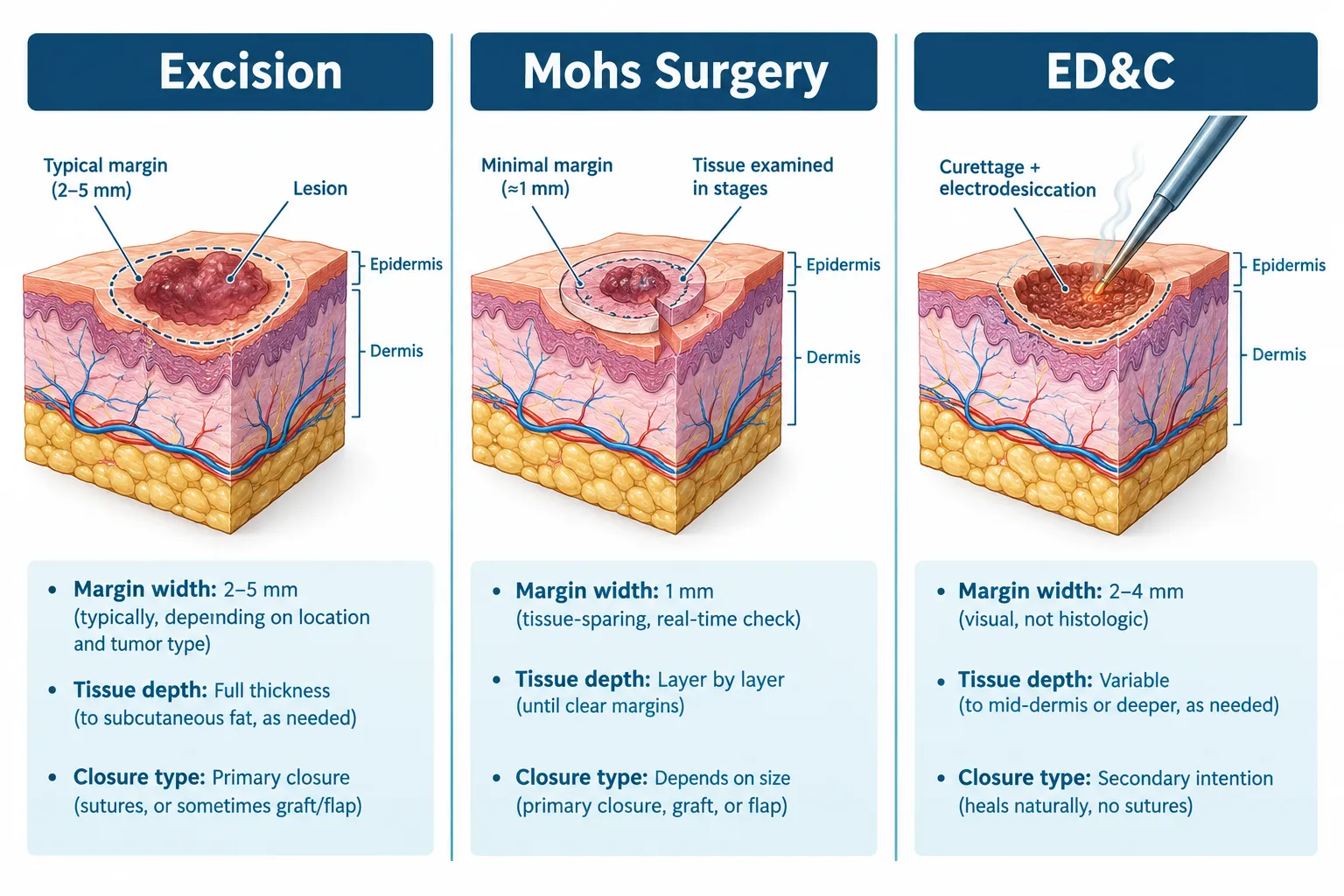
Standard excision removes the tumor with a pre-measured margin of normal-looking skin and closes the wound with stitches, while Mohs micrographic surgery removes the tumor in thin layers that are checked under a microscope in real time until no cancer cells remain. Both are effective, but they serve different risk profiles within squamous cell carcinoma treatment [4][7].
Standard excision is a single-stage procedure. The surgeon cuts out the visible tumor plus a margin, typically 4 mm for low-risk SCC and up to 6 mm or more for higher-risk tumors, then sends the tissue to a lab for processing, which usually takes several days for results [1][7]. If margins come back clear, treatment is complete. If not, a second procedure may be needed.
Standard excision:
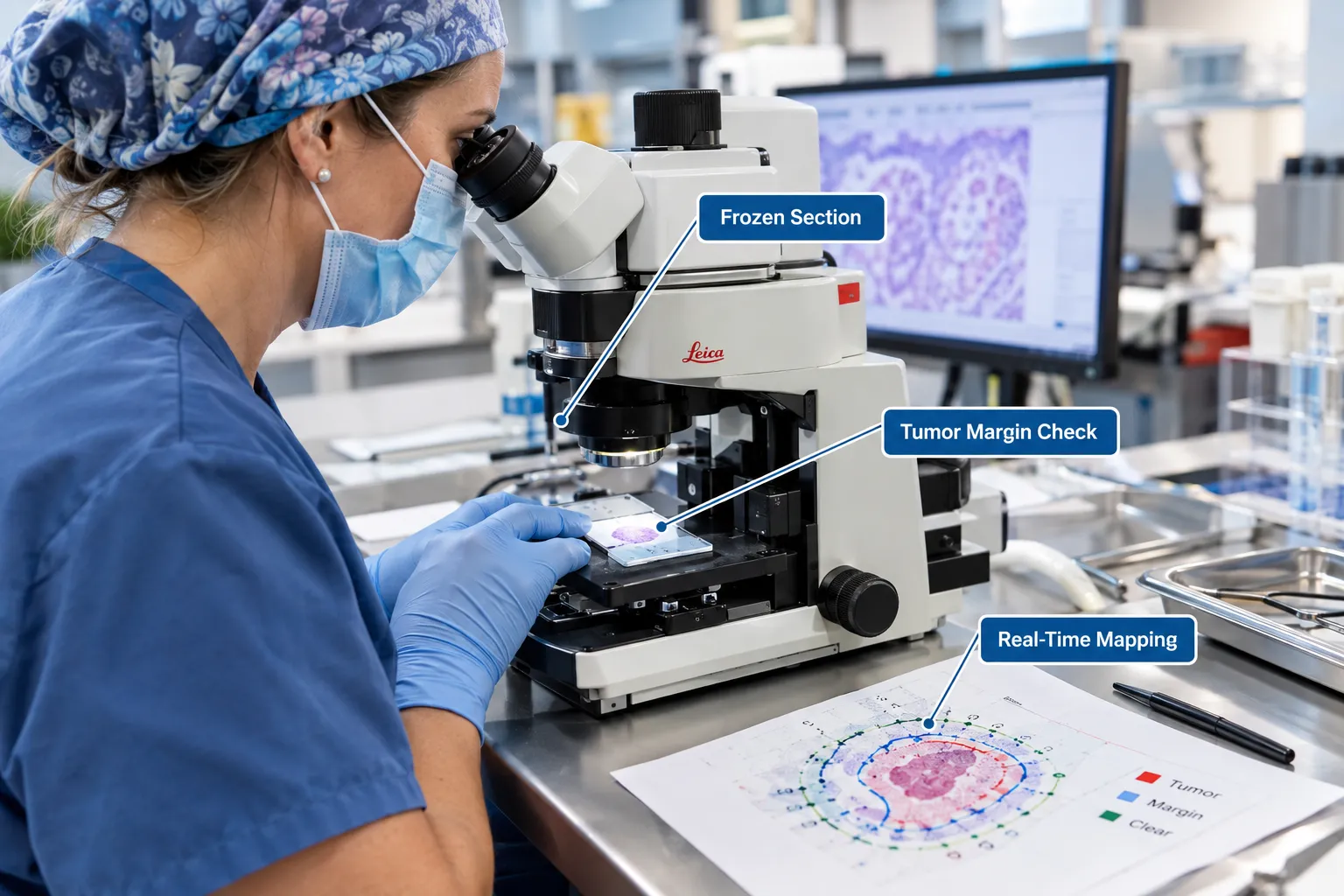
Mohs surgery is different because the pathology happens on-site and in real time. The surgeon removes a thin layer of tissue, maps it, and examines 100 percent of the surgical margin under a microscope while the patient waits. If any cancer cells remain at the edge, the surgeon removes another layer only from that specific spot, repeating until the margin is completely clear [4][8].
Mohs surgery:
Choose excision if: the tumor is low-risk, located on the trunk or limbs, and cosmetic tissue conservation is not a major concern.
Choose Mohs if: the tumor is on the face or another high-risk site, is recurrent, has aggressive features under the microscope, or sits in an area where every millimeter of tissue matters for function or appearance.
Common mistake: assuming Mohs is always "better." For a small, low-risk SCC on the back, standard excision delivers comparable cure rates with less time in the chair and lower cost. Mohs is a targeted tool, not a universal upgrade [2][7].
Curettage and electrodesiccation (ED&C) is a technique where the tumor is scraped out with a sharp instrument called a curette, and the base is then burned with an electric needle to destroy any remaining cancer cells; this cycle is often repeated two or three times in the same session [5][6]. It is one of the oldest treatments for non-melanoma skin cancer and is still used today, but its role in squamous cell carcinoma treatment is much narrower than for basal cell carcinoma.
ED&C works reasonably well when the cancer is confined to the upper layers of skin, because the curette can feel the difference between soft, friable tumor tissue and firmer normal dermis. That tactile distinction is the whole basis of the technique, there is no microscopic margin check, so success depends heavily on operator experience and appropriate patient selection [5][6].
Edge case: a patient on blood thinners who cannot easily stop them for a formal excision may still be a reasonable ED&C candidate for a small, low-risk SCC, since ED&C has less bleeding risk than incisional surgery. This is a case where treatment choice bends around a medical constraint rather than pure oncologic ideal.
Mohs micrographic surgery generally costs more than standard excision, which in turn usually costs more than curettage and electrodesiccation, because Mohs requires on-site pathology, longer surgeon time, and often a same-day reconstruction. Exact prices vary widely by region, provider, and whether the procedure is bundled with reconstructive closure, so patients should request a written estimate before treatment.
Several factors drive the cost difference:
Decision rule: for a low-risk SCC on the arm, the added cost of Mohs surgery rarely changes the outcome enough to justify the price difference. For a high-risk SCC on the nose or ear, the extra cost of Mohs is frequently justified by lower recurrence risk and better cosmetic outcome, a point explored further below.
Mohs micrographic surgery is generally the preferred squamous cell carcinoma treatment for facial tumors because it removes the least amount of healthy tissue while still checking 100 percent of the surgical margin, which matters enormously on a structure as compact and visible as the face [4][7]. Facial skin cancer treatment is as much about preserving function and appearance as it is about cure.
The face presents unique challenges:
Because of these factors, most current guidelines recommend Mohs surgery for squamous cell carcinoma on the nose, ears, eyelids, lips, and other central facial zones, particularly for tumors larger than 6 mm or with any high-risk features [2][7]. Standard excision remains reasonable for smaller, clearly defined, low-risk facial SCCs when Mohs is not available, though many dermatologic surgeons default to Mohs for any facial SCC given the tissue-sparing advantage [4].
Quick example: a 7 mm SCC on the nasal ala (the side of the nose) is a strong candidate for Mohs surgery, since even a 4 mm margin taken with standard excision could remove a disproportionate amount of tissue relative to the small working space available, whereas Mohs allows layer-by-layer removal until margins are clear without unnecessary tissue loss.
For patients researching where to get this kind of care, comparing established programs, such as this list of top skin cancer screening and treatment clinics in Toronto, can help identify centers with dedicated Mohs and dermatologic surgery expertise.
Surgery is the first-line treatment for invasive squamous cell carcinoma, but non-surgical options exist for patients who cannot tolerate surgery or have very superficial disease, including topical chemotherapy, photodynamic therapy, and radiation therapy [1][9]. These alternatives are not interchangeable with surgery for most invasive SCC, they carry lower cure rates and are typically reserved for specific situations.
Topical 5-fluorouracil or imiquimod cream can be used for SCC in situ (Bowen's disease), which is confined to the epidermis and has not invaded deeper tissue. These creams are not appropriate for invasive squamous cell carcinoma because they cannot reach or destroy tumor cells that have grown into the dermis [1][9].
Photodynamic therapy uses a light-activated drug applied to the skin, followed by exposure to a specific wavelength of light that destroys abnormal cells. It has a role in treating superficial, in-situ disease but is generally not recommended as primary treatment for invasive SCC [1].
Radiation therapy can be an effective option for patients who are poor surgical candidates, for example, older patients with significant comorbidities, or tumors in locations where surgery would cause major functional loss. Radiation is also used as an adjuvant treatment after surgery when there is perineural invasion or positive margins, and it is considered in cases where surgery alone did not achieve clear margins [1][9]. NCI's PDQ treatment summary confirms radiation's supporting role, particularly for patients who decline surgery or cannot medically tolerate it [9].
Decision rule: non-surgical treatment is reasonable for SCC in situ, for patients who are not surgical candidates, or as an adjuvant after surgery, not as a first choice for a healthy patient with invasive SCC who can safely undergo excision or Mohs.
Common mistake: using an over-the-counter or prescription cream on a lesion that has never been biopsied. Any suspicious growth needs a tissue diagnosis first, since treating unconfirmed cancer with topical medication can delay proper care and allow the tumor to grow.
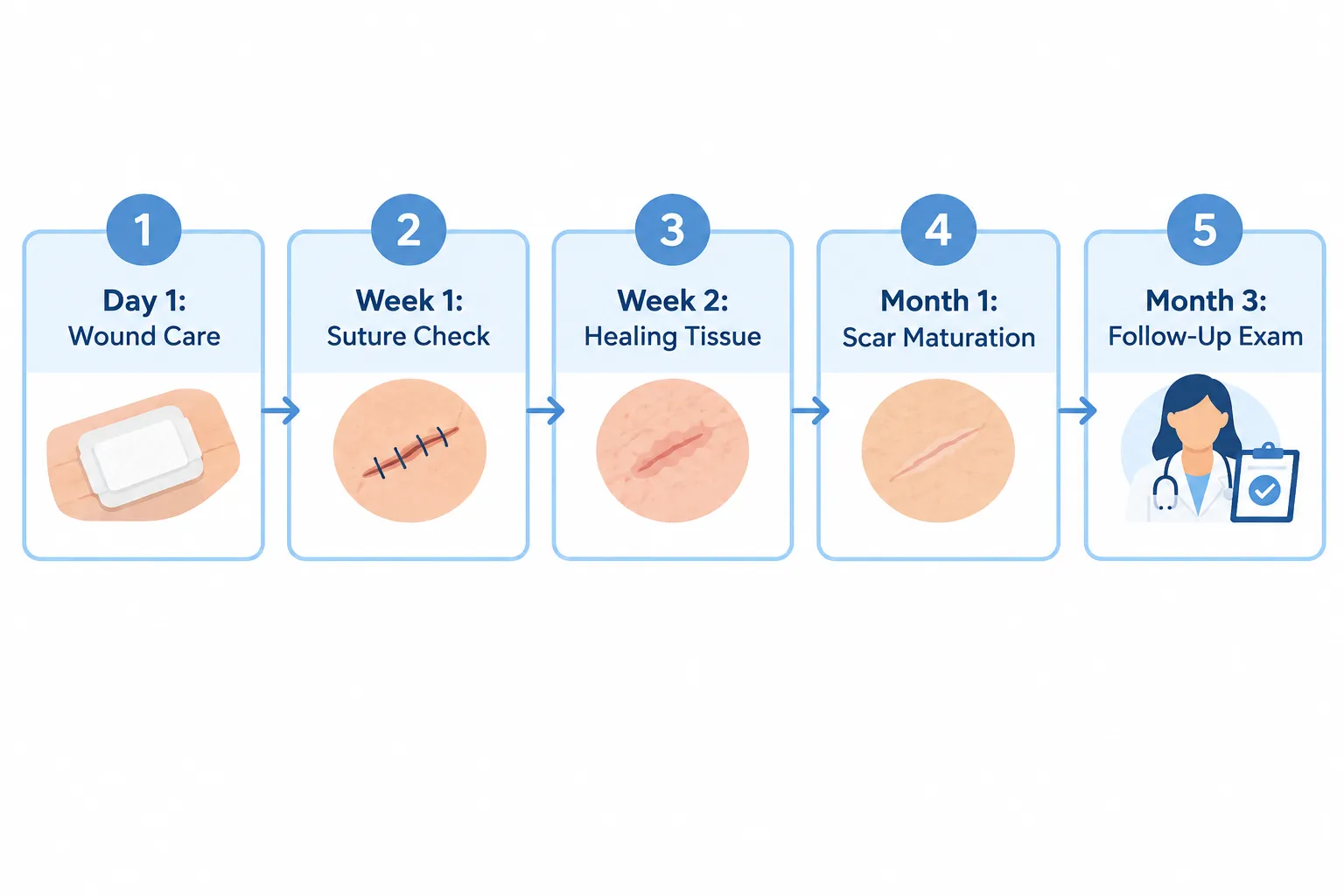
Recovery time is shortest for ED&C (days), moderate for standard excision (roughly 1 to 3 weeks for the surgical site to heal, with sutures typically removed within 1 to 2 weeks), and variable for Mohs surgery depending on the size of the defect and type of reconstruction used to close it [3][4].
TreatmentTypical procedure timeInitial healingFull healing/scar maturationED&C15-30 minutes2-4 weeks (open wound care)4-8 weeksStandard excision30-60 minutes1-2 weeks (sutures in place)6-12 weeksMohs surgery2-4+ hours (multiple stages)1-3 weeks (depends on repair)6-12+ weeks
A few practical notes:
Edge case: patients with diabetes, poor circulation, or who smoke should expect longer healing times across all three methods, and this should factor into the choice of technique, a large Mohs defect requiring a complex flap may not be ideal for a patient with significant wound-healing risk factors. For general recovery expectations after skin cancer surgery, this guide on basal cell carcinoma recovery and what to expect after removal covers wound care principles that apply similarly to SCC surgical sites.
ED&C can work for carefully selected, low-risk squamous cell carcinoma, but outcome data show it is less reliable for SCC than for basal cell carcinoma, and its success depends heavily on tumor selection and operator skill [5][6]. It is not considered an equivalent alternative to excision or Mohs for most squamous cell carcinoma cases.
Recent outcome research adds important nuance:
Decision rule: ED&C is reasonable for a small, superficial, well-differentiated SCC on the trunk in a patient who understands the trade-off of a less precise margin check. It is not appropriate for facial tumors, recurrent tumors, or any lesion with aggressive histologic features.
Common mistake: choosing ED&C purely because it is fast and inexpensive without confirming the tumor's risk category first. A biopsy showing perineural invasion or poor differentiation should rule out ED&C regardless of size or location.
Mohs surgery should be chosen over regular excision when the squamous cell carcinoma is high-risk, recurrent, located on the face or another cosmetically or functionally sensitive area, or when the tumor's borders are difficult to define clinically [2][4][7]. The core advantage of Mohs is complete margin assessment paired with maximum tissue conservation, valuable exactly in situations where standard margins would either be inadequate or overly destructive.
Specific indications favoring Mohs surgery include:
Conversely, standard excision remains appropriate when the tumor is small, well-differentiated, clearly bordered, and located on a low-risk site such as the trunk or proximal extremities [1][7].
Quick example: a recurrent 1.5 cm SCC on the ear in an organ transplant recipient checks nearly every box favoring Mohs, high-risk location, recurrence, and immunosuppression, making it a poor candidate for standard excision despite the tumor's modest size.
For comparison, similar risk-based logic applies to basal cell carcinoma treatment decisions, detailed further in this guide to basal cell carcinoma treatment approaches.
Every squamous cell carcinoma treatment carries some risk of bleeding, infection, scarring, and incomplete tumor removal, but the specific risk profile differs by method. Understanding these differences helps set realistic expectations before choosing a technique.
Common mistake: underestimating the reconstruction risk of Mohs surgery on the face. Some patients focus only on the tumor removal step and are surprised by the complexity of the repair needed for a larger-than-expected defect. Discussing potential reconstruction scenarios in advance helps avoid this surprise.
Recurrence rates after squamous cell carcinoma treatment depend heavily on tumor risk category and treatment method, ranging from roughly 3 to 8 percent after standard excision of low-risk tumors to under 5 percent after Mohs surgery for high-risk tumors, while ED&C used outside its ideal indications carries a meaningfully higher recurrence rate [1][5][7]. No treatment guarantees zero recurrence, which is why long-term follow-up matters regardless of method chosen.
Key factors influencing recurrence:
A 2024 comprehensive review examining how excision, Mohs, and ED&C integrate into long-term follow-up strategy emphasized that treatment choice should factor not just into initial cure rates, but into how easily recurrence can be detected and re-treated at each site [3]. Regular skin checks after treatment, typically every 3 to 12 months depending on risk category, remain an essential part of managing squamous cell carcinoma long term [1][2].
Edge case: a patient with multiple prior skin cancers and a history of recurrence may benefit from more frequent follow-up visits and a lower threshold for choosing Mohs surgery on future lesions, even ones that would otherwise seem low-risk.
Mohs surgery is generally worth the extra cost for high-risk squamous cell carcinoma, tumors in cosmetically sensitive areas, and recurrent cancers, because the combination of higher cure rates and tissue conservation reduces the long-term risk of re-treatment and extensive reconstruction [4][7]. For low-risk tumors on the trunk or limbs, the added expense is harder to justify since standard excision achieves comparable cure rates at lower cost.
Consider these factors when weighing the cost:
Decision rule: if the tumor checks any high-risk box (size, location, histology, recurrence, immune status), the extra cost of Mohs is generally a reasonable investment. If it is a straightforward low-risk lesion on the back or leg, standard excision offers essentially equivalent cure rates for less money and less time.
Untreated squamous cell carcinoma will continue to grow, invade deeper tissue layers, and can eventually spread to lymph nodes or distant organs, making early treatment far simpler and more successful than delayed treatment [9][10]. Unlike some skin conditions that stay stable without intervention, SCC is a true malignancy that does not resolve on its own.
The natural progression, left untreated, generally follows this pattern:
Advanced or metastatic cutaneous squamous cell carcinoma underscores why complete local treatment at the earliest stage is so important, once a tumor progresses beyond the skin, treatment options narrow considerably and outcomes worsen [9][10]. This is the central argument for prompt evaluation of any new or changing growth, rather than a "wait and see" approach.
Common mistake: dismissing a slow-growing, scaly patch as a harmless age spot or actinic keratosis without a proper evaluation. While many rough patches are benign or precancerous, only a clinical exam, and often a biopsy, can reliably distinguish them from early squamous cell carcinoma. If uncertain about a growth, comparing options at established programs such as the best basal cell carcinoma removal clinics in Toronto can be a useful starting point for finding dermatologic surgery expertise, since many of these centers manage both basal cell and squamous cell carcinoma.
The table below summarizes how standard excision, Mohs micrographic surgery, and ED&C stack up across the factors that matter most when planning squamous cell carcinoma treatment.
FactorStandard excisionMohs surgeryED&CBest forLow-risk SCC, trunk/limbsHigh-risk, recurrent, facial SCCSmall, superficial, low-risk SCCMargin checkLab-processed, results in daysReal-time, 100% marginNone (tactile judgment only)Tissue conservationModerateHighestNot applicable (no margin)Typical cure rateAbout 92%+ (low-risk) [1][7]Often 97%+ (primary tumors) [4][7]Lower and more variable for SCC [5][6]Procedure time30-60 minutes2-4+ hours15-30 minutesRecovery1-3 weeks1-3+ weeks (depends on repair)2-4 weeks (open wound)Relative costModerateHigherLowestNot recommended forHigh-risk, recurrent SCCVery low-risk SCC where excision sufficesHigh-risk SCC, hair-bearing skin, face
Is Mohs surgery the same as regular skin cancer surgery?
No. Mohs surgery involves real-time, on-site microscopic examination of 100 percent of the tumor margin during the procedure, while standard excision sends tissue to an outside lab and waits days for results. Both remove the tumor with a margin, but Mohs offers more precise margin control [4][7].
Can squamous cell carcinoma be cured with just curettage and electrodesiccation?
ED&C can cure select small, superficial, low-risk squamous cell carcinomas, but it is generally less reliable for SCC than for basal cell carcinoma and is not recommended for high-risk, recurrent, or hair-bearing-area tumors [5][6].
How long does it take to recover from Mohs surgery on the face?
Initial healing typically takes 1 to 3 weeks depending on the size of the defect and type of repair, while full scar maturation can take several months. Larger reconstructions on the face may need longer follow-up [3][4].
Does insurance typically cover Mohs surgery for squamous cell carcinoma?
Coverage varies by insurer, region, and documented risk factors. Because Mohs is often medically necessary for high-risk or facial tumors, many insurance plans do cover it, but confirming coverage and any out-of-pocket costs beforehand is recommended.
What is the main risk of choosing excision over Mohs for a high-risk tumor?
The main risk is a higher chance of incomplete margin removal, since standard excision uses a fixed margin without real-time, complete-margin microscopic checking. This can translate into a higher recurrence rate for high-risk or poorly defined tumors [4][7].
Can squamous cell carcinoma go away on its own without treatment?
No. Squamous cell carcinoma does not resolve without treatment. It typically continues to grow and can invade deeper tissue or, less commonly, spread to lymph nodes or other organs if left untreated [9][10].
Is radiation therapy ever used instead of surgery for squamous cell carcinoma?
Yes, radiation is sometimes used as primary treatment for patients who cannot undergo surgery, and as adjuvant treatment after surgery when there is perineural invasion or incomplete margins. It is not typically first-choice treatment for healthy patients who can have surgery [1][9].
How soon after diagnosis should squamous cell carcinoma be treated?
Treatment should generally begin as soon as reasonably possible after diagnosis, since SCC does not regress on its own and delay allows further growth and invasion. Exact timing depends on tumor characteristics and should be discussed with the treating physician [8][9].
Choosing between excision, Mohs surgery, and ED&C for squamous cell carcinoma treatment comes down to one central question: how much risk does this specific tumor carry, and where is it located? Low-risk tumors on the trunk or limbs generally do well with standard excision, which is faster and less expensive while still delivering strong cure rates. High-risk tumors, recurrent cancers, and anything on the face, ears, hands, feet, or genitals typically call for Mohs micrographic surgery, where the higher cost buys complete margin checking and maximum tissue conservation. Curettage and electrodesiccation has a narrow but legitimate role, limited to small, superficial, low-risk lesions on non-hair-bearing skin.
None of these decisions should be made without a confirmed biopsy and a risk assessment from a qualified clinician. The next practical step for anyone with a suspicious growth is straightforward: get it examined and biopsied promptly, ask directly which risk category the tumor falls into, and discuss which of these three methods matches that risk level. Waiting rarely improves the odds, and squamous cell carcinoma treated early, regardless of which surgical method is used, carries a far better outlook than the same tumor treated after months of delay.
[1] Squamous Cell Patient - https://www.nccn.org/patients/guidelines/content/PDF/squamous_cell-patient.pdf
[2] aad - https://www.aad.org/member/clinical-quality/guidelines/scc
[3] Pmc6652228 - https://pmc.ncbi.nlm.nih.gov/articles/PMC6652228/
[4] Pmc9189743 - https://pmc.ncbi.nlm.nih.gov/articles/PMC9189743/
[5] Pmc10872771 - https://pmc.ncbi.nlm.nih.gov/articles/PMC10872771/
[6] Pmc8659794 - https://pmc.ncbi.nlm.nih.gov/articles/PMC8659794/
[7] P339 - https://www.aafp.org/afp/2020/0915/p339
[8] Nbk441939 - https://www.ncbi.nlm.nih.gov/books/NBK441939/
[9] Skin Treatment Pdq - https://www.cancer.gov/types/skin/hp/skin-treatment-pdq
[10] Pmc7319751 - https://pmc.ncbi.nlm.nih.gov/articles/PMC7319751/