
Last updated: June 24, 2026
Quick Answer: Skin cancer on the hand is a real and underappreciated threat. The hands are among the most sun-exposed parts of the body, making them a common site for basal cell carcinoma, squamous cell carcinoma, and, less frequently, melanoma. Approximately 2.5% of all skin cancers occur in the hand region, including the fingers, wrists, and joints [1]. Early detection dramatically improves outcomes, and most cases are treatable when caught before they spread.
Skin cancer on the hand appears in several distinct forms depending on the type. BCC typically looks like a pearly or waxy bump, a flat flesh-colored lesion, or a crusty spot that does not heal [2]. SCC usually presents as a rough, scaly patch, a firm dome-shaped growth, or a sore that bleeds easily [3]. Melanoma on the hand may appear as a dark, irregularly shaped mole, a streak under a fingernail, or a dark spot with uneven borders.

Common visual signs of skin cancer on the hand include:
For a visual reference on early-stage lesions, the first stages of skin cancer pictures guide provides helpful comparison images.
Common mistake: Many people mistake early SCC on the hand for eczema or a persistent callus. The key difference is that skin cancer lesions do not respond to moisturizers or topical steroid creams and tend to grow or change over weeks.
Skin cancer on the hand is not rare. About 2.5% of all skin cancers occur in the hand region, affecting the skin, bones, cartilage, joints, and surrounding structures [1]. Among hand cancers specifically, SCC is the most frequently diagnosed type, followed by BCC. Melanoma accounts for a smaller proportion but carries the highest risk of serious complications.
The hands are particularly vulnerable because they receive cumulative UV exposure throughout a person's lifetime, often without sunscreen protection. Many people apply sunscreen to the face and arms but routinely skip the backs of the hands.
Yes, melanoma absolutely can develop on the hands. While melanoma is more commonly associated with the back, shoulders, and legs, the hands, fingers, and nail beds are legitimate sites for this aggressive cancer.
Acral lentiginous melanoma (ALM) is a specific subtype that appears on the palms, soles, and under the nails. It is the most common form of melanoma in people with darker skin tones and is frequently diagnosed at a later stage because it develops in areas that are less routinely checked.
Warning signs of melanoma on the hand include:
For more detail on how melanoma progresses, see the guide on advanced melanoma stages.
Age spots and skin cancer on the hand often look similar at first glance, but there are reliable ways to distinguish them. Age spots (also called liver spots or solar lentigines) are flat, evenly colored brown patches caused by UV exposure. They do not bleed, crust, itch, or change shape rapidly.
FeatureAge SpotSkin CancerColorUniform tan or brownMultiple shades, unevenBordersSmooth, well-definedIrregular, blurred, or raisedSurfaceFlat, smoothRough, scaly, crusty, or raisedBleedingNeverCommon with SCC and BCCGrowthStable over yearsGrows or changes over weeks/monthsHealingNot applicableSores that won't healSensationPainlessMay itch, burn, or be tender
Decision rule: If a spot on the hand has changed in size, color, or texture within the past 4 to 8 weeks, or if it bleeds without injury, treat it as suspicious until a dermatologist evaluates it. Age spots do not behave that way.
For additional context on crusty or changing skin spots, the article on crusty spots on skin covers several related conditions.
The hands are one of the most sun-exposed areas of the body, and that cumulative UV damage adds up over decades. Unlike the face, the hands are rarely protected by makeup with SPF, and most people do not reapply sunscreen to their hands after washing them throughout the day.
Several factors make the hands particularly susceptible:
Risk factors that increase susceptibility include lighter skin tone, blue or green eyes, blonde or red hair, a personal or family history of skin cancer, and a history of blistering sunburns during adolescence [4].
Skin cancer between the fingers and under the nails is less common but more dangerous because it is frequently missed during self-examination. The skin folds between fingers and the nail bed are sites where both SCC and ALM (acral lentiginous melanoma) can develop.
Signs to watch for in these specific areas:
Because these areas are harder to see, a full skin exam by a dermatologist is the most reliable way to catch lesions in the finger webs and nail beds.
In some respects, yes. Skin cancer on the hand can be more complex to treat than cancer on the trunk or back because surgeons must preserve hand function, tendons, nerves, and joints during removal. Wide excision margins, which are standard for many skin cancers, are harder to achieve on the hand without affecting mobility.
Additionally, SCC on the hand has a higher rate of perineural invasion (spreading along nerve pathways) compared to SCC on the trunk, which can make it more aggressive in this location. Subungual melanoma (under the nail) is also frequently diagnosed late, which worsens prognosis.
That said, most skin cancers on the hand, when caught early, are highly treatable. The key concern is not the location itself but the stage at diagnosis.
Treatment for skin cancer on the hand depends on the type, size, depth, and location of the lesion. Most cases are treated with one of the following approaches [6]:
Surgical Excision
The most common treatment. The surgeon removes the tumor along with a margin of healthy tissue. On the hand, preserving function is a priority, so excision margins are carefully planned.
Mohs Micrographic Surgery
Preferred for BCC and SCC on the hand, especially near the fingers or nail beds. Mohs surgery removes tissue layer by layer, examining each layer under a microscope before proceeding. This technique has the highest cure rate while sparing the maximum amount of healthy tissue.
Cryotherapy
Liquid nitrogen freezes and destroys superficial lesions. Best suited for small, early-stage BCC or precancerous actinic keratoses. Not typically used for melanoma or deep SCC.
Topical Chemotherapy
Creams such as 5-fluorouracil (5-FU) or imiquimod can treat superficial BCC and actinic keratoses. Applied directly to the skin over several weeks.
Radiation Therapy
Used when surgery is not possible due to the location or the patient's health. Also used after surgery if margins are unclear.
Immunotherapy and Targeted Therapy
Reserved for advanced or metastatic melanoma and some high-risk SCCs. These systemic treatments are managed by oncologists.
For patients in the Toronto area seeking evaluation and treatment, the Skin Cancer Clinic in Toronto offers rapid access without a referral.
The cost of treating skin cancer on the hand varies significantly based on the treatment type, provider, and whether the procedure is covered by provincial health insurance.
In Canada (Ontario):
In the United States (estimates):
Key point: The earlier skin cancer is caught and treated, the less complex and costly the procedure. A small excision is far less expensive than treating a cancer that has spread to lymph nodes and requires systemic therapy.
Yes, skin cancer on the hand can spread, and the risk depends on the type and stage. BCC rarely metastasizes but can grow deeply into local tissue, including tendons and bone, if neglected. SCC has a meaningful risk of spreading to regional lymph nodes, particularly in the elbow and armpit, and from there to distant organs [3]. Melanoma carries the highest metastatic risk of the three major types and can spread to lymph nodes, lungs, liver, brain, and bone.
Signs that skin cancer may have spread include:
If there is any concern about spread, a dermatologist or oncologist will typically order imaging and may recommend a sentinel lymph node biopsy. For a broader look at how cancer progresses through the body, the complete guide to understanding cancer progression is a useful resource.
BCC on the hand carries an excellent prognosis when treated promptly. BCC is the most common form of skin cancer overall, and it grows slowly, rarely spreads to other organs, and responds well to surgical removal [2].
Prognosis factors for BCC on the hand:
The main risk with BCC on the hand is not metastasis but local destruction. An untreated BCC can erode through skin, fat, and even bone over time, making early treatment critical for preserving hand function.
If a spot on the hand looks suspicious, the first step is to see a dermatologist or a physician with skin cancer expertise as soon as possible. Do not wait to see if it "goes away on its own." Most skin cancers do not resolve without treatment, and delays allow the lesion to grow deeper or spread.
Step-by-step action plan:
For those in Ontario, the best skin cancer screening clinics in Toronto can help identify a qualified provider quickly.
See a dermatologist if any of the following apply to a spot on the hand:
Edge case: Even if a spot has been present for years and suddenly starts to change, that change is a red flag. Long-standing stability followed by rapid growth is a known pattern in some SCCs and should not be dismissed.
Wondering whether a skin concern warrants a visit? The article on does skin cancer hurt addresses a common question about symptoms that people often overlook.
Prevention is straightforward but requires consistency. The hands are easy to overlook in a daily sun protection routine, but protecting them is no different from protecting the face.
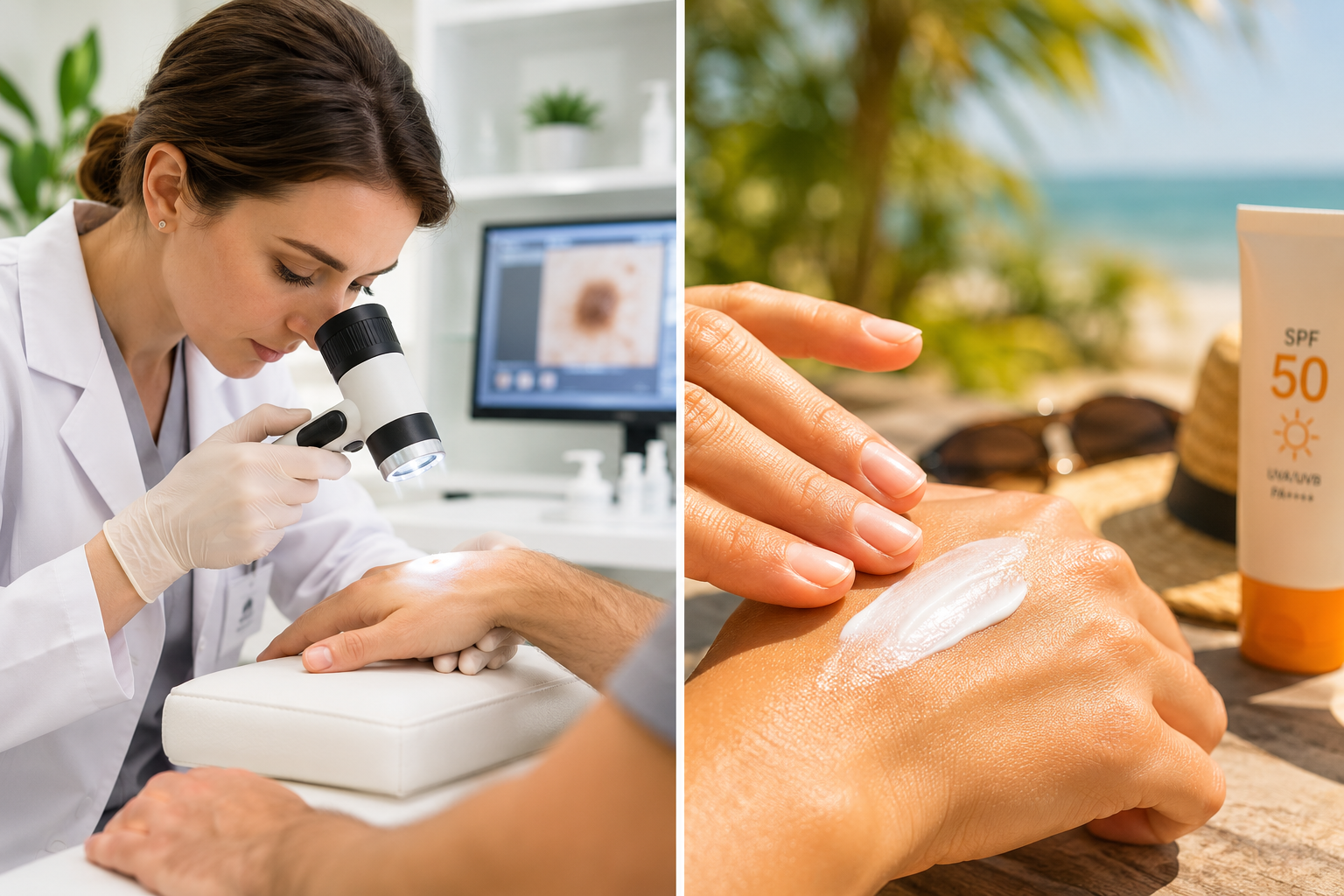
Daily prevention habits:
For high-risk individuals (fair skin, outdoor occupation, prior skin cancer), consider UPF-rated sun gloves for driving and daily outdoor tasks. These are widely available and provide consistent protection without the need to reapply sunscreen.
Q: Can skin cancer appear on the palm of the hand?
Yes, though it is less common than on the back of the hand. Acral lentiginous melanoma specifically targets the palms, soles, and nail beds. Any unusual dark spot or growth on the palm should be evaluated.
Q: Is skin cancer on the hand painful?
Not always. Many skin cancers are painless in early stages. Some SCCs and advanced BCCs can become tender, itchy, or painful as they grow, but the absence of pain does not mean a lesion is safe [5].
Q: How long does it take for skin cancer to develop on the hand?
Most skin cancers develop over years or decades of cumulative UV exposure. However, once a lesion becomes clinically visible, it can grow noticeably within weeks to months depending on the type.
Q: Can a biopsy confirm skin cancer on the hand?
Yes. A skin biopsy is the definitive diagnostic tool. A small sample of tissue is removed and examined under a microscope by a pathologist. It is a simple outpatient procedure.
Q: Does wearing rings or watches protect the skin under them from cancer?
Partially. Skin covered by a ring or watch strap does receive less direct UV exposure. However, the surrounding skin remains exposed, and skin cancer can develop at the edges of covered areas.
Q: Can children get skin cancer on their hands?
Skin cancer in children is rare but not impossible, particularly in those with genetic conditions like xeroderma pigmentosum. Blistering sunburns in childhood significantly increase lifetime risk, making early sun protection habits important [4].
Q: What is the difference between SCC and BCC on the hand?
BCC usually appears as a pearly, waxy bump or a flat sore and rarely spreads to other organs. SCC appears as a rough, scaly patch or firm growth and carries a higher risk of spreading to lymph nodes [2][3].
Q: How do I know if a dark spot under my fingernail is melanoma?
A dark streak under a nail that was not caused by injury, that runs the full length of the nail, or that is widening at the base should be evaluated by a dermatologist. Nail melanoma can look similar to a bruise but does not grow out with the nail.
Q: Is Mohs surgery available for hand skin cancer in Canada?
Yes. Mohs micrographic surgery is available at select dermatology and surgical centers in Canada, including in major cities like Toronto. It is the preferred technique for skin cancers in functionally important areas like the hand.
Q: Can skin cancer on the hand be treated without surgery?
In some cases, yes. Superficial BCC and precancerous actinic keratoses can be treated with topical creams, cryotherapy, or photodynamic therapy. However, most confirmed skin cancers on the hand are best treated with surgical removal for the highest cure rate [6].
Q: How often should I have my hands checked for skin cancer?
Annual full-body skin exams by a dermatologist are recommended for most adults, with more frequent checks for those with a history of skin cancer, fair skin, or significant UV exposure. Monthly self-exams of the hands are also advisable.
Q: Does sunscreen on the hands actually prevent skin cancer?
Yes. Consistent use of broad-spectrum SPF 30+ sunscreen on the hands reduces cumulative UV damage, which is the primary driver of BCC and SCC. No sunscreen eliminates risk entirely, but regular use meaningfully lowers it.
Skin cancer on the hand is a genuine risk that most people underestimate. The hands spend a lifetime in the sun, often without protection, and the cumulative UV damage eventually shows up as BCC, SCC, or, less commonly, melanoma. The good news is that the vast majority of hand skin cancers are curable when caught early and treated appropriately.
Actionable next steps:
For those in the Greater Toronto Area seeking expert evaluation, the Minor Surgery Center skin cancer clinic offers rapid access without a referral, making it straightforward to get a professional opinion quickly.
[1] Tumor On The Hand Wrist Or Finger Is It Cancer - https://www.medicine.net/news/Worldmedicine/Tumor-on-the-Hand-Wrist-or-Finger-Is-It-Cancer.html?utm_source=openai
[2] Basal Cell Carcinoma On The Hand - https://www.bderm.com/services/general-dermatology/basal-cell-carcinoma-on-the-hand/?utm_source=openai
[3] Squamous Cell Carcinoma - https://www.aad.org/skin-conditions/dermatology-a-to-z/squamous-cell-carcinoma?utm_source=openai
[4] Skin Cancer On Arm - https://www.medicalnewstoday.com/articles/skin-cancer-on-arm?utm_source=openai
[5] Skin Cancer Symptoms and Causes - https://www.mayoclinic.org/diseases-conditions/skin-cancer/symptoms-causes/syc-20377605?utm_source=openai
[6] Skin Cancer - Cleveland Clinic - https://my.clevelandclinic.org/health/diseases/15818-skin-cancer?utm_source=openai