
Last updated: March 26, 2026
Quick Answer: Yes, mole removal on the eyelid is safe when performed by a qualified surgeon or dermatologist experienced with periorbital tissue. The eyelid's thin, delicate skin requires specific techniques, but serious complications are rare. Most patients heal well with minimal scarring, especially when the right method is matched to the mole's size, depth, and location.
The eyelid is one of the thinnest, most mobile patches of skin on the human body. It protects the eye, supports tear drainage, and moves hundreds of times per day. These factors make mole removal on the eyelid more technically demanding than removing a mole from, say, the back or arm.
Key anatomical considerations include:
Because of these factors, the question "mole removal on the eyelid — is it safe?" depends heavily on who performs the procedure and which method they use. In experienced hands, outcomes are generally excellent [3][7].

Several techniques are available, and the right choice depends on the mole's size, depth, location on the eyelid, and whether malignancy is suspected [7].
A surgical blade shaves the mole flush with the surrounding skin. This works best for raised, pedunculated (stalk-like), or dome-shaped moles. Shave excision produces minimal scarring and heals quickly on the eyelid because it does not disrupt the deeper dermis [1]. It's one of the most common approaches for benign eyelid moles.
Best for: Raised, soft, clearly benign moles on the eyelid skin (not the margin)
The mole is cut out with a scalpel and the wound is closed with fine sutures. This is the most definitive method, ensuring complete removal. It's preferred when the mole is flat, deeply pigmented, or clinically suspicious [1]. Scarring is more likely than with shave excision, but a skilled surgeon can minimize this with careful closure technique.
Best for: Flat, pigmented, or suspicious moles; any lesion requiring pathology confirmation
A circular cutting tool removes a small, cylindrical core of tissue. This is often used diagnostically — to sample a mole before deciding on full removal [7].
Best for: Diagnostic sampling of ambiguous lesions
A fine RF probe uses electrical current to ablate the mole tissue with minimal bleeding. This technique is precise and can be well-suited to the delicate eyelid area when performed by a trained provider [7].
Best for: Superficial, benign moles where minimal thermal spread is needed
CO2 or Nd:YAG lasers can vaporize mole tissue. However, laser use near the eye is restricted — protective metal eye shields must be placed directly on the cornea before any laser is fired [2]. Laser is not the first-line choice for eyelid moles because the risk of ocular injury is higher than with surgical methods, and it does not produce a tissue sample for pathology [2].
Best for: Superficial pigmented lesions when performed by oculoplastic or laser-experienced surgeons; not recommended as a routine first option
MethodScarring RiskPathology Sample?Best ForShave excisionLowPartialRaised, benign molesSurgical excisionModerateYes (complete)Flat, suspicious, or deep molesPunch biopsyLow–ModerateYesDiagnostic samplingRadiofrequencyLowNoSuperficial, benign molesLaserLow–ModerateNoSelected superficial lesions
Yes — with the right provider and method, eyelid mole removal is safe. Research and clinical data consistently show that serious complications are uncommon when the procedure is performed by a qualified surgeon [3].
Here's what the data shows:
"The eyelid's rich blood supply actually supports faster healing than many other body areas — but it also demands precision to avoid distorting the lid's natural position."
The key safety factors are:
For patients in Ontario, clinics like The Minor Surgery Center offer experienced surgical teams with thousands of mole removal procedures completed.
Not every eyelid mole is benign. Some lesions that appear to be simple moles are actually early-stage skin cancers — including basal cell carcinoma, squamous cell carcinoma, or melanoma.
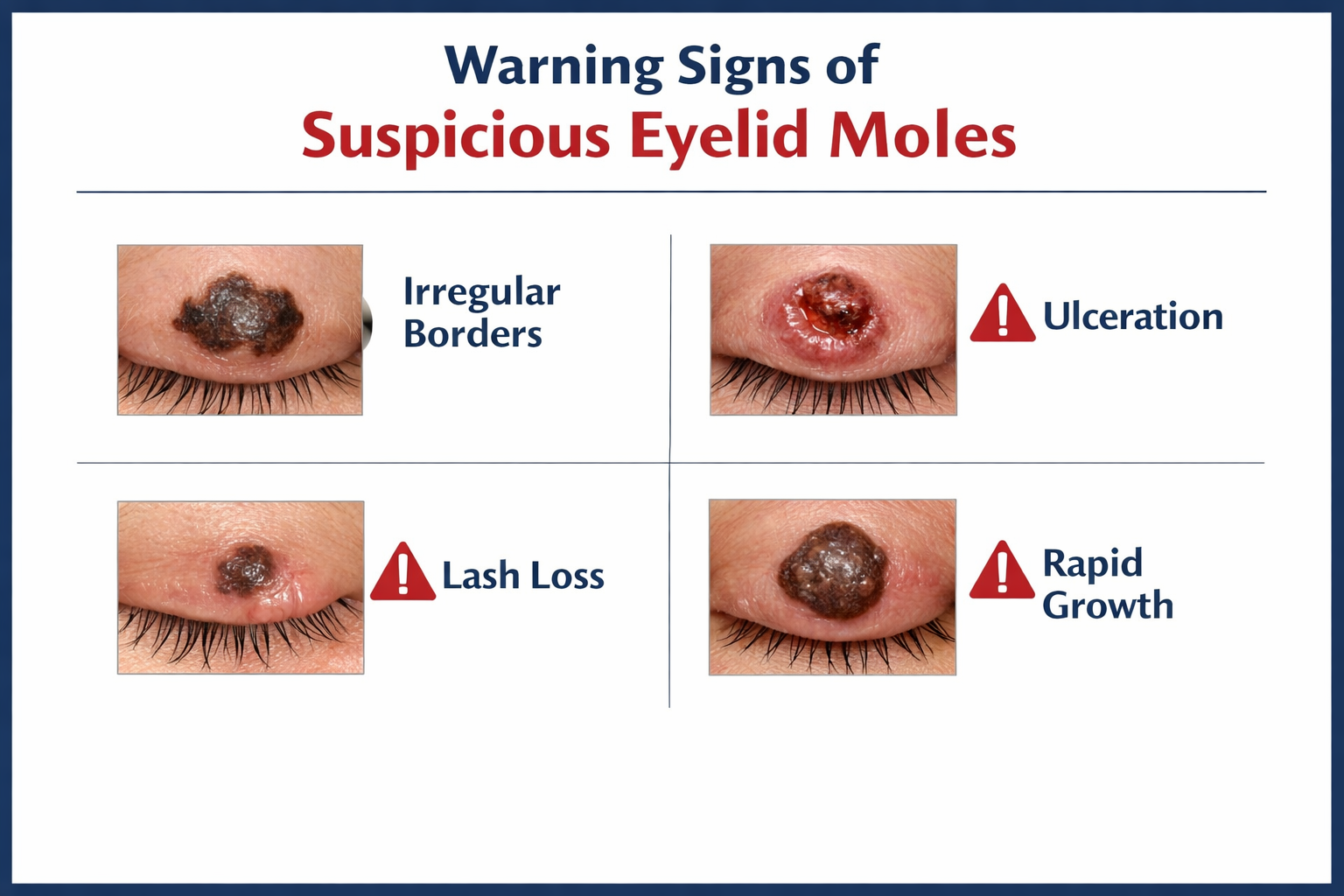
See a doctor promptly if an eyelid mole shows any of these features [3]:
Any of these features means the lesion needs a biopsy and pathology review before cosmetic removal is considered. Understanding the 4 main types of skin cancer can help patients recognize what they're looking for.
Common mistake: Assuming a mole is benign because it's been present for years. Some eyelid malignancies grow slowly and are overlooked for a long time.
Every surgical procedure carries some risk. For eyelid mole removal, the risks are manageable but worth understanding clearly [8].
This is one of the most important decisions a patient makes. The eyelid is not the place for a generalist or an unqualified aesthetician.
Appropriate providers include:
Avoid:
For patients across Ontario, The Minor Surgery Center has locations in Toronto, Mississauga, Markham, and other cities, with board-certified surgeons experienced in minor skin procedures.
Most eyelid moles are completely harmless. People seek removal for three main reasons [1]:
Understanding the reason for removal helps the surgeon choose the right approach. A cosmetically motivated removal of a small raised mole may be handled with shave excision in minutes. A suspicious flat lesion near the lash line needs excision, margin assessment, and pathology.
Aftercare tips:
Q: Can a mole on the eyelid be cancerous?
Yes. Eyelid moles can occasionally be basal cell carcinoma, squamous cell carcinoma, or melanoma. Any mole with irregular borders, ulceration, rapid growth, or lash loss should be evaluated by a doctor promptly [3].
Q: Does eyelid mole removal hurt?
The procedure itself is not painful because local anesthetic is used. After the anesthetic wears off, mild discomfort and swelling are normal for 1–3 days. Most patients describe it as manageable with over-the-counter pain relief.
Q: Will there be a scar after eyelid mole removal?
Some degree of scarring is expected with any excision. Shave excision typically produces the least visible scar on eyelid skin [1]. Most scars fade significantly over 3–6 months.
Q: Is laser mole removal safe on the eyelid?
Laser can be used safely on the eyelid, but it requires protective metal eye shields placed directly on the eye, and it must be performed by an experienced provider. It is not the first-line recommendation for most eyelid moles because it carries a higher risk of ocular injury and does not produce a tissue sample for pathology [2].
Q: Can I remove an eyelid mole at home?
No. Home removal methods — including mole removal creams, pens, or DIY cutting — are dangerous near the eye and can cause permanent injury. They also prevent pathology testing, which means a cancerous lesion could go undetected [8].
Q: How long does recovery take?
Most patients return to normal activities within 1–3 days. Full wound healing takes 2–6 weeks, and the final scar appearance may take up to 6 months to settle.
Q: What is ectropion and how common is it after eyelid mole removal?
Ectropion is an outward turning of the eyelid that can expose the eye surface. It occurs in approximately 1.9% of lower eyelid mole removal cases [3]. It is more common when too much skin is removed from the lower lid.
Q: Does insurance cover eyelid mole removal?
Coverage depends on the reason for removal. If the mole is symptomatic (obstructing vision, causing irritation) or suspicious for malignancy, some plans may cover it. Purely cosmetic removal is generally not covered. Use a mole removal cost estimator to understand out-of-pocket costs.
Q: Should I see a dermatologist or a surgeon for eyelid mole removal?
Both can be appropriate, depending on the mole's characteristics. For moles near the eyelid margin or with any suspicious features, an oculoplastic surgeon or experienced minor surgery specialist is preferred. For straightforward raised moles on the eyelid skin, a dermatologist or minor surgery clinic with periorbital experience is suitable.
Q: What if the mole grows back after removal?
Recurrence is possible, especially after shave excision. If a mole returns, it should be re-evaluated — recurrence can occasionally indicate incomplete removal of a malignant lesion. A surgical excision with clear margins is usually recommended for recurrent moles.
The short answer is yes — eyelid mole removal is safe when done correctly. The procedure carries real but manageable risks, and serious complications are uncommon in experienced hands. The eyelid's delicate anatomy demands a qualified provider, the right technique, and mandatory pathology testing for all removed tissue.
Patients across Ontario can find experienced surgical teams at The Minor Surgery Center, with clinics in Brampton, Oakville, North York, Scarborough, and beyond.
[1] Can You Remove Moles On The Eyelid - https://www.hazanyderm.com/can-you-remove-moles-on-the-eyelid
[2] New York Safe Laser Mole Removal Eyelid - https://www.realself.com/question/new-york-safe-laser-mole-removal-eyelid
[3] Is It Safe To Remove A Nevus From The - https://www.droracle.ai/articles/856120/is-it-safe-to-remove-a-nevus-from-the
[4] Removing Skin Tags On The Eyelid - https://moleremovallosangeles.com/removing-skin-tags-on-the-eyelid/
[5] Mole Removal Safety What You Should Know - https://1aesthetic.com/mole-removal-safety-what-you-should-know/
[6] Mole Removal 101 Safe And Effective Methods Explained - https://cosmeticdermatologystlouis.com/mole-removal-101-safe-and-effective-methods-explained/
[7] Mole Skin Tag Removal Off The Eyelid - https://www.khaneyelidsurgery.com/mole-skin-tag-removal-off-the-eyelid/
[8] Is It Harmful To Have Mole Removal Around Your Eyes - https://venividieye.com/blog/is-it-harmful-to-have-mole-removal-around-your-eyes
[9] How Do I Remove A Skin Tag On My Eyelid - https://londondermatologyclinics.com/how-do-i-remove-a-skin-tag-on-my-eyelid/
[10] Mole Removal What To Know - https://www.westlakedermatology.com/blog/mole-removal-what-to-know/