
Last updated: May 12, 2026
Quick Answer: A focused mole check is used when one or a few moles are concerning. A full body mole check examines the skin more broadly for abnormal lesions. Mole mapping usually involves digital photography or imaging to track moles over time and is often used for people with many moles, atypical moles, or a higher melanoma risk. Choosing between them depends on your personal risk profile and what is prompting you to seek care.
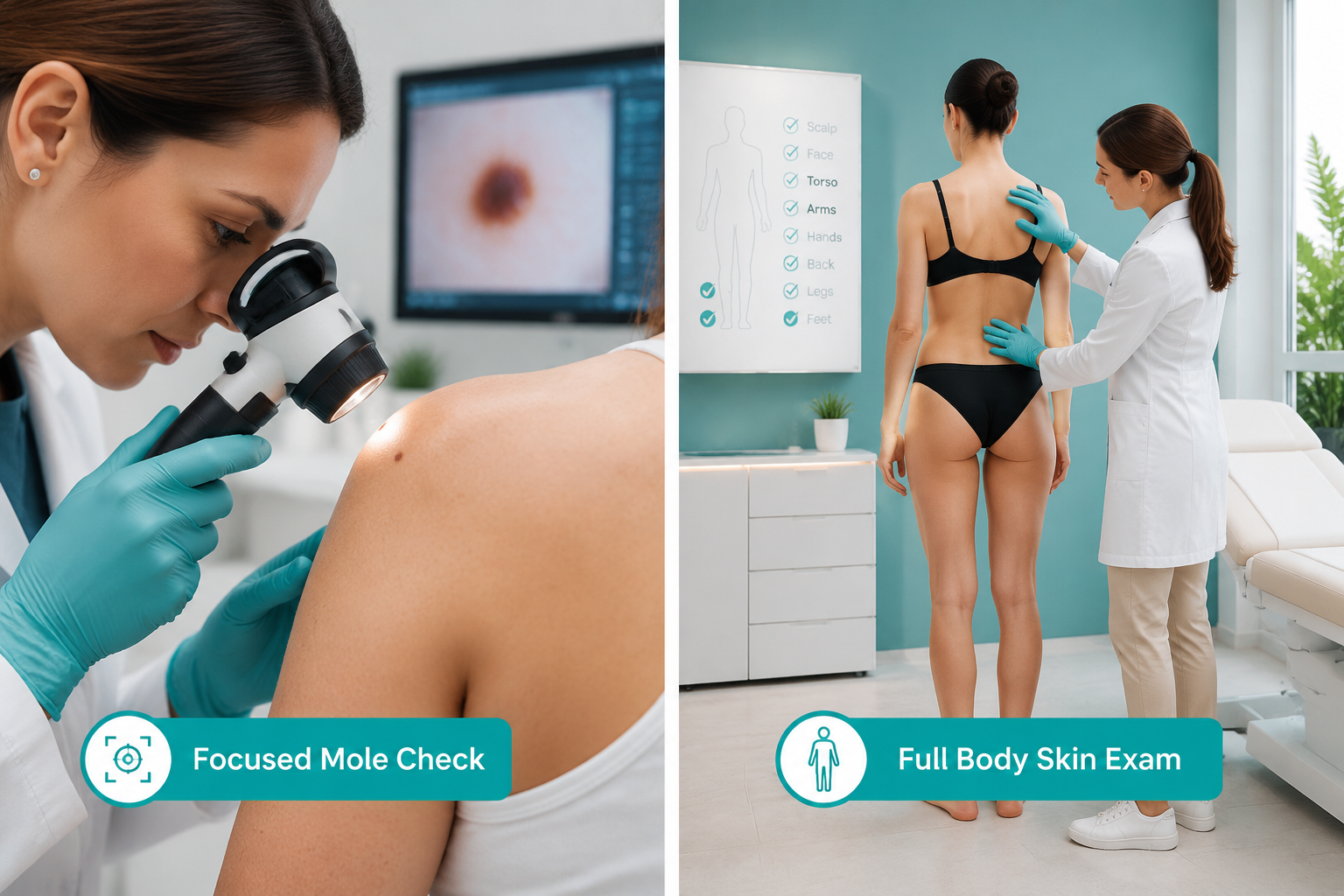
The core difference comes down to scope and technology. A full body mole check is a clinical examination of the skin from head to toe, performed by a trained clinician using visual inspection and often a dermoscope (a handheld magnifying tool). Mole mapping goes further by adding standardized digital photography or total body photography (TBP) to create a baseline record of every mole, so future changes can be detected by comparing images over time [5].
Here is a simple side-by-side breakdown:
FeatureFocused Mole CheckFull Body Mole CheckMole MappingScopeOne or a few molesEntire skin surfaceEntire skin surface + imagingTechnology usedDermoscopeDermoscopeDermoscope + digital photography/TBPBest forOne changing or worrying moleGeneral skin screeningHigh-risk patients, many molesTracks changes over timeNoNoYesTypical visit frequencyAs neededAnnually or as advisedAnnually, with image comparisonCan lead to biopsyYesYesYes
Common mistake: Many people assume mole mapping and a full body skin exam are the same thing. They are not. Mole mapping enhances a full body exam with imaging — it does not replace the hands-on clinical assessment [2].
A focused mole check is a targeted clinical assessment of one or a small number of specific moles that are causing concern. It is the appropriate choice when you have noticed a change in a particular spot — not a general screening for your whole body.
During a focused check, a clinician examines the mole or moles in question using visual inspection and dermoscopy. They assess the lesion against established criteria (most commonly the ABCDE rule: Asymmetry, Border, Colour, Diameter, Evolution) to determine whether it looks benign, suspicious, or requires further action such as a biopsy or removal.
When a focused mole check makes sense:
Edge case: A focused check can sometimes reveal that the concerning mole is actually benign, but the clinician may notice another suspicious lesion nearby and recommend a broader exam. This is one reason a full body skin exam is often a better starting point for people who have not had a recent skin check.
For patients in the Greater Toronto Area who need a specific mole assessed, the mole removal specialists at The Minor Surgery Center offer focused assessments with over 9,000 procedures completed.
A full body mole check — also called a full body skin exam or total body skin examination (TBSE) — is a head-to-toe clinical review of the entire skin surface for any abnormal lesions. It covers areas that are difficult to self-examine, including the scalp, behind the ears, between the toes, the lower back, and the buttocks.
A trained clinician systematically works through the body, using a dermoscope to look more closely at any lesion that appears unusual. The goal is to catch early signs of skin cancer — including melanoma, basal cell carcinoma, and squamous cell carcinoma — as well as precancerous changes like actinic keratosis.
What a full body skin exam typically includes:
How long does a full body mole check take? Most full body skin exams take between 15 and 30 minutes, depending on the number of lesions present and how many require closer inspection.
Melanoma Canada's 2026 Mole Mobile Tour, which launched May 1, 2026, is bringing free full body skin screenings to communities across all 10 Canadian provinces through October 31, 2026, with a focus on reaching rural and Indigenous areas that have limited access to dermatology services [7]. This kind of initiative underscores how valuable a broad skin check can be as a first-line screening tool.
Mole mapping is a process that combines a full body skin exam with standardized digital photography or total body photography (TBP) to create a detailed visual record of all moles and skin lesions. This record becomes a baseline that clinicians can compare against at future visits, making it much easier to detect subtle changes that might not be obvious to the naked eye during a single exam.
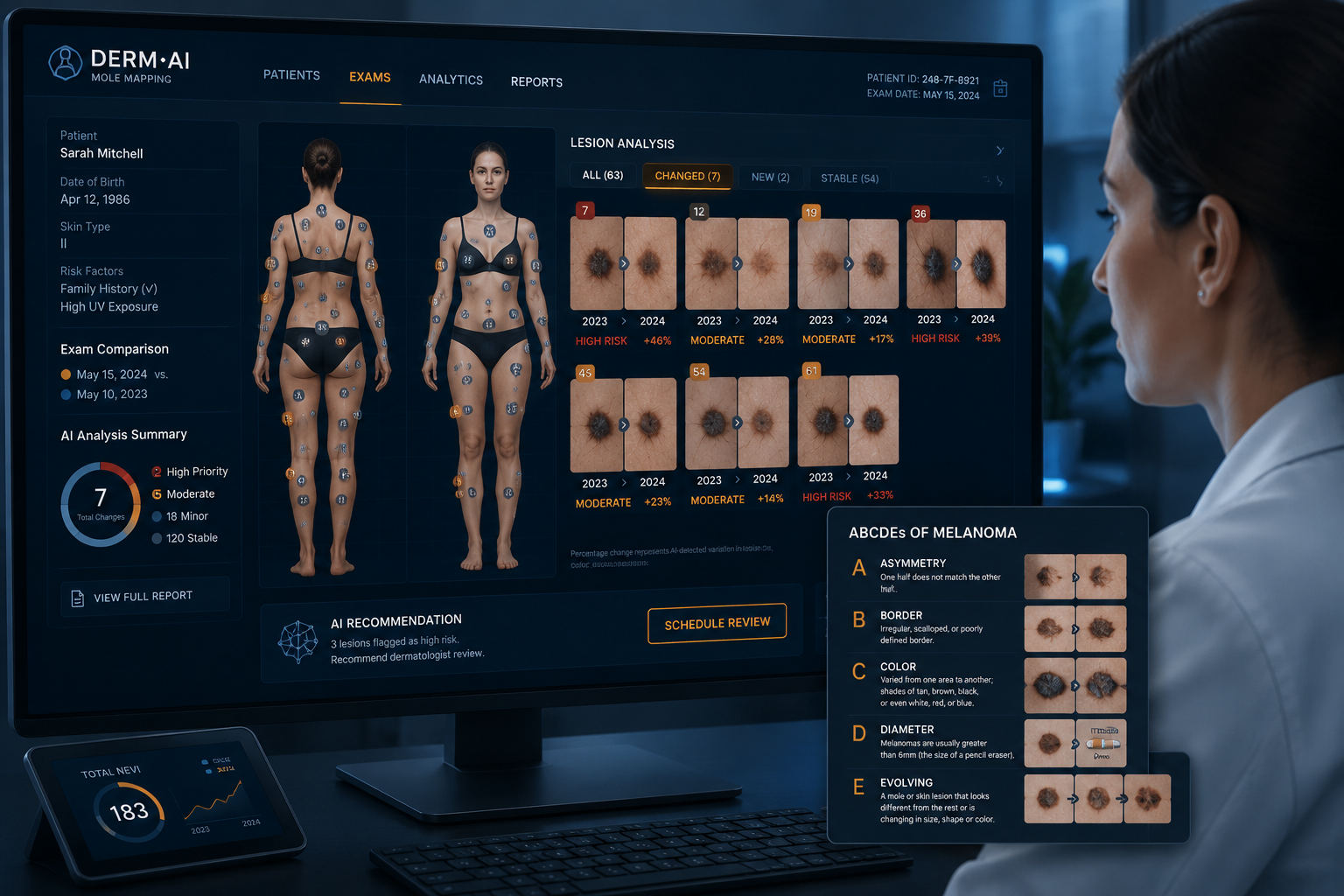
Modern mole mapping systems use high-resolution cameras to capture the full body surface, followed by close-up dermoscopic images of individual moles. Some clinics now use AI-assisted platforms that automatically flag lesions showing changes between annual scans. AI-assisted mole mapping has been reported to achieve accuracy above 90% for early melanoma detection in high-risk patients [4], and Premier Health notes that these systems can help reduce unnecessary biopsies by giving clinicians a clearer picture of what has actually changed [10].
Key things mole mapping does:
What mole mapping does not do: It does not replace the clinical examination. A dermatologist or trained clinician still needs to assess the images and examine the skin directly. Mole mapping enhances clinical judgment — it does not automate it [2].
For a detailed look at clinic options, see this guide to the best mole mapping clinics in Toronto, which covers pricing and what to expect.
Are 3D mole mapping apps a reliable alternative? Generally, no. Consumer apps lack the image resolution, standardization, and clinical oversight of professional mole mapping systems. For more on this, see are 3D mole mapping apps reliable?
Mole mapping is best suited for people who have a higher-than-average risk of developing melanoma. For lower-risk individuals, a standard full body skin exam is usually sufficient. The decision to pursue mole mapping should be made with a clinician based on a review of your personal risk factors.
Strong candidates for mole mapping include:
Premier Health experts recommend mole mapping — specifically Automated Total Body Mapping — for high-risk patients, noting that AI comparison of annual images can reduce unnecessary biopsies while improving early detection [10].
Choose mole mapping if: You have multiple risk factors above, you have been told you have atypical moles, or a previous skin exam found a lesion that needed removal and you want ongoing monitoring.
You likely do not need mole mapping if: You have few moles, no personal or family history of melanoma, and no atypical features — a standard annual full body skin exam is appropriate.
A focused mole check is the right choice when one specific mole is the concern, and you do not have broader risk factors that would warrant a full body exam or mole mapping.
This applies most often to people who:
Decision rule: If your concern is limited to one spot and you have no known risk factors for melanoma, start with a focused mole check. If the clinician finds additional concerning lesions during that visit, they will recommend a broader exam.
Patients across the GTA can access focused mole assessments at multiple locations, including downtown Toronto, Mississauga, North York, Markham, and Oakville.
Yes — both a focused mole check and a full body skin exam can lead directly to a biopsy or mole removal if a lesion looks suspicious. This is not something to be alarmed about; it is the intended outcome of effective screening.
If a clinician identifies a mole or lesion that cannot be confidently classified as benign on visual and dermoscopic inspection, they will typically recommend one of the following:
Can a focused mole check detect skin cancer? Yes. A skilled clinician using dermoscopy can identify features consistent with melanoma, basal cell carcinoma, or squamous cell carcinoma during a focused exam. Early detection significantly improves outcomes for all three types. A May 2026 Instagram post from a dermatologist's office highlighted several melanomas detected through routine office checks — reinforcing that even standard exams catch real cancers [9].
Can mole mapping detect melanoma? Yes, and it may detect melanoma at an earlier stage in high-risk patients. By comparing images over time, mole mapping can identify lesions that are evolving before they become visually obvious, which is particularly valuable for people with many moles where it is easy to miss subtle changes [8].
For more information on what happens when a suspicious lesion is found, see skin cancer and surgeries for skin lesions.
For most adults, a full body skin exam once a year is a reasonable baseline. The frequency should increase based on your risk profile and what previous exams have found.
General guidance by risk level:
Risk LevelRecommended FrequencyLow risk (few moles, no history, no atypical moles)Every 1–2 yearsModerate risk (some moles, mild sun exposure history)AnnuallyHigh risk (many moles, atypical moles, family/personal history)Annually, with mole mappingPost-melanomaEvery 3–6 months initially, then annually as advised
Between professional checks, regular self-examination is valuable. The American Academy of Dermatology (AAD) promotes body mole maps as a tool for self-exams alongside professional full body checks [AAD, 2026]. A simple body map — a diagram where you mark the location of moles — helps you notice new or changing spots between appointments.
Common mistake: Many people only book a skin check when they notice something worrying. Waiting for a visible change means some early lesions will be missed. Routine annual checks catch lesions before they reach a stage where they are obvious.
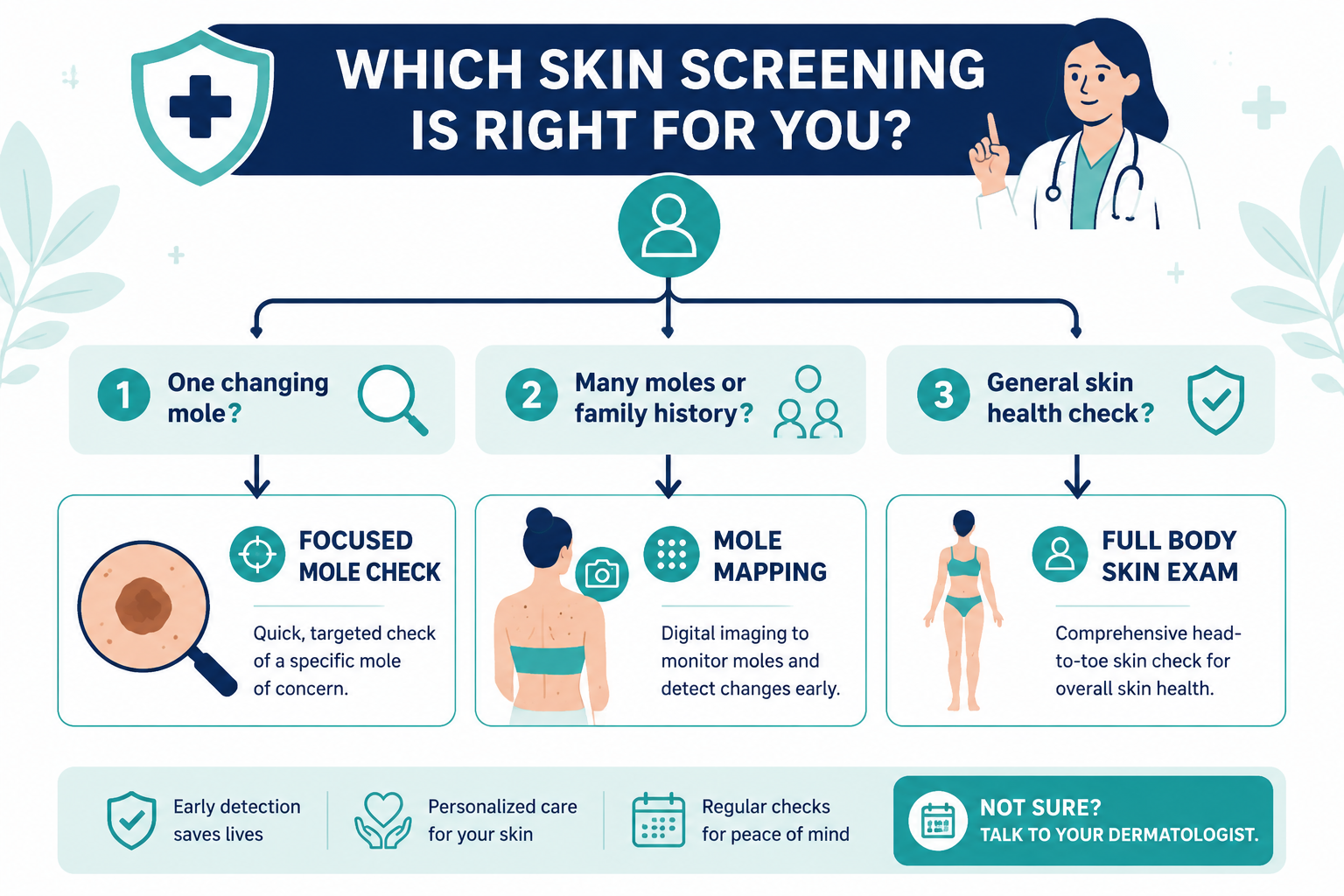
The right choice depends on three things: your risk profile, your current concern, and what your last skin check found. Here is a practical decision guide:
Book a focused mole check if:
Book a full body skin exam if:
Book mole mapping if:
💡 A practical note: If you are unsure which to book, a full body skin exam is the best starting point. The clinician can assess your risk during that visit and recommend mole mapping if it is warranted. You do not need to self-diagnose your risk level before booking.
For patients who need multiple moles assessed at once, it is worth knowing that multiple moles can often be evaluated in a single visit, which saves time and allows for a more complete picture.
What is a full body mole check?
A full body mole check is a head-to-toe clinical examination of the entire skin surface performed by a trained clinician. It uses visual inspection and dermoscopy to identify abnormal lesions, including potential skin cancers. It typically takes 15 to 30 minutes.
What is mole mapping?
Mole mapping is a process that combines a full body skin exam with standardized digital photography or total body photography. It creates a visual record of all moles that can be compared at future visits to detect subtle changes over time. It is most useful for high-risk patients.
What is the difference between a mole check and mole mapping?
A mole check (focused or full body) is a clinical examination performed at a single point in time. Mole mapping adds digital imaging to track changes between visits. Mole mapping enhances a full body exam — it does not replace it [2].
Do I need mole mapping or just one mole checked?
If one specific mole is worrying you and you have no broader risk factors, a focused mole check is appropriate. If you have many moles, atypical moles, or a personal or family history of melanoma, mole mapping is worth discussing with a clinician.
Who should get mole mapping?
People with 50 or more moles, atypical or dysplastic moles, a personal or family history of melanoma, significant sun exposure history, or fair skin with a history of sunburns are the strongest candidates for mole mapping [10].
Who should get a full body skin exam?
Most adults benefit from a full body skin exam at least once a year, regardless of risk level. It is the standard starting point for anyone who has not had a recent skin check or who wants a general assessment of their skin health.
How often should I get my moles checked?
Low-risk adults: every one to two years. Moderate-risk adults: annually. High-risk adults (many moles, atypical moles, personal or family history of melanoma): annually with mole mapping. Post-melanoma patients: as directed by their specialist, often every three to six months initially.
How long does a full body mole check take?
Most full body skin exams take between 15 and 30 minutes. The time varies depending on the number of moles and lesions that require closer inspection.
Can mole mapping detect melanoma?
Yes. Mole mapping can detect melanoma at an earlier stage in high-risk patients by identifying lesions that are evolving between annual visits. AI-assisted mole mapping systems have reported accuracy above 90% for early melanoma detection in high-risk cases [4].
Can a focused mole check detect skin cancer?
Yes. A clinician using dermoscopy during a focused mole check can identify features consistent with melanoma, basal cell carcinoma, or squamous cell carcinoma. If a suspicious lesion is found, a biopsy or removal will be recommended.
Is mole mapping covered by insurance in Canada?
Mole mapping is generally considered a cosmetic or elective service and is not covered by provincial health plans in most Canadian provinces. Costs vary by clinic and the extent of imaging involved. A focused or full body skin exam may be covered if performed by a physician for a medical concern — check with your provider.
What happens if something suspicious is found during a mole check?
If a clinician identifies a suspicious lesion, they will typically recommend a biopsy (excisional or punch) or removal. The sample is sent to a pathology lab to determine whether the lesion is benign, precancerous, or malignant. Results usually take one to two weeks.
The choice between a focused mole check, a full body skin exam, and mole mapping is not complicated once you understand what each one does. A focused check is for a specific worrying mole. A full body skin exam is the standard annual screening tool for most adults. Mole mapping adds digital imaging for people who need ongoing monitoring because of higher melanoma risk.
Actionable next steps:
Early detection is the single most effective tool for improving melanoma outcomes. The right type of skin check — chosen based on your risk profile — is how you get there.
For patients across the Greater Toronto Area, The Minor Surgery Center offers mole assessments and removal at locations including Scarborough, Brampton, Whitby, and Newmarket. Use the minor surgery cost estimator to get an idea of pricing before you book.
[1] Your Best Skin In 2026 Annual Mole Mapping Lesion Checks Explained - https://www.komokaskin.ca/your-best-skin-in-2026-annual-mole-mapping-lesion-checks-explained
[2] Facebook video: Mole Mapping vs. Skin Checks — What's the Difference? - https://www.facebook.com/100042021823706/videos/mole-mapping-vs-skin-checkswhats-the-difference-mole-mapping-does-not-replace-yo/2186694105409243/
[4] Mole Map Success: Are You A Good Candidate - https://int.livhospital.com/mole-map-success-are-you-a-good-candidate/
[5] Difference Between Mole Mapping vs Mole Check - https://dermasurge.co.uk/difference-between-mole-mapping-vs-mole-check/
[7] Melanoma Canada Launches 2026 Mole Mobile Tour - https://melanomacanada.ca/blog/melanoma-canada-launches-2026-mole-mobile-tour/
[8] Mole Mapping Worth It - https://www.molemap.net.au/skin-cancer/mole-mapping-worth-it
[9] Instagram post: Melanomas detected via dermatologist office checks - https://www.instagram.com/p/DX4CksOlbNm/
[10] Mole Mapping Early Detection For Skin Cancer - https://www.premierhealth.com/your-health/articles/women-wisdom-wellness-/mole-mapping-early-detection-for-skin-cancer