
Last updated: October 14, 2026
Minor surgery is tax-deductible in Canada only when a medical practitioner performs it for a medically necessary reason, such as removing a mole that is changing shape or a cyst that keeps getting infected. The claim works through the medical expense tax credit on your tax return, not as a standard business-style deduction, and purely cosmetic procedures are excluded by Canada Revenue Agency rules [1][2].
Minor surgery can be claimed on a Canadian tax return if it meets the Canada Revenue Agency's definition of an eligible medical expense, meaning a licensed medical practitioner performed it for a health reason. The size or complexity of the procedure does not matter to CRA; what matters is whether subsection 118.2(2) of the Income Tax Act covers it [3].
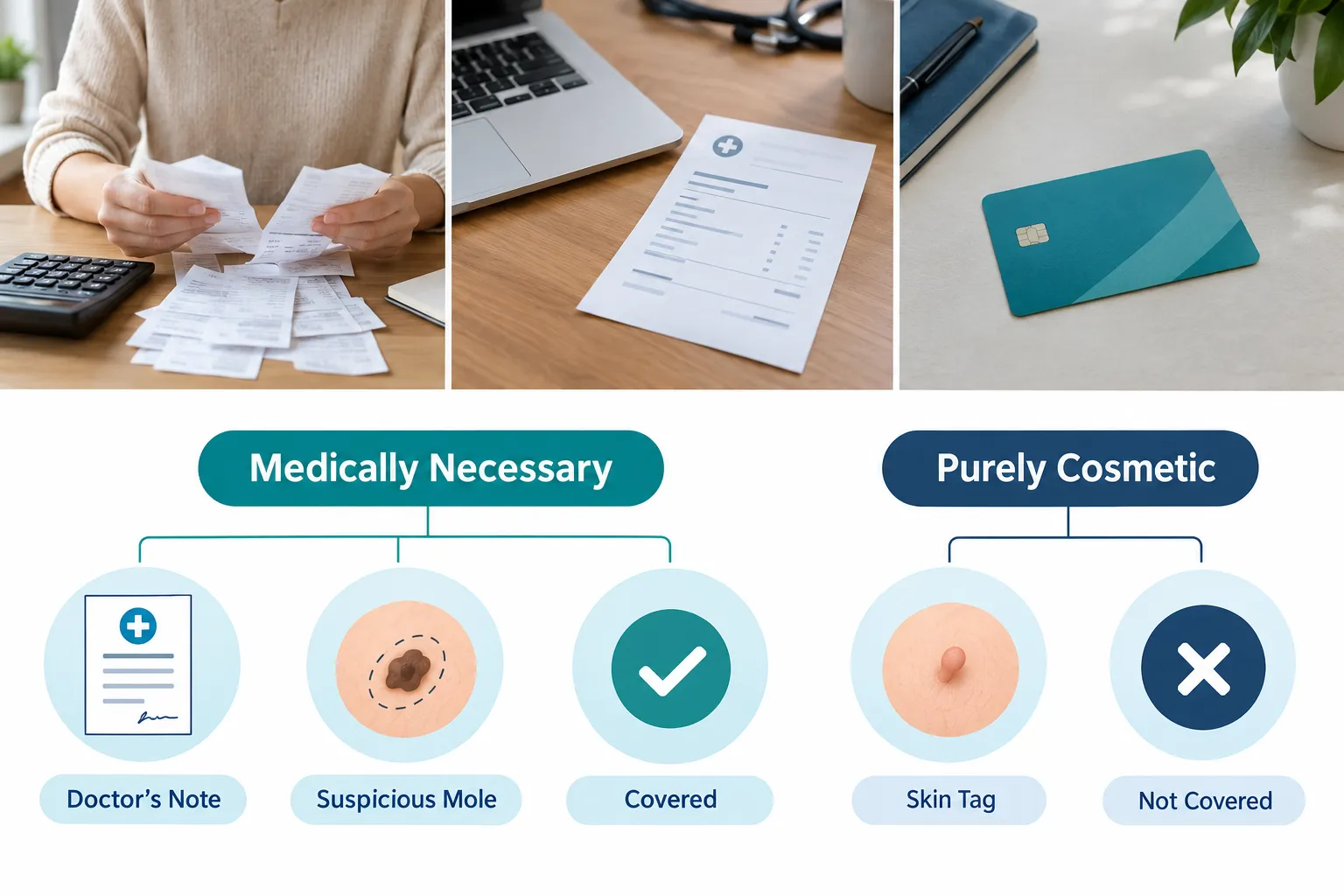
A mole removed because a dermatologist flagged irregular borders, a cyst removed because it became infected, or a lipoma removed because it was pressing on a nerve are all examples where a medical reason exists. By contrast, removing a skin tag purely because someone dislikes how it looks, with no documented health concern, generally will not qualify. For background on how OHIP and private clinics differ in coverage, see OHIP vs private clinic for minor surgery in Ontario.
Decision rule: If a doctor's note or clinical record states a health-related reason for the procedure, the expense is more likely to qualify. If the only reason given is appearance, it is unlikely to qualify.
The medical expense tax credit is a non-refundable federal tax credit that reduces the amount of tax you owe, calculated on eligible medical expenses that exceed a minimum threshold. It is not a direct deduction from income and it is not a refund of the amount spent; it lowers your tax bill by a percentage of the eligible amount above the threshold [1][3].
For a recent tax year, the federal threshold is the lesser of 3% of net income or a fixed dollar amount, with a credit rate of 15% applied to the amount above that threshold; the fixed dollar figure is indexed annually, so confirm the exact number for your filing year directly on canada.ca [3]. Because the dollar threshold changes yearly, this article will not state a fixed figure for every year. Always check the current Canada Revenue Agency page before filing.
Here is a simplified example of how the credit works, using illustrative numbers only:
ScenarioNet incomeEligible medical expensesApproximate credit impactLower income$35,000$1,500More of the expense counts because 3% of income is a smaller numberHigher income$90,000$1,500Less of the expense counts because 3% of income is a larger number
This is why many Ontario households claim medical expenses, including minor surgery costs, under the spouse or partner with the lower net income, since the 3%-of-income threshold is smaller for that person [3].
Canada Revenue Agency rules exclude expenses incurred purely for cosmetic purposes, and this exclusion applies to procedures carried out after March 4, 2010, even if a licensed medical practitioner performs them [1][10]. The deciding factor is the purpose of the procedure, not where or by whom it was performed.
CRA guidance and aligned benefits documentation list examples of excluded cosmetic procedures, including liposuction, hair replacement, Botox-type injections, teeth whitening, and cosmetic mole or wart removal done for appearance alone [6][7]. A procedure can still qualify if there is a documented medical or reconstructive necessity, such as removing a suspicious lesion or correcting a deformity from an accident, trauma, or disease [1][6].
Procedure exampleReason givenLikely CRA treatmentMole removalSuspicious change noted by a doctorLikely eligibleCyst removalRecurrent infection or painLikely eligibleLipoma removalPain or restricted movementLikely eligibleSkin tag removalAppearance only, no symptomsLikely not eligibleSeborrheic keratosis removalIrritation from clothing or shavingPossibly eligible with documentation
Common mistake: Assuming that paying privately instead of using OHIP automatically makes a procedure cosmetic. The payment method does not determine eligibility; the medical reason does. For a deeper comparison of cosmetic versus medically necessary classifications and how insurers view them, see cosmetic vs medical necessity insurance coverage guide.
Claiming minor surgery as a medical expense involves collecting proper receipts, confirming the 12-month claim period, and entering the total on the correct line of your tax return. The process is the same whether the expense is $300 or $3,000.
Edge case: If a procedure happens in late December but payment is processed in January, confirm which tax year the payment date falls into, since CRA tracks the 12-month window based on when the expense was paid, not when the procedure occurred [3].
A health spending account can reimburse minor surgery costs when the procedure fits within the Canada Revenue Agency's list of eligible medical expenses, because HSA eligibility generally mirrors the rules used for the medical expense tax credit. Purely cosmetic procedures are typically excluded from HSA reimbursement for the same reason they are excluded from the METC [11].
Government of Alberta guidance on health spending accounts confirms that reimbursable expenses must generally qualify under the same CRA criteria used for the METC, meaning employees coordinating an HSA claim with a private clinic visit should expect the same medical-necessity standard [11]. If an employer-sponsored HSA reimburses a cosmetic skin tag removal in error, that reimbursement could later be treated as a taxable benefit, so it is worth confirming eligibility with the plan administrator before submitting a claim.
Example: An employee pays privately for lipoma removal because of nerve pain, submits the itemized receipt to their HSA, and receives reimbursement without needing to file a separate tax claim, since the expense was already covered through the benefit plan rather than claimed again on the tax return.
Private or group health insurance may cover minor surgery when the plan defines the procedure as medically necessary, but coverage varies significantly by insurer and policy, so checking the plan booklet or calling the insurer before the procedure is the only reliable way to confirm coverage. Industry information from the Canadian Life and Health Insurance Association notes that group benefit plans are designed by employers and insurers with varying levels of coverage for supplementary health services, which can include minor surgical procedures beyond what OHIP pays for.
Insurers typically ask for the same kind of documentation CRA requests: a clear description of the medical reason for the procedure and an itemized invoice from the treating practitioner. Readers comparing cosmetic classifications across tax rules and insurance policies may find the cosmetic vs medical necessity insurance coverage guide useful, since insurers and CRA do not always define "cosmetic" identically.
Decision rule: Contact the insurer before booking a private procedure if coverage is uncertain. Submitting a claim after the fact with no pre-approval does not guarantee reimbursement, even for medically necessary procedures.
Patients should ask the clinic for an itemized receipt that lists the practitioner's name, the specific procedure performed, the date of service, and the amount paid, since this is the document CRA, HSAs, and insurers all request when assessing a claim. A vague receipt that only shows a total dollar amount with no procedure description is harder to defend if CRA reviews the claim.
Before paying privately for mole, cyst, lipoma, or skin tag removal, confirm with the clinic that the receipt will include enough detail to support a medical expense claim. Ask your clinic for an itemized receipt, as shown on The Minor Surgery Center's pricing page, which lists starting prices for common private procedures such as lipoma removal at $695, sebaceous or pilar cyst removal at $695, mole removal at $600, skin tag removal at $300, and seborrheic keratosis removal at $600.
Common mistake: Losing the original receipt and relying only on a credit card statement. A credit card statement shows that a payment was made, but it does not describe the procedure, so it is weaker evidence if CRA asks for supporting documents.
OHIP covers minor surgical procedures that a physician determines are medically necessary, while procedures considered cosmetic or elective by OHIP's criteria are typically only available through private payment. Skin cancer removal, carpal tunnel release surgery, and trigger finger surgery are generally OHIP-covered when medically indicated, while many mole, cyst, lipoma, and skin tag removals are billed privately when OHIP's criteria for medical necessity are not met.

This distinction between OHIP eligibility and private payment is separate from, but related to, the tax question. A procedure can be billed privately and still qualify for the medical expense tax credit if there is a documented medical reason, even though OHIP declined to cover it. For specific procedure coverage details, see is lipoma removal covered by OHIP in Ontario and is mole removal covered by OHIP. A broader comparison of public versus private pathways is available in OHIP vs private clinic for minor surgery in Ontario.
Example: A patient whose mole does not meet OHIP's urgent referral criteria pays privately for removal. Because a physician documented a medical concern about changing pigmentation, the expense may still be eligible for the medical expense tax credit, even though OHIP did not pay for it.
Minor surgery for tax purposes in Canada is any procedure performed by a licensed medical practitioner for a medical reason, regardless of how small or routine the procedure is. CRA's eligible medical expenses list does not use the terms "minor" or "major" surgery; it refers instead to payments for medical services provided by a medical practitioner or a hospital [2].
This means mole, cyst, lipoma, and skin tag removal can all fall under the same eligibility test as a larger operation, as long as the medical necessity requirement is met. There is no separate, lower threshold or special exclusion just because a procedure is quick or done under local anesthetic.
Cosmetic procedures are not tax deductible in Canada when performed purely to improve appearance with no medical or reconstructive purpose. This exclusion has applied to expenses incurred after March 4, 2010, under rules confirmed by CRA and summarized in professional tax guidance [1][10].
Examples cited in CRA-aligned materials include liposuction, hair replacement procedures, wrinkle-reducing injections, teeth whitening, and cosmetic mole or wart removal performed for appearance alone [6][7]. If a procedure also has a medical justification, such as removing tissue after a diagnosis of a suspicious growth, it can still qualify despite also improving appearance as a side effect.
Dental surgery is tax deductible in Canada under the same medical expense tax credit framework as other medical procedures, provided it is performed by a licensed dentist or other eligible practitioner for a dental health reason. CRA's eligible medical expenses list specifically includes payments to dental practitioners for dental services [1][2].
Purely cosmetic dental work, such as teeth whitening done for appearance alone, is excluded under the same cosmetic-procedure rule that applies to other elective procedures [6].
Prescription glasses, contact lenses, and hearing aids are listed as eligible medical expenses by the Canada Revenue Agency, provided they are prescribed or recommended by a medical practitioner [1][2]. These items fall under the same medical expense tax credit framework used for minor surgery, meaning receipts and prescriptions should be kept in the same way.
Weight loss surgery can be tax deductible in Canada when a medical practitioner determines it is medically necessary, such as for treating obesity-related health complications, consistent with CRA's general rule that eligible medical expenses must relate to diagnosis, treatment, or prevention of a disease or condition [1]. Purely elective weight loss procedures with no documented medical indication would be assessed under the same cosmetic-exclusion standard applied to other elective surgeries [1][6].
Either spouse or common-law partner can claim the family's combined eligible medical expenses, and expenses for dependants can also be claimed on line 33199 by the supporting individual [2][3]. CRA generally allows the expenses of a spouse, common-law partner, and dependent children under 18 to be combined on line 33099, with other eligible dependants claimed separately on line 33199 [2].
Medical expenses are reported by totaling eligible receipts for the qualifying 12-month period and entering the amount on line 33099 or line 33199 of the tax return, following the instructions on CRA's dedicated page for these lines [2]. The credit is then calculated after subtracting the applicable threshold, as explained in CRA's Income Tax Folio S1-F1-C1 [3].
Is minor surgery tax deductible in Canada if I pay out of pocket?
Yes, out-of-pocket payments for medically necessary minor surgery can be claimed under the medical expense tax credit, provided the procedure was performed by a licensed medical practitioner and documented with an itemized receipt [1][2].
Does the surgery need a doctor's prescription or referral to be tax deductible?
CRA does not require every procedure to have a formal prescription, but the service must be performed by an eligible medical practitioner for a medical reason; some expense categories on CRA's list do require a prescription, so checking the specific line item on CRA's eligible expenses page is recommended [1][2].
What is the difference between a tax deduction and the medical expense tax credit?
A deduction reduces taxable income directly, while the medical expense tax credit is a non-refundable credit that reduces tax payable after the eligible amount exceeds a set threshold; Canada does not offer a standard personal deduction for medical expenses, only the credit [3].
Do I need receipts to claim medical expenses on my taxes in Canada?
Yes, CRA requires supporting receipts or invoices for medical expense claims, and these should be kept for at least six years in case of a review [1][2].
Can I deduct minor surgery costs if OHIP partially covered the procedure?
Only the portion paid privately and not reimbursed by OHIP or insurance can be claimed as an eligible medical expense; amounts already covered by a public plan are not eligible again under the METC [1].
Is minor surgery tax deductible in Canada for self-employed individuals the same way as for employees?
Self-employed individuals and employees both claim medical expenses through the same medical expense tax credit system on their personal tax return; self-employment status does not create a separate business deduction for personal medical procedures under current CRA rules [1][3].
Minor surgery is tax deductible in Canada in the sense that medically necessary procedures qualify for the medical expense tax credit, while purely cosmetic procedures do not, and this standard applies whether the surgery happens through OHIP or a private clinic [1][2]. Ontario residents paying privately for mole, cyst, lipoma, or skin tag removal should document the medical reason for the procedure, keep an itemized receipt, track the 12-month claim period, and decide which spouse should claim the expense based on net income [3].
Before filing, confirm the current year's METC threshold and credit rate directly on canada.ca, since these figures are indexed annually [3]. This article is general information only, not personal tax or medical advice; consult an accountant or contact the Canada Revenue Agency directly to confirm how these rules apply to a specific situation.
[1] Medical Expenses - https://www.canada.ca/en/revenue-agency/services/forms-publications/publications/rc4065/medical-expenses.html
[2] Lines 33099 33199 Eligible Medical Expenses You Claim On Your Tax Return - https://www.canada.ca/en/revenue-agency/services/tax/individuals/topics/about-your-tax-return/tax-return/completing-a-tax-return/deductions-credits-expenses/lines-33099-33199-eligible-medical-expenses-you-claim-on-your-tax-return.html
[3] Income Tax Folio S1 F1 C1 Medical Expense Tax Credit - https://www.canada.ca/en/revenue-agency/services/tax/technical-information/income-tax/income-tax-folios-index/series-1-individuals/folio-1-health-medical/income-tax-folio-s1-f1-c1-medical-expense-tax-credit.html
[6] Medform - https://support.cchifirm.ca/en/assistance/T1/2021/content/forms/medform.htm
[7] Revised Eligible HCSA Expenses (Website) - https://assets.greenshield.ca/greenshield/Plan%20Members/Benefits%20Dictionary/hcsa-eng/revised%20Eligible%20HCSA%20Expenses%20(Website).pdf
[10] Rc4064 13e - https://support.drtax.ca/dtmax/eng/kb/dtmax/eng/rc4064-13e.pdf
[11] Government of Alberta Health Spending Account Guide - https://www.canada.ca/en/revenue-agency/services/forms-publications/publications/rc4065/medical-expenses.html