
One in five Canadians will develop skin cancer in their lifetime — and most cases start as a mole that quietly changed over time. [4]
If you've been Googling "dermatologist close to me for mole checks and removal: what to expect at your first visit," you're already doing the right thing. Catching a suspicious mole early is one of the most powerful steps you can take for your long-term health.
But we know the unknown can feel intimidating. What happens in the room? Will they remove it that day? Does it hurt? How much does it cost?
This guide answers all of it — clearly, honestly, and without the medical jargon overload.

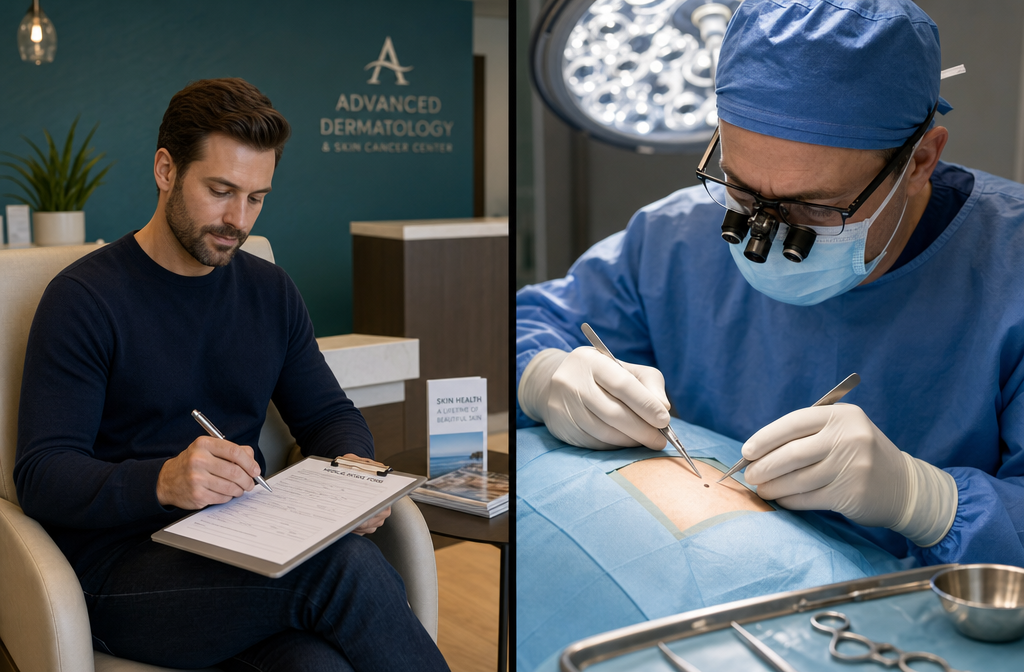
When you walk in for your first visit, expect a short intake process. You'll fill out a health history form covering your current medications, any past skin treatments, and your family history of skin conditions — including melanoma or other skin cancers. [1]
Pro tip: Take photos of any moles that concern you before your appointment. If a mole has changed over the past few months, a side-by-side comparison is genuinely useful for your doctor.
Bring notes on:
Once you're in the room, your doctor will perform a thorough skin check. This means examining all visible moles — not just the ones you're worried about.
They'll use a dermatoscope — a small, handheld magnifying device with a light — to get a detailed look at each lesion. Think of it like a high-powered magnifying glass that lets your doctor see patterns invisible to the naked eye. [3]
A standard first visit runs 15 to 30 minutes. If you're having a full-body skin examination, plan for up to 45 minutes. [2]
Dermatologists don't just eyeball a mole and guess. They use a structured framework called the ABCDE criteria to assess each one. [3]
LetterWhat It Stands ForWhat to Look ForAAsymmetryOne half doesn't match the otherBBorderEdges are irregular, ragged, or blurredCColourMultiple shades — brown, black, red, white, or blueDDiameterLarger than 6mm (about the size of a pencil eraser)EEvolutionAny change in size, shape, colour, or new symptoms
If a mole checks one or more of these boxes, your doctor will recommend the next step — which might be a biopsy, monitoring, or removal. [5]
💬 "Most moles are completely harmless. But the ones that aren't — catching them early makes all the difference."
You can also explore early-stage skin cancer signs and pictures to better understand what dermatologists are looking for before your visit.
This is one of the most common questions patients ask — and the answer is: often, yes. [6]
Many outpatient clinics, including The Minor Surgery Center, are set up to assess and remove moles in the same appointment. You don't need to book a separate surgery day or navigate a hospital waitlist.
Same-day removal is typically possible when:
Sometimes your doctor will want to:
If you're wondering whether you can remove multiple moles in one visit, the answer is often yes — and it's worth asking your clinic upfront.
1. Surgical Excision
The mole is fully cut out using a scalpel. The skin is then closed with sutures. This method is used for deeper or larger moles, and for any lesion that needs to be sent to pathology in one piece. [5]
2. Surgical Shave
A surgical blade shaves the mole flush with the skin surface. This is faster, often requires no stitches, and works well for raised, benign moles. [5]
Both procedures are done under local anaesthetic — meaning the area is numbed before anything happens. Most patients are surprised by how quick and comfortable the process is. Curious about what to expect? Our detailed guide on whether mole removal hurts covers exactly that.
If tissue is sent to a lab, results typically come back within 1–2 weeks. Your clinic will contact you with findings and next steps. If the mole turns out to be a basal cell carcinoma or another form of skin cancer, your care team will walk you through treatment options right away.
You can read more about what happens after removal in our guide on basal cell carcinoma recovery.
This depends on a few factors: whether you have a referral, your province's health coverage rules, and whether the clinic is private or public.
In Ontario, OHIP covers medically necessary mole checks when referred by a family doctor. However, cosmetic mole removal — removing a mole because you don't like how it looks — is typically not covered.
Private dermatology visits without insurance can range from $150 to $300+ for an initial consultation, with removal costs added separately. [7]
At The Minor Surgery Center, we believe in transparent pricing. Use our free minor surgery cost estimator to get a clear sense of what your procedure might cost before you ever walk through the door.
Not all mole removal clinics are created equal. Here's what matters:
✅ Board-certified surgeons with experience in skin lesion removal
✅ On-site surgical capability — so you're not bounced between locations
✅ Clear communication about what's being removed and why
✅ Pathology access — tissue should be sent for analysis when warranted
✅ Minimal wait times — your time matters
Our experienced surgical team includes board-certified plastic and reconstructive surgeons who specialise in skin lesion removal. Every patient gets a personalised treatment plan — not a one-size-fits-all approach.
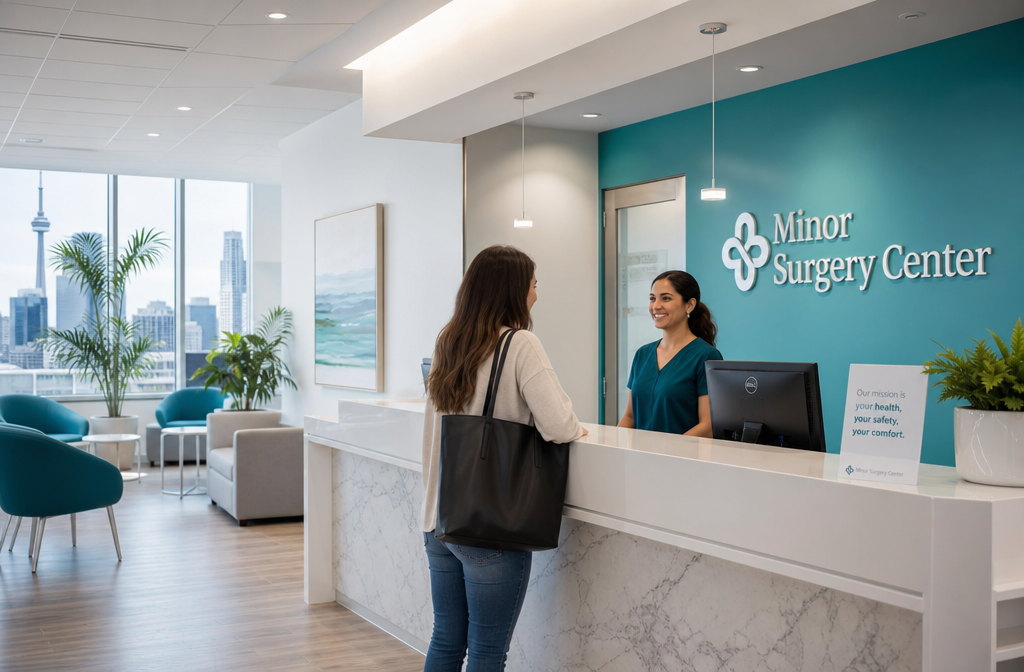
The Minor Surgery Center offers expert outpatient care across multiple Toronto-area locations. Whether you're in the east end, north, or west of the city, there's a clinic close to you:
No hospital. No long waitlists. Just safe and efficient surgery with a comfort-first approach — and a team that's genuinely glad you came in.
The Mayo Clinic recommends a professional skin exam once a year for most adults — more frequently if you have a personal or family history of skin cancer, fair skin, or a large number of moles. [4]
Between visits, do a self-check monthly. Use a mirror (or ask someone you trust) to look at hard-to-see spots like your back, scalp, and the soles of your feet.
If you notice any of the ABCDE warning signs between appointments, don't wait for your annual check. Book sooner.
You've found a dermatologist close to you for mole checks and removal. Now make the most of your first visit.
Before you go:
Questions to ask your doctor:
Being prepared doesn't just speed things up — it helps your doctor give you the most accurate assessment possible. [1]
Here's the honest truth: most moles are completely harmless. But the ones that aren't — they respond best to early action.
Finding a dermatologist close to you for mole checks and removal doesn't have to be complicated or stressful. With the right clinic, you can walk in, get a thorough assessment, and in many cases, get back to your life the same day — with answers and a clear plan.
The Minor Surgery Center offers minimally invasive solutions for mole removal, delivered by an experienced surgical team that treats you like a person, not a number. Our comfort-first approach means you'll know exactly what's happening, every step of the way.
Ready to take the next step?
👉 Use our free cost estimator to understand your options.
👉 Find your nearest clinic at The Minor Surgery Center.
👉 Browse our complete skin conditions and procedures guide to learn more.
That mole isn't going to check itself. Let's get it looked at. 🩺
[1] First Dermatology Visit - https://stutzdermatology.com/blog/first-dermatology-visit/?utm_source=openai
[2] What To Anticipate During Your First Dermatology Visit A Patient S Guide - https://www.otsdermatology.com/blog/what-to-anticipate-during-your-first-dermatology-visit-a-patient-s-guide?utm_source=openai
[3] Moles - https://www.bannerhealth.com/services/dermatology/moles?utm_source=openai
[4] How Often Should I Get Moles Checked - https://mcpress.mayoclinic.org/living-well/how-often-should-i-get-moles-checked/?utm_source=openai
[5] Moles Treatment - https://www.aad.org/diseases/a-z/moles-treatment?utm_source=openai
[6] Will A Dermatologist Remove My Mole On First Visit - https://feinsteindermatology.com/blog/will-a-dermatologist-remove-my-mole-on-first-visit/?utm_source=openai
[7] How Much Is A Dermatologist Visit Without Insurance - https://scienceinsights.org/how-much-is-a-dermatologist-visit-without-insurance/?utm_source=openai