
Last updated: April 7, 2026
A cyst on the eyelid is most commonly a chalazion, a blocked meibomian gland that causes a painless, firm nodule deep in the eyelid tissue. An epidermoid cyst is far less common on the eyelid but looks similar, forming from trapped keratin near the skin surface. The two conditions require different treatments, so an accurate diagnosis matters before any removal is attempted.
A cyst on the eyelid (chalazion vs. epidermoid) refers to two distinct types of benign eyelid lumps that are frequently confused with each other. A chalazion is a localized, granulomatous inflammatory reaction caused by a blocked meibomian (tarsal) gland in the eyelid, not by bacterial infection [1]. An epidermoid cyst is a benign skin cyst filled with keratin, arising from the surface epidermis rather than from glandular tissue.
The meibomian glands sit inside the tarsal plate, the firm cartilage-like structure that gives the eyelid its shape. These glands secrete an oily layer that prevents the tear film from evaporating too quickly. When one of these glands becomes blocked, secretions back up and trigger a chronic inflammatory response, forming the characteristic firm nodule known as a chalazion [1].
Key features:
An epidermoid cyst on the eyelid forms when skin cells (keratinocytes) become trapped beneath the surface and continue producing keratin, creating a slow-growing sac. On the eyelid, these cysts sit closer to the skin surface than a chalazion and are not connected to the meibomian glands.
Key features:
Clinical pearl: Case reports published in 2024 confirm that epidermoid cysts can closely mimic large chalazia on the eyelid, and imaging (ultrasound or MRI) is sometimes required to distinguish them before surgery [7].
For a broader look at how epidermoid cysts differ from other common skin cysts, see this comparison of epidermoid, sebaceous, and pilar cysts.
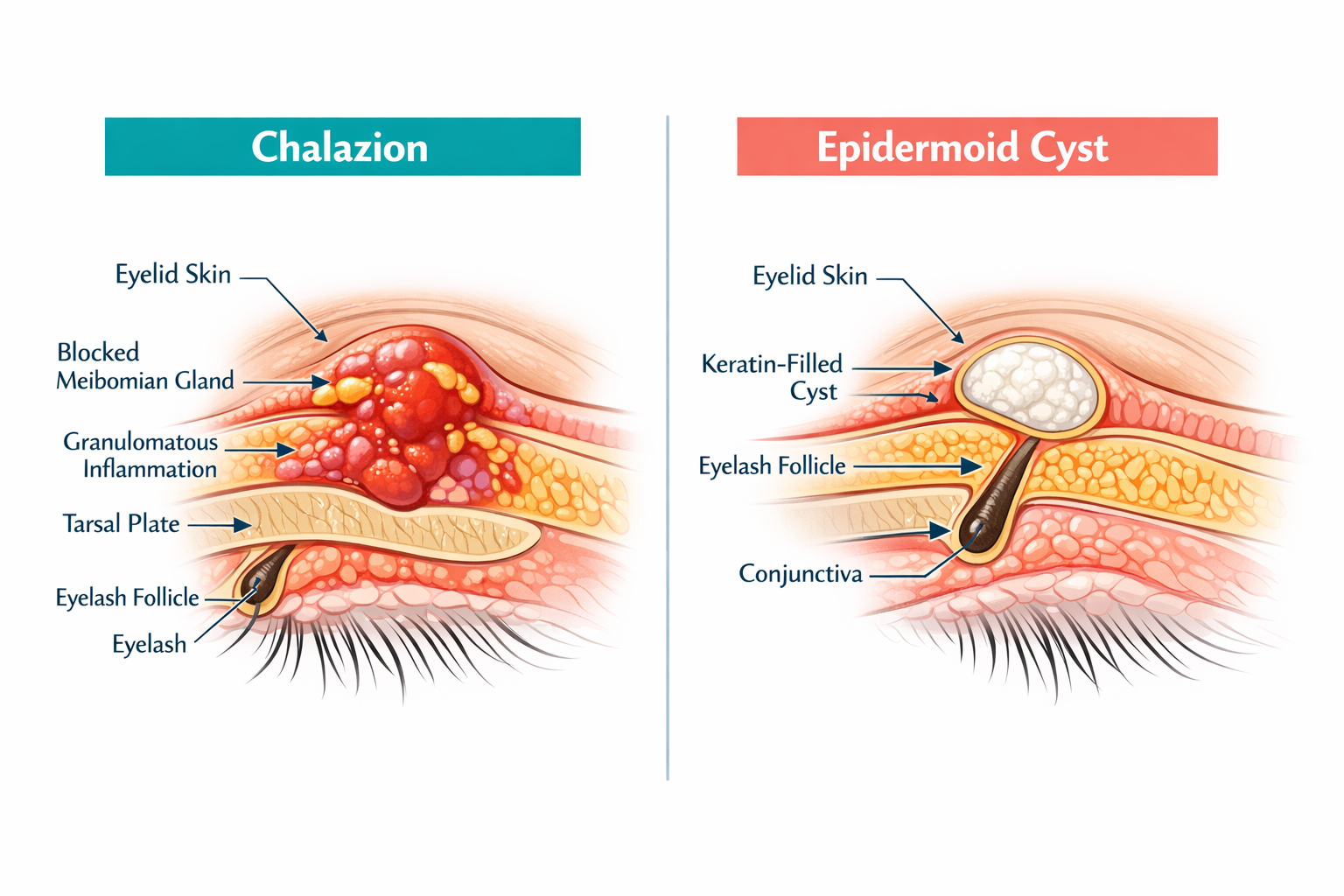
The most reliable distinguishing features are location within the eyelid, relationship to the tarsal plate, and the presence or absence of a central punctum. A chalazion sits deep in the tarsal plate and has no punctum; an epidermoid cyst sits superficially in the skin and often has one.
FeatureChalazionEpidermoid CystOriginBlocked meibomian glandTrapped epidermal cellsDepthDeep (tarsal plate)Superficial (skin layer)Central punctumAbsentOften presentTendernessMild initially, then noneNone unless infectedSpontaneous resolutionCommon (2–8 weeks) [1]Rare without removalInner eyelid appearanceYellow nodule visibleNormal conjunctivaResponse to warm compressesOften improvesNo effectRecurrence riskModerateLow if fully excisedMalignancy riskVery low (but biopsy recurrent ones)Very low
Ophthalmologists and surgeons use several tools to differentiate the two when clinical examination is inconclusive:
Choose imaging if: The lesion is growing rapidly, has atypical features, or does not respond to standard chalazion treatment after 6–8 weeks.
Chalazia form when meibomian gland secretions thicken and block the gland's duct, triggering inflammation. Epidermoid cysts on the eyelid form when skin cells become trapped, either spontaneously or after minor trauma or surgery.
Several conditions increase the likelihood of developing a chalazion:
For a deeper look at the full spectrum of skin cysts and their causes, the 20+ types of cysts guide covers the most common presentations across the body.
Chalazia are the most common benign eyelid lesion in ophthalmology, accounting for nearly half of all eyelid lumps seen in clinical practice [5]. Epidermoid cysts on the eyelid are comparatively rare, though they are among the more common skin cysts on other parts of the face and body.
Chalazia affect people of all ages, including children, though they are most frequently seen in adults between 30 and 50 years old. They are slightly more common in people with oily skin or pre-existing inflammatory skin conditions.
Epidermoid cysts on the eyelid are uncommon enough that when they do appear, they are often initially misdiagnosed as chalazia. This matters because the treatments differ: warm compresses and steroid injections work for chalazia but have no effect on epidermoid cysts.
Any eyelid lump with atypical features should be evaluated promptly by an ophthalmologist or surgeon. While most eyelid cysts are benign, certain characteristics raise concern for more serious diagnoses, including sebaceous gland carcinoma, basal cell carcinoma, or other malignancies.
Red flags requiring urgent referral [6]:
⚠️ Critical rule: A chalazion that recurs in exactly the same spot after surgical removal should always be sent for histopathological analysis. Sebaceous gland carcinoma can masquerade as a recurrent chalazion and carries significant risk if missed [6].
Treatment depends entirely on the type of cyst, its size, and how long it has been present. Chalazia have several non-surgical options; epidermoid cysts on the eyelid almost always require surgical excision for definitive resolution.
Acute phase (first 1–2 weeks):
Chronic phase (if the lump persists beyond 4–6 weeks):
Option A: Steroid injection
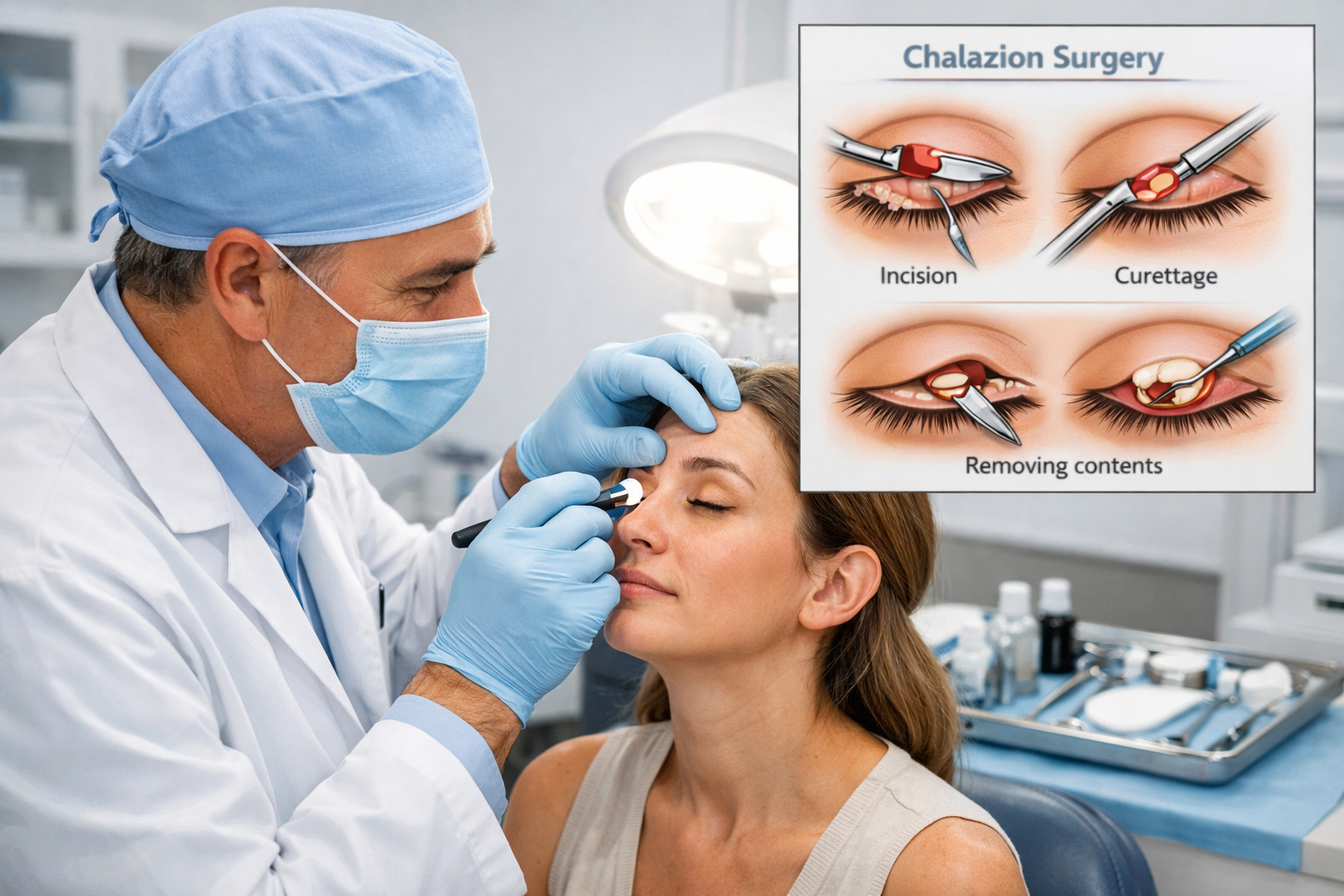
Option B: Surgical incision and curettage (I&C)
Chronic recurrent chalazia:
Epidermoid cysts do not respond to warm compresses or steroid injections. The only effective treatment is complete surgical excision, including removal of the entire cyst wall (sac). If the sac is left behind, the cyst will recur.
The procedure is performed under local anesthetic. The surgeon makes a small incision over the cyst, dissects it free from surrounding tissue, and removes it intact. Because the eyelid skin is thin and delicate, this requires careful technique to minimize scarring. For more detail on what this involves, see the step-by-step guide to cyst removal surgery.
Understanding why complete sac removal matters is explained in detail in this article on why removing the entire cyst sac is crucial.
Most chalazia resolve without treatment; epidermoid cysts do not. Leaving a chalazion alone is a reasonable first approach for the first 4–8 weeks, provided there are no red-flag features.
Bottom line: If a lump has been present for more than 8 weeks without improvement, or if it is growing, a clinical assessment is warranted regardless of whether it appears to be a chalazion or an epidermoid cyst.
For those in the Greater Toronto Area seeking an assessment, The Minor Surgery Center offers consultations with board-certified surgeons experienced in eyelid and facial cyst removal.
Chalazia can be partially prevented through consistent eyelid hygiene; epidermoid cysts have no reliable prevention strategy.
There is no proven way to prevent epidermoid cysts from forming. Protecting the eyelid skin from trauma and sun damage is sensible general advice, but it does not guarantee prevention.
Q: Can a chalazion go away on its own?
Yes. Most chalazia resolve spontaneously within 2–8 weeks with warm compresses and eyelid massage. No treatment is needed during this period unless the lump is large, affecting vision, or showing red-flag features [1].
Q: Is a chalazion the same as a stye?
No. A stye (hordeolum) is an acute, painful infection of an eyelash follicle or gland near the lash margin. A chalazion is a chronic, non-infectious inflammatory nodule located deeper in the eyelid. Styes are usually more painful and resolve faster [3].
Q: Does squeezing or popping an eyelid cyst help?
No. Squeezing a chalazion or epidermoid cyst on the eyelid can introduce bacteria, cause infection, and make surgical removal more difficult. The eyelid skin is thin and delicate, and trauma to the area can lead to scarring.
Q: How long does recovery take after chalazion surgery?
The eyelid is typically swollen and bruised for about one week after incision and curettage. Most people return to normal activities within a few days, though the area may remain slightly tender for 1–2 weeks [1].
Q: Will an epidermoid cyst on the eyelid come back after removal?
If the entire cyst sac is removed, recurrence is rare. If the sac is ruptured or left behind during surgery, the cyst is likely to return. This is why complete excision by an experienced surgeon matters.
Q: Can a child have a chalazion removed?
Yes. Chalazia in children are treated similarly to adults. Steroid injection is often preferred in children because multiple chalazia can be treated simultaneously, avoiding the need for general anesthesia in some cases [1].
Q: Is a cyst on the eyelid ever cancerous?
The vast majority of eyelid cysts are benign. However, sebaceous gland carcinoma can mimic a recurrent chalazion, and basal cell carcinoma can appear as an eyelid lump. Any lump with atypical features or that recurs in the same location after removal should be biopsied [6].
Q: How much does eyelid cyst removal cost in Toronto?
Costs vary depending on the clinic, type of procedure, and whether the removal is performed under provincial health coverage or privately. For pricing information, see The Minor Surgery Center's cyst removal services or contact a clinic directly for a consultation.
Q: What is the difference between an epidermoid cyst and a sebaceous cyst on the eyelid?
The terms are often used interchangeably, but they are technically different. An epidermoid cyst is lined by stratified squamous epithelium and filled with keratin. A true sebaceous cyst originates from the sebaceous gland. On the eyelid, most "sebaceous cysts" are actually epidermoid cysts on histopathology. See this epidermoid vs. sebaceous cyst comparison for more detail.
Q: Can warm compresses shrink an epidermoid cyst?
No. Warm compresses are effective for chalazia because they help liquefy blocked meibomian gland secretions. They have no effect on the keratin-filled sac of an epidermoid cyst.
Q: When should someone see a doctor about an eyelid lump?
See a doctor if the lump: has been present for more than 6–8 weeks without improvement, is growing, causes vision changes, has irregular borders, is associated with eyelash loss, or has recurred after previous treatment [6].
A cyst on the eyelid (chalazion vs. epidermoid) is almost always benign, but the two conditions behave very differently and require different management.
Here is what to do based on your situation:
For those in Ontario, The Minor Surgery Center has locations across the Greater Toronto Area, including North York, Mississauga, Markham, and Oakville, with board-certified surgeons experienced in facial and eyelid cyst removal.
[1] Chalazion Pro – https://patient.info/doctor/ophthalmology/chalazion-pro
[2] Surgery To Remove Your Child's Cysts – https://www.cuh.nhs.uk/patient-information/surgery-to-remove-your-childs-cysts/
[3] Chalazion – Cleveland Clinic – https://my.clevelandclinic.org/health/diseases/17657-chalazion
[4] Eyelid Bump Types, Removal, Treatment and Testing – https://www.khaneyelidsurgery.com/eyelid-bump-types-removal-treatment-and-testing/
[5] Eyelid Lesions: Diagnosis and Treatment – https://www.reviewofophthalmology.com/article/eyelid-lesions-diagnosis-and-treatment
[6] Eyelid Lesions in General Practice – https://www1.racgp.org.au/ajgp/2019/august/eyelid-lesions-in-general-practice
[7] Epidermoid Cyst Presenting as Eyelid Lesion (PMC) – https://pmc.ncbi.nlm.nih.gov/articles/PMC11841541/