
Last updated: May 26, 2026
Cubital tunnel syndrome is a medical condition caused by the compression, stretching, or irritation of the ulnar nerve as it passes through a narrow channel on the inner side of the elbow [4][8]. This pressure disrupts nerve signals, causing numbness, tingling, and weakness in the ring and small fingers [4][8]. Early intervention with conservative treatments like night splinting can prevent permanent nerve damage, while surgery is reserved for severe or progressive cases [4][8].
Nearly 1 in 100 people will experience the persistent, frustrating numbness of an entrapped ulnar nerve at some point in their lives, making it the second most common nerve compression condition in the upper body. This guide offers a comprehensive breakdown of Cubital tunnel syndrome — elbow nerve compression explained to help patients identify symptoms, evaluate treatment pathways, and preserve hand function.
Cubital tunnel syndrome is a compressive neuropathy where the ulnar nerve becomes pinched or stretched as it travels through the cubital tunnel on the inner side of the elbow [4][8]. This mechanical pressure limits blood flow to the nerve, leading to progressive tingling, numbness, and muscle weakness in the hand [4][8].
The ulnar nerve originates in the neck and travels down the arm to control several muscles in the forearm and hand, as well as providing sensation to the pinky and ring fingers [4][8]. At the elbow, the nerve must pass through the cubital tunnel, a narrow space bordered by bone (the medial epicondyle) and tissue (Osborne's ligament and the flexor carpi ulnaris muscle) [4].
Because the ulnar nerve lies directly against the bone with very little protective padding, it is highly vulnerable to external pressure [8]. When the elbow is bent (flexed), the cubital tunnel stretches and narrows, increasing pressure on the nerve by up to three times compared to when the arm is straight [4][8]. Additionally, some individuals possess an anomalous muscle, such as the anconeus epitrochlearis, which further restricts space within the tunnel [4].

Decision Rule: If symptoms only occur when the elbow is bent for long periods, the cause is likely dynamic stretching of the nerve. If symptoms are constant, the nerve may be physically compressed by a structure like a bone spur or a cyst [4][8]. Understanding this distinction helps clinicians determine the best treatment pathway.
Cubital tunnel syndrome involves compression of the ulnar nerve at the elbow, whereas carpal tunnel syndrome involves compression of the median nerve at the wrist [4][8]. This anatomical difference means that cubital tunnel syndrome affects the pinky and ring fingers, while carpal tunnel syndrome affects the thumb, index, middle, and half of the ring finger [8].
Many patients experience hand numbness and immediately assume they have carpal tunnel syndrome. This common carpal tunnel syndrome misdiagnosis can lead to ineffective treatments, such as wearing a wrist splint when the actual problem originates at the elbow. Understanding the specific nerve pathways is crucial for receiving the correct care.
To help distinguish between these two conditions, consider the key differences outlined in the table below:
FeatureCubital Tunnel SyndromeCarpal Tunnel SyndromeNerve AffectedUlnar Nerve [4]Median NervePrimary Site of CompressionMedial Elbow (inner elbow) [4][8]Volar Wrist (carpal tunnel)Sensation LossSmall finger and outer half of ring finger [8]Thumb, index, middle, and inner half of ring fingerCommon TriggersProlonged elbow bending, leaning on elbows [8]Repetitive wrist bending, keyboard usageClassic Physical SignPositive Tinel's sign at the elbow [4]Positive Phalen's test at the wristSevere ComplicationClawing of the ring and pinky fingers [4]Wasting of the thumb muscle (thenar atrophy)
In some cases, patients may experience compression at both the wrist and the elbow, or even in the neck [4]. This is known as "double crush syndrome," where a nerve is compressed at multiple points along its path. To explore how these nerve pathways interact, read more about the carpal tunnel and the ulnar nerve connection.

You can differentiate cubital tunnel syndrome from other elbow conditions by checking for neurological symptoms like tingling in your pinky finger and a "funny bone" sensation when tapping the inner elbow [4][8]. Musculoskeletal conditions, such as golfer's elbow, cause localized soreness in the elbow tendons during movement but do not produce numbness or tingling in the hand [8].
Physicians use several clinical maneuvers to diagnose cubital tunnel syndrome [4]:
A 2023/2024 consensus-type study assembled an expert panel of hand and upper-extremity surgeons to establish common diagnostic criteria [2]. They agreed that typical sensory changes, provocative tests, and electrodiagnostic thresholds are key to standardizing clinical pathways and staging the condition accurately [2].
Occupations and recreational activities that require repetitive elbow bending, prolonged holding of a flexed elbow, or direct pressure on the inner arm put individuals at a much higher risk of ulnar nerve compression [8]. This includes office workers leaning on desks, truck drivers resting their arms on window ledges, and manual laborers performing repetitive reaching tasks [8].
Individuals with systemic health conditions like diabetes, a history of elbow trauma, or specific anatomical variations are the most likely to develop cubital tunnel syndrome [4][8]. The condition is also more prevalent in males and older adults, though it can affect younger populations under certain circumstances [3].
Yes, ulnar nerve gliding (or "flossing") exercises are highly effective at reducing mild to moderate symptoms by gently stretching and sliding the nerve through the cubital tunnel [8]. These movements help release adhesions and improve blood flow to the nerve tissue [5][8].
Unlike muscles, nerves do not like to be aggressively stretched. Instead, they need to slide smoothly through the surrounding tissues. Nerve glides involve tensioning one end of the nerve while relaxing the other, allowing the nerve to slide back and forth like a thread through a needle. For a broader comparison of therapeutic movements, read about carpal tunnel stretches vs nerve glides.
Common Mistake: Many patients perform these exercises too aggressively. Over-stretching an already irritated nerve will inflame it further. Keep the movements slow, gentle, and within a pain-free range of motion.
Most patients with mild to moderate cubital tunnel syndrome do not require surgery and can find lasting relief through conservative treatments like night splinting and activity modification [8]. Surgical intervention is reserved for individuals who do not improve after several weeks of conservative care, or those showing signs of progressive muscle weakness and nerve damage [4][8].
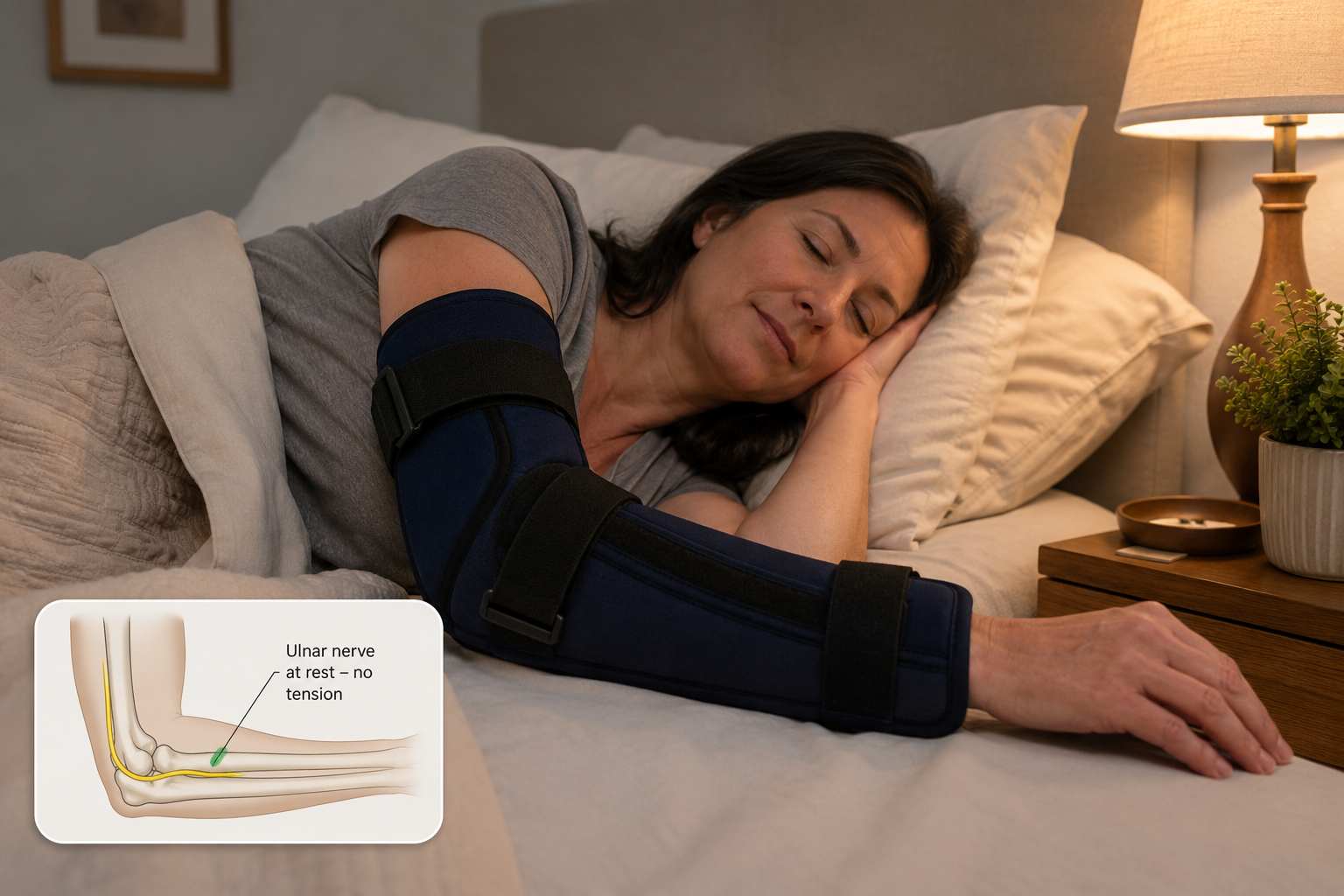
Surgery becomes necessary if you experience constant numbness, a loss of coordination in your fingers, or visible muscle wasting (atrophy) in the web space between your thumb and index finger [4][8]. In these scenarios, waiting too long can lead to permanent, irreversible nerve damage [4].
The cost of cubital tunnel surgery typically ranges from $2,500 to $8,000 USD (or equivalent CAD) per arm when performed in a private healthcare facility, depending on the complexity of the procedure and the type of anesthesia used. In public healthcare systems, such as Canada's provincial health plans, the surgery is fully covered for medically necessary cases, though wait times can vary significantly.
Basic recovery from cubital tunnel surgery, including wound healing and a return to light daily activities, takes about 4 to 6 weeks [8]. However, complete nerve recovery and the return of full hand strength can take anywhere from 6 months to a year, as compressed nerves heal very slowly [8][10].
A 2025 systematic review update in the Journal of Hand Surgery compared simple in-situ decompression with subcutaneous anterior transposition [10]. The study found no clinically meaningful difference in overall functional outcomes, patient-reported satisfaction, or complication rates between the two modern techniques [10]. Because simple decompression involves less tissue disruption, it often allows for a slightly faster recovery and a quicker return to work compared to transposition [10]. For a general comparison of hand surgery healing times, see our guide on carpal tunnel surgery recovery.
Yes, severe or long-standing compression of the ulnar nerve can cause irreversible damage, leading to permanent numbness and muscle wasting in the hand [4][8]. When compression is left untreated for too long, the nerve fibers die, and the muscles they control shrink and lose their function permanently [4].
Once muscle atrophy and "clawing" have been present for more than a year, even a successful surgical decompression may not fully restore muscle bulk or strength [4]. This highlights why academic nerve clinics and hand specialists advocate for early intervention rather than a "watchful waiting" approach for progressive symptoms.
The most damaging mistakes people make are sleeping with their elbows tightly bent, ignoring early symptoms of finger numbness, and using inappropriate wrist braces that do not address the elbow [8]. Additionally, performing aggressive, high-tension stretches or continuing to lean on hard surfaces can accelerate nerve damage [8].
Emerging alternative treatments for cubital tunnel syndrome include high-intensity laser therapy (HILT) and extracorporeal shock-wave therapy (ESWT), which are designed to reduce inflammation and promote tissue healing [5]. While these non-invasive modalities show promise when combined with ulnar nerve gliding exercises, they are currently used as supportive therapies rather than primary cures [5].
A clinical trial running through early 2026 is actively evaluating the effectiveness of high-intensity laser therapy versus shock-wave therapy for patients with post-burn cubital tunnel syndrome [5]. Both treatments are combined with standardized ulnar nerve gliding exercises to target pain reduction and functional hand improvement [5].
Yes, mild cases of cubital tunnel syndrome can resolve on their own if you modify your activities, avoid keeping your elbow bent for long periods, and use a night splint [8]. However, moderate to severe cases with constant numbness or muscle weakness typically require medical intervention or surgery [4][8].
Cubital tunnel pain typically feels like an ache or burning sensation on the inner side of the elbow, often accompanied by a "funny bone" tingling that shoots down the forearm into the pinky and ring fingers [4][8].
Typing itself does not directly cause cubital tunnel syndrome, but keeping your elbows bent at a sharp angle or resting them on hard desk edges while typing can compress and irritate the ulnar nerve [8].
You should avoid heavy weightlifting, particularly exercises that require deep elbow bending (like tricep extensions or heavy bicep curls), while your ulnar nerve is actively inflamed [8]. If you do lift, focus on keeping your elbows relatively straight and avoid resting them on hard gym benches.
If left untreated, severe cubital tunnel syndrome can lead to permanent loss of sensation in the hand, irreversible wasting (atrophy) of the hand muscles, and a physical deformity known as "claw hand" [4][8].
Doctors diagnose cubital tunnel syndrome primarily through a clinical exam, using tests like Tinel's sign (tapping the elbow) and the elbow flexion test, and they may use electrodiagnostic nerve conduction studies to confirm and stage the condition [4][8].
A cold compress (ice pack) wrapped in a towel is generally better for acute flares to reduce inflammation around the elbow, while warm compresses can be used later to relax tight forearm muscles. Never apply ice directly to the bare skin over the nerve.
Yes, sleeping with your elbows tightly bent (such as hugging a pillow or sleeping in a tight fetal position) stretches and compresses the ulnar nerve, often causing you to wake up with numb, tingling hands [8].
Managing cubital tunnel syndrome effectively requires early recognition of symptoms, prompt lifestyle adjustments, and a structured treatment plan to protect the ulnar nerve from permanent damage [4][8]. By adopting simple habits like night splinting, ergonomic modifications, and gentle nerve-gliding exercises, most individuals can achieve full recovery without the need for surgery [8].
If you are experiencing persistent tingling or numbness in your pinky and ring fingers, take the following immediate steps:
[2] S036350232300285x - https://www.sciencedirect.com/science/article/abs/pii/S036350232300285X
[3] Diagnosing And Treating Cubital Tunnel Syndrome In Adolescents - https://pediatricsnationwide.org/2023/08/30/diagnosing-and-treating-cubital-tunnel-syndrome-in-adolescents/
[4] Cubital Tunnel Syndrome - https://www.orthobullets.com/hand/6021/cubital-tunnel-syndrome
[5] Post Burn Cubital Tunnel Syndrome Response To High Intensity Laser Therapy Versus Shock Wave Therapy - https://www.centerwatch.com/clinical-trials/listings/NCT07102992/post-burn-cubital-tunnel-syndrome-response-to-high-intensity-laser-therapy-versus-shock-wave-therapy
[8] Ulnar Nerve Entrapment At The Elbow - https://orthoinfo.aaos.org/en/diseases--conditions/ulnar-nerve-entrapment-at-the-elbow/
[10] Pmc12966733 - https://pmc.ncbi.nlm.nih.gov/articles/PMC12966733/