
Last updated: September 29, 2026
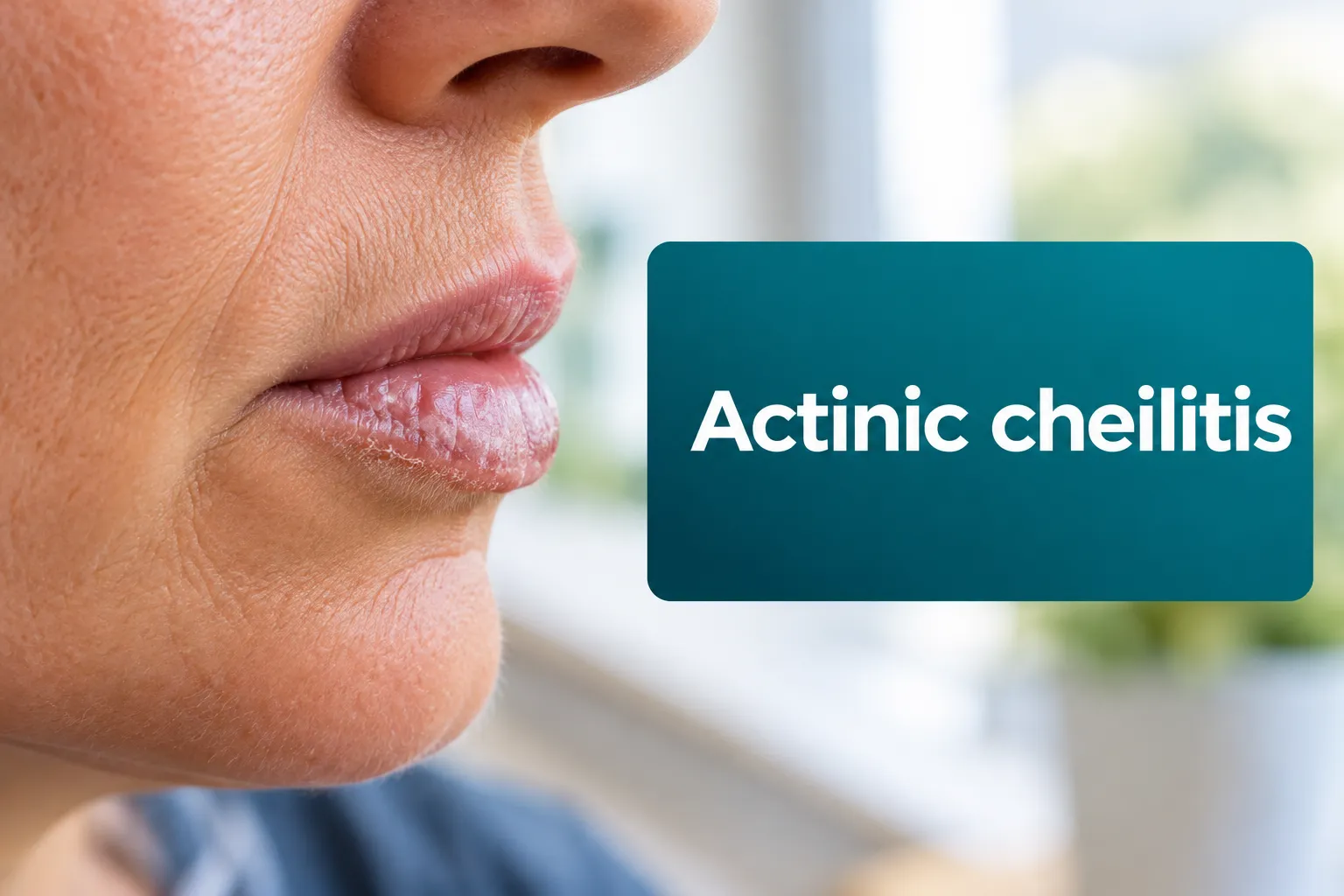
Actinic cheilitis is sun-damage precancer on the lip, most often the lower lip, caused by years of ultraviolet exposure. It is classified as an oral potentially malignant disorder because a meaningful share of cases progress to squamous cell carcinoma (SCC) over time.[2][4] Most lip SCCs actually begin as actinic cheilitis, which is why dermatologists treat it seriously rather than watching and waiting.[7][9]
Actinic cheilitis is a precancerous change on the lip caused by long-term sun exposure, and it is serious enough to be classified alongside other oral potentially malignant disorders. It affects the vermilion, the reddish skin of the lip, most often the lower lip because that surface catches more direct sunlight than the upper lip throughout the day.[1][4][12]
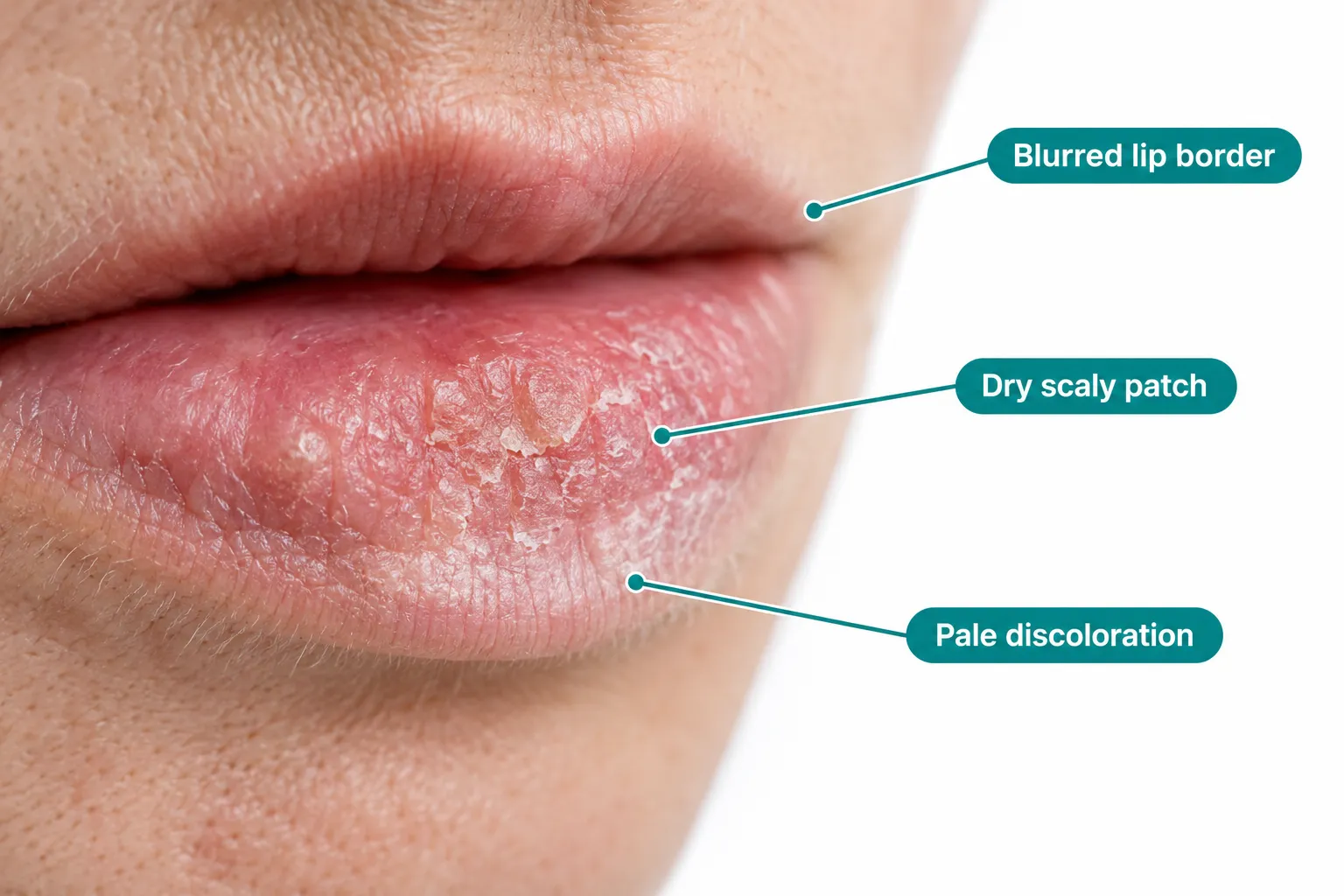
The condition develops when ultraviolet radiation damages the keratinocyte cells that make up the lip's outer layer. Over years, that damage builds up. The tissue becomes thinner (atrophic), starts to scale, and the sharp line between the lip and surrounding skin, the vermilion border, becomes blurred or disappears in patches.[1][4]
What makes actinic cheilitis different from ordinary sun-chapped lips is the underlying cell damage. A sunburned lip heals. Actinic cheilitis reflects cumulative genetic and structural changes in the tissue that do not fully reverse, even after the visible dryness settles down.[1][2]
Some clinical reviews go further and describe severe actinic cheilitis as squamous cell carcinoma in situ of the lip, meaning the most advanced form sits at the very edge of the dysplasia spectrum, one step short of invasive cancer.[2][12] That framing is why many specialists recommend active treatment rather than a "wait and monitor" approach for anything beyond the mildest cases.
Choose active treatment if: the lesion has been present for months, shows scaling or white patches, or sits on skin that has had decades of outdoor sun exposure. Watchful monitoring with strict sun protection may be reasonable only for very early, mild dryness in a younger patient with no risk factors, and only under a clinician's guidance.
Early actinic cheilitis usually looks like persistent dry, rough, or scaly patches on the lower lip that do not improve with lip balm. The color often turns pale, whitish, or slightly gray instead of the normal pink-red of the lip.[1][4]
Common early signs include:
As the condition advances, thickened white or scaly plaques can appear, small cracks or fissures may form, and some patients develop a persistent flaky crust. A common mistake is assuming this is simply severe chapped lips and treating it with balm or petroleum jelly for months. If a patch does not clear within two to three weeks of basic care, it needs a clinical look, not more waiting.
An edge case worth noting: actinic cheilitis can look patchy rather than uniform, with some areas of normal-looking lip next to visibly damaged skin. That patchiness is itself a clue, since ordinary chapped lips tend to affect the whole lip evenly.
Yes. Actinic cheilitis can progress to squamous cell carcinoma, and this is the central reason the diagnosis matters. Reported transformation rates vary by study, ranging from about 3% in newer systematic reviews to 6-10% in clinical summaries, with older literature citing figures as high as 10-30%.[3][4][7]
The wide range reflects differences in study design, lesion severity at diagnosis, and how long patients were followed. What is consistent across the research is the direction of risk: actinic cheilitis carries a meaningfully higher chance of turning into SCC than sun damage on other areas of skin, which is why it gets treated more aggressively than ordinary actinic keratosis elsewhere on the body.[2]
Timing matters too. The transformation process is typically slow, taking anywhere from about 1 to 30 years from the first signs of actinic cheilitis to invasive SCC.[5][9] That long window is actually good news for patients: it means there is real time to catch and treat the lesion before it becomes cancer, provided the lip is checked regularly rather than ignored.
Progression is not guaranteed, but it is also not rare. One case report described a patient who developed metastatic lip SCC after years of an untreated actinic lesion, illustrating that although progression is slow, it can eventually become life-threatening if left unaddressed.[10] For a broader look at how precancerous skin changes evolve step by step, see this complete guide to understanding cancer progression.
Quick example: a 58-year-old outdoor construction worker notices dry, whitish patches on his lower lip that have been present for over a year. Given the duration and occupational sun exposure, this falls into the higher-risk category and warrants biopsy rather than reassurance.
Actinic cheilitis, cold sores, and actinic keratosis are three different conditions that can all show up near the mouth, but they have different causes, appearances, and treatment paths. Confusing them delays proper care, so the distinctions matter.
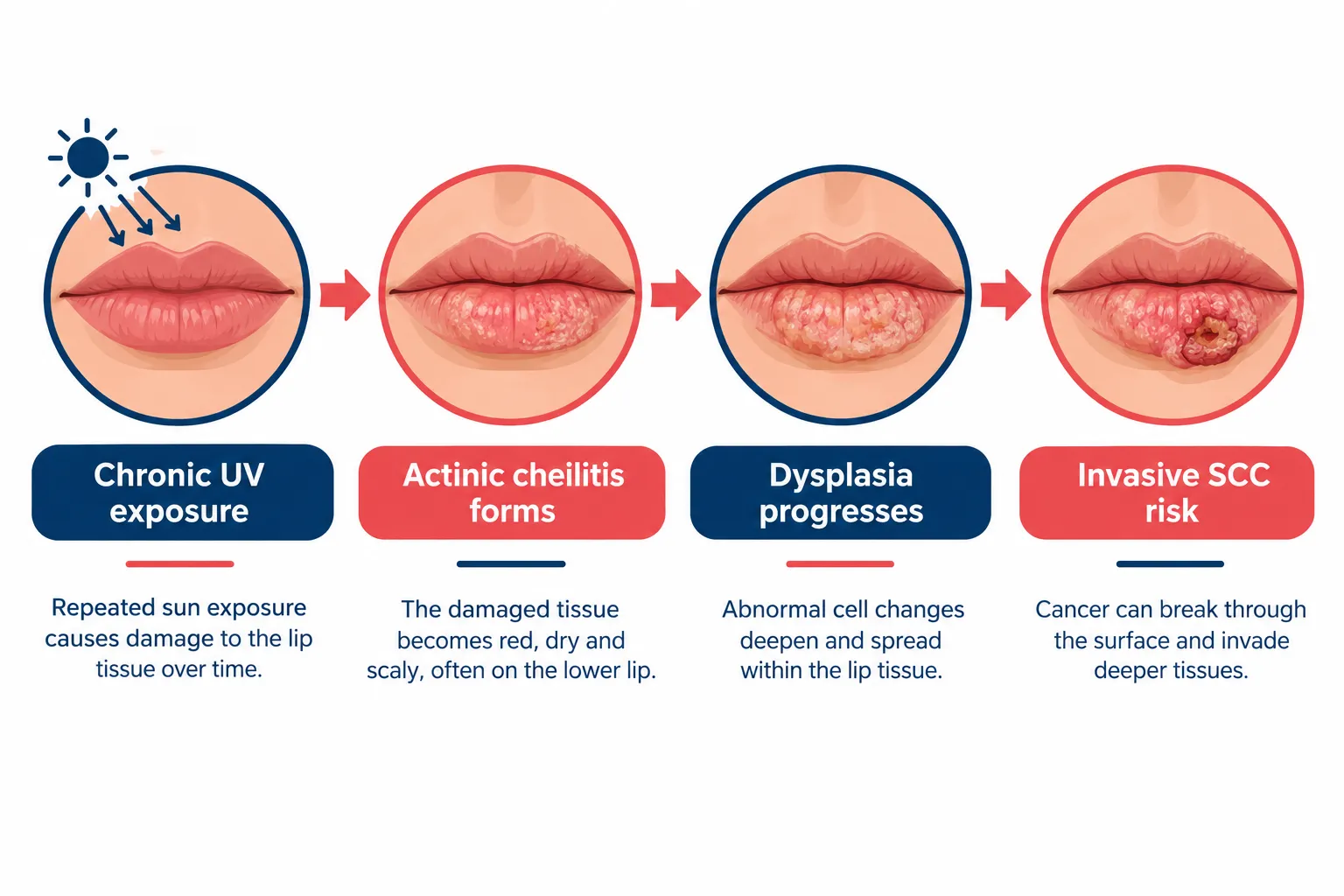
Actinic cheilitis is caused by chronic sun damage and develops slowly over months to years, while a cold sore is caused by the herpes simplex virus and appears suddenly, often within a day or two of a trigger like stress, illness, or sun exposure.[1]
FeatureActinic CheilitisCold SoreCauseCumulative UV damageHerpes simplex virus (HSV-1)OnsetGradual, over months to yearsSudden, within 1-2 daysAppearanceDry, scaly, pale patches; blurred lip borderFluid-filled blisters that crust overPainUsually mild or noneOften tingling, burning, or painfulDurationPersistent unless treatedTypically resolves in 7-10 daysContagiousNoYesCancer riskYes, precancerousNo
Decision rule: if the lip lesion is blistering, painful, and resolves within two weeks, think cold sore. If it is dry, scaly, persistent for months, and located on the sun-exposed lower lip, think actinic cheilitis.
Actinic cheilitis and actinic keratosis are closely related but not identical. Both result from UV damage and both are precancerous, but actinic keratosis refers to sun-damaged patches on regular skin, while actinic cheilitis specifically refers to the same type of damage occurring on the lip's vermilion tissue.[2][12]
Actinic cheilitis is sometimes described as the lip-specific version of actinic keratosis, but it carries a comparatively higher rate of progression to squamous cell carcinoma than actinic keratosis on other body sites, largely because lip tissue is thinner and more exposed.[2] For a full breakdown of how ordinary actinic keratosis behaves and when it becomes dangerous, see this detailed explainer on actinic keratosis and this guide on actinic keratosis progressing to SCC.
The people most at risk for actinic cheilitis are older adults with fair skin who have spent years in the sun without consistent lip protection, particularly men who work outdoors. Risk climbs with age, cumulative sun exposure, and smoking.[2][5]
Key risk factors include:
A meta-analysis identified more than 4 hours of daily sun exposure, especially without sunscreen, as directly associated with increased actinic cheilitis risk, reinforcing photoprotection as the core preventive strategy.[5]
Edge case: younger adults with intense recreational sun exposure, such as surfers, sailors, or golfers who spend hours outdoors without lip protection, can develop actinic cheilitis in their 30s and 40s even without an outdoor occupation. Age alone should not rule the diagnosis in or out.
The most effective way to prevent actinic cheilitis is consistent daily sun protection on the lips, starting well before any visible damage appears. Because the damage is cumulative, prevention habits matter most for people who spend regular time outdoors.
Practical prevention steps:
Common mistake: using regular lip balm without SPF and assuming moisture alone prevents damage. Moisturizing helps comfort but does nothing to block ultraviolet radiation, which is the actual driver of the disease.
Actinic cheilitis does not reliably go away on its own, and home care alone is not considered adequate treatment for confirmed cases. Sun protection and moisturizing can slow further damage and ease dryness, but they do not reverse the cellular changes already present in the tissue.[2][9]
What home care can reasonably do:
What home care cannot do:
A 2021 review found that when actinic cheilitis was adequately treated with recognized clinical therapies, no cases in the available case series went on to develop cancer afterward.[9] That finding supports active treatment over passive home management once a diagnosis is confirmed.
Decision rule: choose home care alone only for very mild, recently noticed dryness with no scaling, no color change, and no risk factors, and only as a short trial before seeing a clinician. Choose professional treatment if the lesion has been present more than a few weeks, shows scaling, whitish discoloration, or occurs in someone with significant sun exposure history.
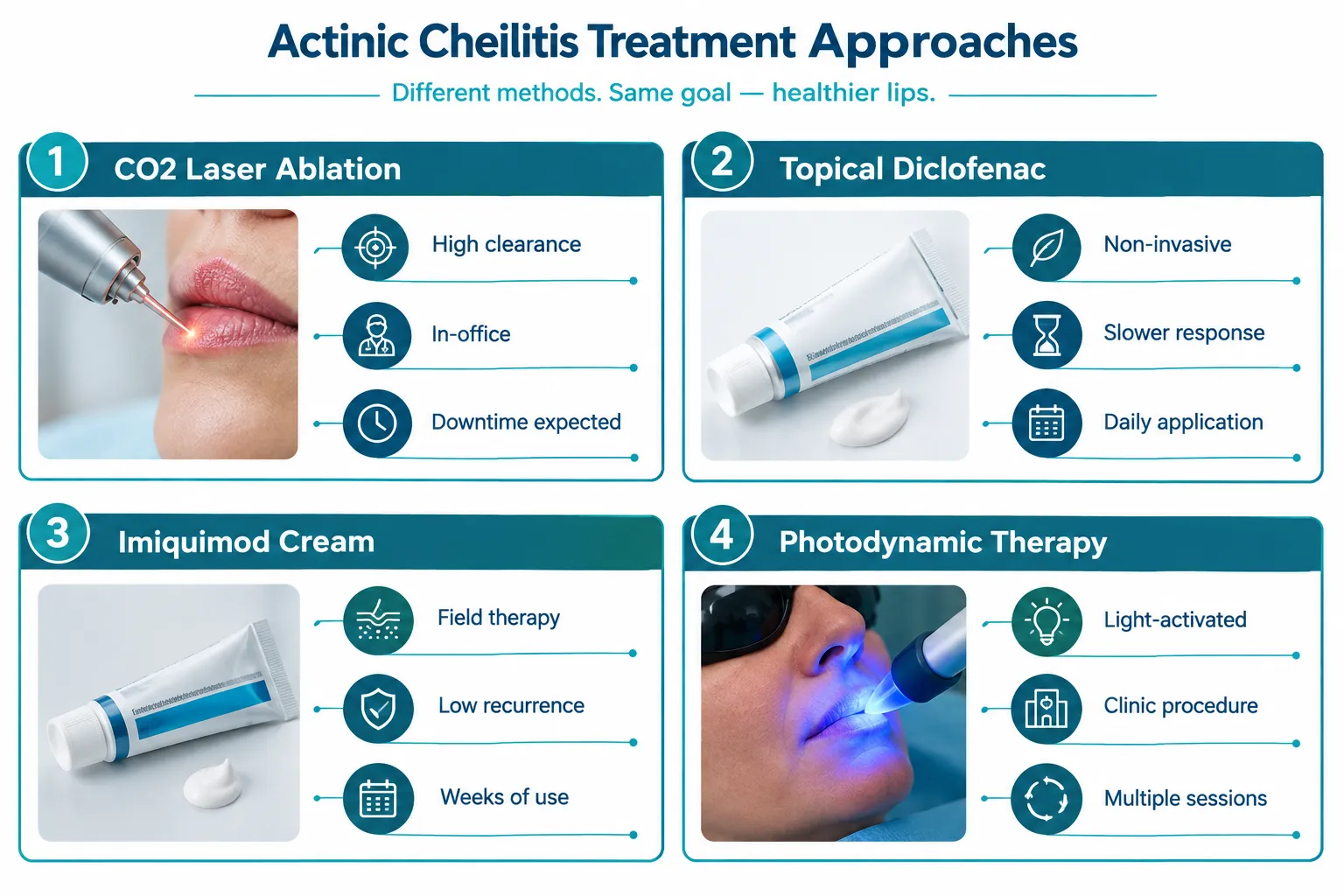
Treatment for actinic cheilitis ranges from topical creams for mild, widespread lesions to ablative procedures like laser or surgery for more advanced disease, with choice depending on lesion severity, size, and patient factors. A 2025 systematic review and meta-analysis in Biomedicines compared outcomes across the major treatment types.[6]
That 2025 meta-analysis found:
TreatmentTypeTypical Complete ResponseRecurrence TendencyBest FitCO2 laser ablationProceduralVery high (about 97%)[6]Low to moderateModerate-severe, well-defined lesionsVermilionectomy (lip shave)SurgicalHighLowSevere or extensive dysplasiaEr:YAG laserProceduralHighHigher (about 14%)[6]Localized lesions, cosmetic priorityPhotodynamic therapy (PDT)Field therapyModerate-highModerate, improved when laser-primed[6]Diffuse mild-moderate lesionsImiquimod creamTopicalModerateVery low (about 0%)[6]Mild-moderate, patient prefers non-surgical optionTopical diclofenacTopicalLower (about 53%)[6]VariableVery mild lesions, adjunct therapy
Cost note: actual pricing depends heavily on clinic, region, lesion size, and whether the procedure is done under local anesthesia in-office or requires a surgical suite. As a general estimate, topical creams tend to be the lowest upfront cost but may need weeks of daily application, while laser ablation and vermilionectomy involve a higher single procedural cost but often achieve clearance in one or few sessions. Confirm specific pricing directly with a treating clinic, since costs are not standardized across providers.
For lesions requiring surgical management, procedures like vermilionectomy are typically performed by facial plastic or reconstructive surgeons experienced in lip anatomy; see the surgical profile of Dr. Chris Hong for an example of this type of specialist care.
Among topical options, imiquimod cream currently shows the best combination of reasonable clearance and very low recurrence, while topical diclofenac shows the weakest standalone performance in recent comparative data.[6]
Practical guidance for choosing a topical approach:
Mistake to avoid: stopping a prescribed topical course early because of temporary redness or peeling. Some irritation is an expected part of how field therapies work on precancerous tissue, and stopping too soon can leave treatment incomplete. Always follow the prescribing clinician's specific instructions on duration and monitoring.
Yes. Any persistent lip dryness, scaling, or color change lasting more than two to three weeks should be evaluated by a dermatologist, oral medicine specialist, or facial plastic surgeon experienced with lip lesions. Self-diagnosis is unreliable because actinic cheilitis can closely resemble ordinary chapped lips in its earliest stage.[4][12]
See a specialist promptly if any of the following apply:
A clinical exam typically includes visual inspection and, when the lesion looks suspicious, a biopsy to check for dysplasia or early carcinoma, since visual assessment alone cannot reliably predict which lesions will progress.[4][12] For patients in the Toronto region, options for professional evaluation include a full body skin exam and screening or a visit to a dedicated skin cancer clinic.
Edge case: patients sometimes delay a dental or dermatology visit because the lesion does not hurt. Actinic cheilitis is frequently painless even in advanced stages, so absence of pain should never be used to rule out the need for evaluation.
Recurrence after treatment for actinic cheilitis varies by method, with ablative laser techniques showing higher partial recurrence than some topical field therapies, though outcomes depend on lesion severity and follow-up care.[6] Overall, treated lesions that are properly managed and followed have a favorable long-term outlook.
Key recurrence findings from recent comparative data:
Decision rule for follow-up: patients treated with any modality should have a clinical recheck within a few months of treatment completion, then periodic lip checks going forward, since recurrence can be subtle and resemble the original dryness or scaling. Combining thorough treatment with strict ongoing sun protection is the most consistent way to minimize recurrence risk over time. This mirrors the approach used for other precancerous skin lesions; see this overview of common precancerous skin conditions and how they progress for related context.
Is actinic cheilitis the same as chapped lips?
No. Chapped lips are temporary dryness from cold, wind, or dehydration that resolves within days with moisturizing. Actinic cheilitis is a persistent, sun-caused precancerous change that lasts for months and does not resolve with lip balm alone.
What percentage of actinic cheilitis cases turn into cancer?
Estimates vary by study, ranging from about 3% in newer systematic reviews to 6-10% in clinical summaries, with older literature citing up to 10-30% in some cases.[3][4][7] The wide range reflects differences in lesion severity and study methods.
Can actinic cheilitis be cured completely?
Yes, in many cases. Treatments like CO2 laser ablation showed complete response rates around 97% in a 2025 meta-analysis, and other modalities like imiquimod and photodynamic therapy also achieve meaningful clearance, though follow-up monitoring remains important.[6]
How is actinic cheilitis diagnosed?
Diagnosis starts with a visual exam of the lip by a dermatologist or oral medicine specialist. If the lesion looks suspicious for dysplasia or early carcinoma, a biopsy confirms the diagnosis, since appearance alone cannot reliably predict severity.[4][12]
Does actinic cheilitis only affect the lower lip?
It affects the lower lip far more often because that surface receives more direct sun exposure throughout the day. The upper lip can be involved but far less commonly.[1]
Is actinic cheilitis contagious?
No. It results from cumulative UV damage, not an infectious agent, so it cannot spread to another person through contact.
What happens if actinic cheilitis is left untreated?
Untreated lesions can persist indefinitely and, in a portion of cases, progress slowly over years to invasive squamous cell carcinoma, which in rare, long-neglected cases has been reported to metastasize.[9][10]
Can lip balm with SPF prevent actinic cheilitis?
Consistent daily use of SPF lip balm reduces further UV damage and is a core prevention strategy, though it cannot reverse damage that has already occurred.[5]
Actinic cheilitis is not a cosmetic nuisance. It is sun-damage precancer on the lip that can lead to squamous cell carcinoma, and the research consistently shows that a meaningful share of untreated cases progress over time, with the majority of lip SCCs tracing back to this exact lesion.[7][9] The path from first dry patch to invasive cancer is usually slow, often spanning years, which is precisely why early recognition and proper treatment change the outcome.
Next steps that make a real difference: check the lower lip monthly for persistent dryness, scaling, or color change; apply SPF lip balm daily regardless of season; and book a clinical evaluation as soon as any lip change lasts beyond two to three weeks. Treatment options ranging from topical imiquimod to CO2 laser ablation offer strong clearance rates when matched correctly to lesion severity.[6] Waiting rarely improves the odds. Acting early consistently does.
[1] Nbk551553 - https://ncbi.nlm.nih.gov/sites/books/NBK551553/
[2] Pmc8886241 - https://pmc.ncbi.nlm.nih.gov/articles/PMC8886241/
[3] 23007 Actinic Cheilitis - https://my.clevelandclinic.org/health/diseases/23007-actinic-cheilitis
[4] Mbcb230141 - https://www.jomos.org/articles/mbcb/full_html/2023/03/mbcb230141/mbcb230141.html
[5] Pmc8760378 - https://pmc.ncbi.nlm.nih.gov/articles/PMC8760378/
[6] Pmc12383482 - https://pmc.ncbi.nlm.nih.gov/articles/PMC12383482/
[7] medicalnewstoday - https://www.medicalnewstoday.com/articles/319133
[8] Nbk551553 - https://www.ncbi.nlm.nih.gov/books/NBK551553/
[9] Pmc8268797 - https://pmc.ncbi.nlm.nih.gov/articles/PMC8268797/
[10] Pmc3119986 - https://pmc.ncbi.nlm.nih.gov/articles/PMC3119986/
Meta Title: Actinic Cheilitis: Precancer on the Lip Linked to SCC
Meta Description: Learn how actinic cheilitis, a lip precancer, can lead to SCC, its symptoms, risk factors, treatment options, costs, and when to see a dermatologist.
Tags: actinic cheilitis, lip precancer, squamous cell carcinoma, sun damage lips, actinic keratosis, skin cancer prevention, vermilionectomy, imiquimod cream, photodynamic therapy, dermatology skin checks, lip cancer symptoms, oral potentially malignant disorder