
Last updated: May 19, 2026
Residents of Aurora and Newmarket, Ontario, can access professional skin tag removal Aurora Ontario services through several local clinics and through nearby specialist centers in Vaughan and North York. Most benign skin tags are removed using surgical snipping, electrocautery, cryotherapy, or CO₂ laser in a single office visit, with no general anesthesia required. The closest high-volume specialist options are The Minor Surgery Center in Vaughan and Toronto Minor Surgery Center in North York, both of which serve the York Region corridor and accept patients without a long wait.
Skin tags (acrochordons) are small, soft, flesh-colored growths that hang from the skin on a thin stalk. Moles (nevi) are pigmented spots formed by clusters of melanocytes. Both are extremely common in adults across Aurora, Newmarket, and the broader York Region.
Why people seek removal:
Key distinction: Skin tags are always benign. Moles carry a small but real risk of malignancy and should be assessed by a physician before removal, not treated as a simple cosmetic errand. [9]
The ABCDE rule for moles (recommended by Toronto Dermatology Centre and widely used by Ontario clinicians):
LetterWhat to CheckWarning SignAAsymmetryOne half doesn't match the otherBBorderIrregular, ragged, or blurred edgesCColourMultiple shades of brown, black, red, or whiteDDiameterLarger than ~6 mm (pencil eraser)EEvolutionAny change in size, shape, color, or new symptom
Any mole meeting one or more of these criteria warrants a physician consultation before proceeding with removal. For a broader look at concerning skin changes, the 25+ Types of Skin Lesions guide is a useful starting reference.
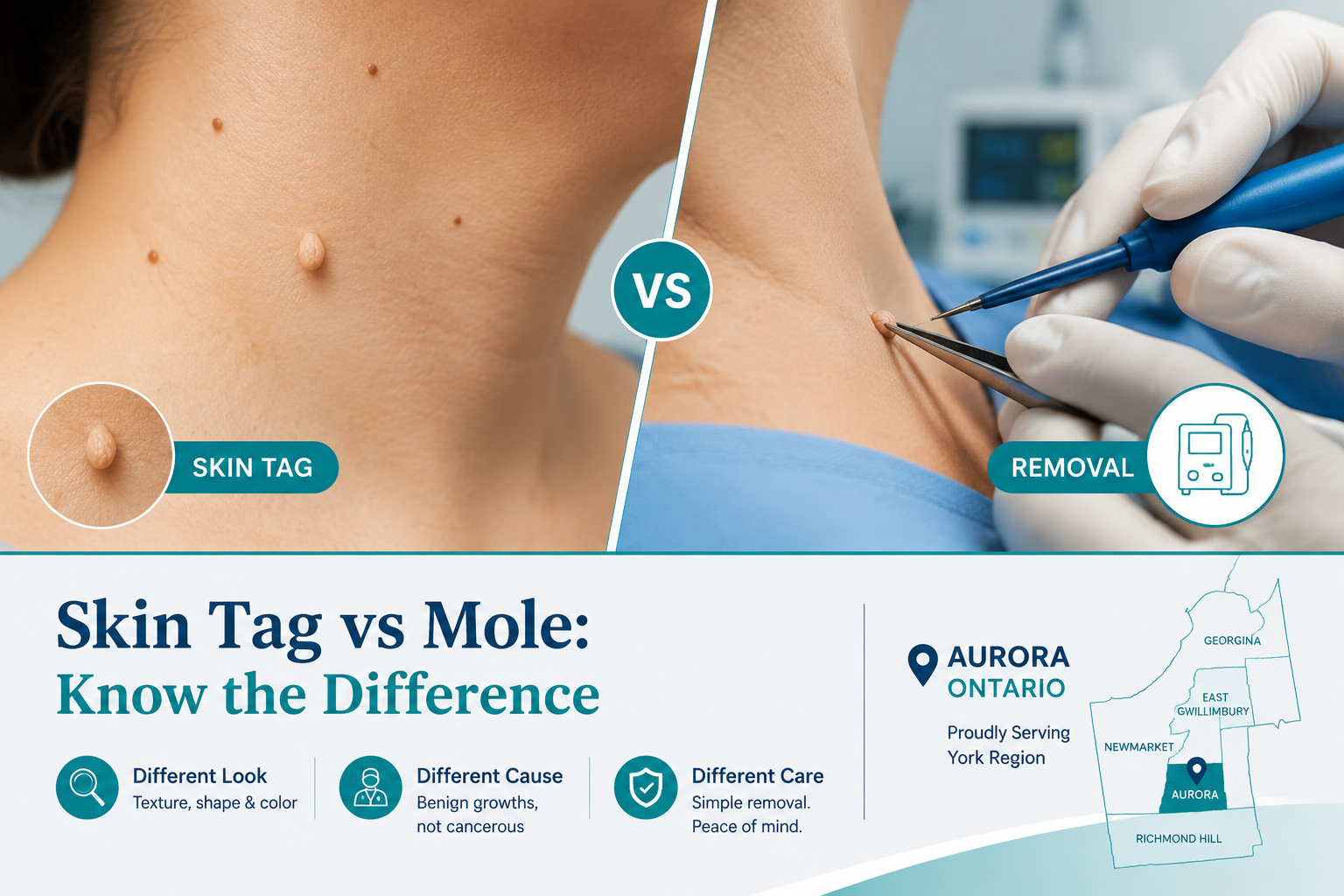
Direct answer: Aurora and Newmarket residents have access to local med-spa options (electrocautery, cryotherapy, CO₂ laser) and physician-led minor surgery clinics in Vaughan and North York. For straightforward benign skin tags, any well-equipped local clinic with trained staff is adequate. For moles, a physician-led clinic with pathology access is the right choice.
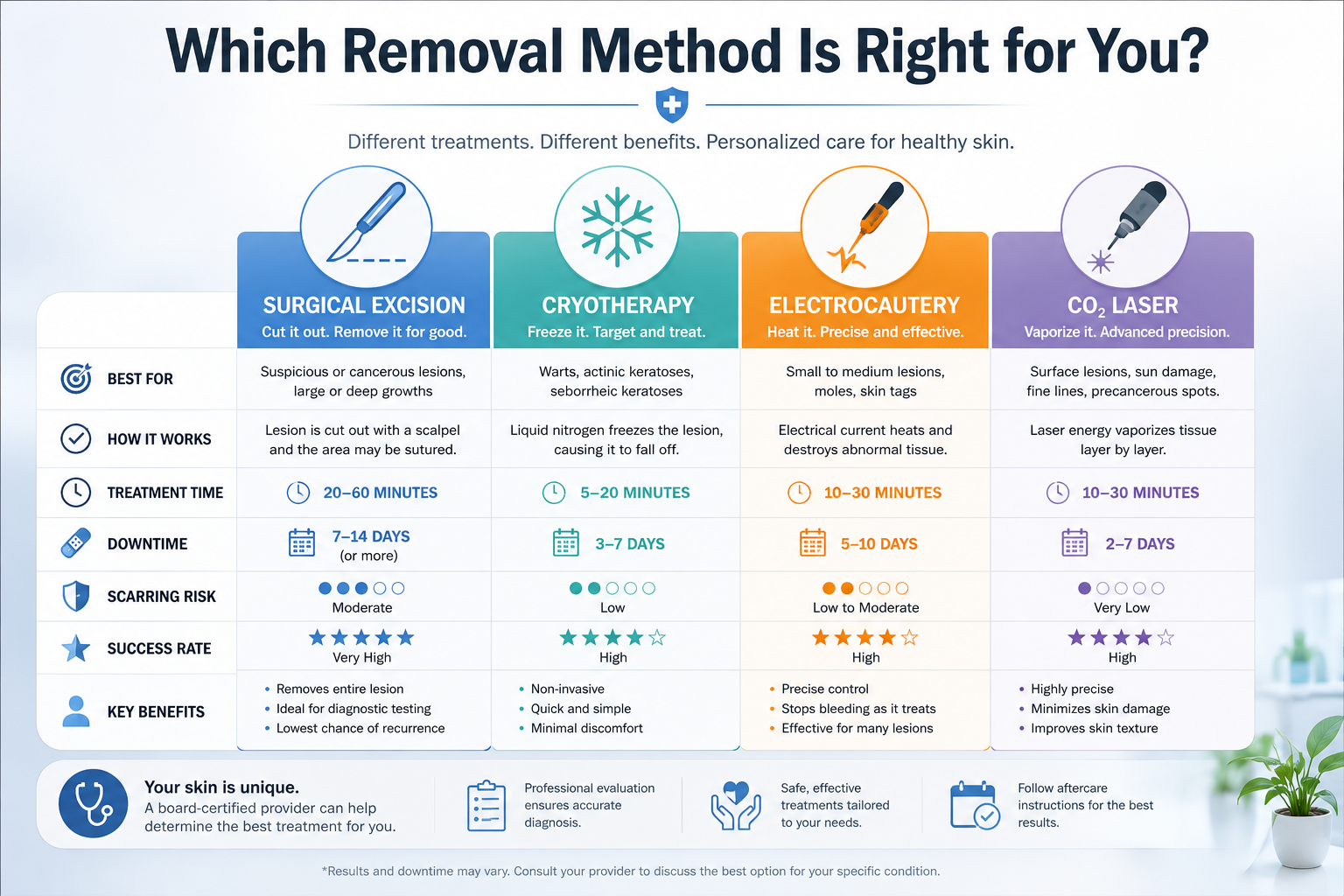
1. Surgical Snipping / Excision
A physician or trained clinician uses sterile scissors or a scalpel to cut the tag at its base after applying a topical or local anesthetic. Fast, definitive, and allows the tissue to be sent for pathology. Best for: larger tags, moles requiring biopsy, or any lesion where malignancy needs to be ruled out.
2. Electrocautery
An electrical current dries and destroys the tissue. Manas Med Spa (serving the Richmond Hill/Aurora corridor) describes this as a 10–30 minute in-office procedure with topical anesthetic and minimal downtime; the treated tag blackens and falls off within one to two weeks. [4] Best for: multiple small skin tags in a single session.
3. Cryotherapy (Liquid Nitrogen or Nitrous Oxide)
Extreme cold destroys the lesion. Beauty O'Clock, which serves Aurora, Newmarket, and Richmond Hill, uses high-pressure nitrous oxide cryotherapy and positions it as a "gold standard" for benign lesion destruction covering skin tags, angiomas, seborrheic keratoses, and warts — with no anesthesia required and the ability to treat multiple lesions in one visit. [5] Best for: patients who prefer no needles and have several small lesions.
4. CO₂ Laser
York Laser and MedSpa, which explicitly serves Newmarket, Aurora, and York Region, states that CO₂ laser removal is very safe, carries no risk of causing cancer, and delivers precise cosmetic outcomes. [8][2] Elegance Cosmetic Clinic (Toronto) notes that laser targets pigment cells while minimizing trauma to surrounding tissue, reducing scarring risk. [9] Best for: flat or pigmented lesions, facial tags where cosmetic precision matters.
Choose the method based on:
For a side-by-side breakdown, see the Skin Tag Removal Methods comparison guide.
Direct answer: For straightforward benign skin tags, several local Aurora/Newmarket clinics offer cryotherapy and electrocautery. For moles, atypical lesions, or anything requiring pathology, the two most recommended specialist options near this corridor are The Minor Surgery Center in Vaughan and Toronto Minor Surgery Center in North York, both operated by board-certified surgeons with high procedure volumes.
The Minor Surgery Center in Vaughan is a high-volume, physician-led clinic specializing in mole, cyst, skin tag, and lipoma removal. It sits along the Hwy 400 corridor, making it one of the most accessible specialist options for Aurora and Newmarket patients heading south. Key advantages:
The North York clinic is another strong option for York Region patients willing to travel slightly further. It offers the same physician-led model, pathology access, and specialist expertise for complex or atypical lesions that local med-spas are not equipped to manage.
Several clinics operate directly in the Aurora/Newmarket area:
Decision rule: Choose a local med-spa if you have confirmed benign skin tags and want a quick, affordable cosmetic fix. Choose The Minor Surgery Center (Vaughan or North York) if you have a mole, an atypical lesion, multiple growths, or any concern about malignancy.
For patients specifically looking for Newmarket-area services, the Newmarket Mole, Cyst & Skin Tag Removal page covers local availability and booking in detail.
Direct answer: Cosmetic skin tag and mole removal is almost never covered by OHIP, so patients pay out of pocket. Costs vary by method, number of lesions, and clinic type. Expect a range from roughly $75–$150 per session at med-spas for simple cryotherapy or electrocautery of one to three tags, up to $300–$600+ at physician-led clinics for surgical excision of moles with pathology.
Estimated cost ranges (2026, Ontario):
ProcedureTypical RangeNotesCryotherapy (1–3 tags)$75–$150No anesthesia, quick sessionElectrocautery (1–3 tags)$100–$200Topical anesthetic, 10–30 min [4]CO₂ Laser (1–3 lesions)$150–$350Higher precision, cosmetic focus [2]Surgical excision (1 mole)$250–$600+Includes local anesthetic, pathology extraPathology fee$50–$150Billed separately by lab
Note: These are estimates based on publicly available Ontario clinic pricing as of 2026. Actual costs depend on lesion count, size, and clinic. Use the Minor Surgery Cost Estimator for a personalized quote.
When OHIP may cover removal:
Common mistake: Assuming that because a GP refers you, OHIP will cover the removal. Referral does not automatically equal coverage. Confirm with the clinic before your appointment.
Direct answer: When performed by trained clinicians in a properly equipped facility, skin tag and benign mole removal is a low-risk procedure. The main risks are infection, scarring, pigment changes, and — most importantly — missing a malignant lesion if the tissue is not sent for pathology.
Regulatory context in Ontario (2026):
The College of Physicians and Surgeons of Ontario (CPSO) is actively tightening oversight of out-of-hospital premises (OHPs). Clinics performing higher-risk tissue removal or procedures under deeper sedation must meet detailed infection control, emergency preparedness, and documentation standards, with in-person inspections now routine rather than exceptional. [7] This regulatory tightening means patients should verify that their chosen clinic operates under proper CPSO oversight — not just as an unregulated aesthetic studio.
Practical risks by method:
Why DIY removal is a bad idea:
Elegance Cosmetic Clinic strongly warns against DIY skin tag removal because of infection risk, scarring, and the danger of assuming a lesion is benign without professional assessment. [9] Home kits using string ligation or over-the-counter freeze sprays are not equivalent to clinical cryotherapy and carry real complication risks.
Edge case — darker skin tones:
Cryotherapy and laser carry a higher risk of post-inflammatory hypopigmentation or hyperpigmentation in patients with Fitzpatrick skin types IV–VI. A physician-led consultation is especially important in these cases to choose the safest method.
For a broader look at when skin changes warrant cancer screening, the Skin Cancer screening guide provides useful context.
Direct answer: Preparation is minimal for most skin tag removals but slightly more involved for mole excisions. The main steps are: confirm the lesion type with a clinician, avoid blood thinners if instructed, and arrange post-procedure wound care supplies in advance.
What to expect on the day:
Direct answer: Recovery after simple skin tag removal is typically 24–48 hours of minor redness or tenderness. Mole excisions with sutures require 5–14 days of wound care and suture removal. Most patients return to normal daily activity the same day.
MethodImmediate EffectHealing TimeReturn to ActivityCryotherapyRedness, possible blister1–2 weeksSame dayElectrocauteryBlackened tag falls off1–2 weeks [4]Same dayCO₂ LaserRedness, crusting1–2 weeksSame day (avoid sun)Surgical ExcisionSutured wound5–14 days24–48 hours
Post-care essentials:
Common mistake: Stopping wound care too early. The healing process continues under the surface for weeks after the skin looks closed. Consistent moisturizing and sun protection for 6–12 weeks significantly improves the final cosmetic result.
Direct answer: Aurora and Newmarket sit in a well-served corridor of York Region. Patients have local options plus easy access to specialist clinics in Vaughan, North York, Markham, and Barrie. The main trade-off is between convenience (local med-spa) and clinical depth (specialist minor surgery center).
The Minor Surgery Center operates multiple locations across the GTA and surrounding areas. For Aurora and Newmarket patients, the most relevant locations are:
For patients further afield in the GTA, locations also exist in Brampton, Mississauga, and Oakville.
Why drive to a specialist instead of using a local clinic?
Direct answer: Before booking any skin lesion removal in Aurora, Newmarket, or nearby, ask five core questions to ensure you're choosing a safe, qualified provider.
Red flags to watch for:
For a full list of frequently asked questions about minor skin surgery, the Minor Skin Surgery FAQ covers costs, recovery, pathology, and more.
Q: Can a skin tag turn into cancer?
No. Skin tags (acrochordons) are always benign. They do not have malignant potential. However, what looks like a skin tag could occasionally be a different type of lesion, so professional assessment is worthwhile if you're unsure. [8]
Q: Does skin tag removal hurt?
Most methods involve minimal discomfort. Cryotherapy causes a brief stinging sensation. Electrocautery and surgical removal use topical or local anesthetic, so the procedure itself is typically pain-free, with mild soreness afterward for 24–48 hours. [4]
Q: How many skin tags can be removed in one session?
This depends on the method and clinic. Cryotherapy and electrocautery can treat multiple tags in a single session. Surgical excision of multiple moles may require more time and is sometimes split across visits. [5]
Q: Is mole removal covered by OHIP in Ontario?
Cosmetic mole removal is not covered. OHIP may cover removal if a mole is clinically suspicious for malignancy or causes a documented functional problem. Confirm coverage with your GP and the clinic before booking.
Q: How do I know if my mole needs to be removed urgently?
Use the ABCDE rule: asymmetry, irregular border, multiple colors, diameter over 6 mm, or any evolution (change) in the mole. If any of these apply, see a physician promptly rather than booking a cosmetic removal.
Q: Can I get skin tag removal done the same day as my consultation in Aurora?
Many clinics, including some local Aurora/Newmarket options and The Minor Surgery Center, offer combined consult-and-treat appointments for straightforward benign skin tags. For moles, a separate consultation is usually recommended first.
Q: What is the difference between a skin tag and a wart?
Skin tags are smooth, soft, and flesh-colored, hanging on a stalk. Warts are caused by HPV, feel rough or cauliflower-like, and are slightly contagious. Both can be treated with cryotherapy, but they require different clinical approaches.
Q: Are there any home remedies that actually work for skin tags?
Over-the-counter freeze kits and string ligation methods exist but are not recommended by dermatologists. They carry infection and scarring risks, and they don't allow for any assessment of whether the lesion is truly benign. [9]
Q: How long does it take to see final results after removal?
For cryotherapy and electrocautery, the treated area heals in one to two weeks. Surgical excision scars continue to fade for three to twelve months. Sun protection during healing significantly improves the final appearance.
Q: What if my removed mole comes back?
Incomplete removal can cause recurrence. Surgical excision with clear margins is the most definitive method. If a mole recurs after removal, return to the clinic promptly — recurrence in a previously atypical mole warrants re-excision and pathology review.
Q: Do I need a referral to visit The Minor Surgery Center in Vaughan or North York?
No. The Minor Surgery Center accepts self-referrals. Patients from Aurora and Newmarket can book directly without a GP referral, though having a GP's assessment of a suspicious mole is always helpful context for the surgeon.
Q: Is laser mole removal better than surgical excision?
Not necessarily. Laser is excellent for flat, pigmented, benign lesions where cosmetic precision is the priority. Surgical excision is better when pathology is needed, the mole is raised, or there is any clinical uncertainty about the lesion. [9]
Skin tag removal Aurora Ontario is accessible, affordable, and — when done correctly — very low risk. The key is matching the right method and provider to the specific lesion.
Here's how to move forward:
Ontario's regulatory environment for skin procedures is tightening in 2026, which is actually good news for patients: it means clinics are being held to higher standards of safety, documentation, and transparency. [7] Choosing a CPSO-compliant, physician-led facility is the single most important decision you can make when having any skin lesion removed.
[1] Skin Tag Removal - https://www.beyondskinderm.com/skin-tag-removal/
[2] Laser Skin Tag Removal - https://www.yorklasermedspa.com/laser-skin-tag-removal/
[4] Electrocautery Skin Tag Removal Richmond Hill Aurora Newmarket - https://manasmedspa.ca/electrocautery-skin-tag-removal-richmond-hill-aurora-newmarket/
[5] Moles And Skin Tags Removal Cryotherapy In Aurora Newmarket Richmond Hill And Near Me - https://beautyoclock.ca/pages/moles-and-skin-tags-removal-cryotherapy-in-aurora-newmarket-richmond-hill-and-near-me
[7] Cosmetic Surgery Regulation 2026 Tightening - https://www.tainoconsultants.com/blog/cosmetic-surgery-regulation-2026-tightening
[8] Skin Tags - https://www.yorklasermedspa.com/skin-tags/
[9] Moles And Skin Tags - https://elegancecosmeticclinic.ca/moles-and-skin-tags/