

Last updated: September 23, 2026
A lipoma on the stomach is a soft, slow-growing lump made of fat cells that sits under the skin of the abdomen or, less commonly, deeper within the abdominal wall or cavity. Most are benign, painless, and harmless, but a lipoma that grows quickly, feels firm, or causes pain should be checked by a doctor to rule out other soft-tissue masses or, rarely, a liposarcoma.
A lipoma is a benign tumor made of mature fat cells wrapped in a thin fibrous capsule. On the stomach, lipomas most often develop in the subcutaneous fat just beneath the skin, but they can also arise in deeper layers, including the preperitoneal space, the parietal peritoneum, the retroperitoneum, or even within the wall of the intestine or duodenum.[2][5][7][10][12][14]
Doctors don't fully understand what triggers a lipoma to form. What is known is that fat cells begin to multiply in a localized area and organize into a distinct, encapsulated mass rather than spreading through surrounding tissue the way cancer would. On the abdomen, this can create a few different clinical pictures:
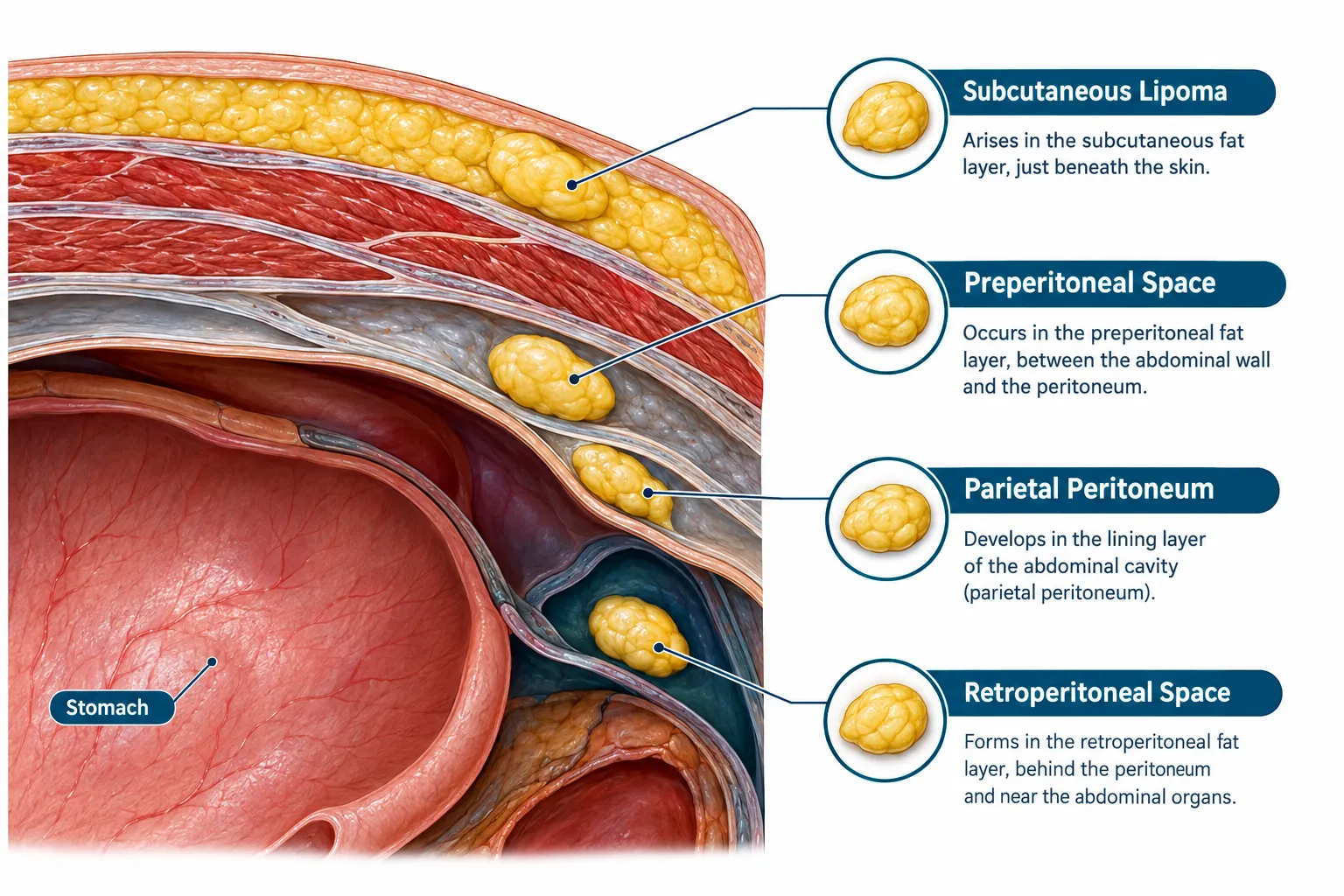
An anterior abdominal wall lipoma connected to the peritoneum is considered extremely rare and can look strikingly similar to a gynecologic mass on imaging, which sometimes leads to a misdiagnosis and unnecessary pelvic procedures before the true diagnosis is confirmed.[2] This is one reason accurate imaging and, when needed, a tissue sample matter before assuming any abdominal lump is "just fat."
Decision rule: if a lump on the stomach is soft, easily movable, and has been stable for months or years, a subcutaneous lipoma is the most likely explanation. If the lump feels deep, fixed, or is discovered incidentally on a scan for something else, it may be a preperitoneal or retroperitoneal lipoma that needs further workup.
The clearest signs of a lipoma on the stomach are a soft, round or oval lump that moves slightly when pressed, causes no pain, and has grown very slowly over months or years. Other abdominal lumps, such as cysts, hernias, or swollen lymph nodes, tend to feel firmer, be more tender, or change with position or activity.
A simple self-check can help narrow things down, though it should never replace a medical exam:
FeatureTypical lipomaPossible red flag for something elseTextureSoft, doughy, rubberyHard, firm, or rock-likeMovementSlides slightly under skin when pushedFixed in place, doesn't moveGrowth speedVery slow, over yearsNoticeable growth over weeks or a few monthsPainUsually painlessTender, throbbing, or painful to touchSkin changesSkin looks normal over the lumpRedness, warmth, ulceration, or discolorationSize change with positionStays the same lying down or standingBulges more when standing, straining, or coughing
Ultrasound is usually the first imaging test doctors order for a suspected abdominal lipoma because it is inexpensive and highly accurate for superficial masses. In one series of anterior abdominal wall lesions, ultrasound correctly identified subcutaneous lipoma features in 11 cases, and every one was later confirmed on tissue examination.[3] For deeper or unusually large masses, CT or MRI gives a clearer picture of size, location, and how close the mass sits to organs, muscles, or blood vessels.[5]
For a closer look at how clinicians tell lipomas apart from cysts, hernias, and other bumps, see this guide on differentiating lipomas from other soft tissue masses.
Common mistake: assuming any painless lump must be a harmless lipoma without ever having it examined. A firm, fixed, or fast-growing mass deserves a medical evaluation even if it doesn't hurt, since pain is not a reliable way to separate benign from concerning growths.
A lipoma is a fatty growth that sits within or under the tissue layers of the abdominal wall, while a hernia is a gap or weakness in the abdominal muscle that lets internal tissue, such as fat or a loop of intestine, push through. The two can feel similar at first touch, but they behave very differently.
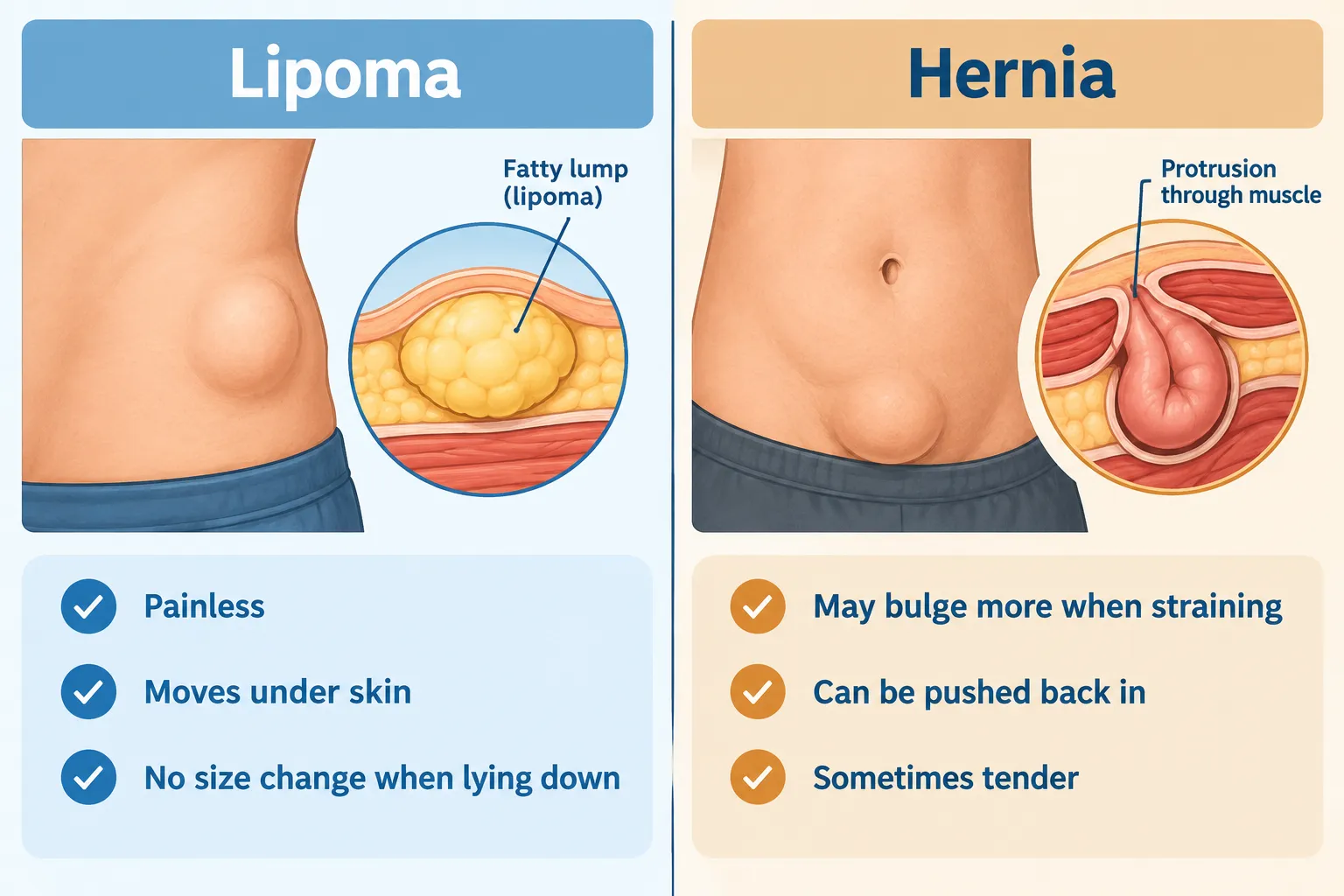
Key differences to check for:
Edge case: some preperitoneal lipomas sit right next to a small abdominal wall defect and can be mistaken for a hernia, or vice versa, because both create a soft bulge near the same muscle layer. When the diagnosis isn't obvious on physical exam, ultrasound or CT resolves the confusion before any procedure is planned.
Choose to see a doctor promptly if: the bulge becomes suddenly painful, red, or hard, or if nausea and vomiting develop alongside it. These are signs of a possible strangulated hernia, which is a medical emergency and unrelated to how a lipoma behaves.
Stomach lipomas are almost always benign and are not considered dangerous in the vast majority of cases. True malignant transformation of a lipoma into liposarcoma is very rare, but doctors still recommend evaluating any mass that grows quickly, feels firm, or exceeds about 5 centimeters, since these features can sometimes indicate a different, more serious soft-tissue tumor.
A 2025 case report in Frontiers in Surgery described a giant abdominal lipoma large enough to raise suspicion for liposarcoma until it was surgically removed and confirmed as benign fat tissue under the microscope.[1] This illustrates an important point: size alone can make a lipoma look concerning on imaging, but a definitive answer typically requires either a biopsy or full surgical removal followed by pathology review.
Situations that warrant closer attention include:
Painful lipomas are also more common than many people assume. A 2026 report described a painful subcutaneous lipoma on the abdominal wall as the actual cause of chronic right upper abdominal pain that had initially been blamed on the gallbladder or liver.[4] This case is a useful reminder that lipomas should be considered in the differential diagnosis of unexplained regional abdominal pain, not just dismissed because "lipomas don't hurt."
For a deeper look at when a fatty lump might need extra scrutiny, this article on whether a lipoma can turn into cancer and this related piece on whether lipomas can turn into cancer walk through the warning signs in more detail.
Choose to request imaging or a specialist referral if: the lipoma is painful, larger than a golf ball, growing steadily, or located deep rather than just under the skin. Choose routine monitoring if the lump has been stable, soft, and painless for over a year.
There is no single known cause of lipomas, but genetics, age, and certain metabolic factors appear to raise the likelihood of developing them. Most lipomas appear in adults between 40 and 60 years old, and having a family history of multiple lipomas increases personal risk significantly.
Contributing factors researchers and clinicians point to include:
This metabolic connection doesn't mean every lipoma signals a health problem, but it's a reasonable prompt to have routine blood pressure, cholesterol, and glucose checked if multiple lipomas appear, especially in combination with other risk factors like excess weight or a sedentary lifestyle.
Common mistake: assuming lipomas are caused by poor hygiene, diet, or lack of exercise. There's no solid evidence linking daily habits directly to lipoma formation, even though general metabolic health may play a supporting role.
Most lipomas grow very slowly, often taking years to become noticeably larger, and many stay the same size indefinitely. Left untreated, a typical small subcutaneous lipoma on the stomach usually causes no harm, but deeper or unusually large lipomas can eventually press on nearby structures or become difficult to remove cleanly.
What untreated lipomas can look like over time:
Edge case: a lipoma that seems stable for years can occasionally start growing again, particularly if hormonal changes, weight gain, or other metabolic shifts occur. Any change in growth pattern after a long period of stability is worth a follow-up exam.
Decision rule: leaving a small, stable, painless lipoma alone is a reasonable choice for many patients. Choose removal instead if the lipoma is growing, causing discomfort, restricting movement, or creating diagnostic uncertainty that only surgery and pathology can resolve.
A lipoma on the stomach becomes a genuine concern when it grows quickly, turns painful, feels hard or fixed in place, or is large enough to distort the shape of the abdomen. These features suggest it may not be a simple lipoma or that it has grown to a size where removal is more complicated.
Specific warning signs that call for prompt medical evaluation:
Quick example: a 45-year-old with a soft, pea-sized lump on the belly that hasn't changed in three years likely needs no urgent action beyond a routine check. A 60-year-old with a new, firm, tennis-ball-sized mass that's grown over two months needs imaging and likely a biopsy or excisional removal without delay.
If there's any doubt, a same-week appointment with a general practitioner, dermatologist, or general surgeon is the safest route. Many clinics that specialize in minor surgical procedures can also perform an in-office exam and, if appropriate, arrange imaging quickly; for example, patients in the Toronto area can review options at a dedicated mole, cyst, lipoma, and carpal tunnel surgery center that focuses on this type of evaluation and treatment.
There is no proven non-surgical method that reliably removes or shrinks a lipoma; surgical excision or liposuction-style extraction remains the only way to get rid of one completely. Creams, essential oils, supplements, and topical remedies marketed online for lipoma removal have no solid clinical evidence behind them.
Here's how the realistic options compare:
Diet and exercise deserve a direct answer too, since it's one of the most common questions people ask: changing what you eat or how much you work out will not shrink an existing lipoma. Weight loss can reduce overall body fat, but it does not target the encapsulated fat cells inside a lipoma the way it reduces regular fat stores. For a detailed breakdown of why this is the case, see this explainer on whether exercise or diet can shrink lipomas.
Home remedies also carry real risk. Attempting to squeeze, cut, or otherwise extract a lipoma at home can cause infection, scarring, and incomplete removal that makes a later professional procedure more difficult. This guide on the real dangers of DIY lipoma removal covers the specific complications that can occur. For a closer look at why over-the-counter creams don't work, this resource on whether a lipoma can be removed without surgery using creams is worth reading before trying any topical product.
Choose non-surgical monitoring if: the lipoma is small, painless, and not bothersome cosmetically. Choose a procedure if: it's growing, uncomfortable, affecting confidence, or if there's any uncertainty about the diagnosis that only pathology can settle.
Lipoma removal surgery on the stomach is usually a short outpatient procedure, taking roughly 15 to 45 minutes for a typical subcutaneous lump under local anesthesia, though deeper or giant lipomas can take one to a few hours under general anesthesia. Costs and risks scale mainly with the lipoma's size, depth, and location.
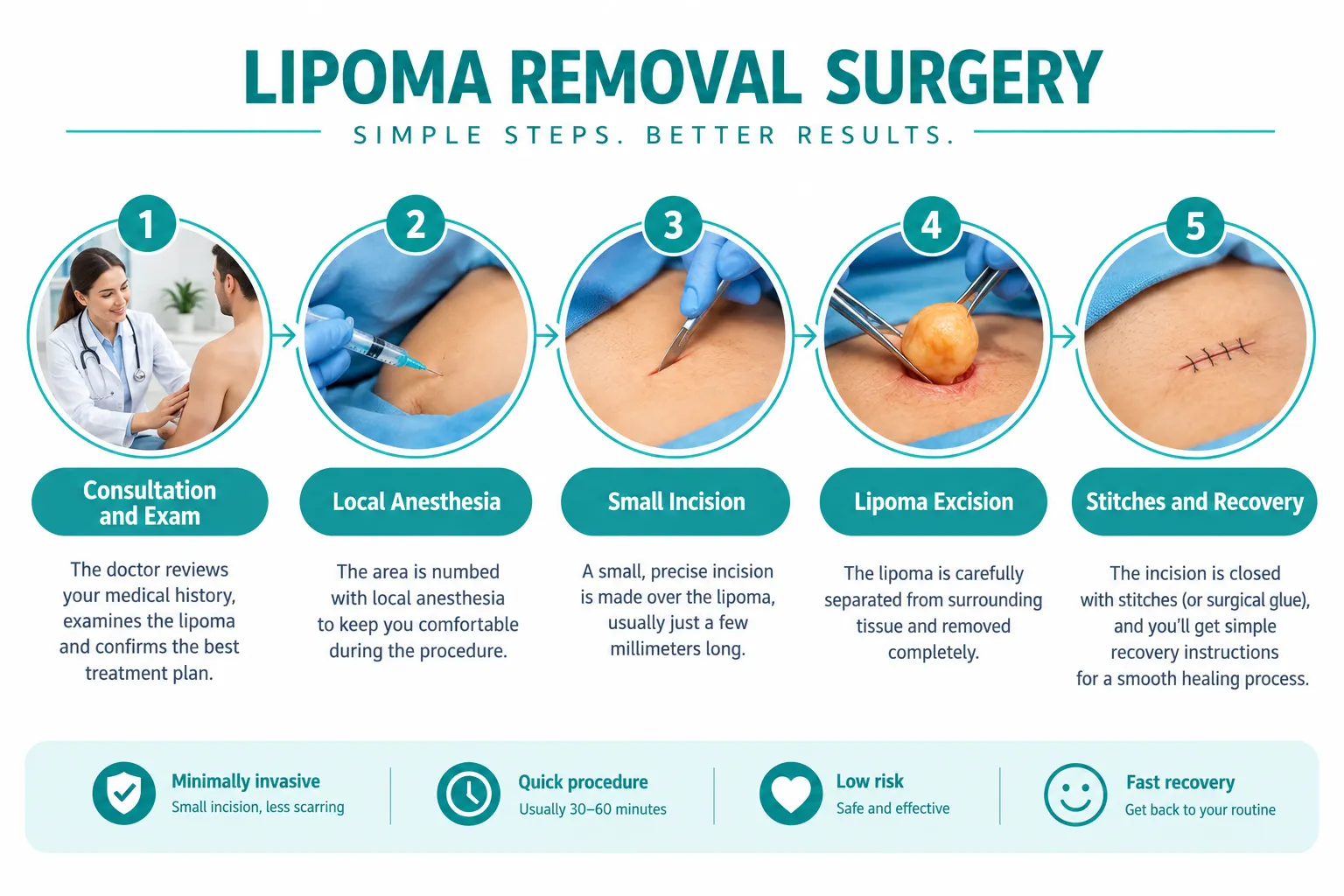
How long it takes
Recent case reports back up how well minimally invasive options work for many abdominal lipomas. A 2025 report described a giant parietal peritoneal lipoma removed laparoscopically with an uncomplicated recovery, and noted that only seven similar giant abdominal wall lipomas had ever been documented, with just one previously treated laparoscopically before this case.[6] A separate 2024 report on a pedunculated upper abdominal peritoneal lipoma causing intermittent pain also showed a smooth recovery after laparoscopic excision.[9] These findings point to a growing role for laparoscopic techniques even for larger or deeper stomach lipomas that once would have required a large open incision.
What it typically costs
Costs vary by clinic, region, lipoma size and depth, and whether local or general anesthesia is used. Simple in-office removal of a small subcutaneous lipoma tends to sit at the lower end of the cost range, while deep, laparoscopic, or hospital-based removal of a large lipoma costs considerably more due to operating room time, anesthesia, and any pathology fees. Patients researching options in a specific city can compare providers and general pricing structure through resources like this comparison of lipoma clinics in Toronto covering costs, surgeons, and techniques.
Risks and possible complications
A more complete breakdown of possible issues, including how often they occur and how they're managed, is covered in this guide on complications from lipoma removal. For patients weighing whether to see a skin specialist or a surgeon, this comparison of a dermatologist versus a general surgeon for lipoma removal explains which specialist typically handles which size and depth of lipoma. Photos and recovery timelines from actual patients can also be reviewed in this collection of before and after lipoma removal results.
Common mistake: assuming all stomach lipomas require the same type of surgery. A small superficial lump and a giant retroperitoneal mass are treated very differently, and matching the right technique to the right lipoma affects both recovery time and outcome.
A lipoma removed completely, capsule included, has a low chance of recurring in the exact same spot. Recurrence is more likely when the excision was incomplete, when the lipoma was unusually large or infiltrated into surrounding tissue, or when the person has a genetic tendency to form multiple lipomas over time.
Key points on recurrence:
Quick example: someone who has a 3-centimeter subcutaneous lipoma fully excised with its capsule under local anesthesia has a very low chance of it returning at that spot. Someone who had a large lipoma partially removed via liposuction for cosmetic reasons has a meaningfully higher chance of noticing a smaller lump reappear within a few years.
Anyone who develops several lipomas over their lifetime, whether on the stomach or elsewhere, may want to ask a doctor about family history and metabolic screening, given the documented association between multiple lipomas and metabolic syndrome features.[13] Patients dealing with lipomas in sensitive areas, such as the chest wall, may also find it useful to compare notes with resources on breast lipoma presentation and treatment, since the surgical principles are similar even though the location differs.
Is a lipoma on the stomach always just under the skin?
No. Most stomach lipomas are subcutaneous, but some form deeper in the preperitoneal space, the retroperitoneum, or even within the intestinal wall, which can make them harder to feel and require imaging to detect.[2][5][10]
Can a lipoma on the stomach cause pain?
Yes, though it's less common. Some subcutaneous lipomas press on nearby nerves and cause localized, chronic pain that can be mistaken for other conditions like gallbladder or liver problems.[4]
Do stomach lipomas show up on a normal physical exam?
Superficial lipomas are usually easy to feel during a physical exam. Deeper ones, including preperitoneal or retroperitoneal lipomas, often need ultrasound, CT, or MRI to confirm and characterize them.[3][5]
Is surgery the only way to remove a stomach lipoma?
Yes, for complete removal. Steroid injections may shrink a lipoma slightly, but surgical excision or liposuction-style extraction are the only approaches that can eliminate it, and excision has the lowest recurrence rate.
How big can a stomach lipoma get if left alone?
Most stay small, but rare cases have reached extreme sizes; one documented retroperitoneal lipoma measured 53 by 36 by 9 centimeters and filled most of the abdominal and pelvic cavity before removal.[5]
Does having a lipoma mean something is wrong with metabolism?
Not necessarily, but a 2025 study found people with lipomas had higher rates of metabolic syndrome features like high blood pressure and abnormal blood sugar compared with people without lipomas, so it can be a reasonable prompt for a general health check.[13]
Can a lipoma inside the intestine cause a blockage?
It's rare, but intestinal or diffuse lipomatosis of the small bowel has caused torsion and obstruction in documented cases, so unexplained bowel symptoms alongside a known lipoma should be evaluated promptly.[7]
How soon can someone return to normal activity after lipoma removal?
Recovery from a small, superficial lipoma removal is typically quick, often within a few days for light activity. Deeper or laparoscopic procedures for larger lipomas usually require a longer recovery period, sometimes one to two weeks before resuming strenuous activity.
Should every stomach lump be biopsied?
Not every lump needs a biopsy, but any lump that's growing, firm, painful, or unusual for the person's age should be evaluated by a doctor who can decide whether imaging, biopsy, or full excision with pathology review is appropriate.
A lipoma on the stomach is, in the great majority of cases, a benign, slow-growing fatty lump that doesn't require urgent treatment. The exceptions matter, though: lipomas that grow fast, feel firm, sit deep in the abdominal wall, or cause pain deserve a proper exam and, often, imaging to rule out other soft-tissue masses or the rare case of liposarcoma.
For anyone noticing a new lump on the belly, the practical next steps are straightforward. Track any changes in size, firmness, or discomfort over a few weeks. Book an appointment with a general practitioner, dermatologist, or general surgeon for a hands-on exam rather than relying on self-diagnosis. Ask about ultrasound if the lump feels deep or the diagnosis is unclear. If removal is recommended, discuss which technique, whether simple excision, laparoscopic removal, or another approach, fits the size and location of the specific lipoma. Skipping home remedies and DIY extraction avoids unnecessary infection risk and gives the best chance of a clean, low-recurrence result.
[1] Full - https://www.frontiersin.org/journals/surgery/articles/10.3389/fsurg.2025.1639098/full
[2] Crmi 1024 - https://anncrmi.org/articles/CRMI-1024.html
[3] Dda6682db54d9e4ad8c1559aedb7ec54 - https://iasj.rdd.edu.iq/journals/uploads/2025/08/20/dda6682db54d9e4ad8c1559aedb7ec54.pdf
[4] Pmc12906697 - https://pmc.ncbi.nlm.nih.gov/articles/PMC12906697/
[5] pubmed.ncbi.nlm.nih.gov - https://pubmed.ncbi.nlm.nih.gov/39663128/
[6] pubmed.ncbi.nlm.nih.gov - https://pubmed.ncbi.nlm.nih.gov/41458744/
[7] amjcaserep - https://amjcaserep.com/abstract/full/idArt/942527
[8] pubmed.ncbi.nlm.nih.gov - https://pubmed.ncbi.nlm.nih.gov/38854315/
[9] d-nb.info - https://d-nb.info/1333435789/34
[10] Duodenal Lipoma A Case Report - https://www.onlinescientificresearch.com/journals/jcir/articles/duodenal-lipoma-a-case-report.html