
Last updated: November 10, 2026
This article is for education only and is not medical advice. If you notice any new change in your breast or nipple, see a family doctor.
A nipple turning inward after childbirth is more common than most people expect, and most of the time it is not dangerous. Still, the difference between "normal postpartum change" and "something to get checked" matters, and it comes down to timing, symmetry, and whether other changes show up alongside it.
Nipples can flatten or invert after pregnancy, breastfeeding, weight loss or with age as breast tissue and ducts change. Long-standing inversion on both sides is usually harmless, but a nipple that newly turns inward, especially on one side, or with a lump, dimpling, or discharge, needs a doctor's check first. Treatment options range from suction devices to minor surgery.
A nipple that has recently turned inward, particularly on just one side, can sometimes signal breast cancer or another breast condition and should be checked by a family doctor before anyone considers cosmetic treatment. This is the single most important thing to know before reading further.
Long-standing inversion that has been present since puberty, affects both breasts, and hasn't changed recently is usually benign and not linked to cancer [1][2]. What changes the picture is newness and asymmetry.
See a doctor promptly if your nipple:
Not every new change is cancer. Mastitis and breast abscess can cause swelling and nipple retraction along with redness, fever, and pain, and usually need antibiotics or drainage [1]. Duct ectasia, a benign widening of milk ducts common closer to menopause, can also pull a nipple inward and sometimes causes thick discharge [1][3]. A family doctor can sort out which cause fits your situation, often with an exam and, if needed, imaging.
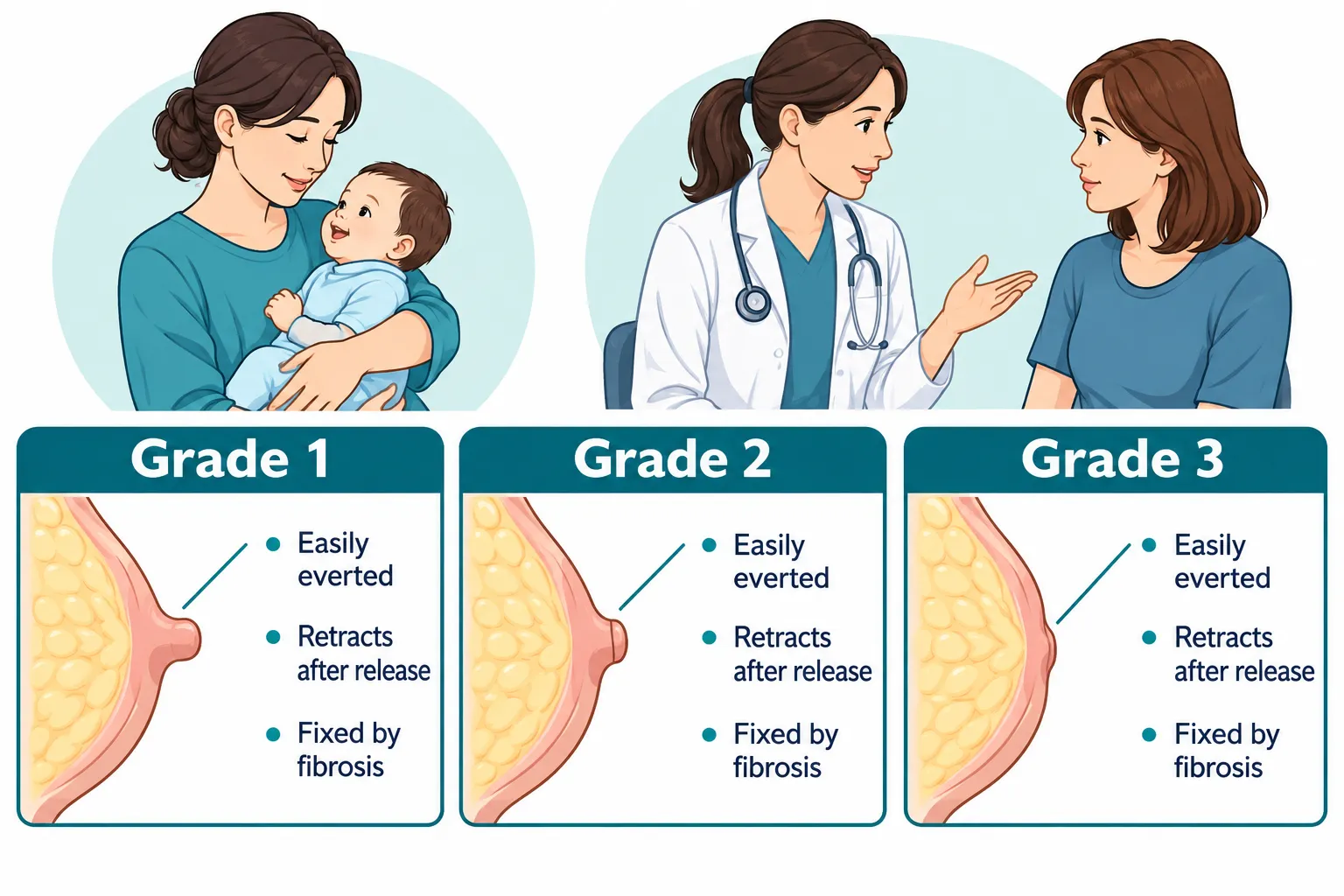
An inverted nipple points inward instead of outward, and clinicians grade it by how easily it can be pulled back out and how much it affects duct function. Roughly 10%,20% of the general population has some degree of nipple inversion, though estimates vary by study and definition [2].
GradeAppearanceCan it be pulled out?Breastfeeding impactGrade 1Mild inversion, looks nearly normalYes, easily, and stays outDucts generally unaffected; breastfeeding usually fineGrade 2Moderate inversionYes, but retracts againPossible, but latch may be harderGrade 3Severe, fixed inversionUsually not, due to scar-like fibrosisBreastfeeding may be very difficult
Source: StatPearls/NCBI grading system [2].
Pregnancy hormones and breast tissue growth can flatten or pull a nipple inward simply because the breast is filling, swelling, and reshaping itself. Cleveland Clinic notes this is a recognized pregnancy-related change, and many people can still breastfeed through it [1].
Engorgement is a big piece of this. When breasts become very full and swollen, the areola and nipple can stretch flat, sometimes almost overnight, this is part of why some people describe a nipple that "inverted suddenly" in the first days after birth. The American College of Obstetricians and Gynecologists notes severe engorgement can stretch and flatten the nipple, areolar complex, and that excessive pumping during this edema phase can make swelling worse rather than better [per research]. Reverse-pressure softening, gently pressing inward and back from the nipple base before latching, can temporarily move fluid away and make the nipple easier to grasp.
Frequent pumping itself is sometimes blamed for inversion, but there isn't solid evidence that normal pumping causes new, permanent inversion in someone with previously typical nipples. If pumping suction feels unusually strong or painful, check the flange size and fit with a lactation consultant rather than assuming it's "causing" inversion.
Weight loss, menopause, and general ageing can all change the fat and connective tissue that normally hold a nipple projected outward, leading to flattening or inversion over time. This is different from the pregnancy pathway but works on similar tissue.
Gradual, symmetric changes over months to years tied to one of these life stages are usually not urgent. A nipple that flips inward over a few days to weeks, out of step with any clear hormonal shift, deserves a doctor's look.
Yes, many people with inverted or flat nipples can breastfeed successfully, because a baby latches onto the areola and surrounding breast tissue, not just the nipple tip. La Leche League International stresses that a deep latch onto a good portion of the areola is what matters most for milk transfer, which is why nipple shape alone rarely predicts success [1][3].

Helpful approaches include:
A lactation consultant or your local public health breastfeeding clinic can watch a feed and troubleshoot latch issues specific to your anatomy, this is often more useful than any single trick.
Sometimes, yes, inversion caused by pregnancy swelling or breastfeeding-related changes can resolve on its own once hormones settle and weaning is complete, but there's no fixed timeline and it does not happen for everyone. Mild (Grade 1) inversion is more likely to improve than Grade 3, which involves tighter fibrous bands holding the nipple in [2].
For some, the nipple stays flat or inverted permanently after breastfeeding ends, and that is also a normal outcome, not a medical problem by itself. If it bothers you cosmetically or functionally (for example, a future pregnancy), non-surgical tools or correction surgery are both reasonable paths to discuss with a doctor, there's no pressure to "fix" it if it doesn't bother you.
Non-surgical tools can temporarily draw a nipple outward, and some people use them for comfort, breastfeeding prep, or everyday appearance, though evidence on lasting correction is limited. Common options:
Nipple shells vs. nipple shields: shells are worn between feeds to train the nipple outward over time; shields are worn during the feed itself to help the baby latch. They solve different problems and many breastfeeding parents use both at different stages.
If you've ruled out other causes with your doctor, you might also read about related breast changes like a skin tag on the nipple, which is a separate, usually harmless issue.
Inverted nipple correction is a minor outpatient surgery that releases the tight tissue holding the nipple inward so it can sit projected permanently. The Minor Surgery Center (TMSC) performs this procedure under local anesthetic, and patients go home the same day.
Good candidates are generally adults who have finished the acute postpartum period (or are not planning to breastfeed soon), who have a doctor-confirmed benign cause of inversion, and who are bothered by the appearance or hygiene of the inverted nipple. People with an unexplained new or one-sided inversion should be medically cleared first, before any cosmetic procedure.
Surgical techniques generally fall into two categories: duct-preserving, which tries to keep the milk ducts intact, and duct-dividing, which cuts the ducts to release the nipple more fully. A June 2026 systematic review and meta-analysis of breastfeeding after nipple-repair surgery reported a pooled breastfeeding success estimate of 83.59% (95% CI 75.60%,89.33%) [per research], which is encouraging but is not a guarantee tied to any one technique. Ask your surgeon directly which approach they plan to use and how it may affect future breastfeeding before booking surgery.
Because this is performed under local anesthetic in an outpatient setting, there's no hospital stay required. Specific recovery timelines and outcomes vary by individual and technique, so discuss expected healing with your surgeon at consultation rather than relying on generic timelines. For general context on healing after minor procedures, see when to consider seeing a plastic surgeon for a minor procedure.
Inverted nipple correction starts at $2,000 at TMSC and is a private-pay cosmetic procedure, not covered by OHIP in most cases. OHIP generally covers procedures considered medically necessary, and purely cosmetic corrections typically fall outside that definition, with coverage depending on documented medical necessity rather than personal preference.
Is inverted nipple surgery worth it? For many people bothered by appearance, hygiene, or breastfeeding difficulty tied to severe inversion, the one-time cost and short outpatient visit can feel worthwhile compared to years of managing the issue with devices. It's a personal decision best made after a free consultation where a surgeon reviews your specific grade of inversion and goals.
For a broader look at what's publicly insured versus private-pay in Ontario, see OHIP vs. private clinic for minor surgery, and for tax planning, is minor surgery tax-deductible in Canada.
TMSC operates five GTA clinics, Toronto/North York, York Mills, Vaughan, Mississauga, and Oakville, see our clinics for locations. No referral is needed, and surgeries are performed by board-certified plastic and reconstructive surgeons, co-founders Dr. Kunaal Jindal and Dr. Roberto Tutino.
See a family doctor if inversion is new, one-sided, or paired with a lump, dimpling, discharge, redness, or pain, as outlined in the callout box above [1][2]. Also see a doctor if you're unsure whether your inversion is benign before pursuing any cosmetic correction, or if breastfeeding difficulty persists despite trying shells, shields, or lactation support, a consultant or doctor can rule out mastitis, duct issues, or latch problems that have nothing to do with nipple shape.
Is it normal for nipples to invert after breastfeeding?
Yes. Breast tissue, ducts, and skin elasticity change during and after breastfeeding, and flattening or inversion is a recognized, usually harmless outcome [1][2].
Can an inverted nipple be a sign of breast cancer?
A nipple that newly inverts, especially on one side or with a lump, dimpling, or discharge, can be a sign of breast cancer and should be checked promptly. Long-standing inversion on both sides is usually not cancer-related [1][2].
Will my nipple go back to normal after breastfeeding?
It might, especially with mild (Grade 1) inversion, but there's no guaranteed timeline and some people have lasting flattening after weaning [2].
Can I breastfeed after inverted nipple surgery?
Many people can, and a review found pooled breastfeeding success around 83.59% after nipple-repair surgery, but this depends on the surgical technique used and whether milk ducts are preserved [per research]. Ask your surgeon directly.
How much does inverted nipple surgery cost in Ontario?
At TMSC, inverted nipple correction starts at $2,000 as a private-pay procedure.
Is inverted nipple surgery covered by OHIP?
Generally no. OHIP typically covers medically necessary procedures, and cosmetic nipple correction usually doesn't meet that bar unless there's a documented medical reason.
Most inverted nipples after pregnancy, breastfeeding, weight loss, or menopause are a normal part of how breast tissue changes over a lifetime, and they're rarely dangerous. The exception is a nipple that turns inward suddenly, on one side, or alongside a lump, dimpling, discharge, or redness, that always deserves a doctor's visit first. From there, options range from simple shells and shields to considering correction surgery if the change bothers you and other causes have been ruled out.
If your doctor has ruled out other causes and you'd like to discuss correction, call (647) 614-1611 or book a free consultation at The Minor Surgery Center, no referral needed.