

Last updated: September 23, 2026
A cyst on the buttocks is typically a fluid-filled sac that forms under the skin, most often an epidermoid cyst from a blocked hair follicle or a pilonidal cyst near the tailbone. Most are harmless and shrink or drain on their own, but red, swollen, or painful cysts can become infected abscesses that need medical drainage. See a doctor if a buttock cyst grows quickly, oozes pus, causes fever, or keeps coming back in the same spot.
Most buttock cysts form when a hair follicle or skin pore becomes blocked, trapping dead skin cells, oil, or hair fragments under the surface. In the specific case of pilonidal cysts, loose hair works its way into the skin near the tailbone and triggers an inflammatory reaction that builds a sac or tunnel.
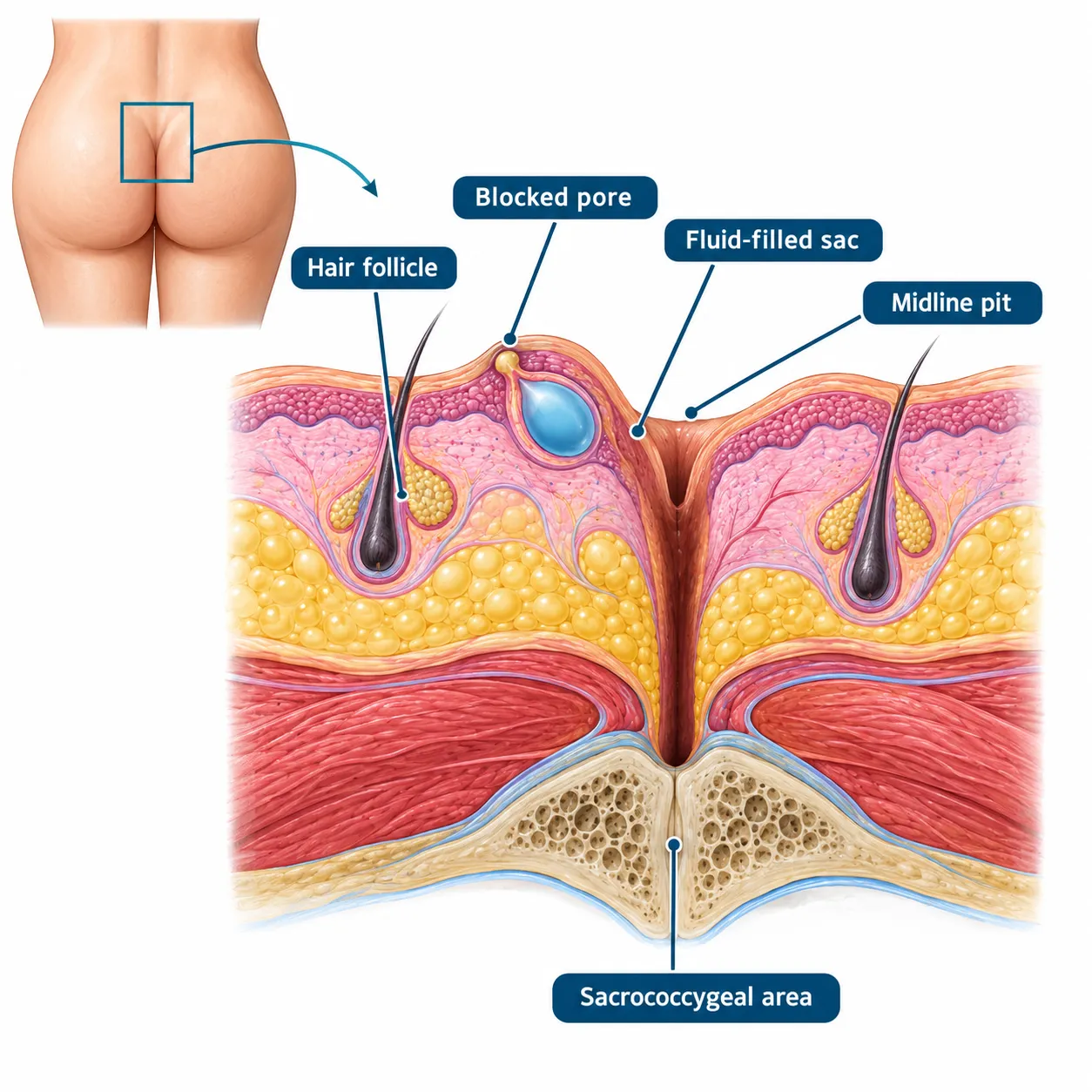
Several factors make cyst formation on the buttocks more likely:
A common mistake is assuming every bump on the buttocks is acne or a pimple. Acne cysts tend to be smaller and clustered, while a true epidermoid or pilonidal cyst is usually a single, firm lump that grows slowly over weeks or months.
Most cysts on the buttocks are benign and not dangerous on their own, but they can become a health concern if they get infected, grow large, or sit near the tailbone where pilonidal disease develops. Danger comes less from the cyst itself and more from complications like abscess formation, spreading infection, or chronic non-healing sinus tracts.
Signs that a buttock cyst needs prompt attention rather than a wait-and-see approach:
Decision rule: choose urgent care or an emergency visit if a buttock cyst is combined with fever above 38°C (100.4°F), rapidly spreading redness, or an inability to sit without severe pain. Choose a routine doctor visit if the cyst is firm, mobile, and not painful, but has been present for more than two to three weeks.
True cancerous transformation of a long-standing buttock cyst is rare, but chronic pilonidal sinus tracts that go untreated for years have occasionally been linked to skin changes, which is one more reason recurrent cysts should not be ignored indefinitely.
A cyst on the buttocks is a slow-growing sac with a defined wall, usually painless until it gets irritated, while a boil (furuncle) is an acute bacterial infection of a hair follicle that develops fast and is tender from the start. Boils tend to come to a head with a visible pus-filled tip within days, whereas cysts can sit unchanged for weeks.
FeatureCyst on the ButtocksBoil (Furuncle)OnsetSlow, over weeks or monthsFast, over 1 to 3 daysPainUsually painless unless inflamedTender and throbbing from early onTextureFirm, round, mobile under skinSoft center, red firm borderCauseBlocked follicle or trapped hair (pilonidal)Bacterial infection of a single follicleTypical resolutionExcision if it does not resolveDrains and heals within 1 to 2 weeks
Choose to treat a lump as a boil if it appeared suddenly, is extremely tender, and has a visible white or yellow center. Choose to treat it as a cyst if it has been present for weeks, feels like a smooth movable ball, and only recently became sore. For a deeper breakdown of overlapping features, this comparison of boils versus cysts and this guide on cysts versus abscesses cover the visual and clinical differences in more detail.
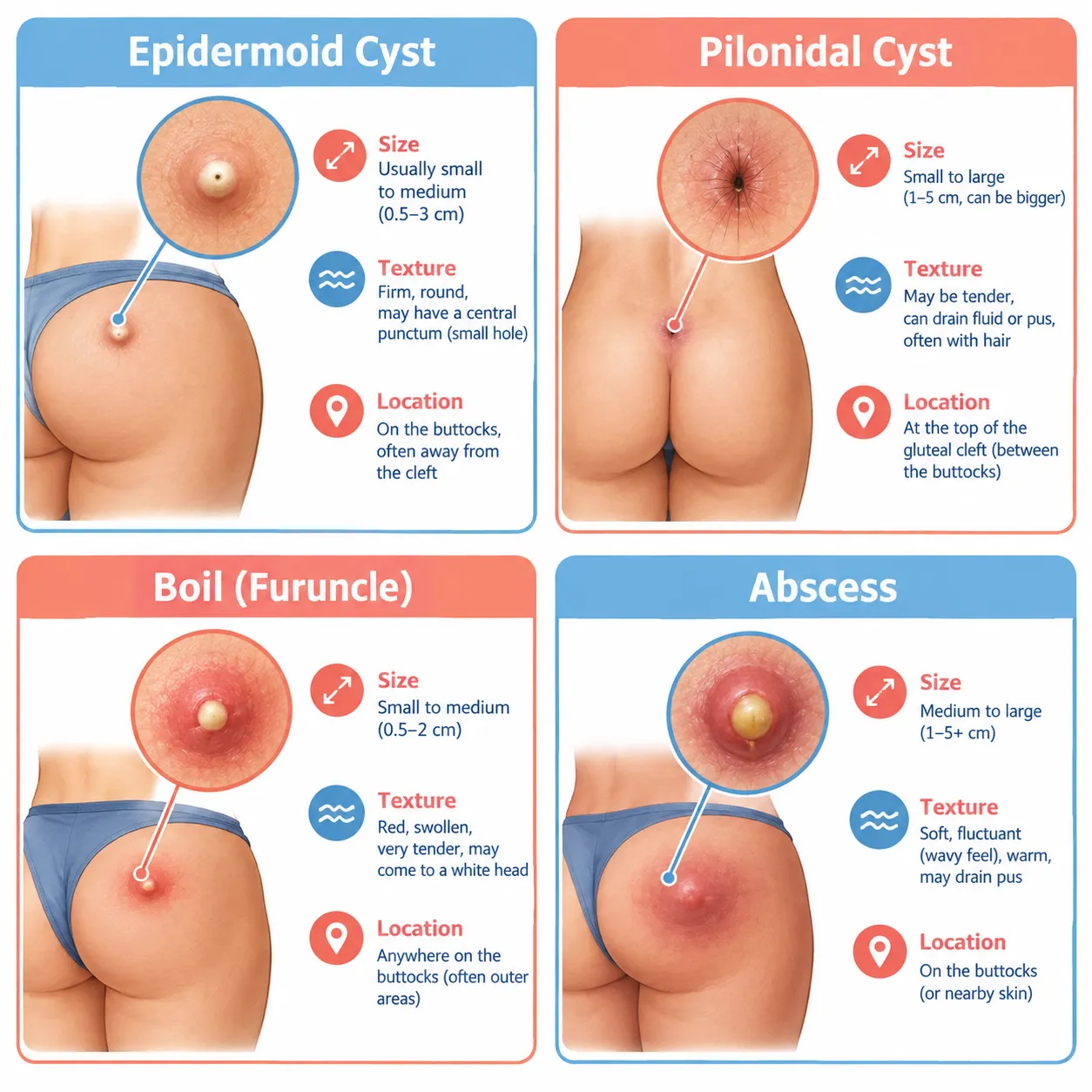
No, not every cyst on the buttocks is a pilonidal cyst, but pilonidal disease is the most common specific type found in this location. A pilonidal cyst forms in the midline skin fold just above the tailbone, while other buttock cysts (epidermoid or sebaceous-type) can appear anywhere on the buttock cheeks, further from the gluteal cleft.
Key distinguishing features of pilonidal cysts:
A cyst located higher on the buttock cheek, away from the cleft, is more likely a standard epidermoid cyst related to a blocked follicle rather than pilonidal disease. The distinction matters because treatment approaches differ: pilonidal disease often needs hair-focused prevention strategies and specific surgical techniques, while a simple epidermoid cyst usually just needs excision of the sac. For more on how cyst behavior changes based on where it forms on the body, see this overview of cyst location challenges.
A small, non-inflamed cyst on the buttocks can sometimes shrink or resolve without treatment, but an infected or pilonidal cyst rarely goes away permanently without drainage or excision. Even when a cyst appears to disappear, the sac wall or sinus tract often remains under the skin and can refill later.
What tends to happen without treatment:
Cyst TypeLikely Outcome Without TreatmentSmall, painless epidermoid cystMay stay stable for months or slowly shrinkInflamed but not infected cystOften becomes more tender and enlargesInfected cyst or abscessTypically worsens, rarely resolves alonePilonidal cyst with a pitProne to recurrent flare-ups over time
Edge case: a cyst that ruptures on its own and drains fluid may look like it resolved, but if the surrounding sac lining stays in place, the cyst commonly refills within weeks to months. This is why complete removal of the sac wall, not just drainage of fluid, is the step that actually prevents recurrence, a principle explained further in this guide on why removing the entire cyst sac matters.
An infected buttock cyst usually looks red, swollen, and shiny over the surface, feels warm to the touch, and is noticeably more painful than a simple cyst. Pus may leak from a central opening, and the surrounding skin can look tight or angry compared to the rest of the buttock.
Visual and physical signs of infection:
Common mistake: assuming a draining cyst is "healing" simply because pressure has been relieved. Drainage often brings temporary relief from pain, but the infection and the underlying sac can still be present, meaning the area needs a proper medical evaluation rather than being left alone. Incision and drainage performed by a clinician is strongly recommended for an acute pilonidal abscess, and routine antibiotics are generally reserved for cases with spreading skin infection (cellulitis) or systemic symptoms like fever.[1][5]
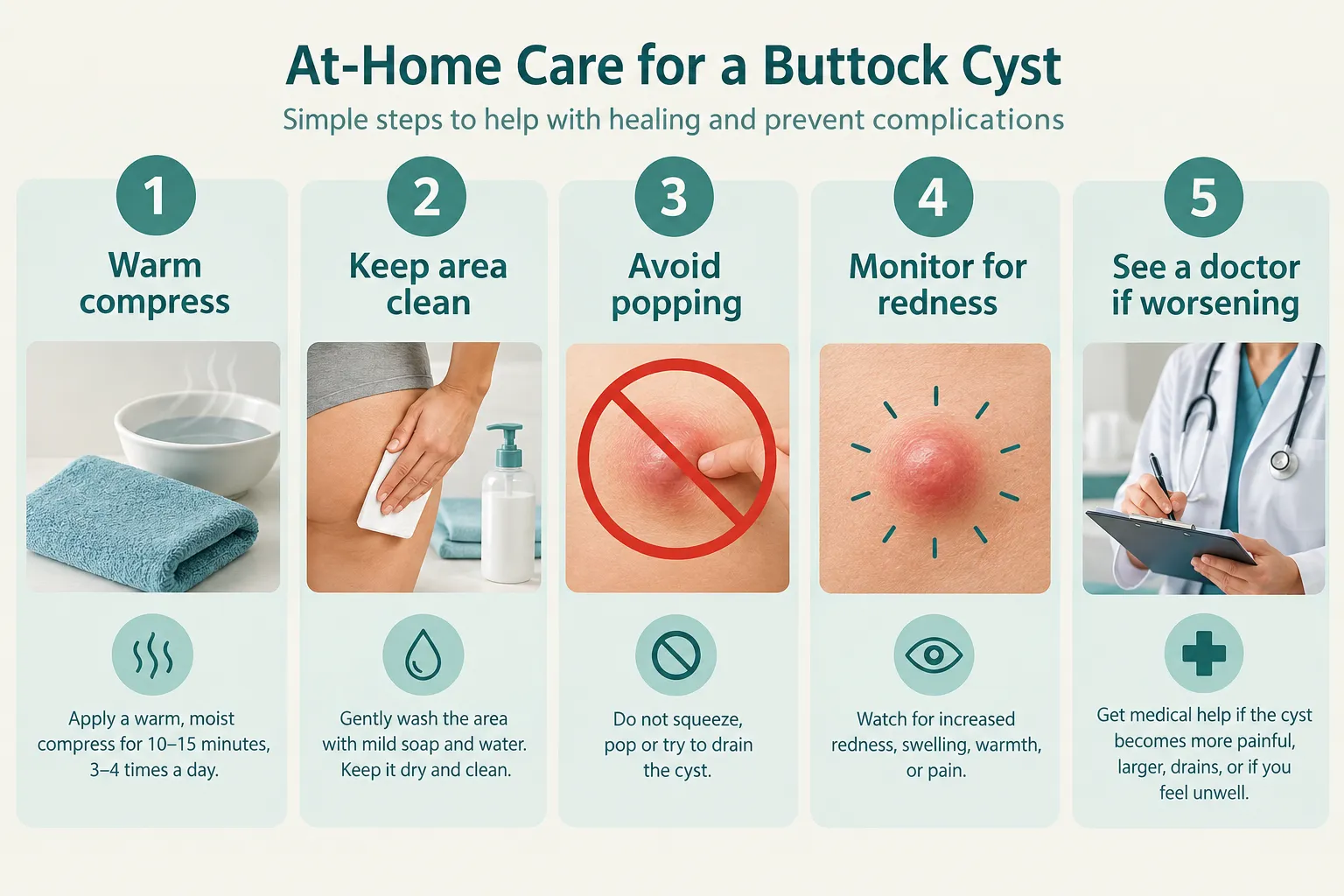
Home care is appropriate only for small, non-infected cysts on the buttocks that are not rapidly growing or draining pus. The goal of home treatment is to reduce irritation and support natural drainage, not to remove the cyst permanently.
Reasonable home-care steps for a mild buttock cyst:
Pros and cons of home management:
Pros
Cons
Decision rule: try home care for up to one week if the cyst is small, painless, and not growing. Stop home care and see a clinician sooner if pain increases, redness spreads, or drainage becomes thick or foul-smelling.
Popping a cyst on the buttocks at home is not recommended because it increases the risk of infection, scarring, and incomplete removal of the cyst sac, which usually leads to the cyst coming back. Even when fluid drains successfully, the wall of the cyst typically remains under the skin.
Reasons to avoid self-popping:
Quick example: a person who repeatedly squeezes a buttock cyst over several weeks may notice temporary relief each time, but the lump returns larger and more inflamed with each cycle, eventually requiring more extensive treatment than if it had been evaluated early. If a cyst has already ruptured on its own, the safest response is to cover it with a clean dressing and arrange a medical evaluation rather than continuing to manipulate it.
Getting rid of a buttock cyst permanently generally requires a medical procedure that either drains an active infection or removes the entire cyst sac, since home care alone rarely eliminates the underlying capsule. The right approach depends on whether the cyst is currently infected, chronic, or tied to pilonidal disease.
Common medical treatment options:
Choose incision and drainage if there is an active, painful abscess needing immediate relief. Choose excision or a flap procedure if the cyst or sinus tract keeps recurring despite prior drainage. Choose phenol or fibrin glue-based approaches if the disease is chronic but not currently infected and a less invasive option is preferred.[1][3]
See a doctor about a buttock cyst if it grows quickly, becomes painful, leaks pus, causes fever, or has recurred more than once in the same location. Waiting too long on an infected cyst often means a more extensive procedure is needed than if it had been treated early.
Clear triggers for a medical visit:
Edge case: a cyst that seems to be shrinking but leaves behind a persistent small opening or dimple in the skin should still be checked, since this pattern is typical of a pilonidal sinus tract that can flare again later.
Family doctors and general practitioners can evaluate and manage most simple buttock cysts, while general surgeons, colorectal surgeons, or dermatologists typically handle drainage, excision, or recurrent pilonidal disease. The right specialist depends on the cyst's complexity and location.
Decision rule: start with a family doctor for a new, uncomplicated cyst. Go directly to urgent care if there are signs of a spreading infection or fever. Ask for a referral to a general or colorectal surgeon if a pilonidal cyst has recurred, or if a prior drainage procedure did not fully resolve the problem. Clinics that specialize in minor skin procedures, including sebaceous cyst removal, can also be a practical option for straightforward excisions.
The cost to remove a cyst on the buttocks depends on whether the procedure is a simple in-clinic excision or a more complex surgical repair for recurrent pilonidal disease, along with the clinic, region, and whether the visit is covered by public or private insurance. Costs vary widely by location and cannot be reliably generalized as a single number without a source-specific estimate.
Factors that influence total cost:
For readers in Ontario, Canada specifically, a detailed breakdown of typical price ranges and what affects them is covered in this dedicated guide on cyst removal cost in Ontario. It is worth requesting a clear quote before any procedure, since recurrent or complex pilonidal cases that need off-midline flap closure generally cost more than a single straightforward excision.[1]
Healing time for a buttock cyst ranges from about one to two weeks for a simple drained cyst to several weeks or longer for surgical excision or flap repair of chronic pilonidal disease. Location near the buttock crease and constant pressure from sitting can slow healing compared to cysts elsewhere on the body.
Typical healing timelines:
Treatment TypeApproximate Healing TimeSimple incision and drainage1 to 2 weeks for the wound to closeExcision of a small epidermoid cyst2 to 3 weeks for surface healingPit-picking or EPSiT procedure2 to 4 weeks, often with faster return to activityPhenol treatment for pilonidal diseaseVariable; several weeks with repeat applications possible[1][3]Off-midline flap closure (Karydakis, Limberg)4 to 6 weeks or more, given the larger wound area[1]
Decision rule: expect a shorter recovery if the procedure is limited to drainage or a small excision away from the gluteal cleft. Expect a longer recovery if the cyst required a flap closure or if it is a recurrent pilonidal case with prior scar tissue. A general overview of what affects healing speed after any cyst procedure is available in this guide on cyst removal recovery time.
Recurrent cysts on the buttocks are most often caused by ongoing hair follicle blockage, incomplete removal of a prior cyst sac, or unmanaged risk factors like excess gluteal hair, friction, and moisture. Pilonidal disease in particular has a well-known tendency to recur if the underlying causes are not addressed.
Reasons cysts keep coming back:
The most consistently supported prevention strategy across current pilonidal guidance is regular hair removal in and around the gluteal cleft. Both a 2025 Egyptian national guideline and American Society of Colon and Rectal Surgeons guidance highlight this as a practical way to reduce recurrence.[1][4][8] Laser hair removal is generally favored over shaving for long-term prevention, since shaving has been associated with higher recurrence rates in guidance from Scottish NHS sources.[12] For cysts unrelated to hair, addressing chronic friction (loose clothing, cushioned seating, moisture control) can reduce the chance of new cysts forming in the same general area.
Is a cyst on the buttocks the same as a pimple?
No. A pimple is a small, short-lived blockage of a skin pore, usually resolving within days, while a cyst on the buttocks is a deeper, longer-lasting sac that can persist for weeks or months without treatment.
Can a buttock cyst turn into cancer?
Cancer developing from a simple buttock cyst is rare. Long-standing, untreated pilonidal sinus tracts have occasionally been linked to skin changes over many years, which is one reason chronic cysts should be evaluated rather than ignored indefinitely.
Does a pilonidal cyst always need surgery?
Not always. Mild, non-infected pilonidal disease can sometimes be managed with phenol application, fibrin glue, or pit-picking procedures, while active abscesses generally need incision and drainage first.[1][3]
Is it normal for a buttock cyst to hurt when sitting?
Yes, pain with sitting is common, especially for cysts near the tailbone or in the gluteal cleft, since sitting puts direct pressure on the area. Persistent pain that worsens over days should be evaluated.
Can shaving cause a cyst on the buttocks?
Shaving can contribute to ingrown hairs and pilonidal cyst formation by pushing hair fragments beneath the skin. Guidance from Scottish NHS sources notes that shaving has been associated with recurrence of pilonidal disease, and laser hair removal is often preferred for long-term prevention.[12]
Will antibiotics alone get rid of a buttock cyst?
Usually not. Antibiotics are generally reserved for cases with spreading skin infection or systemic symptoms like fever, while the cyst or abscess itself typically needs drainage or excision to resolve fully.[1][5]
How do I know if my buttock lump is a cyst or a swollen lymph node?
A cyst is usually located just under the skin and feels like a smooth, mobile ball, while a swollen lymph node is often deeper and linked to a broader infection or illness. A closer comparison of features is available in this guide on cysts versus lymph nodes.
Can a buttock cyst come back after surgical removal?
Yes, especially with pilonidal disease treated by midline closure, which carries a higher recurrence rate than off-midline flap techniques like Karydakis or Limberg closure.[1][5]
Is it safe to exercise with a cyst on the buttocks?
Light activity is usually fine for a small, non-infected cyst, but high-friction or high-sweat exercise can irritate the area. Avoid activities that put direct pressure on an inflamed or draining cyst until it is evaluated.
A cyst on the buttocks is common, usually manageable, and rarely a medical emergency, but it is also not something to permanently ignore, especially near the tailbone where pilonidal disease tends to recur. The safest path is simple: watch small, painless cysts for a short period, apply basic home care like warm compresses and clean dressings, and avoid popping or squeezing the lump. Seek medical care promptly if there is rapid growth, spreading redness, pus, fever, or repeated recurrence in the same spot.
For anyone dealing with a persistent or recurring buttock cyst, the next practical step is a proper clinical evaluation rather than another round of home remedies. A clinician can confirm whether the lump is a simple epidermoid cyst, a pilonidal cyst, or something else entirely, and can recommend the treatment level that matches the actual severity, from simple drainage to a definitive excision that removes the full sac and lowers the chance of it ever coming back.
[1] View - https://lms.ehc.gov.eg/lms/mod/book/view.php?id=658
[3] View - https://lms.ehc.gov.eg/lms/mod/book/view.php?id=658&chapterid=4230&lang=ar
[4] Repview - https://www.ascrsu.com/ascrs/repview?type=784-166&name=2_2851067_PDF
[5] Index - https://lms.ehc.gov.eg/lms/mod/book/tool/print/index.php?id=658
[8] Repview - https://www.ascrsu.com/ascrs/repview?type=784-159&name=2_2851067_PDF
[12] Scottish NHS guidance on pilonidal disease hair removal - referenced within national pilonidal disease clinical guidance