
Last updated: May 12, 2026
Quick Answer: You should get a mole checked if it is new, changing, bleeding, itching, crusting, painful, irregular in shape, uneven in colour, larger than 6 mm, or noticeably different from your other moles. Even if the mole has been present for years, new changes should be professionally assessed. When in doubt, book an appointment — early detection saves lives.
Get a mole checked immediately if it is new, changing, bleeding, itching, crusting, or painful. Also seek assessment if a mole is asymmetrical, has an irregular border, contains multiple colours, is larger than 6 mm, or simply looks different from your other moles. You do not need to wait until a mole looks dramatically abnormal — early assessment is always the safer choice.
Skin cancer is one of the most common cancers diagnosed worldwide, and melanoma — its most dangerous form — is far more treatable when caught early. The challenge is that many people are unsure whether a mole warrants a professional opinion or whether they are overreacting. The answer is straightforward: if a mole has changed in any way, or if it concerns you, get it checked [7].
Understanding when should you get a mole checked does not require medical training. It requires knowing what to look for and being willing to act on what you find.

The ABCDE rule is a clinically recognised framework that helps identify moles with features associated with melanoma. Each letter represents a specific characteristic to look for during a self-examination. Dermatologists and skin cancer charities consistently recommend this checklist as a starting point for assessing mole risk [1].
A normal mole is typically symmetrical — if you drew a line through the middle, both halves would roughly match. A mole that is asymmetrical, where one half looks different from the other, is worth investigating. Melanomas often grow unevenly, producing an irregular, lopsided shape [1][10].
Benign moles generally have smooth, well-defined edges. A mole with ragged, notched, blurred, or irregular borders is a warning sign. The edges of early melanomas tend to be uneven, sometimes described as having a scalloped or poorly defined outline [1][8].
Most harmless moles are a single, consistent shade of brown or tan. A mole that contains multiple shades — including different browns, blacks, reds, whites, or blues — should be assessed. Uneven colour distribution within a single lesion is one of the more reliable visual indicators of concern [1][5].
Any mole larger than 6 mm (roughly the size of a pencil eraser) should be examined by a professional. That said, diameter alone is not a definitive indicator. Melanomas can and do appear at smaller sizes, so a small mole that meets other ABCDE criteria still warrants attention [6][10].
According to Houston Methodist, Dr. Allenson emphasises that "evolving" is the most important ABCDE sign — because most moles simply stay the same over time [3]. Any change in a mole's size, shape, colour, or texture is a red flag. This includes a mole that starts bleeding, itching, or crusting when it previously did not. Change is the key word here: a mole that has looked the same for decades but suddenly begins to shift should be professionally assessed without delay [3][7].
Beyond the ABCDE criteria, several other changes signal that a mole needs professional evaluation. These signs are sometimes overlooked because they feel minor, but they can be early indicators of a problem.
An itchy mole is not always serious — skin can itch for many reasons, including dryness or irritation. However, a mole that itches persistently, especially without an obvious external cause, should be checked. Itching can indicate cellular changes within the lesion [7][8].
A mole that bleeds without being scratched or injured is a significant warning sign. Spontaneous bleeding from a mole suggests abnormal blood vessel activity and should be assessed promptly. Even if the bleeding stops quickly, do not dismiss it [7].
A mole that develops a crust, scab, or oozes fluid — and does not heal as expected — warrants attention. This type of surface change can indicate that the lesion is behaving abnormally [5][8].
Moles are generally painless. A mole that becomes tender or painful, even intermittently, is worth having examined. Pain in a pigmented lesion is not a common benign finding [7].
A mole that visibly grows over a short period — weeks rather than years — should be assessed urgently. While some benign lesions can enlarge slowly over time, rapid growth is a feature that dermatologists take seriously [8].
A mole that suddenly becomes much darker, or develops a new dark patch within it, is a concern. Darkening can reflect increased melanin production, which may be associated with abnormal cell activity [5].
A mole that was previously flat and becomes raised, or develops a lump within it, should be checked. Changes in surface texture or the development of a nodule within an existing mole are recognised warning signs [8].
The Ugly Duckling Sign is a complementary tool to the ABCDE rule. The concept is simple: a mole that looks noticeably different from all your other moles — even if it does not clearly meet ABCDE criteria — deserves attention. Most people's moles share a general family resemblance in size, shape, and colour. A mole that stands out as the "odd one out" may be worth investigating, as this approach can catch melanomas that do not fit the classic description.
Not every new mole that appears in adulthood is cancerous, but new moles in adults — particularly those over 30 — should be assessed if they look unusual or behave differently from existing moles. Most people develop the majority of their moles during childhood and early adulthood. New moles appearing later in life are less common and therefore merit closer attention [6].
A new mole that is small, evenly coloured, and symmetrical is less likely to be concerning. However, a new mole in an adult that is asymmetrical, multi-coloured, or growing quickly should be seen by a dermatologist. The threshold for seeking assessment should be lower as you get older, particularly if you have other risk factors.
Common question: Should I get a new mole checked as an adult?
Yes — especially if it appears after age 30, looks different from your other moles, or changes within weeks of appearing.
Change is the critical factor, not age. A mole that has been stable for 20 years can still become problematic, and any new change — however subtle — is a reason to seek professional assessment [3][7].
Many people make the mistake of assuming that a long-standing mole is automatically safe. This is not the case. Melanoma can develop within an existing mole at any point. If a mole you have had for years suddenly starts to look different, itch, bleed, or grow, treat it as a new concern and book an appointment.
Key point: The history of a mole matters less than its current behaviour. A changing mole — regardless of how long it has been present — should be assessed.
Some people face a higher baseline risk of developing melanoma and should consider more frequent professional skin checks, not just self-examinations. Risk is not evenly distributed, and understanding where you sit can help you decide how proactive to be.
Risk FactorWhy It MattersFair skin, light eyes, red or blonde hairLess melanin means less natural UV protectionHistory of sunburn, especially blistering burnsUV damage accumulates and increases lifetime riskFamily history of melanomaGenetic predisposition increases personal riskPersonal history of skin cancerPrevious diagnosis raises risk of recurrence or new lesionsLarge number of moles (50+)More moles means more opportunities for abnormal changeAtypical or dysplastic molesIrregular moles carry higher malignant potentialSignificant occupational or recreational sun exposureCumulative UV exposure is a primary risk driverImmunosuppressionReduced immune surveillance increases cancer riskUse of tanning bedsUV radiation from artificial sources raises melanoma risk
It is also worth noting that melanoma presentation can vary significantly across skin tones. Research has highlighted that acral lentiginous melanoma — a subtype that commonly appears on the palms, soles, or under nails — disproportionately affects people with darker skin and is associated with higher mortality rates in Black patients compared to White patients, despite similar disease severity at diagnosis. This underscores the importance of awareness and access to professional checks across all skin tones.
A 2026 Swedish study also demonstrated that AI tools can identify individuals at high risk of melanoma using routine health data, with some flagged individuals having up to a 33% chance of developing melanoma within five years — a development that may eventually change how risk stratification and screening are approached.
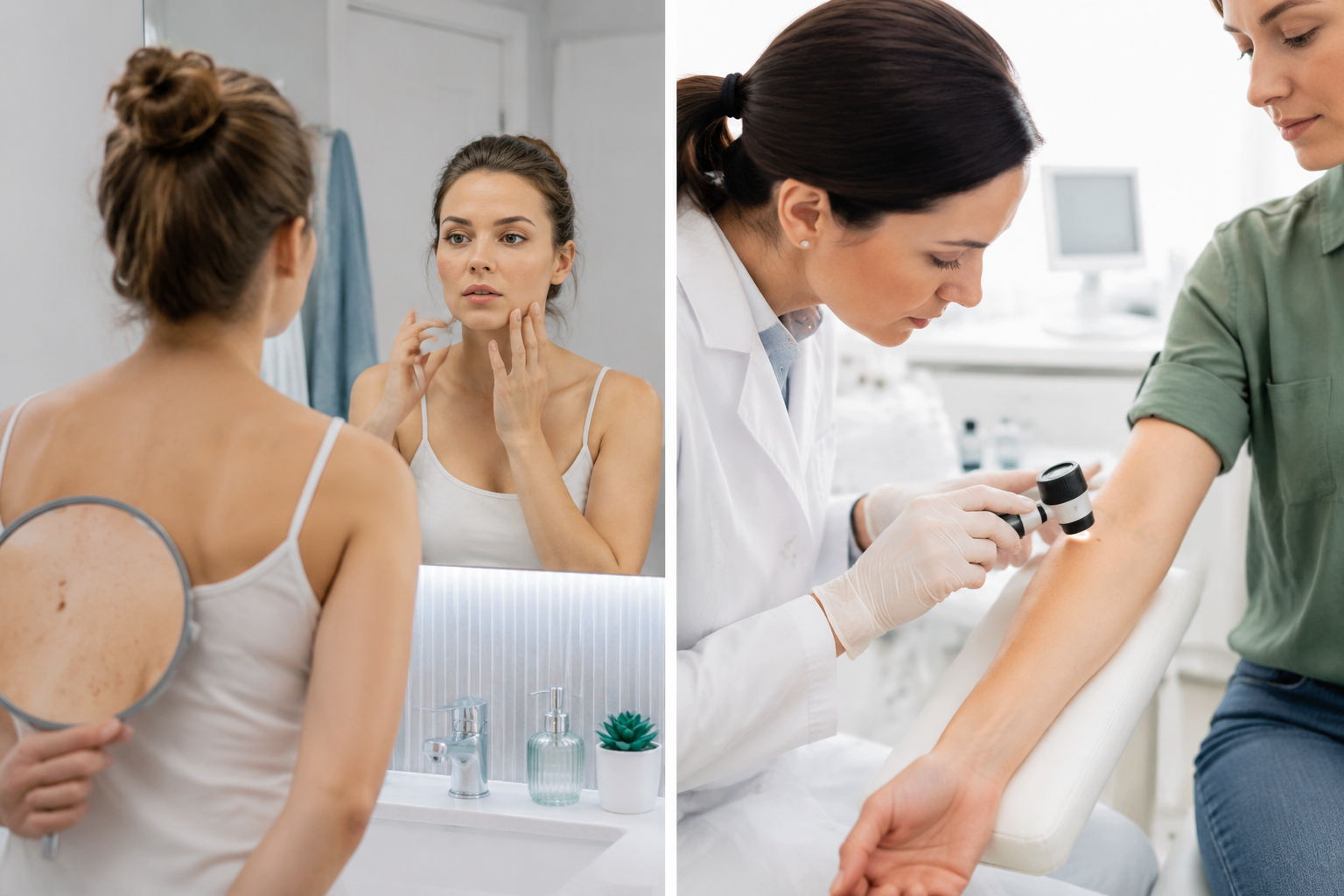
A professional mole check by an experienced dermatologist using dermoscopy is significantly more accurate than either a self-examination or a naked-eye assessment alone. Research published in JAMA Dermatology found that experienced dermatologists using dermoscopy achieved 85.7% sensitivity and 81.3% specificity for melanoma detection, compared to 49.5% sensitivity among primary care physicians — making dermatologists 13.3 times more likely to accurately diagnose melanoma using dermoscopic images.
Dermoscopy — the use of a handheld magnifying device with polarised light — allows clinicians to examine the subsurface structure of a mole in detail that is simply not visible to the naked eye. PMC research has shown that dermoscopy performed by trained clinicians improved melanoma identification accuracy from an odds ratio of 16 with naked-eye examination to 76 with dermoscopy, a nearly fivefold improvement.
AI-assisted skin analysis tools are also advancing rapidly. A 2026 accuracy report from Skinive found that AI-powered skin analysis achieved 97.4% sensitivity and 94.2% overall accuracy in skin image analysis. Across 11 prospective studies including more than 2,500 participants, AI and dermatologists demonstrated comparable diagnostic performance for melanoma detection. These tools are increasingly used as a triage aid, but they do not replace a clinical assessment.
A May 2026 case study documented a 21-year-old patient with aggressive melanoma that appeared harmless and was initially missed — a reminder that even experienced clinicians can face diagnostic challenges, and that persistence in seeking assessment matters when something feels wrong.
A mole check appointment is straightforward, non-invasive, and typically brief. Knowing what to expect can make the process feel less daunting and encourage people to book rather than delay.
Here is what generally happens during a professional mole check:
Most mole checks result in reassurance. The process is quick, and the peace of mind it provides is considerable. If a problem is found, catching it early dramatically improves treatment outcomes.
Regular self-examination is a valuable habit, but it works best as a complement to professional checks — not a replacement for them. Research has shown that regular self-skin examinations can decrease the depth of melanomas at the time of diagnosis and facilitate lower risk when combined with regular professional visits [2].

The Cleveland Clinic recommends performing a skin self-exam monthly, ideally at the same time each month so changes are easier to detect [2].
Common mistake: Checking only the areas most exposed to the sun. Melanoma can develop on areas that rarely see sunlight, including the scalp, soles, palms, and genitals.
When should I get a mole checked?
Get a mole checked if it is new, changing, bleeding, itching, crusting, painful, asymmetrical, multi-coloured, larger than 6 mm, or simply looks different from your other moles. When in doubt, book an appointment — there is no downside to getting a benign mole confirmed as safe.
Should I worry if a mole changes colour?
Yes. A mole that changes colour — especially one that develops multiple shades, darkens suddenly, or gains red, white, or blue tones — should be assessed by a dermatologist. Colour change is one of the recognised ABCDE warning signs of melanoma [1].
Should I worry if a mole is itchy?
Persistent itching in a mole is worth investigating, particularly if there is no obvious external cause such as dry skin or irritation. An itchy mole that also shows other changes should be seen promptly [7].
Should I worry if a mole is bleeding?
Yes. A mole that bleeds spontaneously — without being scratched or injured — is a significant warning sign and should be assessed as soon as possible [7].
Is a raised mole dangerous?
Not necessarily. Many raised moles are benign. However, a mole that was previously flat and becomes raised, or develops a new lump within it, is a change that warrants professional assessment [8].
Can a small mole be cancerous?
Yes. While the ABCDE rule uses 6 mm as a diameter guideline, melanomas can and do appear at smaller sizes. A mole that is small but asymmetrical, multi-coloured, or changing should still be checked [6][10].
Can melanoma be smaller than 6 mm?
Yes. The 6 mm guideline is a useful rule of thumb, not an absolute threshold. Early-stage melanomas are often smaller, which is precisely why other ABCDE criteria and the Ugly Duckling Sign are important alongside diameter [6].
Is it normal for moles to change over time?
Minor changes over many years can be normal, particularly in younger people. However, noticeable changes over weeks or months — in colour, shape, size, or texture — are not typical and should be assessed [3].
Should I get a new mole checked as an adult?
Yes, particularly if you are over 30 and the mole looks unusual or is growing. New moles in adulthood are less common and warrant closer attention than moles that appeared in childhood [6].
What does it mean if a mole looks different from my other moles?
This is known as the Ugly Duckling Sign — a mole that stands out from the rest of your moles may warrant assessment even if it does not clearly meet ABCDE criteria. It is a recognised complementary tool for identifying suspicious lesions.
Understanding when should you get a mole checked — and acting on that knowledge — is one of the most straightforward steps a person can take to protect their health. The warning signs are well established: asymmetry, irregular borders, multiple colours, a diameter over 6 mm, and any form of change. Beyond the ABCDE rule, bleeding, itching, crusting, pain, rapid growth, and the Ugly Duckling Sign are all reasons to seek a professional opinion.
The key message is simple: change matters more than appearance. A mole that has been present for decades but suddenly starts behaving differently deserves the same attention as a brand-new suspicious lesion.
If something about a mole concerns you, that concern is reason enough to book an appointment. A professional assessment takes minutes. The reassurance — or the early diagnosis — is worth every second.
[1] Melanoma Warning Signs And Images - https://www.skincancer.org/skin-cancer-information/melanoma/melanoma-warning-signs-and-images/
[2] 8648 Skin Self Exam - https://my.clevelandclinic.org/health/diagnostics/8648-skin-self-exam
[3] What Skin Cancer Looks Like When To See A Doctor - https://www.houstonmethodist.org/blog/articles/2026/jan/what-skin-cancer-looks-like-when-to-see-a-doctor/
[5] Early Signs Of Skin Cancer What To Look For - https://www.advanceddermatologypc.com/blog/early-signs-of-skin-cancer-what-to-look-for/
[6] NBK572149 - https://www.ncbi.nlm.nih.gov/books/NBK572149/
[7] When To Contact Your Doctor - https://www.aimatmelanoma.org/melanoma-101/early-detection-of-melanoma/when-to-contact-your-doctor/
[8] Melanoma Awareness Month Recognizing Early Warning Signs - https://www.longhornderm.com/melanoma-awareness-month-recognizing-early-warning-signs/
[10] Know When To Visit A Dermatologist The ABCDE Rule Explained - https://renotahoederm.com/know-when-to-visit-a-dermatologist-the-abcde-rule-explained/