
Imagine discovering a soft, movable lump beneath your skin during your morning shower. Your heart races as you wonder: Is this cancer? For millions of people each year, this scenario leads to the discovery of a lipoma—a common, benign fatty growth that's often confused with other types of fatty tumors. Understanding the difference between a lipoma vs fatty tumor can mean the difference between unnecessary anxiety and informed peace of mind.
While the terms "lipoma" and "fatty tumor" are often used interchangeably in everyday conversation, there are important distinctions that matter for your health. This comprehensive guide will walk you through everything you need to know about these soft tissue growths, from identification and diagnosis to treatment options and when to seek medical attention.
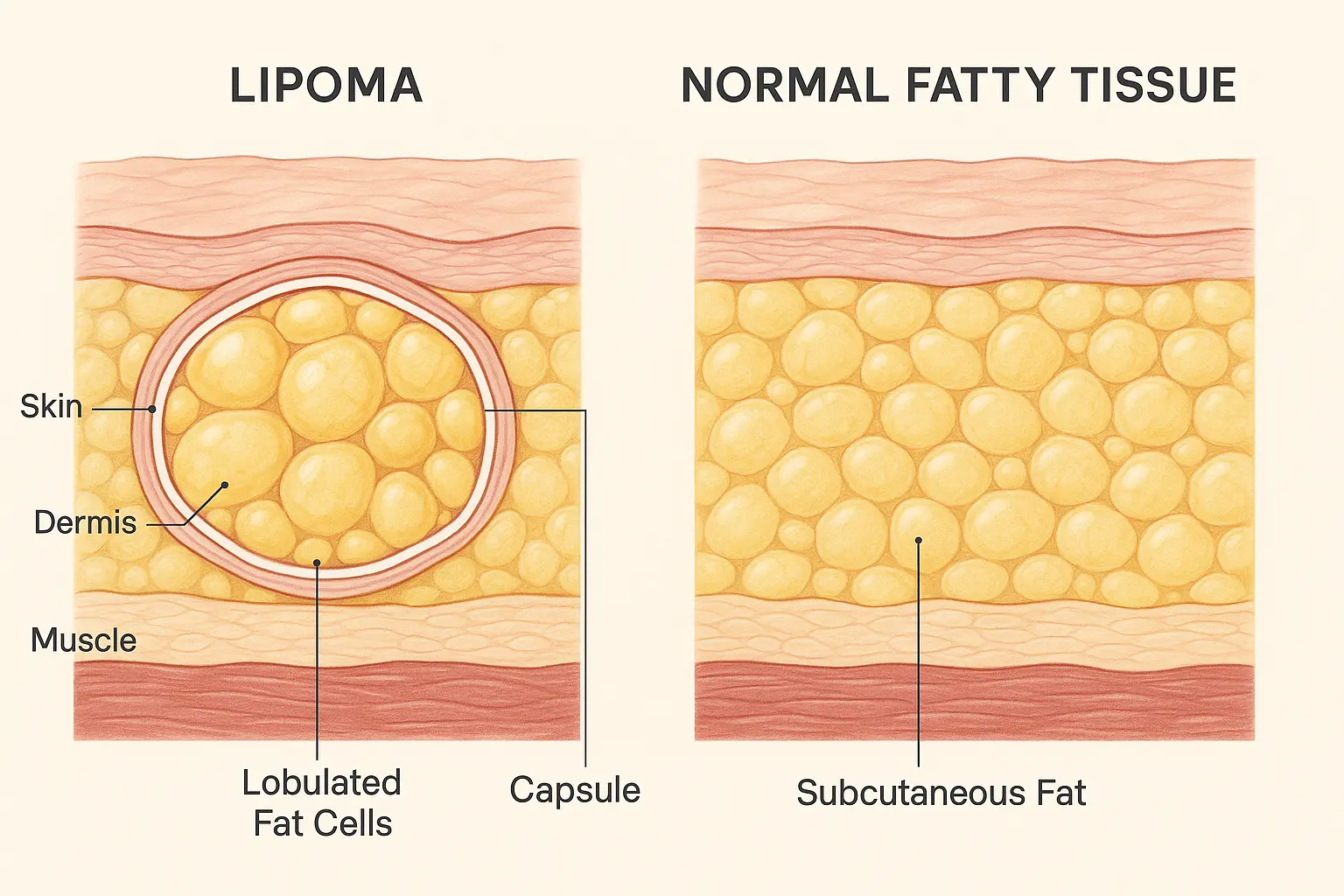
A lipoma is a slow-growing, benign (non-cancerous) tumor made up of fat cells (adipocytes) that cluster together beneath the skin. These soft tissue masses are the most common type of mesenchymal tumor in adults, accounting for approximately 50% of all benign soft tissue tumors.
Lipomas have several distinctive features that help medical professionals identify them:
Lipomas can develop anywhere on the body where fat cells exist, but they most frequently occur in these areas:
✅ Neck and shoulders (most common location)
✅ Back and trunk
✅ Arms and thighs
✅ Forehead and scalp (less common)
✅ Abdomen and chest wall
While lipomas can affect anyone, certain factors increase the likelihood of developing these fatty tumors:
Risk FactorDetailsAgeMost common between ages 40-60, rare in childrenGenderSlightly more common in men than womenFamily historyGenetic predisposition in some familiesMedical conditionsAssociated with Gardner syndrome, Madelung disease, and adiposis dolorosaObesityWeak correlation; lipomas can occur in people of any weight
Understanding what defines a lipoma is the first step in the lipoma vs fatty tumor discussion. For more detailed information about various types of skin lesions, you can explore 25 types of skin lesions explained.
The confusion surrounding lipoma vs fatty tumor terminology is understandable, but clarity is important for proper medical communication and treatment decisions.
"Fatty tumor" is a broad, non-specific term that refers to any abnormal growth composed primarily of fat tissue. This umbrella term can include:
"Lipoma" is a specific medical diagnosis referring to a benign encapsulated tumor of mature adipocytes (fat cells). When doctors use the term "lipoma," they're describing a particular type of fatty tumor with predictable characteristics and behavior.
Understanding the lipoma vs fatty tumor distinction is crucial because:
Important Note: While all lipomas are fatty tumors, not all fatty tumors are lipomas. Accurate diagnosis by a qualified healthcare professional is essential.
Several subtypes of lipomas exist, each with slightly different characteristics:
Conventional Lipoma 🔹
The standard type composed entirely of mature white fat cells with a thin fibrous capsule.
Angiolipoma 🔹
Contains both fat cells and numerous small blood vessels; often painful and more common in young adults.
Fibrolipoma 🔹
Contains significant fibrous tissue mixed with fat cells; feels firmer than conventional lipomas.
Spindle Cell Lipoma 🔹
Contains spindle-shaped cells along with fat cells; most common on the neck and shoulders of older men.
Pleomorphic Lipoma 🔹
Contains unusual-looking cells but remains benign; requires biopsy to distinguish from liposarcoma.
Intramuscular Lipoma 🔹
Grows within muscle tissue rather than the subcutaneous layer; more difficult to remove completely.
For patients considering removal options, understanding before and after lipoma removal outcomes can provide valuable insights into what to expect.
Recognizing the characteristic features of a lipoma can help you determine when to seek medical evaluation versus when a growth is likely benign and non-urgent.
When examining a potential lipoma, healthcare providers and patients should note these key features:
The "Slip Sign" Test 💡
When you press on a lipoma with your fingers, it should easily slip away to the side. This mobility is a hallmark feature of lipomas because they're not attached to underlying structures.
Texture Assessment 💡
Lipomas feel soft, doughy, and rubbery—similar to the texture of a marshmallow or soft cheese. They should not feel hard, firm, or rock-like.
Size Evaluation 💡
Most lipomas measure between 1-3 cm (about the size of a grape to a walnut), though some can grow to 10 cm or larger.
Growth Rate 💡
Lipomas grow very slowly over months to years. Rapid growth over weeks is atypical and warrants immediate medical evaluation.
While most lipomas are asymptomatic (causing no symptoms), some people experience:
Certain situations make lipomas more problematic:
ScenarioWhy It's ProblematicRecommended ActionLocated on jointsMay restrict movement or cause discomfortConsider removal if affecting functionPressing on nervesCan cause pain, numbness, or tinglingMedical evaluation recommendedGrowing rapidlyMay indicate atypical featuresUrgent medical assessment neededVery large sizeCan cause cosmetic or functional issuesDiscuss removal options with doctorMultiple lipomasMay indicate genetic syndromeGenetic counseling may be beneficial
While lipomas are benign, certain warning signs suggest a growth may not be a simple lipoma:
⚠️ Rapid growth over days to weeks
⚠️ Hard, firm texture that doesn't move easily
⚠️ Fixed to underlying structures (not mobile)
⚠️ Larger than 5 cm in diameter
⚠️ Painful without pressure or increasingly painful
⚠️ Located deep in muscle rather than just under the skin
⚠️ Irregular borders or uneven texture
⚠️ Skin changes over the lump (redness, warmth, ulceration)
These features may indicate a liposarcoma (malignant fatty tumor) or another type of soft tissue mass requiring different management. If you're concerned about any unusual skin growth, consulting with a best skin cancer clinic can provide peace of mind through professional evaluation.
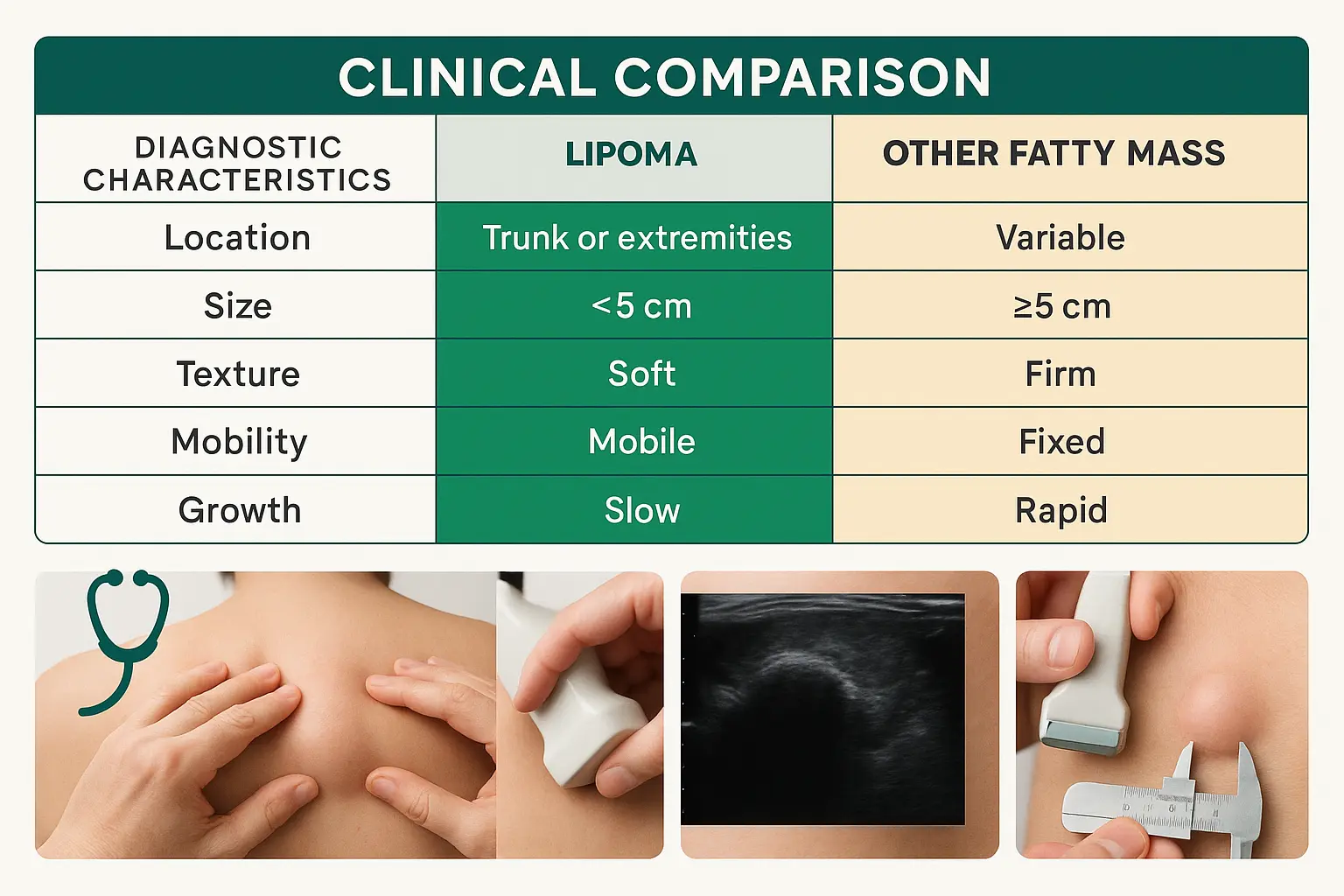
Accurate diagnosis is the cornerstone of appropriate management when dealing with any soft tissue mass. The diagnostic process for lipoma vs fatty tumor differentiation involves several steps.
The diagnostic journey typically begins with a thorough physical examination by a healthcare provider:
Visual Inspection 👁️
The doctor examines the size, shape, color, and location of the growth, looking for characteristic lipoma features.
Palpation 👁️
By feeling the lump, the physician assesses texture, mobility, depth, tenderness, and whether it's well-defined or irregular.
Medical History 👁️
Questions about when the lump appeared, growth rate, symptoms, family history of similar growths, and any associated medical conditions help guide diagnosis.
When clinical examination alone isn't sufficient for diagnosis, imaging helps characterize the fatty tumor:
Ultrasound 🔬
MRI (Magnetic Resonance Imaging) 🔬
CT Scan (Computed Tomography) 🔬
When imaging or clinical features raise concerns about malignancy, tissue sampling becomes necessary:
Fine Needle Aspiration (FNA) 💉
A thin needle extracts cells for microscopic examination. Quick and minimally invasive, but may not provide enough tissue for definitive diagnosis of fatty tumors.
Core Needle Biopsy 💉
A larger needle removes a small cylinder of tissue, providing more material for pathological analysis. More accurate than FNA for lipoma evaluation.
Excisional Biopsy 💉
The entire lump is surgically removed and examined. This approach both diagnoses and treats the lipoma simultaneously, making it the preferred method when removal is already planned.
Once tissue is obtained, a pathologist examines it under a microscope to determine:
Healthcare providers must distinguish lipomas from other soft tissue masses:
ConditionKey Distinguishing FeaturesEpidermoid cystAttached to skin, may have central pore, firmer textureSebaceous cystConnected to skin, may drain cheesy materialGanglion cystFirm, often near joints, filled with clear jelly-like fluidLymph nodeUsually deeper, may be tender, multiple nodes often presentAbscessPainful, red, warm, may have fever or drainageLiposarcomaRapid growth, firm, fixed, irregular borders, larger sizeNeurofibromaAssociated with nerves, may cause tingling or numbness
For those interested in learning about other types of growths that may be confused with lipomas, exploring information about 17 types of cysts can be helpful.
While discussing lipoma vs fatty tumor, it's essential to address liposarcoma—the malignant counterpart that, though rare, requires immediate medical attention.
A liposarcoma is a cancerous tumor that develops from fat cells. Unlike benign lipomas, liposarcomas:
Liposarcomas are relatively rare:
Liposarcomas are classified into several subtypes with different behaviors:
Well-Differentiated Liposarcoma 📊
The most common and least aggressive type; grows slowly and rarely metastasizes but can recur locally after removal.
Dedifferentiated Liposarcoma 📊
Develops from well-differentiated liposarcoma; more aggressive with higher risk of metastasis and local recurrence.
Myxoid Liposarcoma 📊
Second most common type; moderate aggressiveness; can metastasize to unusual sites like other soft tissue areas.
Pleomorphic Liposarcoma 📊
Rarest and most aggressive type; high risk of metastasis; poorest prognosis among liposarcoma subtypes.
Understanding these differences can be lifesaving:
FeatureLipoma (Benign)Liposarcoma (Malignant)Growth rateVery slow (months to years)Rapid (weeks to months)SizeUsually < 5 cmOften > 5 cmTextureSoft, doughy, mobileFirm, hard, may be fixedPainUsually painlessMay be painfulBordersWell-defined, smoothIrregular, poorly definedDepthSuperficial (subcutaneous)Often deep (intramuscular)Age of onsetAny age, peak 40-60Usually > 50 yearsTreatmentObservation or simple excisionWide excision, radiation, chemotherapyRecurrenceRare after complete removalCommon, especially if margins inadequateMetastasisNeverPossible, depending on subtype
Seek immediate medical evaluation if a fatty lump has these characteristics:
🚨 Rapid size increase over weeks
🚨 Size greater than 5 cm (about 2 inches)
🚨 Deep location within muscle rather than just under skin
🚨 Hard, firm consistency that doesn't move freely
🚨 Pain that's new or worsening
🚨 Fixed to underlying tissue or bone
🚨 Irregular shape with unclear boundaries
Critical Point: While the vast majority of fatty lumps are benign lipomas, any concerning features warrant prompt evaluation to rule out liposarcoma or other malignant conditions.
For comprehensive skin cancer screening and evaluation of concerning growths, specialized clinics like The Minor Surgery Center offer expert diagnostic services.
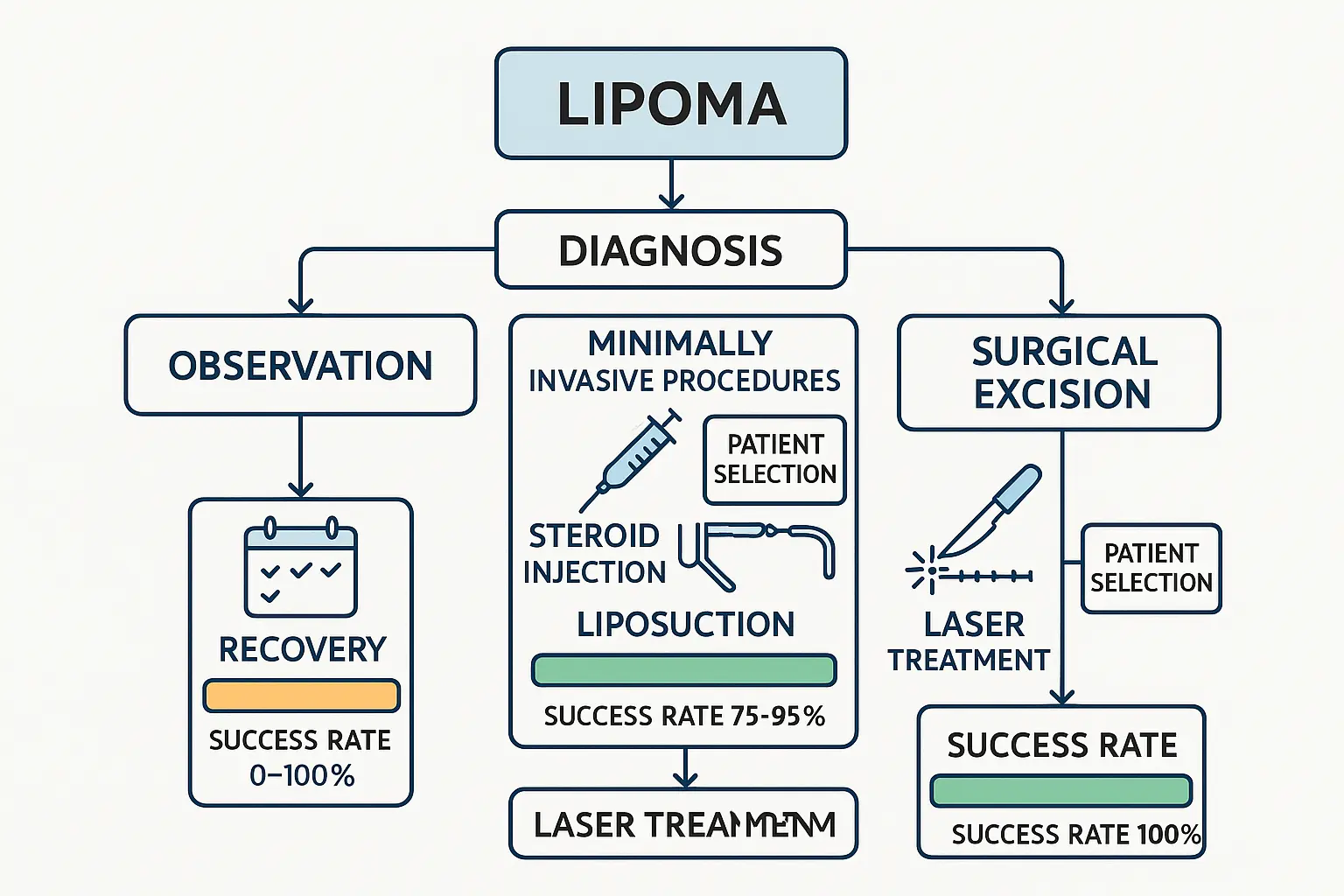
When it comes to managing lipoma vs fatty tumor cases, treatment approaches vary based on the specific diagnosis, size, location, symptoms, and patient preferences.
For many lipomas, no treatment is necessary. Observation is appropriate when:
Monitoring Protocol:
Several minimally invasive approaches exist for lipoma management:
Steroid Injections 💊
Corticosteroid injections directly into the lipoma can shrink it by 50-75% in some cases. Best for small lipomas in cosmetically sensitive areas. Multiple injections over several months may be needed.
Liposuction 💊
A small incision allows insertion of a thin tube to suction out the fatty tissue. Advantages include minimal scarring and quick recovery. Disadvantages include higher recurrence rates (up to 50%) because the capsule remains, and it's only suitable for soft lipomas without fibrous components.
Laser-Assisted Lipolysis 💊
Uses laser energy to liquefy fat before removal through a small cannula. Minimally invasive with less bruising than traditional liposuction. For more information on this technique, see 1444 nm Nd:YAG laser lipolysis.
Complete surgical removal remains the most effective treatment for lipomas:
Procedure Details:
Advantages:
Disadvantages:
Some individuals develop multiple lipomas (lipomatosis), which presents unique challenges:
Prioritization Strategy:
Special Considerations:
Post-removal care is essential for optimal healing:
Immediate Post-Operative Period (0-3 days):
Short-Term Recovery (4-14 days):
Long-Term Healing (2 weeks to 6 months):
Malignant fatty tumors require aggressive, multidisciplinary treatment:
Surgical Resection 🏥
Wide excision with clear margins (removing tumor plus surrounding normal tissue) is the primary treatment. Limb-sparing surgery is preferred when feasible.
Radiation Therapy 🏥
Often used before surgery (neoadjuvant) to shrink the tumor or after surgery (adjuvant) to eliminate remaining cancer cells and reduce recurrence risk.
Chemotherapy 🏥
Effectiveness varies by liposarcoma subtype. More commonly used for high-grade, aggressive tumors or metastatic disease.
Follow-Up Surveillance 🏥
Regular imaging (CT or MRI) and physical examinations every 3-6 months for several years to detect recurrence or metastasis early.
For those seeking lipoma removal services, exploring options at Ajax mole, cyst, and skin tag removal or Barrie mole and cyst removal clinics can provide accessible care.
While lipomas are benign, understanding how to manage them and potentially reduce risk can improve quality of life.
Unfortunately, there's no proven way to prevent lipomas from developing. Since the exact cause remains unclear and genetic factors play a significant role, prevention strategies are limited.
However, maintaining overall health may help:
Healthy Weight Management 🌟
While lipomas aren't directly caused by obesity, maintaining a healthy weight supports overall tissue health. Note that thin individuals can develop lipomas too, so weight alone isn't a determining factor.
Injury Prevention 🌟
Some theories suggest trauma may trigger lipoma formation in predisposed individuals. Protecting yourself from injuries through proper safety equipment and techniques may theoretically help.
Regular Skin Checks 🌟
Monthly self-examinations help detect new lipomas early and monitor existing ones for changes. Early detection of concerning features allows for prompt medical evaluation.
Schedule an appointment with a healthcare provider when:
📋 You discover a new lump or bump under your skin
📋 An existing lipoma changes in size, shape, or texture
📋 A lipoma becomes painful or tender
📋 You develop multiple lipomas
📋 A lipoma interferes with movement or daily activities
📋 You're concerned about the cosmetic appearance
📋 You have a family history of lipomas or soft tissue tumors
When discussing lipoma vs fatty tumor concerns with your healthcare provider, consider asking:
While medically benign, lipomas can cause significant psychological distress:
Common Emotional Responses:
Coping Strategies:
Understanding insurance coverage for lipoma removal can prevent financial surprises:
Typically Covered:
Often Not Covered:
Tips for Insurance Approval:
For comprehensive information on various skin conditions and their management, the blog at The Minor Surgery Center offers valuable educational resources.
No, lipomas do not transform into cancer. A benign lipoma will remain benign throughout its existence. However, it's theoretically possible (though extremely rare) for a liposarcoma to be initially misdiagnosed as a lipoma if proper evaluation wasn't performed. This is why concerning features (rapid growth, large size, deep location, firmness) warrant thorough investigation including imaging and possibly biopsy.
Classic lipoma features include:
Concerning features suggesting something other than a simple lipoma:
When in doubt, always consult a healthcare professional for proper evaluation.
No, most lipomas do not require removal. Treatment is optional and typically pursued when:
Many people live with lipomas indefinitely without any problems.
While both are benign lumps under the skin, they have distinct differences:
Lipoma:
Cyst (epidermoid or sebaceous):
Recurrence is uncommon when lipomas are completely excised (removed with their capsule intact). Recurrence rates:
New lipomas can develop in other locations, especially in people prone to multiple lipomas, but the specific removed lipoma rarely returns if properly excised.
Yes, several genetic syndromes feature multiple lipomas:
Familial Multiple Lipomatosis:
Dercum's Disease (Adiposis Dolorosa):
Gardner Syndrome:
Madelung Disease:
If you have multiple lipomas, discuss genetic evaluation with your healthcare provider.
The removal procedure itself is not painful because local anesthesia numbs the area. You may feel:
Most patients report minimal pain during recovery, describing it as similar to a bruise or minor injury.
Typical removal time: 20-45 minutes depending on:
This is usually an outpatient procedure—you go home the same day.
Coverage varies by insurance plan and specific circumstances:
More likely to be covered:
Less likely to be covered:
Always check with your insurance provider before scheduling the procedure and get pre-authorization when possible.
Understanding the nuances of lipoma vs fatty tumor is essential for anyone who has discovered a soft lump beneath their skin. While the terms are often used interchangeably, knowing the distinctions empowers you to make informed decisions about your health care.
Most fatty lumps are benign lipomas that pose no health risk and require no treatment unless they cause symptoms or cosmetic concerns. These common growths affect millions of people and can be safely monitored or removed based on individual circumstances and preferences.
Proper diagnosis matters. While the vast majority of subcutaneous fatty masses are harmless lipomas, certain features warrant thorough evaluation to rule out liposarcoma or other concerning conditions. Don't hesitate to seek medical attention for any lump that grows rapidly, feels hard, causes pain, or exhibits other warning signs.
Treatment is a personal choice for benign lipomas. Options range from simple observation to minimally invasive procedures to complete surgical excision. The best approach depends on your specific situation, symptoms, cosmetic concerns, and preferences.
Stay vigilant but not anxious. Regular self-examinations help you detect new growths and monitor existing ones for changes. However, remember that lipomas are extremely common and almost always benign, so finding one is rarely cause for alarm.
If you've discovered a lump that might be a lipoma:
Step 1: Observe and Document 📝
Note when you first noticed it, its size, texture, and any symptoms. Take photos to track changes over time.
Step 2: Schedule a Medical Evaluation 📝
See a healthcare provider for proper diagnosis, especially for new lumps or those with concerning features.
Step 3: Get Appropriate Testing 📝
Follow through with recommended imaging or biopsy if your doctor suggests it.
Step 4: Discuss Treatment Options 📝
If treatment is recommended or desired, explore all options including risks, benefits, costs, and recovery expectations.
Step 5: Make an Informed Decision 📝
Choose the approach that best aligns with your medical needs, lifestyle, and preferences.
Step 6: Follow Up Appropriately 📝
Whether you choose observation or removal, maintain appropriate follow-up care and monitoring.
Don't delay seeking medical evaluation if you notice:
⚡ A new lump or bump under your skin
⚡ Rapid growth of an existing lump
⚡ Hard, firm texture or fixed position
⚡ Pain, especially if worsening
⚡ Size larger than 5 cm (about 2 inches)
⚡ Deep location within muscle
⚡ Multiple new lumps appearing
⚡ Any concerning changes in existing lipomas
For professional evaluation and treatment of lipomas and other soft tissue masses, specialized clinics offer comprehensive services including diagnosis, imaging, and removal procedures. The Minor Surgery Center provides expert care for patients seeking answers about concerning lumps and professional treatment options.
Living with lipomas—whether you have one or many—doesn't have to be stressful. Armed with accurate information about lipoma vs fatty tumor distinctions, warning signs to watch for, and available treatment options, you can approach these common growths with confidence rather than fear.
Remember that while lipomas are extremely common and almost always benign, each person's situation is unique. What's right for one patient may not be appropriate for another. Work closely with your healthcare provider to develop a personalized plan that addresses your specific needs, concerns, and goals.
The vast majority of people with lipomas live full, healthy lives without complications. By staying informed, monitoring for changes, and seeking appropriate medical care when needed, you can ensure that any fatty lump receives the attention it deserves—neither more nor less.
Your health is worth the time and effort to get proper evaluation and care. Don't let uncertainty or anxiety prevent you from seeking answers. Whether your lump turns out to be a simple lipoma, another benign condition, or something requiring treatment, knowing the truth always empowers better decisions and peace of mind.