
Last updated: June 16, 2026
A neck lipoma is a benign fatty lump that can be safely removed through minor surgery, typically under local anesthesia in an outpatient clinic. Lipoma on neck removal Toronto costs between $650 and $3,000+ depending on the size and complexity of the growth. Most procedures are not covered by OHIP unless the lipoma causes documented functional impairment, so the majority of patients pay privately.
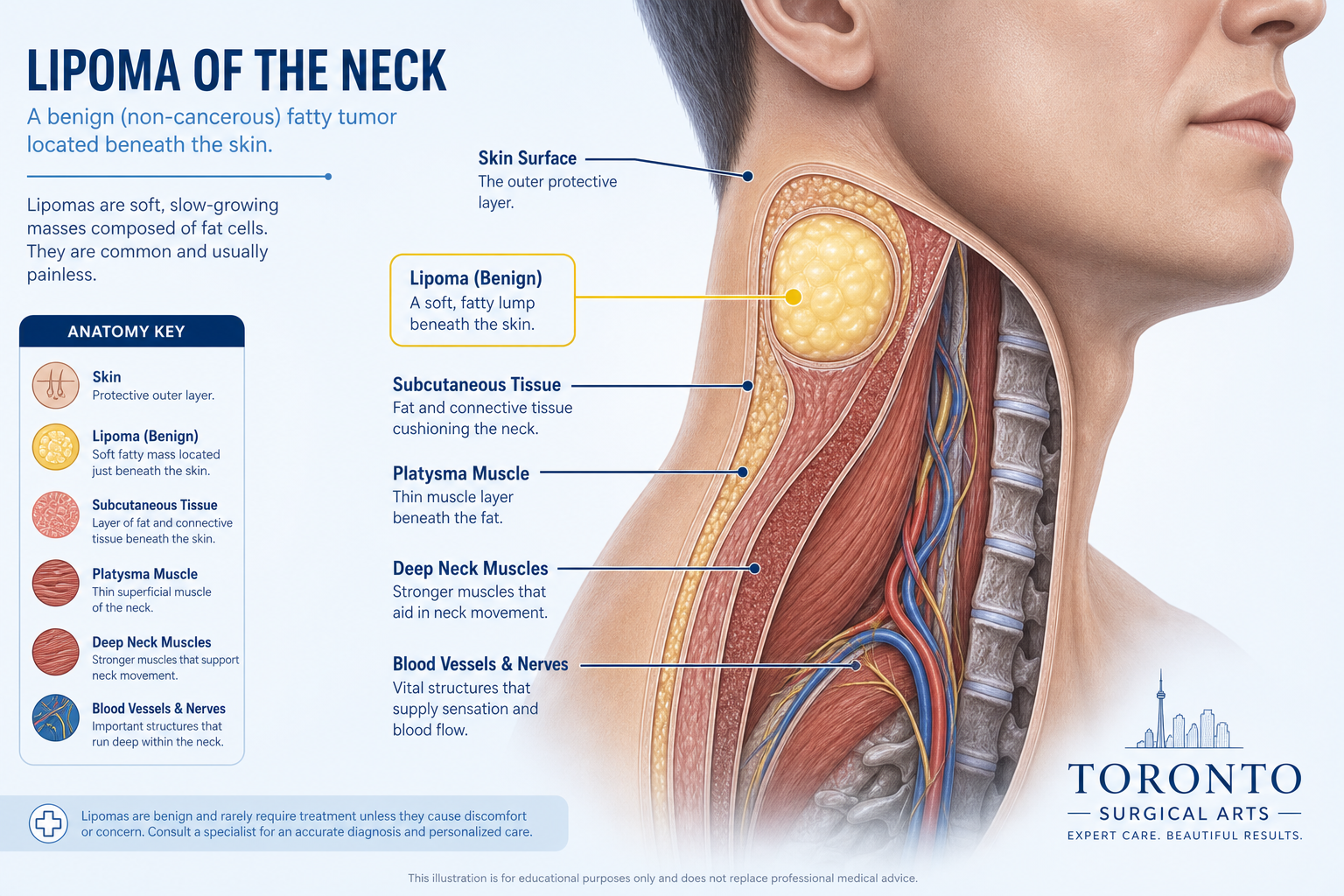
A neck lipoma is a slow-growing, benign tumor made up of fat cells enclosed in a thin fibrous capsule. It sits just beneath the skin and feels soft, doughy, and movable when pressed. Unlike cysts, lipomas do not contain fluid and are not connected to the skin surface. Unlike lymph nodes, they do not become tender or swell in response to infection.
Key characteristics of a neck lipoma:
How to tell a lipoma apart from other neck lumps:
FeatureLipomaSebaceous CystSwollen Lymph NodeTextureSoft, doughyFirm, sometimes fluctuantFirm, rubberyMobilityMoves freelySlightly attached to skinFixed or semi-fixedTendernessUsually noneCan be tender if inflamedOften tender with infectionSkin connectionNonePunctum (small opening) often visibleNoneGrows with infectionNoCan become inflamedYes
If a neck lump is hard, fixed, rapidly growing, or accompanied by unexplained weight loss or night sweats, seek medical evaluation promptly. These features are not typical of a lipoma and warrant further investigation. For guidance on distinguishing lipomas from other soft tissue masses, the Minor Surgery Center's resource on differentiating lipomas provides a useful clinical overview.
Neck lipomas are almost always benign and pose no direct health threat. The overwhelming majority are purely cosmetic concerns. However, a neck lipoma is not entirely without risk of complications if left unaddressed for years.
When a neck lipoma becomes more than cosmetic:
"A lipoma that has been stable for years is almost certainly benign. A lump that suddenly changes in size, texture, or causes new symptoms deserves prompt medical attention."
For most people, a neck lipoma is a cosmetic nuisance rather than a medical emergency. That said, the neck is a sensitive anatomical area with important vascular, neural, and airway structures nearby, which is one reason why removal by an experienced surgeon matters more here than on the arm or back.
Leaving a neck lipoma untreated is medically safe for most patients. Lipomas do not become cancerous on their own, and many people live comfortably with small, stable lipomas for decades without any intervention.
Realistic outcomes of watchful waiting:
When watchful waiting is not the right choice:
The decision to remove or monitor a neck lipoma is personal and should be made in consultation with a qualified surgeon or dermatologist.
A family doctor can diagnose a neck lipoma and refer patients for removal, but most general practitioners do not perform surgical excision themselves. Neck lipomas specifically benefit from specialist involvement because of the proximity to nerves, blood vessels, and the airway.
Who typically performs neck lipoma removal in Toronto:
A detailed comparison of specialist options is available in the guide on whether to choose a dermatologist or general surgeon for lipoma removal.
Common mistake: Patients sometimes ask their family doctor to perform the removal in-office to save time. For small lipomas on the arm or back, this can work. For neck lipomas, the anatomical complexity makes it worth seeing a surgeon who performs these procedures regularly.
One practical advantage in Toronto is that several clinics, including The Minor Surgery Center, accept patients without a referral, reducing wait times significantly.
Lipoma removal in Toronto costs between $650 and $3,000 or more at private clinics, depending primarily on the size of the lipoma, its depth, and the clinic or surgeon chosen. [5] A detailed breakdown is available in the lipoma removal cost Toronto 2026 price guide.
Typical Toronto pricing ranges (2026 estimates):
Lipoma SizeEstimated Cost RangeSmall (under 2 cm)$650 – $950Medium (2–5 cm)$950 – $1,800Large (over 5 cm)$1,800 – $3,000+Multiple lipomas (same session)Discounted bundle pricing varies
Prices at The Minor Surgery Center start at $650 [5], while some other Toronto clinics begin at $595 [4]. These figures typically include the consultation, local anesthesia, the procedure itself, and one follow-up visit. Pathology fees (if the removed tissue is sent for biopsy) may be billed separately.
Factors that increase cost:
For a broader comparison of pricing across Toronto clinics, the best lipoma clinics in Toronto comparison guide covers costs, techniques, and surgeon credentials side by side.
OHIP does not cover lipoma removal when the procedure is performed for cosmetic reasons. This applies to the vast majority of neck lipoma removals in Ontario. A detailed explanation is available in the guide on whether lipoma removal is covered by OHIP or insurance.
When OHIP coverage may apply:
Private insurance coverage:
Many extended health benefit plans (employer-provided or individual) cover minor surgical procedures when deemed medically necessary. Coverage depends on:
Practical steps to maximize coverage:
Most patients in Toronto pay out of pocket and budget accordingly. The relatively low cost of minor surgery at private clinics makes this manageable for most cases.
Lipoma removal is a low-risk procedure overall, but the neck presents specific anatomical considerations that make surgeon selection important. A comprehensive overview of potential complications is covered in the complications from lipoma removal resource.
Common, minor risks (applicable to most excisions):
Neck-specific risks to discuss with your surgeon:
Reducing your risk:
Most patients describe lipoma neck removal as minimally painful. The procedure itself is performed under local anesthesia, so the main sensation during surgery is pressure rather than pain. The injection of local anesthetic can cause a brief stinging sensation, but this passes within seconds.
Pain timeline:
Factors that influence pain levels:
Patients who are anxious about the procedure can discuss oral sedation options with their surgeon. General anesthesia is rarely needed for neck lipoma removal and is typically reserved for very large or deeply situated growths.
Recovery from neck lipoma removal is generally fast. Most patients return to desk work and light daily activities within 24 to 48 hours of the procedure. A detailed recovery timeline is available at how long it takes to recover from lipoma removal surgery.
Typical recovery milestones:
TimeframeWhat to ExpectDay 1Rest recommended; mild soreness; keep wound dryDays 2–3Return to light desk work; avoid neck strainDays 7–14Sutures removed; most swelling resolvedWeeks 2–4Return to exercise and full activityMonths 1–3Scar matures; pink coloration fadesMonth 6+Scar typically flat and pale
Post-operative care tips for neck lipoma removal:
The neck heals well due to its good blood supply, and most patients are satisfied with the cosmetic outcome within three to six months.
Non-surgical approaches exist but are not appropriate for all neck lipomas. They work best on small, superficial lipomas and typically cannot guarantee complete removal.
Available non-surgical options in Toronto:
1. Steroid injections (triamcinolone)
Injected directly into the lipoma, corticosteroids can reduce the size by 50 to 75% in some cases. The lipoma is not fully eliminated, and multiple sessions may be needed. Best suited for small lipomas (under 3 cm) where surgery is declined. [3]
2. Deoxycholic acid injections (e.g., Belkyra/Kybella)
Originally approved for submental fat reduction, deoxycholic acid has been used off-label to dissolve lipomas. It requires multiple treatment sessions and works best on soft, superficial lipomas. Results are gradual and less predictable than surgery. [6]
3. Laser lipolysis (1444 nm Nd:YAG laser)
A minimally invasive technique that uses laser energy delivered through a small needle to liquefy fat cells within the lipoma capsule. This approach leaves a very small entry point with minimal scarring. For more detail on this technology, see the overview of 1444 nm Nd:YAG laser lipoma removal.
4. Liposuction-assisted removal
A small cannula is inserted through a tiny incision to suction out the fatty contents of the lipoma. The capsule may not be fully removed, which slightly increases recurrence risk compared to open excision. Useful for larger lipomas where minimizing scar length is a priority. [3]
Choosing the right approach:
Complete surgical excision of a neck lipoma, including its fibrous capsule, results in a very low recurrence rate. When the capsule is fully removed, regrowth at the same site is uncommon.
Recurrence risk by technique:
Removal MethodApproximate Recurrence RiskComplete surgical excisionLess than 5%Liposuction-assisted (capsule may remain)Up to 20–50%Steroid injectionsLipoma shrinks but is not eliminatedDeoxycholic acid injectionsVariable; capsule typically remains
Why recurrence happens:
Patients with familial multiple lipomatosis (an inherited condition causing multiple lipomas throughout the body) may develop new lipomas in various locations over time, which can be mistaken for recurrence. [2]
Bottom line: If a board-certified surgeon performs complete excision with capsule removal, the chance of the same lipoma returning is low. Choosing an experienced surgeon is the single most important factor in reducing recurrence risk.
There is no universal size threshold that automatically requires surgery. The decision depends on symptoms, location, and patient preference as much as on dimensions.
General clinical guidelines:
Neck-specific considerations:
The neck's anatomical complexity means that even a 2 cm lipoma in a sensitive location (near the carotid triangle or posterior cervical space) may warrant earlier removal than a similarly sized lipoma on the forearm. Depth matters as much as surface diameter.
Toronto has a strong concentration of board-certified plastic surgeons and general surgeons who perform neck lipoma removal. The best lipoma removal clinics in Toronto resource compares over 12 options across the city.
What to look for in a Toronto lipoma surgeon:
Notable board-certified surgeons at The Minor Surgery Center:
Clinic locations across the GTA:
The Minor Surgery Center operates at multiple locations, including downtown Toronto, Vaughan, Oakville, Whitby, Ajax, Newmarket, Barrie, and others, making access convenient regardless of where in the Greater Toronto Area a patient lives. [7]
Red flags to avoid:
Preparation for neck lipoma removal is straightforward. Most patients complete the process from consultation to procedure within one to three weeks at private clinics.
Step-by-step preparation checklist:
Q: How long does the actual neck lipoma removal procedure take?
A: Most neck lipoma excisions under local anesthesia take between 20 and 60 minutes depending on the size and depth of the lipoma. Patients are typically in the clinic for one to two hours total, including preparation and post-procedure observation.
Q: Will I have a visible scar after neck lipoma removal?
A: A small scar is inevitable with surgical excision. Experienced plastic surgeons place the incision along natural skin creases (Langer's lines) to minimize visibility. Most scars fade significantly within six to twelve months and are not noticeable in everyday social situations.
Q: Do I need to fast before the procedure?
A: Fasting is generally not required for procedures performed under local anesthesia. Confirm with your specific clinic, as protocols vary slightly.
Q: Can I go to work the next day after neck lipoma removal?
A: Most patients with desk jobs return to work the following day. Jobs involving physical labor or neck strain typically require two weeks off. [3]
Q: Is there an age limit for neck lipoma removal?
A: There is no upper age limit. Older patients with stable health can safely undergo lipoma removal under local anesthesia. Pediatric neck lipomas are less common and are typically managed by pediatric surgeons.
Q: What should I do if my neck lipoma suddenly becomes painful or grows rapidly?
A: Seek medical evaluation promptly. Sudden pain or rapid growth can indicate inflammation, infection within the lipoma, or, rarely, malignant transformation. Do not delay assessment.
Q: Can I have multiple neck lipomas removed in the same session?
A: Yes, in many cases. Multiple lipomas can often be addressed in one surgical session, which is more cost-effective and reduces total recovery time. Discuss this with your surgeon during the consultation.
Q: How do I know if my neck lump is a lipoma and not a cyst?
A: Clinical examination by a physician is the most reliable first step. Lipomas feel soft and doughy and move freely; cysts may feel firmer and are sometimes attached to the overlying skin. Ultrasound can confirm the diagnosis when there is uncertainty. For related reading, the lipoma vs. ganglion cyst comparison explains key differences.
Q: Is ultrasound or MRI needed before removing a neck lipoma?
A: For small, superficial lipomas with a classic clinical appearance, imaging is often not required. For deeper, larger, or atypically presenting lipomas, ultrasound or MRI helps define the boundaries and proximity to important structures before surgery.
Q: Can a neck lipoma be removed under general anesthesia if I am very anxious?
A: Yes, though it is rarely necessary. Oral sedation (anxiolytic medication taken before the procedure) is a common middle ground that reduces anxiety without requiring general anesthesia. Discuss your concerns openly with the surgeon during consultation.
Q: What is the difference between a lipoma and a liposarcoma?
A: A lipoma is a benign fatty tumor; a liposarcoma is a rare malignant tumor of fat cells. Liposarcomas tend to be larger, deeper, firmer, and faster-growing than lipomas. They cannot be reliably distinguished from lipomas by physical examination alone in all cases, which is why large or atypical neck lumps are sent for pathological analysis after removal. [2]
Q: Are there any home remedies that can dissolve a neck lipoma?
A: No home remedy has been clinically proven to dissolve or eliminate a lipoma. Various topical treatments circulate online, but none have evidence supporting their use, and some pose infection risk. Professional medical treatment remains the only reliable approach.
Neck lipomas are common, benign, and highly treatable. For most patients in Toronto, the path forward is clear: a consultation with a board-certified surgeon, a straightforward outpatient excision under local anesthesia, and a recovery measured in days rather than weeks.
Actionable next steps:
For patients across the Greater Toronto Area, The Minor Surgery Center's lipoma removal service offers access to board-certified surgeons at multiple locations, with no referral required and transparent pricing. Whether the concern is cosmetic, functional, or diagnostic, professional removal remains the safest and most definitive solution for a neck lipoma.
[1] Lipomas - https://www.minorsurgery.ca/conditions-we-treat/lipomas/?utm_source=openai
[2] Lipoma On The Neck Assessment - https://citydermatologyclinic.com/lipomas/lipoma-on-the-neck-assessment/?utm_source=openai
[3] Lipomas - https://rejuuvmed.com/procedures/body/lipomas?utm_source=openai
[4] Lipoma Removal How To Diagnose Treat - https://www.minorsurgery.ca/blog/lipoma-removal-how-to-diagnose-treat/?utm_source=openai
[5] Lipoma - https://www.torontominorsurgery.com/conditions/lipoma?utm_source=openai
[6] Lipoma Removal - https://fcpdermatology.com/lipoma-removal/?utm_source=openai
[7] theminorsurgerycenter - https://www.theminorsurgerycenter.com/?utm_source=openai