
Last updated: November 4, 2026
Yes. Mohs micrographic surgery is an insured physician service under OHIP when it is medically necessary to remove a malignant skin cancer, such as basal cell carcinoma, squamous cell carcinoma, or certain melanomas on high-risk areas [1][2]. OHIP covers the physician's fee and the hospital or facility cost tied to the procedure. Patients generally need a referral from a family doctor or dermatologist, and coverage does not extend to cosmetic skin procedures or most private, non-medically-necessary treatments.
A single stat tells most of the story here: Mohs cure rates for basal cell carcinoma run above 94 percent, according to hospital cancer program data [3]. That's the kind of outcome that keeps provincial health systems funding it, even as costs for other elective dermatology procedures shift onto patients. If you've been told you need Mohs surgery and you're wondering whether your OHIP card will actually cover it, the short answer is almost always yes, but the details matter.
Mohs micrographic surgery is a precision technique for removing skin cancer one thin layer at a time, examining each layer under a microscope before deciding whether to cut deeper. It's used mainly for basal cell carcinoma and squamous cell carcinoma, especially on the face, ears, nose, and other areas where preserving healthy tissue matters most [3].
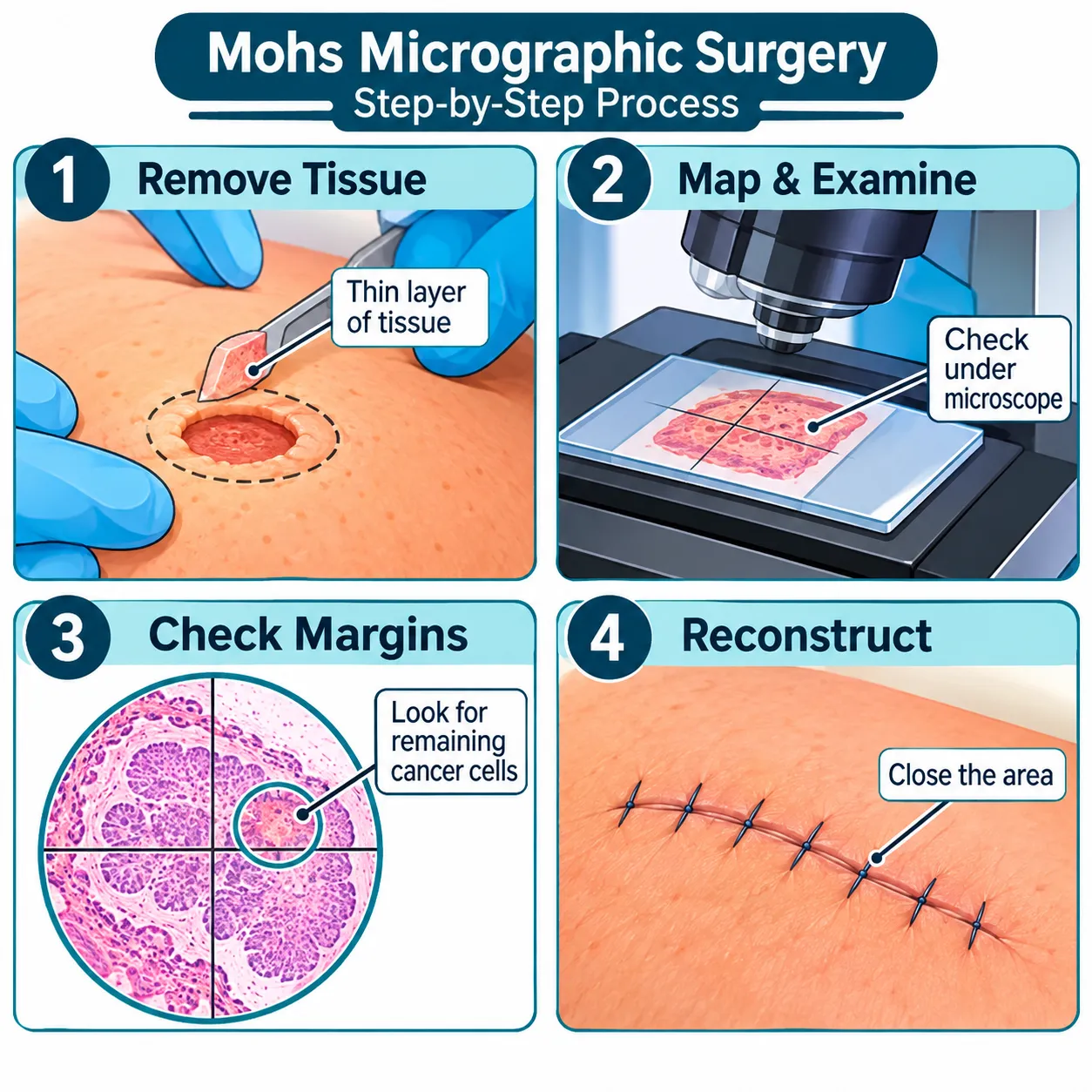
Here's how it works in practice:
This layer-by-layer mapping is what separates Mohs from a standard excision. Choose Mohs if the cancer is on a cosmetically or functionally sensitive area, has indistinct borders, has recurred after prior treatment, or is a more aggressive subtype. A common mistake patients make is assuming all skin cancer removal is "Mohs", it isn't, and the distinction affects both outcome and OHIP billing.
OHIP can cover Mohs surgery for melanoma, but coverage depends on the specific melanoma subtype, its location, and whether Mohs is the medically appropriate approach for that tumor. Melanoma treatment protocols in Ontario more often rely on wide local excision with margin assessment, but Mohs or Mohs-like techniques are sometimes used for certain melanoma in situ cases on the face [3].
Some clarifying points:
If your dermatologist recommends Mohs for a melanoma diagnosis, that recommendation itself is usually the trigger for OHIP coverage, since OHIP insures physician services tied to treating malignant disease [1][2].
OHIP covers physician services for diagnosing and treating malignant skin cancers, which includes basal cell carcinoma, squamous cell carcinoma, and melanoma, regardless of which surgical technique is used [1][2]. The key qualifier is that the lesion must be malignant or reasonably suspected to be malignant, not purely cosmetic.
A quick breakdown of coverage patterns:
ConditionTypically OHIP-coveredNotesBasal cell carcinomaYesMost common reason for Mohs referralSquamous cell carcinomaYesEspecially high-risk or recurrent lesionsMelanoma (in situ, facial)Often, case-dependentDepends on subtype and locationInvasive melanoma (advanced)Yes, via oncology pathwayMay not use Mohs specificallyBenign moles, cysts, skin tagsNoBilled privately as cosmetic or elective
Edge case: a mole that looks suspicious but turns out benign after biopsy may still have the initial diagnostic workup covered, even though the final removal (if purely cosmetic) is not. For general mole, cyst, and lipoma removal pathways outside the cancer context, see this guide to minor surgery and mole removal in Erin Mills, Mississauga.
Yes, in almost every case you need a referral, usually starting with your family doctor or a walk-in physician, who then refers you to a dermatologist or directly to a Mohs surgery centre [5][6]. OHIP coverage for the procedure itself does not require a separate "approval" step beyond the standard referral and diagnosis process.
The typical pathway looks like this:
A common mistake is skipping the family doctor step and trying to self-refer to a specialist. Most Ontario specialists, including Mohs surgery centres, require a referral letter to book an appointment, even if the final treatment is fully OHIP-insured.
The core difference is precision: Mohs surgery examines 100 percent of the tissue margin under a microscope before the wound is closed, while a standard excision removes the visible lesion plus a fixed safety margin and sends the whole sample to pathology afterward, without immediate real-time feedback.
FactorMohs SurgeryStandard ExcisionMargin checked during surgeryYes, 100 percentNo, checked afterward in labTissue sparingHigh, removes minimum necessaryLower, fixed margin removed upfrontSame-day result confirmationYesNo, results take daysBest forFace, recurrent, aggressive lesionsLower-risk, less cosmetically sensitive areasOHIP coverageYes, when medically necessary [1]Yes, when medically necessary
Choose standard excision if the lesion is in a low-risk area like the trunk or limbs and has clear, well-defined borders. Choose Mohs if it's on the face, recurrent, or has poorly defined edges. Both are OHIP-insured when medically necessary, the technique chosen is a clinical decision, not a billing one.
OHIP-covered Mohs surgery is performed at designated hospital-based dermatology surgery centres and academic clinics across Ontario, not at every walk-in clinic or private cosmetic practice. Toronto's hospital network and university-affiliated dermatology divisions operate dedicated Mohs surgery centres [5][6].
Examples of where this type of care is centralized:
If you're trying to find a provider, start with your referring physician rather than searching independently, since Mohs surgery centres generally don't accept walk-ins or self-referrals.
OHIP coverage follows the service, not the setting, but in practice most Mohs surgery in Ontario happens in hospital-based or academic centres rather than small private dermatology clinics, because Mohs requires on-site lab processing equipment and trained technicians [5][6]. A private clinic performing medically necessary Mohs surgery can still bill OHIP for the insured portion, but many private clinics don't offer true Mohs micrographic technique at all.
Watch for this distinction:
For a broader look at how private-pay minor surgery compares to OHIP-funded options generally, this breakdown of OHIP coverage versus private pay is a useful companion read, and this OHIP vs private clinic comparison for minor surgery in Ontario covers similar ground for other procedures.
This situation is rare but can happen if the lesion is reclassified as non-malignant, if the procedure is deemed cosmetic rather than medically necessary, or if you're seeking treatment outside Ontario without pre-approval. In those cases, you have a few realistic options.
A common mistake is assuming a denial is final without asking for the specific reason in writing. Billing codes and documentation errors are fixable; a true non-malignant diagnosis is not.
Yes, wait times exist for OHIP-funded Mohs surgery, driven by limited specialized centres, surgeon availability, and the demand for this highly precise procedure. Exact wait times vary by region and by how urgent the dermatologist flags your case, with faster-growing or higher-risk cancers typically prioritized.
Factors that affect how long you wait:
Decision rule: if your lesion is growing quickly, bleeding, or located somewhere that limits daily function, flag this explicitly to your referring doctor, since urgency genuinely does shift scheduling priority within the OHIP system.
Yes, basal cell carcinoma and squamous cell carcinoma are the two most common and most clearly OHIP-covered indications for Mohs surgery in Ontario. These are the textbook cases where Mohs is considered a first-line, medically necessary treatment, particularly when the lesion sits on the face, ears, scalp, hands, or genitals [3].
Why these two cancers are the clearest cases:
If you've been diagnosed with either condition and your dermatologist recommends Mohs, this is close to a guaranteed OHIP-covered scenario, barring unusual circumstances.
Eligibility comes down to three things: having a valid OHIP card, having a confirmed or strongly suspected malignant skin lesion, and having a physician determine that Mohs is the medically necessary approach for your specific case [1][2]. There's no separate "pre-authorization" application for most Ontario residents beyond the standard referral and diagnostic workup.
A simple eligibility checklist:
Common edge case: new Ontario residents in their first three-month OHIP waiting period may need to cover costs privately or delay non-urgent procedures until coverage activates. If you're unsure about your OHIP status generally, the general OHIP coverage overview from Ontario.ca is the authoritative source [2].
In theory, paying privately can sometimes shorten wait times by accessing a private surgical facility outside the standard OHIP referral queue, but true Mohs micrographic surgery with full pathology mapping is uncommon in a purely private, cash-pay setting in Ontario because of the equipment and staffing it requires.
What this means practically:
Decision rule: if your case is urgent, ask your referring physician to flag it as such within the OHIP system first, this is usually more effective than seeking a private workaround for true Mohs surgery.
OHIP covers a range of medically necessary skin cancer treatments beyond Mohs, including standard surgical excision, cryotherapy, topical chemotherapy for certain superficial cancers, radiation therapy, and oncology referrals for advanced or metastatic cases [1][2]. The treatment chosen depends on cancer type, stage, and location, not patient preference.
Common OHIP-covered alternatives to Mohs:
For broader context on malignant and benign skin condition treatment options available through clinics in the province, see this overview of malignant and benign skin conditions.
Is Mohs surgery covered by OHIP in Ontario?
Yes. Mohs micrographic surgery is an insured physician service under OHIP when performed to treat a malignant skin lesion, billed under fee code R081 [1][4].
Does OHIP cover the hospital facility fee for Mohs surgery, not just the surgeon's fee?
Yes. Facility and hospital costs tied to a medically necessary surgical procedure are also insured under OHIP, alongside the physician fee [1][2].
Do I need a referral to access OHIP-covered Mohs surgery?
Yes, almost always. You typically need a referral from your family doctor or a specialist before being seen at a Mohs surgery centre [5][6].
Can I get Mohs surgery covered by OHIP if I'm a new Ontario resident?
Only after your OHIP coverage becomes active, since new residents often face a waiting period of up to three months before coverage starts [2].
Does OHIP cover Mohs surgery performed outside Ontario or Canada?
Only under strict, pre-approved out-of-country criteria. Spontaneous or unapproved travel for Mohs surgery is generally not reimbursed [2].
Will OHIP cover Mohs surgery for a benign mole I want removed?
No. OHIP only covers Mohs surgery for malignant or strongly suspected malignant lesions. Benign mole removal is typically billed privately as a cosmetic procedure.
How long is the wait for OHIP-covered Mohs surgery in Ontario?
Wait times vary by region and urgency, and there's no single published standard wait time; higher-risk or fast-growing cancers are generally prioritized by referring physicians.
Is there a recent policy change affecting OHIP coverage for Mohs surgery?
No confirmed policy change as of late 2026 has removed or reduced OHIP coverage for medically necessary Mohs surgery [1][2].
Mohs surgery is covered by OHIP when a dermatologist or surgeon determines it's medically necessary to treat a malignant skin lesion, most commonly basal cell carcinoma or squamous cell carcinoma, and sometimes certain melanoma presentations [1][2][3]. The physician fee, billed under code R081, and the associated hospital facility costs are both insured [1][4]. What isn't covered is anything deemed cosmetic, a non-malignant lesion, or care sought outside Ontario without pre-approval.
If you're facing a possible skin cancer diagnosis, the practical next step is simple: talk to your family doctor first. Get the referral moving, ask direct questions about urgency, and if a private clinic offers you a faster "Mohs" option, confirm in writing whether it's the true micrographic technique and whether it's billed to OHIP or out of pocket. Being specific with your questions, rather than assuming either full coverage or full cost, is the single best way to avoid surprises on your bill and delays in your care.