

It's 3 PM on a busy workday, and that familiar tingling sensation creeps into your fingers as you type. Your wrists ache, your hands feel numb, and productivity plummets. Sound familiar? You're not alone—carpal tunnel syndrome affects millions of office workers worldwide, but the solution might be simpler than you think. A 10-Minute Daily Carpal Tunnel Exercise Routine You Can Do at Your Desk can transform your workday from painful to productive, offering relief without leaving your workspace.
• Consistency beats intensity: Just 10 minutes of daily desk exercises can significantly reduce carpal tunnel symptoms and prevent progression
• No equipment needed: All exercises can be performed using only your hands and desk space during regular work breaks
• Immediate and long-term benefits: Experience instant relief from stiffness while building lasting wrist health through improved circulation and flexibility
• Seamless integration: These exercises blend naturally into your workday routine without disrupting productivity or drawing attention
• Prevention is powerful: Regular practice can prevent mild symptoms from developing into severe carpal tunnel syndrome requiring medical intervention
Carpal tunnel syndrome occurs when the median nerve becomes compressed as it passes through the narrow carpal tunnel in your wrist. This compression leads to the characteristic symptoms: numbness, tingling, weakness, and pain that can radiate from your hand up to your shoulder.
Modern work environments create perfect conditions for carpal tunnel development:
The statistics are sobering: carpal tunnel syndrome affects 3-6% of adults in the general population, with office workers experiencing significantly higher rates. Women are three times more likely to develop the condition than men, often due to smaller carpal tunnel anatomy and hormonal factors.
Recognizing early symptoms allows for prompt intervention with conservative treatments before surgical options become necessary:
A 10-Minute Daily Carpal Tunnel Exercise Routine You Can Do at Your Desk works through several physiological mechanisms that address the root causes of median nerve compression.
Regular movement exercises increase blood flow to the hands and wrists, delivering essential nutrients to compressed tissues while removing inflammatory waste products. Enhanced circulation helps:
The carpal tunnel houses nine flexor tendons alongside the median nerve. When these tendons become stiff or inflamed, they contribute to nerve compression. Targeted exercises:
Gentle nerve gliding exercises help the median nerve move freely through its pathway, reducing adhesions and improving function. This process:
This comprehensive routine targets all aspects of carpal tunnel prevention and management. Each exercise can be performed while seated at your desk, making it perfect for busy professionals.
Duration: 30 seconds each direction
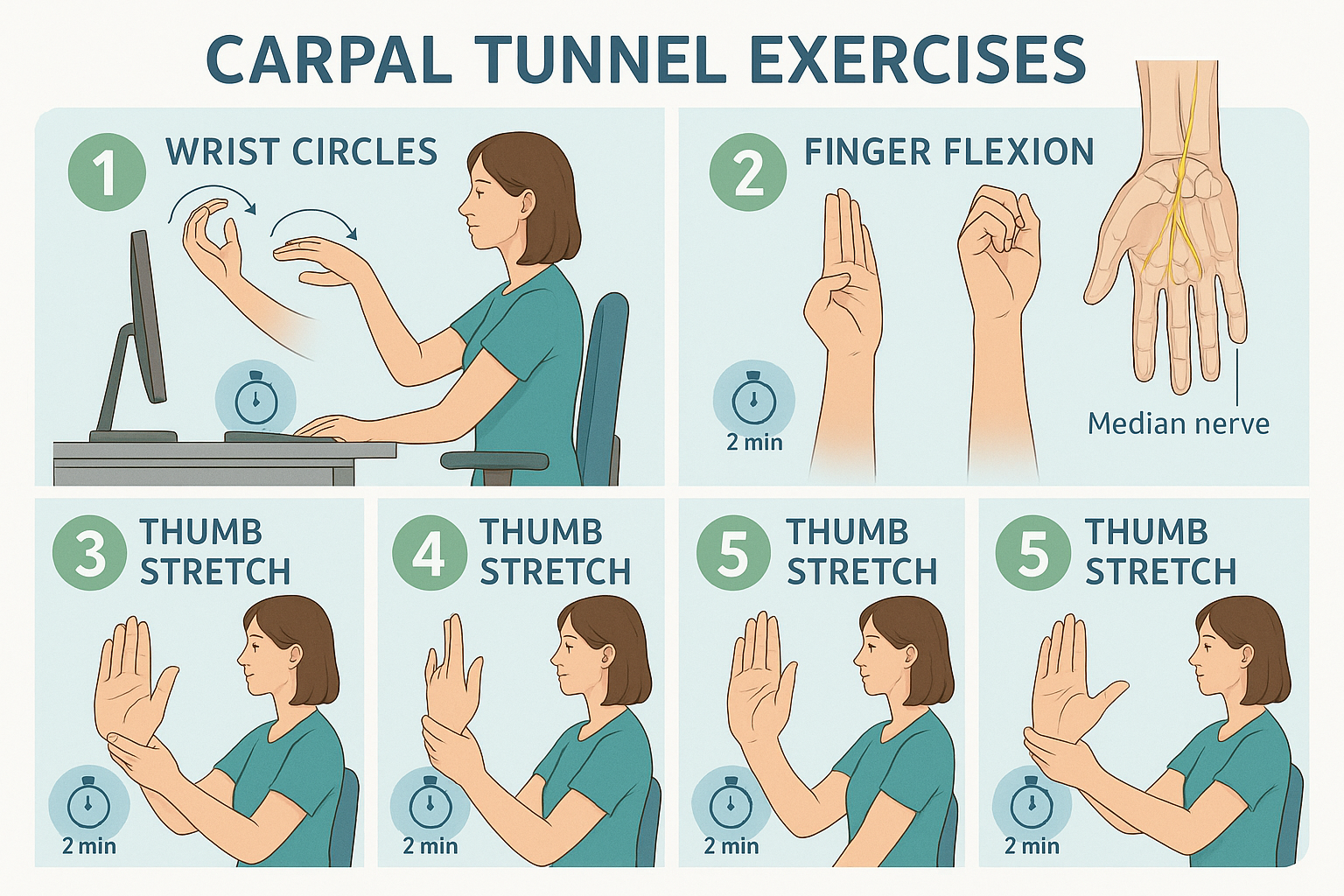
Begin with your arms relaxed at your sides. Slowly rotate your wrists in small circles, starting clockwise for 30 seconds, then counterclockwise for 30 seconds. This movement:
Duration: 1 minute
Start with your hands in loose fists, then slowly extend all fingers wide apart. Hold for 2 seconds, then curl fingers back into loose fists. Repeat 15-20 times. This exercise:
Duration: 1 minute
Place your palms together in front of your chest with fingers pointing upward (prayer position). Slowly lower your hands while keeping palms pressed together until you feel a gentle stretch in your wrists. Hold for 15 seconds, then return to starting position. Repeat 4 times.
Benefits:
Duration: 1 minute each arm
Extend your right arm straight in front of you with palm facing up. Use your left hand to gently pull your right fingers back toward your body until you feel a stretch along the inside of your forearm. Hold for 30 seconds, then switch arms.
Key Points:
Duration: 1 minute each arm
Extend your right arm with palm facing down. Use your left hand to gently push your right hand downward and toward your body until you feel a stretch along the top of your forearm. Hold for 30 seconds, then switch arms.
This stretch targets the often-neglected extensor muscles that work overtime to stabilize your wrists during computer work.
Duration: 2 minutes
This multi-position exercise promotes optimal tendon movement through the carpal tunnel:
Position 1: Start with fingers straight and extended Position 2: Bend fingers at the middle joints (hook fist) Position 3: Make a full fist Position 4: Return to straight fingers
Hold each position for 3 seconds and repeat the sequence 10 times. This exercise:
Duration: 1 minute
If you have a stress ball or similar soft object, perform gentle squeezing exercises. Squeeze for 5 seconds, then release. Repeat 10-12 times. Without equipment, you can:
Duration: 1 minute
The thumb's unique anatomy requires specific attention:
Thumb Extension: Gently pull your thumb away from your palm using your opposite hand. Hold for 15 seconds. Thumb Flexion: Touch your thumb to the base of your little finger. Hold for 15 seconds. Thumb Opposition: Touch your thumb to each fingertip in sequence, holding briefly at each position.
These movements maintain thumb mobility and prevent the weakness that often accompanies carpal tunnel syndrome.
A 10-Minute Daily Carpal Tunnel Exercise Routine You Can Do at Your Desk works best when integrated strategically throughout your day:
Start your workday with gentle warm-up exercises to prepare your hands and wrists for the day ahead. Focus on:
Use your lunch break or mid-afternoon slump for a more comprehensive routine:
End your workday with relaxing stretches that help prevent nighttime symptoms:
Technology Solutions:
Environmental Cues:
When dealing with more pronounced carpal tunnel symptoms, modify your approach:
Reduced Intensity: Perform gentler versions of each exercise with shorter hold times Increased Frequency: Break the 10-minute routine into 2-minute segments throughout the day Pain Monitoring: Stop any exercise that increases numbness or tingling Professional Guidance: Consult with healthcare providers about comprehensive treatment approaches
Different work environments require tailored approaches:
Your exercise routine works best when combined with proper workspace setup:
Keyboard and Mouse Positioning:
Monitor and Seating:
Sleep Positioning: Understanding proper sleep positioning can prevent nighttime symptom flares:
Activity Modification:
While A 10-Minute Daily Carpal Tunnel Exercise Routine You Can Do at Your Desk provides excellent prevention and early intervention, certain symptoms warrant professional evaluation:
Modern carpal tunnel management offers various approaches:
Conservative Treatments:
Surgical Interventions: When conservative measures fail, surgical options may be necessary. The Minor Surgery Center specializes in minimally invasive techniques that can provide lasting relief while minimizing recovery time.
Monitor your progress with these objective measures:
Symptom Journals:
Performance Metrics:
Week 1-2: Focus on establishing routine consistency Week 3-4: Notice reduced morning stiffness and improved flexibility Month 2-3: Experience decreased symptom frequency and intensity Month 3+: Achieve significant functional improvements and prevention benefits
Most people notice initial improvements within 2-3 weeks of consistent practice, with substantial benefits appearing after 6-8 weeks of regular exercise.
A 10-Minute Daily Carpal Tunnel Exercise Routine You Can Do at Your Desk serves as the foundation for lifelong wrist health:
Habit Formation:
Continuous Education: Stay informed about advances in carpal tunnel management and emerging prevention strategies. The field of occupational health continues to evolve, offering new insights into workplace injury prevention.
Workplace Wellness:
Personal Accountability:
A 10-Minute Daily Carpal Tunnel Exercise Routine You Can Do at Your Desk represents a powerful, accessible solution to one of the most common workplace health challenges of our digital age. By dedicating just ten minutes each day to targeted exercises, you can significantly reduce your risk of developing carpal tunnel syndrome while managing existing symptoms effectively.
The beauty of this approach lies in its simplicity and integration with your existing work routine. No special equipment, no gym membership, no disruption to your productivity—just consistent, evidence-based movements that protect and strengthen your hands and wrists.
Remember that prevention is always more effective than treatment. Whether you're experiencing early warning signs or want to protect yourself from future problems, starting this routine today can make a profound difference in your long-term hand health and career longevity.
Take control of your wrist health today. Your future self—and your career—will thank you for the investment in this simple yet powerful daily routine. For comprehensive care and professional evaluation, consider consulting with specialists at The Minor Surgery Center, where expert care meets innovative treatment approaches for optimal hand and wrist health.